




Larry Steckel remembers being a boy in the hot summer, battling with weeds growing in soybean fields.
“I grew up on a farm where cockleburs were terrible in soybeans, and my brother and I had to go out and chop them,” Steckel told The Epoch Times.
All day long in the hot sun, in the end it felt like a losing battle.
More than 50 years later, Steckel continues to be struck by the tenacity of weeds, and the struggles farmers have against them.
And there come pesticides, a miraculous group of chemicals that can wipe away weeds with the sweep of a sprayer.
The problem is, those powders that kill weeds can also have an impact on people’s health.
And that’s where the dilemma comes in.
In June of this year, the Environmental Protection Agency (EPA) approved five new pesticides for use, and they drew public health concerns.
Effective Herbicides, Effective Toxins
Three of the approved pesticides are meant to target weeds: trifludimoxazin, epyrifenacil, and diflufenican.
These three chemicals all share chemical structures that make them per- and polyfluoroalkyl substances (PFAS), or forever chemicals.
“These pesticides have either a single fully fluorinated carbon or something else that allows them to meet the PFAS definition from the OECD,” Varun Subramaniam, a scientific officer at the Environmental Working Group, told The Epoch Times. These chemicals are not considered PFAS under the EPA’s narrower definition, which requires at least two fluorinated carbon bonds.
The first concern with PFAS is that they are highly persistent, meaning they can last in the environment for decades, with people being exposed to higher dosages over a period of years. And all PFAS chemicals have different health effects.
However, their persistence is also what makes PFAS highly appealing chemicals for agriculture.
“Because they’re so persistent, they’re resistant to things like heat, they’re not going to get washed off of your produce. They’re explicitly toxic, which means that they are much more effective at killing the insects, the rodents, the fungi, whatever their target is,” Subramaniam said.
 In an aerial view, a farmer applies a pre-emergent herbicide to a recently planted corn field near Mason City, Iowa, on May 7, 2026. (Scott Olson/Getty Images)
Research from the EPA has shown that exposure to trifludimoxazin can increase thyroid tumors in rodents as well as present liver and reproductive risks. Meanwhile, epyrifenacil and diflufenican can both break down into a known PFAS called trifluoroacetic acid (TFA). TFA is suspected to affect reproductive function and has also been shown to present liver toxicity risks.
While the EPA has stated that by following the dosage used, the pesticides will not present health risks, Subramaniam said what it is not considering is that there are mixing effects as well as accumulating doses over ensuing years.
EPA approves chemicals on a single-use basis, but farmers often do not spray only one pesticide. In the case of trifludimoxazin, it is approved to be used together with another PFAS chemical.
Farmers also use different herbicides during different stages of agriculture.
Epyrifenacil is approved for use for burndown, meaning farmers will spray it before they plant the crops. Other herbicides will be sprayed once weeds appear later.
Strawberries, for example, have been shown to have on average 10 to 14 PFAS pesticides on them.
Additionally, chemicals accumulate in the water and soil, so people’s exposure to chemicals will ultimately increase, possibly higher than EPA’s current safety limits. And it could affect future generations.
Subramaniam put it in context: “If this PFAS is surviving in the environment for hundreds of years, that means that it can expose us, our children, our grandchildren, sometimes our great-grandchildren.”
Prior to these three pesticide approvals, EPA in 2025 also approved two PFAS pesticides—cyclobutrifluram and isocycloseram—meaning that at least five PFAS pesticides have been approved since 2025.
“Comparing this to just one approved in the previous four years of the previous administration, the rate of PFAS approval is increasing,” Subramaniam said.
The Necessity of Herbicides
Yet, from conventional agriculture’s perspective, herbicides are a necessity.
Crops need nutrients to grow.
“But weeds, they’re simply other plants that try to grow on these same soil. If they’re successful, then they’re using resources and these resources are not going to be available to the crop,” Aaron Hager, professor and extension weed science specialist at the University of Illinois Urbana-Champaign, told The Epoch Times.
Using hands to pull weeds is too labor intensive for mass production. That’s why farmers use herbicides to kill weeds. Yet herbicides are like antibiotics—weeds get resistant to them after a while. So new herbicides are needed.
Weeds that compete with major American crops like corn, soybean, and cotton are growing ever resistant to current herbicides. “There really hasn’t been a brand new herbicide mode of action come out since the 1980s, and the weeds have caught up,” said Steckel, who is now a professor of plant sciences at University of Tennessee. “Here in the mid South, we’re at the end of the rope of being able to control weeds and actually raise a crop.”
Farmers need new alternatives to make sure that their crops don’t lose to their competitors, Steckel said.
Steckel, who collaborates with the EPA, said that he is pleased with the agency’s approval of these new pesticides.
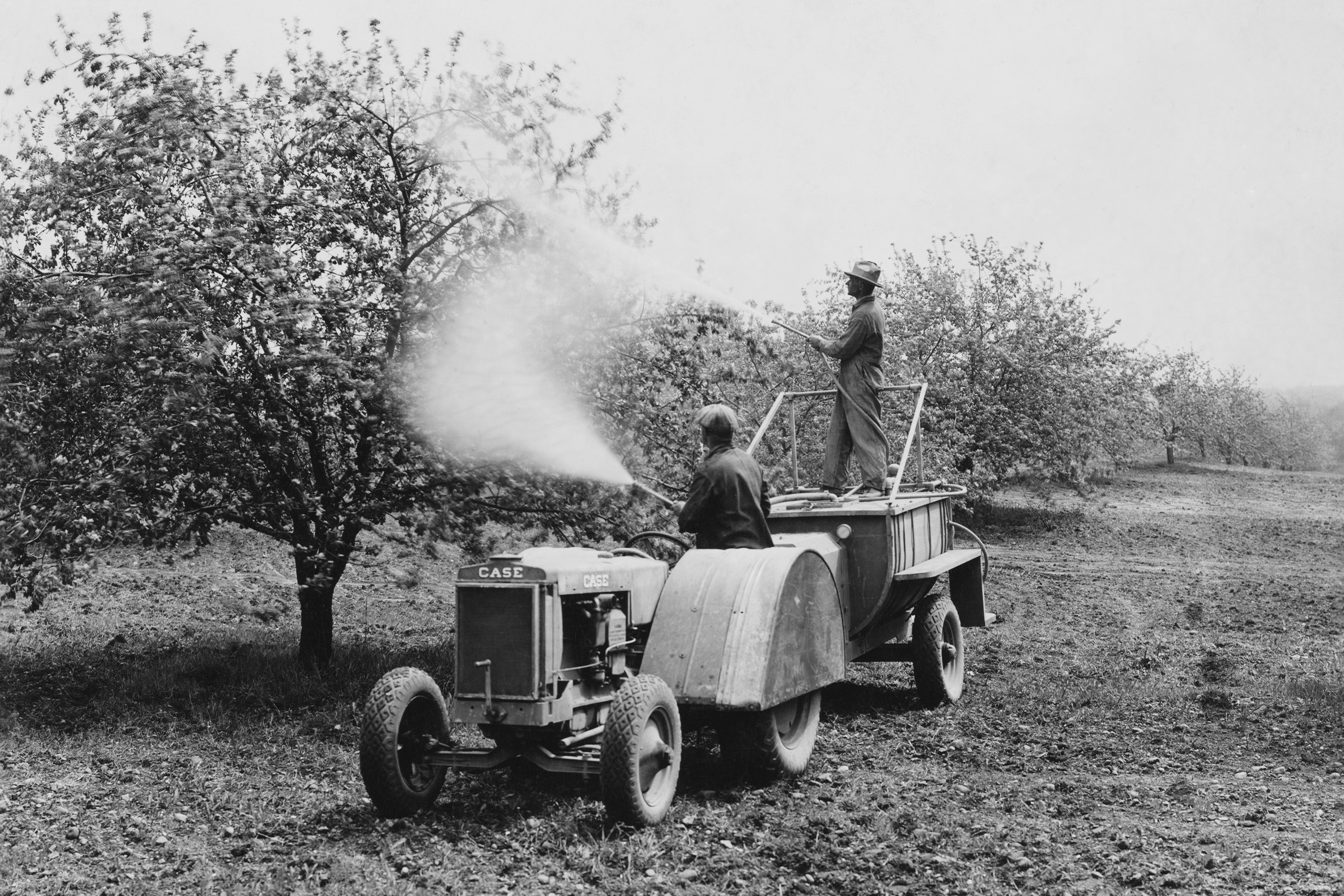 Two agricultural workers stand on a Case Tractor, crop spraying (possibly a pesticide) at a citrus grove, United States, circa 1940. (Pictorial Features/FPG/Archive Photos/Getty Images)
“There’s Palmer amaranth in the South, and its cousin waterhemp in the Midwest,” Steckel said. “High growth rates, real competitive for nitrogen. One female can produce close to a million seeds—given the right space. So it doesn’t take long for them to swap fields out. If we don’t have herbicides, we’re in big trouble.”
Besides, current farming isn’t compatible with nature.
Hager explains: “Farmers are trying to grow one species on an acre of farm. But nature does not like monocultures. Nature is all about diversity.”
There are a variety of strategies to control weeds, but the most efficient way, especially for these large conventional farms, is using herbicides.
Farmers are farming increasingly larger acres. “Fewer farmers are farming more acres than my family did when I was a youngster,” Hager said. “At most we farmed 1,500 acres. Now you’ve got farmers on average probably farming several thousands acres.”
Compared to alternative methods that control weeds, synthetic herbicides are faster, cheaper, and more predictable—farmers know they will get the job done.
Bioherbicides—which use natural products like certain bacteria, fungi, oils, and plant residues that kill certain weeds—often need more application to see its effects.
Herbicides are also less labor intensive and efficient.
“Most herbicides control a very broad spectrum of weeds,” Hager told The Epoch Times. “They’re relatively easy to apply, whether to the soil or to the foliage.”
Using modern tools, farmers can cover hundreds of acres of land in a day.
Contrast that to alternative methods like tillage, using a machine to loosen the soil and remove the weeds. This can only be done before crops are planted. After crops are planted, if a weed grows next to the crop, the weed must be removed either by hand pulling or herbicides.
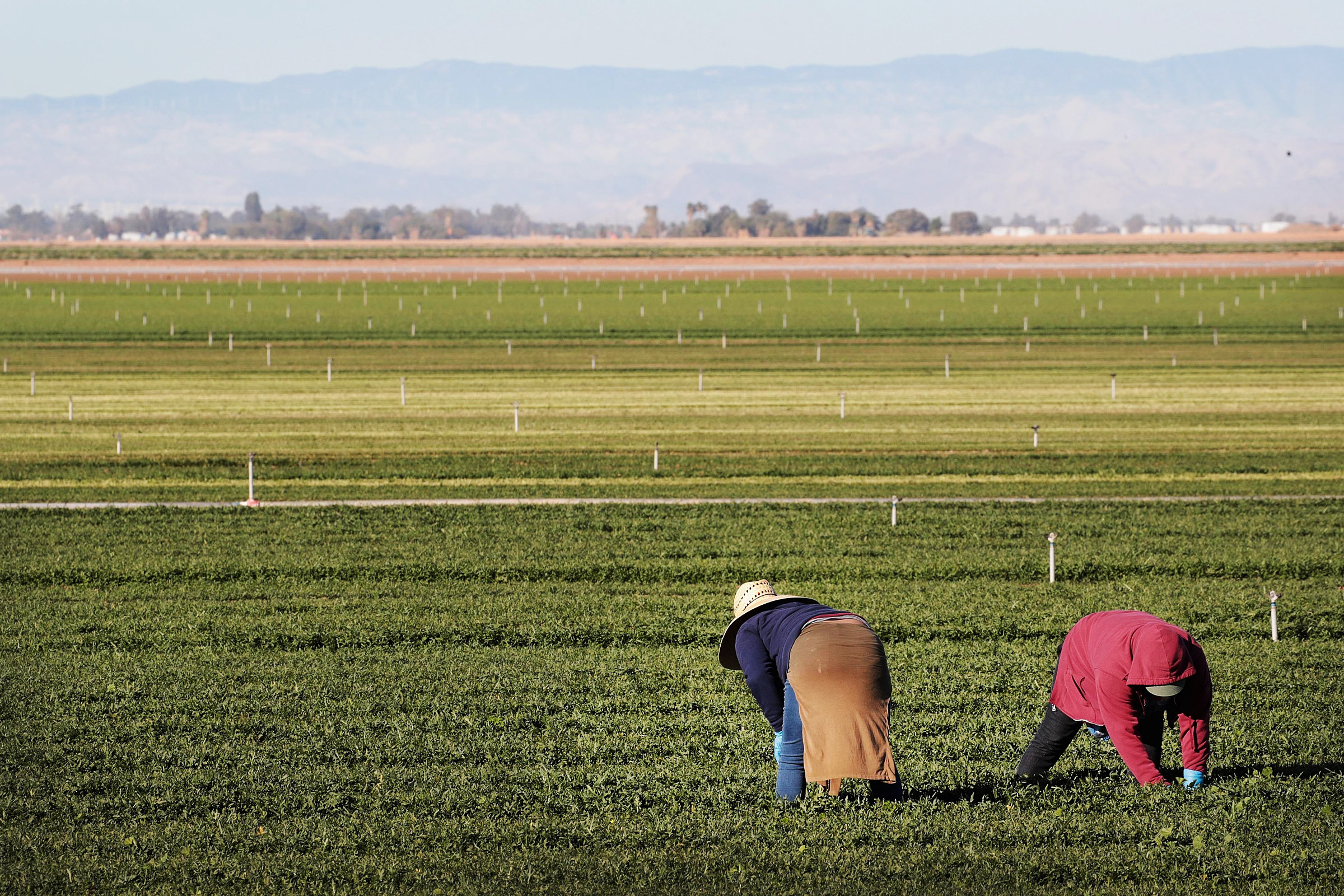 Farm workers pull weeds in a field of organic spinach near El Centro, Calif., on Jan. 25, 2019. (Scott Olson/Getty Images)
“I’ve seen some folks that can be successful, but it’s in relatively small areas,” Steckel said. “But then they got to do a lot of hand weeding.”
Considering that there’s more than 90 million acres of soybeans, 85 million acres of corn, and 10 million acres of cotton in the United States, “that’s an awful lot of hand weeding and you won’t have the people to do it.”
Alternatives and a Way Out
Some agricultural experts have increasingly advocated for changes to agriculture where there’s less of a reliance on herbicides, using integrative ways to control weeds and to prevent weeds from becoming increasingly resistant.
In 2018, researchers at North Carolina State University wrote in a review that herbicide resistance must be taken more seriously.
“We mostly continue to use pesticides as if resistance is a temporary issue that will be addressed by commercialization of new pesticides with novel modes of action. However, current evidence suggests that insect and weed evolution may outstrip our ability to replace outmoded chemicals and other control mechanisms,” they wrote.
Hager said that some farmers use a diversity of weed control tools, apart from only herbicides, to help keep weeds in check. But they may or may not use these tools after considering matters of cost and production.
And herbicides are not the only thing weeds learn to adapt to—weeds have also learned to delay their germination so that they can adapt around tillage.
Subramaniam points to Europe, which has strengthened regulations against PFAS usage and whose agriculture economy didn’t seem to have been significantly affected.
Rather than treating PFAS chemicals as individual chemicals, Europe and some states in the United States have started to consider new PFAS chemicals as a whole class of chemicals instead, taking into consideration how PFAS mixtures interact.
Though research on PFAS is still correlational, Subramaniam said that that does not mean PFAS presents no health risks.
“For science, causality has an extremely high threshold to establish. Examples are lung cancer and smoking. It took decades of us knowing that smoking was associated with lung cancer before we could establish a causal link,” he said.
“That’s why you’ll be hard pressed to find a scientist say X causes Y, unless it’s something that has been indisputably shown across different locations. And the fact is, for a lot of these PFAS chemicals, they’re just too new. There just hasn’t been enough data published.”
But that doesn’t mean EPA can’t take action against PFAS.
“EPA has acted without causality in multiple different examples before,” Subramaniam said. “Causality is rare in science. But some of these associations are far stronger than what we would need to act, and that is certainly a consensus among scientists right now.”
Currently, two of EPA’s approved pesticides are in legal disputes. In August, conservation groups sued the EPA for reapproving trifludimoxazin, citing health and environmental reasons. The product was first approved in 2021 and manufacturers withdrew it after the same groups sued the EPA citing the same concerns. EPA was also sued in January for approving isocyclerosam for use as insecticide in golf courses and for crops. This chemical had been shown to present reproductive risks and is dangerous to pollinators.