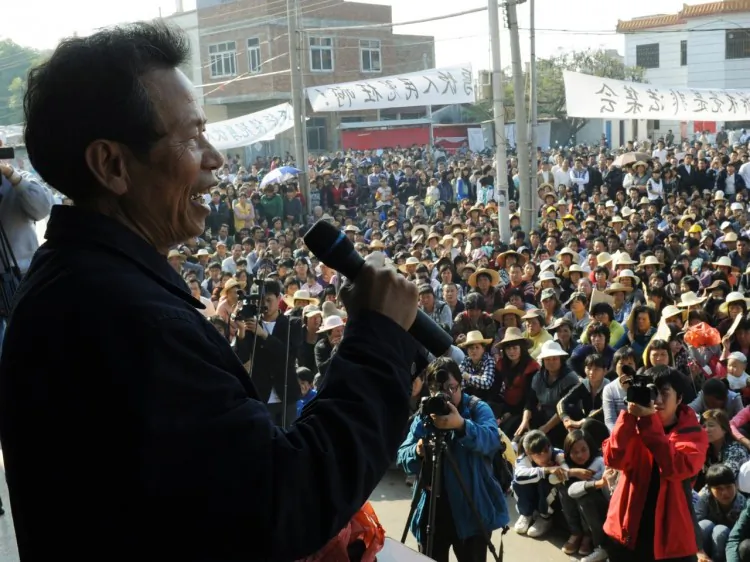
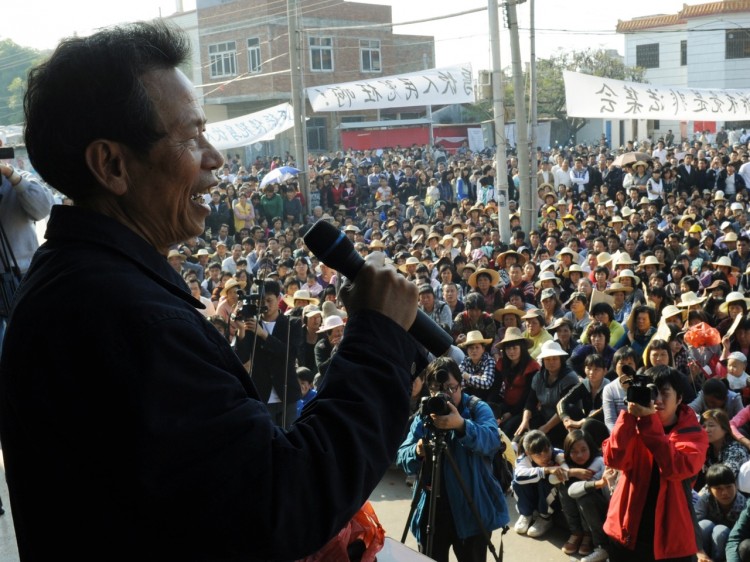
For three months, the rebellious village of Wukan in Guangdong Province seemed to hold out hope that all of the old rules regarding life under the Chinese Communist Party (CCP) need no longer apply. Some suggested a Chinese Spring, a companion to the Arab Spring, was beginning to stir in the waning days of autumn in southern China.
The crisis came to a head in the third week of December. Wukan had planned a mass march of thousands of villagers that would break the blockade of the security forces and end with a protest outside the municipal building of Lufeng City. If the villagers’ three demands were met, they promised to cancel the march and protest.
The demands were, first, to release the arrested villagers; second, to return the body of Xue Jinbo; and third, to recognize the villagers’ elected temporary village committee.
Xue Jinbo had been the village’s freely elected representative. He was taken away by the local police and died two days later in the local police station. His family was allowed to see the body but not take it away. They described a corpse disfigured by torture.
The local authorities denied the accusation but refused to return Xue’s body to his family.
An agreement was reached on Dec. 20 between Lin Zuluan, the representative of the villagers, and Zhu Mingguo, the vice secretary of CCP Committee of Guangdong Province, that seemed to justify the optimism Wukan had inspired. Both sides seemed satisfied with the results.
The Internet censorship on the subject of Wukan was lifted, and the official media started to praise the Guangdong authorities’ wisdom in solving such a difficult issue. As usual, a few low-level officials were blamed for the misconduct. The Party and the provincial officials were portrayed as the good guys. And all of the villagers’ demands were said to have been met.
Collecting the Debt
Most Chinese people didn’t believe the whole situation would end like that so easily. The CCP has never negotiated with the Chinese people since it took power in 1949, not with any individual, not with any organization.
Once or twice, a single top leader has discussed matters with the other side, as when Li Peng, then the premier, met with the student representatives in 1989 before the Tiananmen Square massacre, or Zhu Rongji, also premier at the time, met with the Falun Gong practitioners on April 25, 1999, before the persecution of Falun Gong began.
But Li Peng didn’t make any promise during the meeting. Zhu Rongji agreed to the demands of the Falun Gong practitioners, but Jiang Zemin, then the head of the CCP, broke Zhu’s promise. In both cases, the meetings were followed by the retaliations ordered by the highest authority.
Every Chinese knows that the Party always retaliates against whomever it considers as a challenge or a threat. In Chinese, this kind of retaliation is called “collecting the debt after the autumn harvest.”
Continued next page … New Village Committee
Views expressed in this article are the opinions of the author and do not necessarily reflect the views of The Epoch Times.
 Friends Read Free
Copy
Facebook
Tweet
Friends Read Free
Copy
Facebook
Tweet