The ancient Greeks left behind exciting historical treatises, heart-wrenching tragedies, and intricate, world-defining philosophical texts. They shaped the West with bold proposals about what it meant to uphold freedom of speech, think deeply and carefully, and be human.
The same can be said of the Romans, who proudly borrowed from their predecessors. Together, the Greeks and the Romans articulated the aesthetic principles that for over two millennia defined Western art. Fond of storytelling, they also told fascinating myths about the arts like the four below, which placed love, hope, and desire at the heart of creativity.
Butades and the First Human Portrait
For most of their history, oral transmission was the ancient Greeks’ standard mode of storytelling. Most Greek myths were written down by Latin-speaking Roman authors like the poet Ovid (43 B.C.–circa A.D. 18) and the historian Pliny the Elder (circa A.D. 23–A.D. 79), who embodied the Romans’ genuine appreciation for their prolific forefathers.
Among the figures who captivated Pliny were Butades and his lovesick daughter. Butades was a Greek tile- and vase-maker from Sicyon, near Corinth. He worked with clay, and he cared for his daughter deeply.
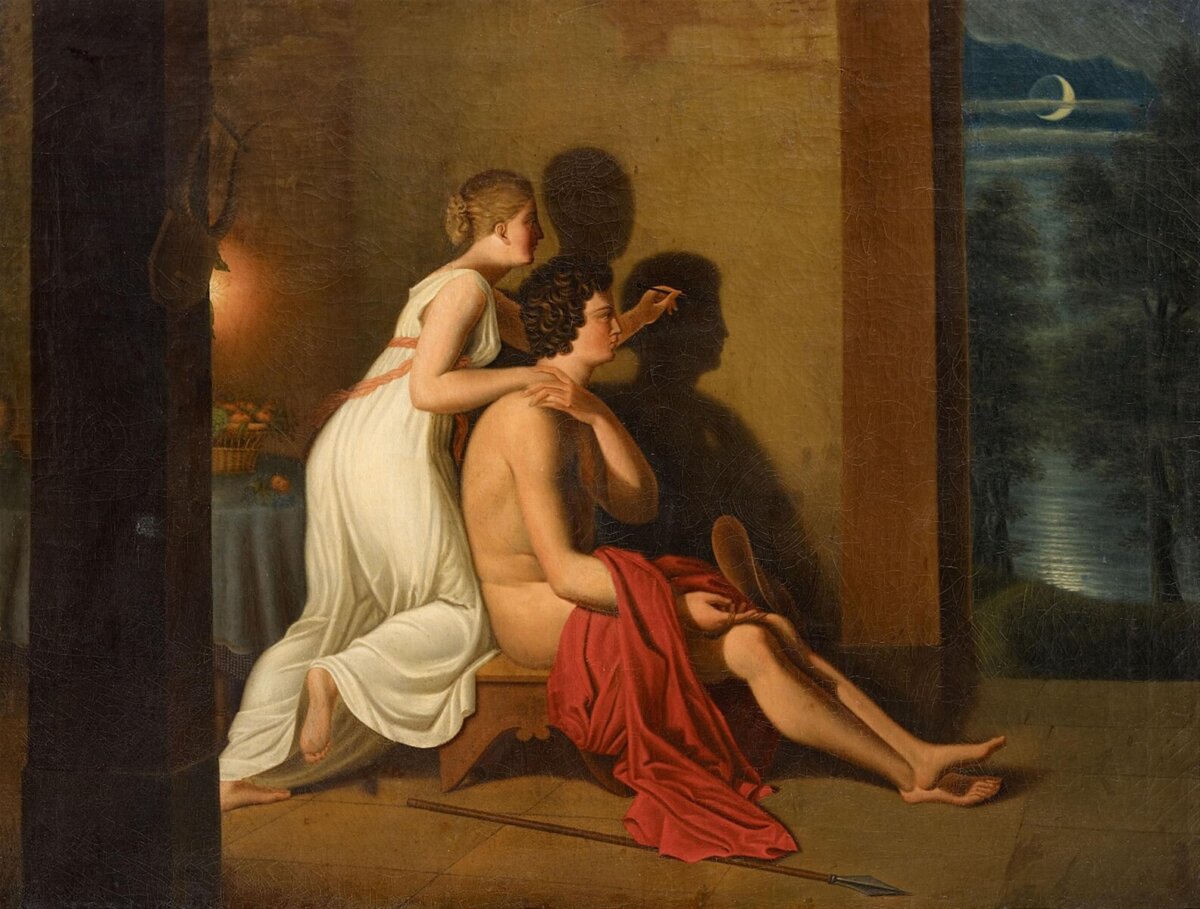
One day, Butades’s daughter met a young man. They spent time together, and she fell in love. But suddenly, for reasons he didn’t disclose, the man had to go abroad. As he prepared to leave from her home, she noticed his shadowed profile on the dimly lit wall and drew its outline.
Butades couldn’t stand to see his daughter in pain. He pressed clay on the silhouette and made a relief of his face, offering it to her as a token to heal her broken heart.
Butades lived around 600 B.C. Pottery was already common, though it had always been ornamental, depicting plants or animals at most.
Pliny credited Butades with “the method of adding red earth to [clay] or else modelling out of red chalk.” More importantly, Butades was the first to portray a human being. After his first human relief, he began adding similar masks as decorations to the outer gutter tiles of roofs. His clay model set in motion the stylistic shift from natural to human subjects that inspired all the iconic Greek art we continue to admire.
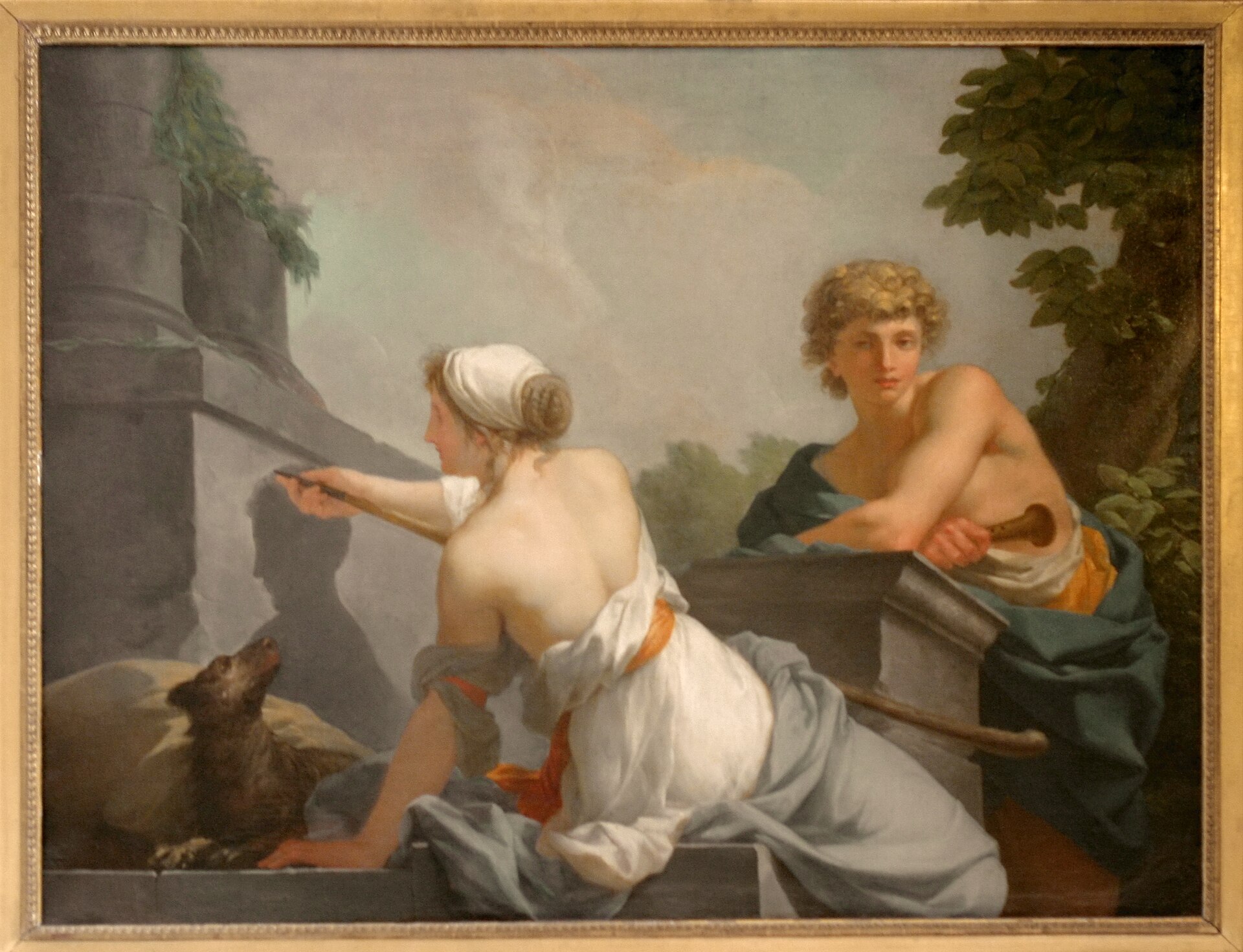 “The Origin of Painting,” circa 1785–1786, by Jean-Baptiste Regnault. Palace of Versailles, France. (Public Domain)
Butades intended the image to console his forlorn daughter. Though an artifact could never replace the man, Butades’s work revealed his belief in beauty’s healing power.
Pygmalion’s Ivory Lover
Ovid told a similar story about Pygmalion, a legendary sculptor from Cyprus.
Tired of courting women who wasted their lives “in wretched shame,” Pygmalion preferred to remain unmarried. Yet his yearning for love endured. To satisfy it, he began sculpting a statue from snow-white ivory. In Ovid’s words, he “gave to it exquisite beauty, which no woman of the world has ever equalled.”
Though he knew it was just a statue, Pygmalion couldn’t help but fall in love with his own creation. The more he gazed at it, the more it resembled a real woman. “Inflamed with love and admiration for the form,” he began to speak to it, caressing it “with loving hands that seem to make an impress, on the parts they touch, so real that he fears he then may bruise her by his eager pressing.”
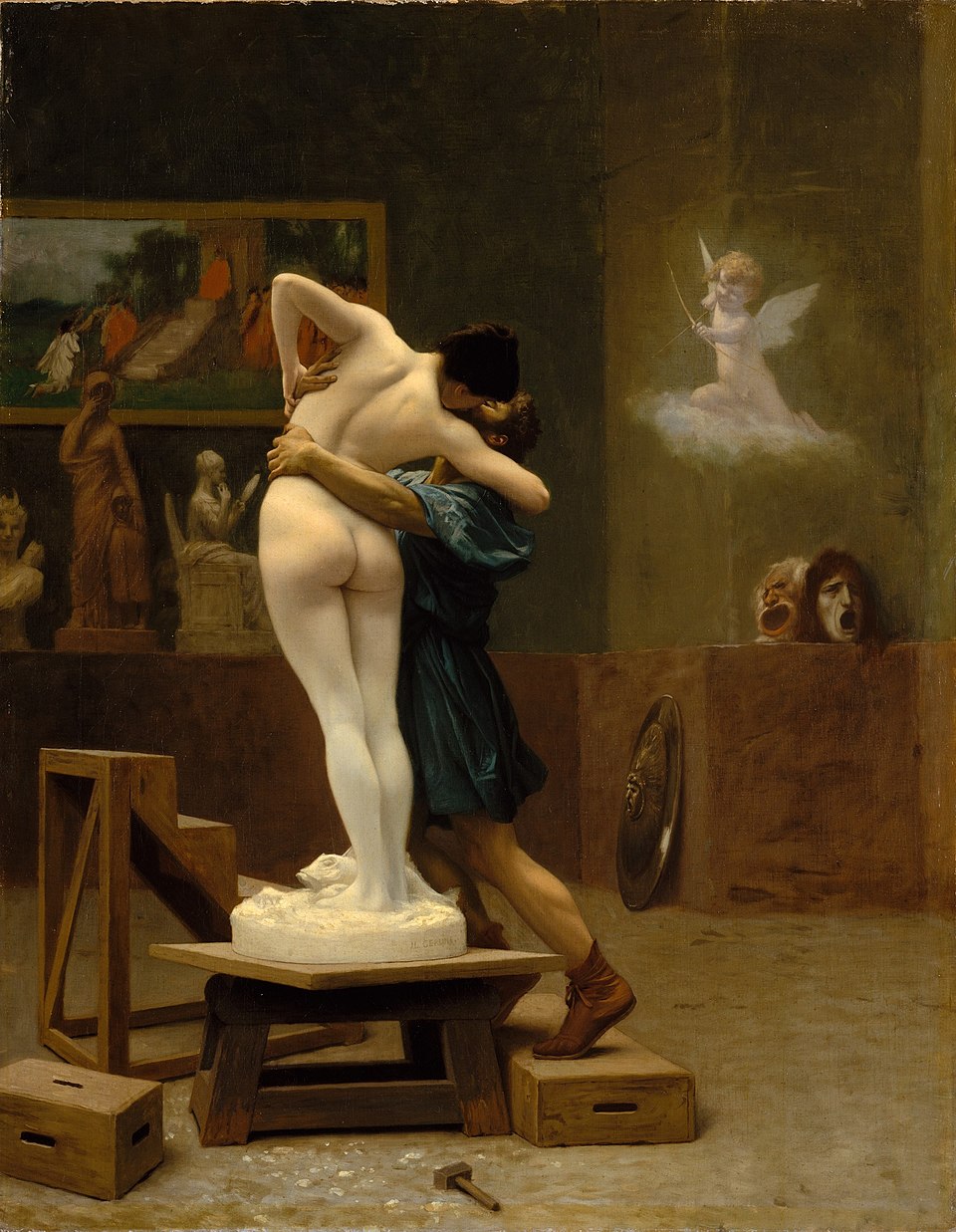 “Pygmalion and Galatea,” 1890, by Jean-Léon Gérôme. Metropolitan Museum of Art, New York City. (Public Domain)
Aphrodite’s festival day came. Joyous parades crowded the streets as people offered gifts and sacrifices to the goddess of beauty and love. Pygmalion stood before Aphrodite’s altar to make a libation, which ended in a prayer: “If it is true, O Gods, that you can give all things, I pray to have as my wife.”
He didn’t have the courage to mention the ivory statue, though that was what he wanted to say. The sacrificial fire flared three times. Even though Pygmalion hadn’t finished his sentence, Aphrodite had understood.
As soon as he returned home, Pygmalion visited his creation. “It must be flesh!” he exclaimed in disbelief as the transformation came to an end: The fair-skinned woman “felt the kisses given to her, and blushing, lifted up her timid eyes, so that she saw the light and sky above, as well as her rapt lover while he leaned gazing beside her.”
Nine months later, the couple welcomed their daughter into the world. Her name was Paphos, after which Pygmalion’s city was named. The location was also associated with the birth of Aphrodite.
Ovid’s story inspired dramas, operas, and movies, not least because it vividly depicts the relationship between art, desire, and madness. The sculptor loved his craft, which became his way of adding to the world the grace and beauty that he thought it lacked. His statue could only morph into a human because he’d put great care into creating it—because he loved it.
Yet Pygmalion’s response was obsessive. He retreated into the comforts of his imagination to satisfy an idealistic desire, reveling in his work as he lost touch with the world. Although the story emphasizes the power of great art to resemble nature’s perfection, it also raises questions about the risks of trying to escape reality with artificial images.
Zeuxis and Parrhasius
When the Greeks referenced painting, they usually meant applying color to pottery, marble, limestone, or wood.
Among the Greeks’ many legendary painters was Zeuxis of Heraclea, who lived around 450 B.C. His work was so striking that people rumored he had “robbed his masters of their art and carried it off with him.” He excelled at still life, depicting small details more accurately than anybody. Or so he thought.
Zeuxis’s work sold well. He became wealthy and self-absorbed. He embroidered his clothes with a golden monogram and started handing out his paintings as gifts, in the conviction that “it was impossible for them to be sold at any price adequate to their value.”
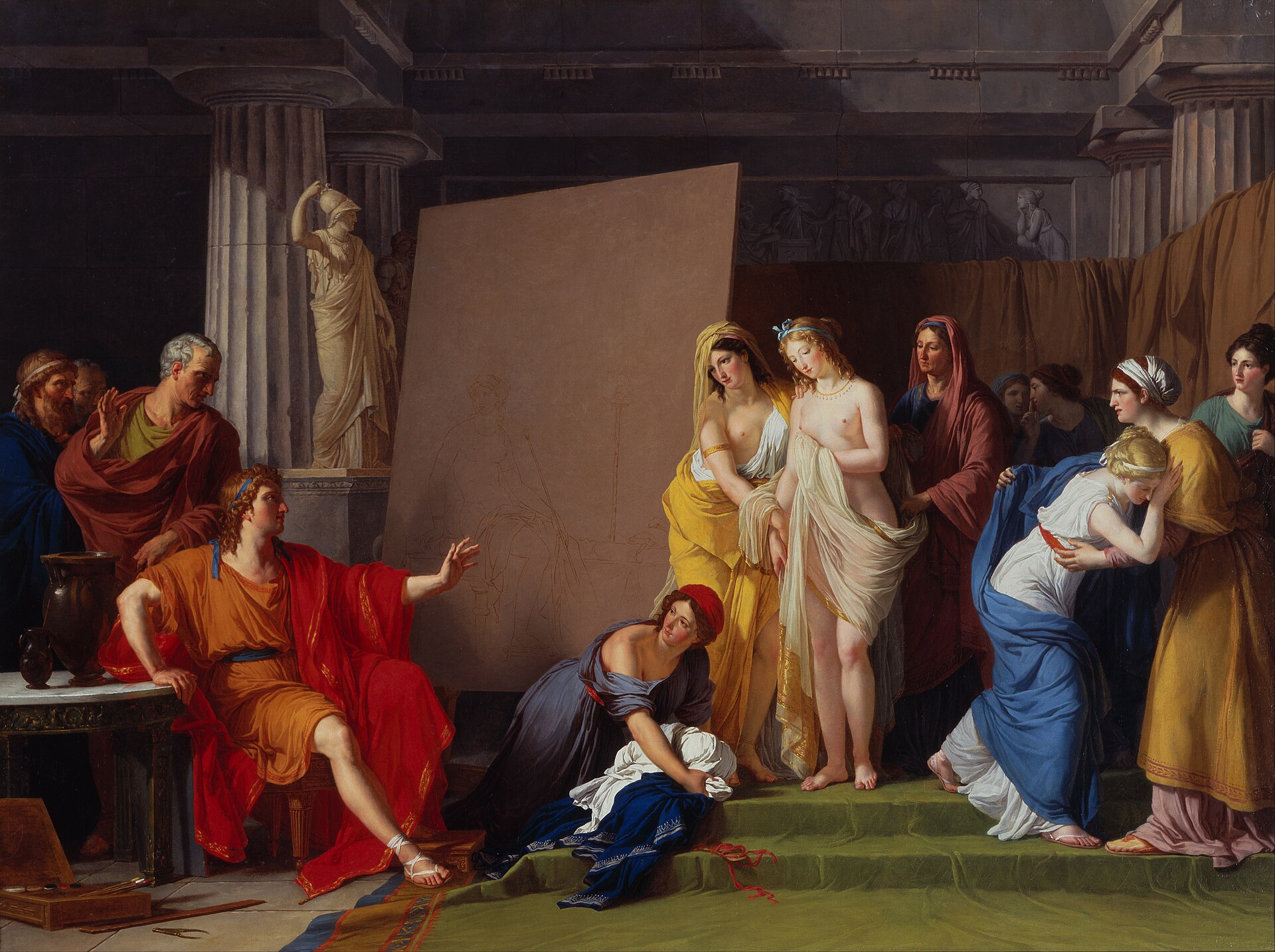 “Zeuxis Choosing His Models for the Image of Helen From Among the Girls of Croton,” circa 1791, by Francois-Andre Vincent. Cantor Arts Center at Stanford University, Stanford, Calif. (Public Domain)
As Zeuxis’s fame increased, so did that of his competitors. Among them was Parrhasius, an ambitious contemporary who challenged him to a paint-off.
Pliny recorded the contest:
“[Zeuxis] produced a picture of grapes so successfully represented that birds flew up to [them]; whereupon Parrhasius himself produced such a realistic picture of a curtain that Zeuxis, proud of the verdict of the birds, requested that the curtain should now be drawn and the picture displayed; and when he realized his mistake, with a modesty that did him honour he yielded up the prize, saying that whereas he had deceived birds Parrhasius had deceived him, an artist.”
Driven by a desire for greatness, the two painters produced their best works. Zeuxis’s skill had deceived animals. Yet, according to the artist, the most relevant judge was the human eye, which represented humans’ aesthetic sensibilities.
For the Greeks and the Romans, man was nature’s greatest creature, at once created and creative. If a painting could convince the best artist that it was nature’s handiwork, it deserved to be called great art.
Marsyas, Apollo, and Human Limitation
The Greeks acknowledged the impressive skill of human artists, but they were also wary of the arrogance that extraordinary talent encouraged in people like Zeuxis, who thought more highly of themselves than was justified.
A popular story about the pitfalls of conceit featured a flute-playing satyr named Marsyas. Satyrs were male entities that represented humanity’s primal nature. Music was their art.
Marsyas wanted to prove to the world that he was the greatest musician alive, so he challenged Apollo—god of light, beauty, and music—to a contest.
In the first round, Apollo played only the lyre, his trademark instrument. Marsyas dazzled the jury with a virtuosic performance on his double-piped flute.
 “Young Marsyas (Marsyas Enchanting the Hares),” 1878, by Elihu Vedder. Crystal Bridges Museum of American Art, Bentonville, Ark. (Public Domain)
In the second round, Apollo accompanied his lyre-playing with a delightful song that won back the judges’ sympathy. Marsyas was furious. He complained that it was unjust to compare two skills against one, insulting the god for his alleged trickery.
Apollo coolly argued that playing the flute was the same as singing; both used the voice. Convinced by the argument, the jury ordered the competitors to only showcase a skill that didn’t involve the voice. Since flute-playing counted as a vocal skill and Marsyas didn’t play another instrument, he was easily defeated.
The audacity to think that he could best Apollo and the gall to accuse the god of dishonesty cost Marsyas his life: “As Apollo punished him, he cried, ‘Ah-h-h! why are you now tearing me apart? A flute has not the value of my life!’ Even as he shrieked out in his agony, his living skin was ripped off from his limbs, till his whole body was a flaming wound, with nerves and veins and viscera exposed.
Everyone but Apollo lamented his sad fate, from gods to satyrs to humans. Their tears trickled through earth’s deepest veins, and, “gathering as a fount, turned upward from her secret-winding caves, to issue, sparkling, in the sun-kissed air, the clearest river in the land of Phrygia,—through which it swiftly flows between steep banks down to the sea.”
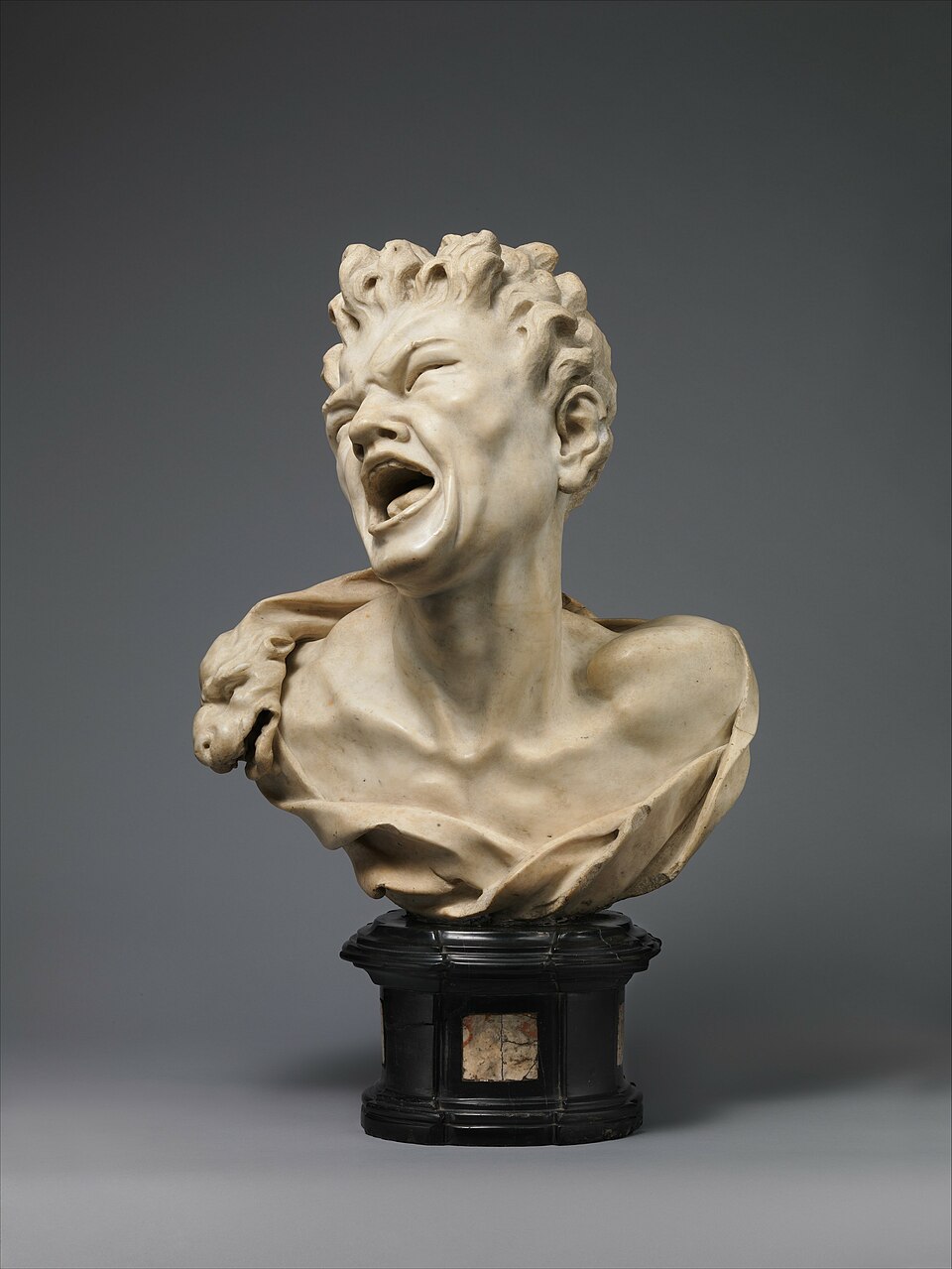 “Marsyas,” circa 1680–1685, by Balthasar Permoser. Metropolitan Museum of Art, New York City. (Public Domain)
Whatever we make of Marsyas’s atrocious death, ancient authors almost unanimously agreed that his punishment was the direct result of hubris. As skilled as he was, Marsyas could never outshine Apollo. Music, and art more generally, ultimately belonged to the gods.
What arts and culture topics would you like us to cover? Please email ideas or feedback to features@epochtimes.nyc