When we think of Greece, Rome, or other ancient civilizations, we often picture temples, monuments, and marble busts. But do we ever think of libraries?
After the invention of writing, libraries became the beating hearts of human societies. They stored legal documents, safeguarded world-shaping literature, and functioned as learning centers for the sake of public welfare.
The Hittite Archive
The world’s first historians spoke Hittite, which is the earliest attested cuneiform language.
Hailing from the northern Black Sea, the Hittites settled in the heart of Anatolia (modern Turkey) around 2000 B.C. They were skilled ironsmiths and war-mongering charioteers with a sophisticated legal system, which they encoded in copious writing.
The Hittite kingdom took its name from the capital: Hattusa. In the early 1900s, archaeologists began excavating the ancient city, where they found open-air temples, colossal stone gates, and other remarkable relics. Among the most noteworthy discoveries was Hattusa’s vast royal archive. Now known as the “Bogazkoy Archive,” the collection numbers over 25,000 cuneiform tablets written in eight languages, including Akkadian, the “lingua franca” among the civilizations in the eastern Mediterranean basin.
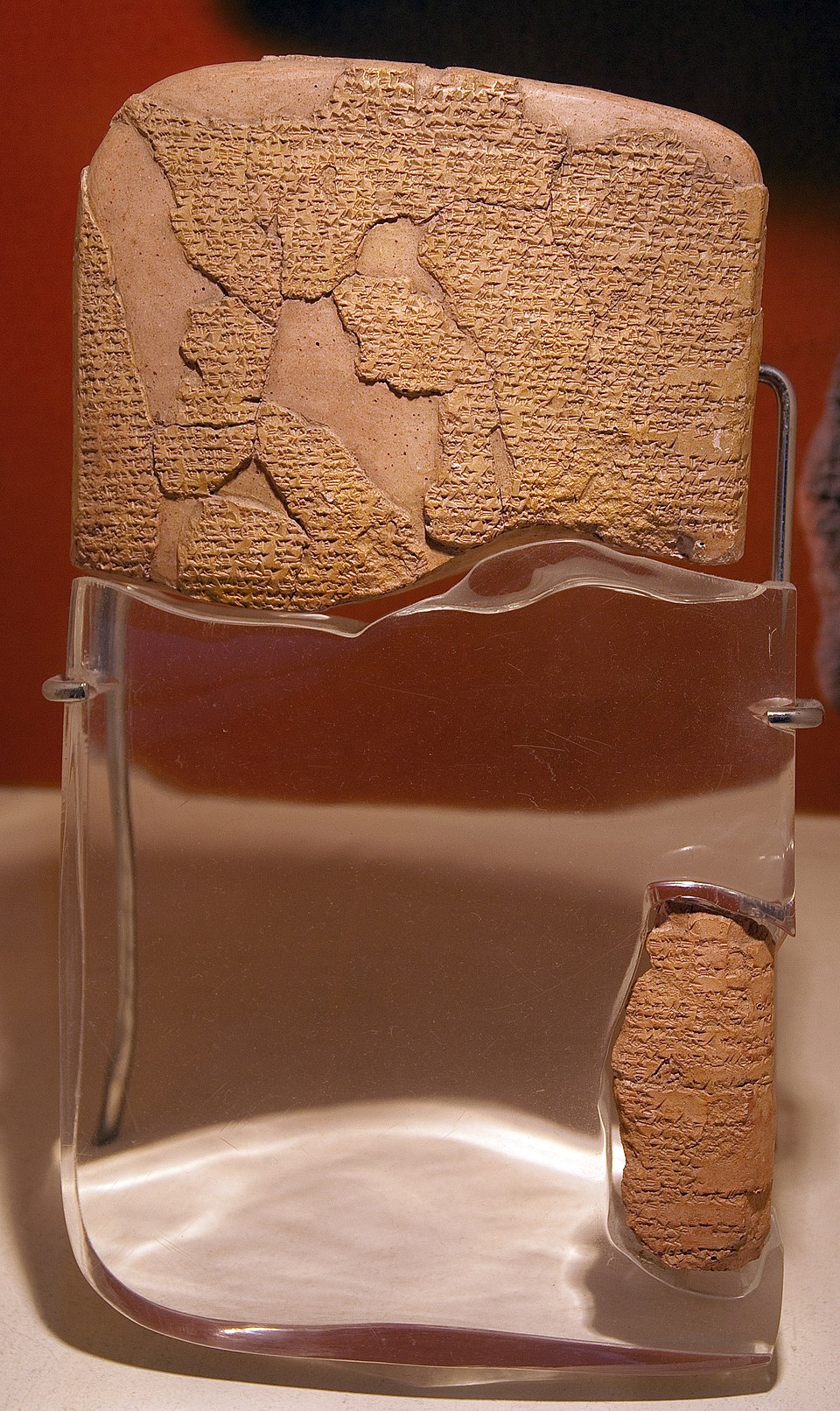 The Treaty of Kadesh was just one of thousands of tablets found in the Bogozoy Archive. (Marcus Cyron/CC BY 3.0)
The archive included historical annals, legal codices, diplomatic correspondence between Hattusa and its subordinate provinces, common prayers, records of public festivals, and abridged versions of polytheistic myths—all valuable resources to understand the ins and outs of a long-lost civilization with a strong interest in upholding its customs.
Hattusa also stored copies of history’s oldest surviving international peace treaty. Known as the “Eternal Treaty,” the document proclaimed a perpetual armistice between the Hittites and the Egyptians, who had been fighting a bloody two-century war over modern Syria, Lebanon, and adjacent territories. Written in Akkadian, the treaty evoked friendship and harmony between Egypt’s Pharaoh Ramses II and Hattusa’s emperor, who are described as brothers united by an indestructible bond.
One of the hundreds of pre-treaty conciliatory letters between Ramses II and the Hittite Queen Puduhepa framed the ceasefire in religious terms. In the pharaoh’s words, “The Sun-god and the Storm-god will give us brotherhood and peace, even in this good relationship in which we find ourselves forever. And our messengers will travel continuously between us forever, fostering brotherhood and peace.”
Ashurbanipal’s Royal Collection
A similar collection of tablets was found in the ancient Assyrian capital of Nineveh, in Mesopotamia (modern Iraq), in the mid-1800s.
By the 7th century B.C., belligerent tribes were encroaching on the Assyrian empire’s territories. The precarious geopolitical situation may have motivated Assyria’s last great king, Ashurbanipal (circa 669 B.C.–631 B.C.), to become an avid collector of texts.
Like the Hittite archive, the 30,000-odd clay tablets from Ashurbanipal’s royal palace include legislation, court cases, correspondence with foreign embassies, and financial accounts. The archive also contains an unusual number of texts about divination: the ancient practice of reading signs to gain insight into the future. Priests and kings relied extensively on divination during tumultuous times.
 A relief of the Banquet of Ashurbanipal from Nineveh, housed in the British Museum, London (Mharrsch/CC BY 4.0)
Ashurbanipal sent messages across Mesopotamia demanding that cities send him copies of their local documents. A trained copyist, the king also hired scribes to make additional duplicates of tablets he owned in Nineveh. Like his interest in divination, this obsessive desire to compile written evidence of Mesopotamia’s laws and customs may be partly explained by Ashurbanipal’s belief in preserving knowledge for posterity. He wanted future generations to appreciate the greatness that preceded them, in Assyria and beyond.
The historically minded English novelist H.G. Wells called Ashurbanipal’s archive “the most precious source of historical material in the world.” Among its items was a version of the “Epic of Gilgamesh,” a foundational myth dating to the 3rd millennium B.C. The epic narrates the adventures of Gilgamesh and Enkidu, two enemies turned friends who vanquish supernatural creatures as a testament to their bravery and strength. Incited by the two friends’ conceit, the gods punish Enkidu with a terminal illness. His imminent death spurs Gilgamesh to embark on a strenuous journey in search of the secret of eternal life.
The epic may have well been forever lost, if not for a trepidatious king’s eager preservation of his decaying world.
The Library of Alexandria
Homer would also have been a nobody today if laborious scholars hadn’t spent countless hours examining papyrus scrolls in the famous library of Alexandria, Egypt.
Alexandria’s library was nothing like the Hittite and Assyrian archives. It was built in the 3rd century B.C., probably by Ptolemy II, king of Egypt and most of the lands over which the Hittites and the Egyptians had competed. Once Alexander the Great died in 323 B.C., the Ptolemies became one of the Mediterranean’s most powerful royal dynasties.
To showcase his kingdom’s splendor, Ptolemy II invested heavily in intellectual projects. The library belonged to the “Mouseion,” an elite academic association that sponsored the best scholars of the day. Legend has it that among its members was the ancient engineer Archimedes, who may have invented his revolutionary water pump while on a research trip in Alexandria.
The library resembled a modern college campus: It comprised a common dining room, reading and meeting rooms, gardens, and lecture halls where teachers and pupils could discuss ideas or consult a large collection of papyrus rolls.
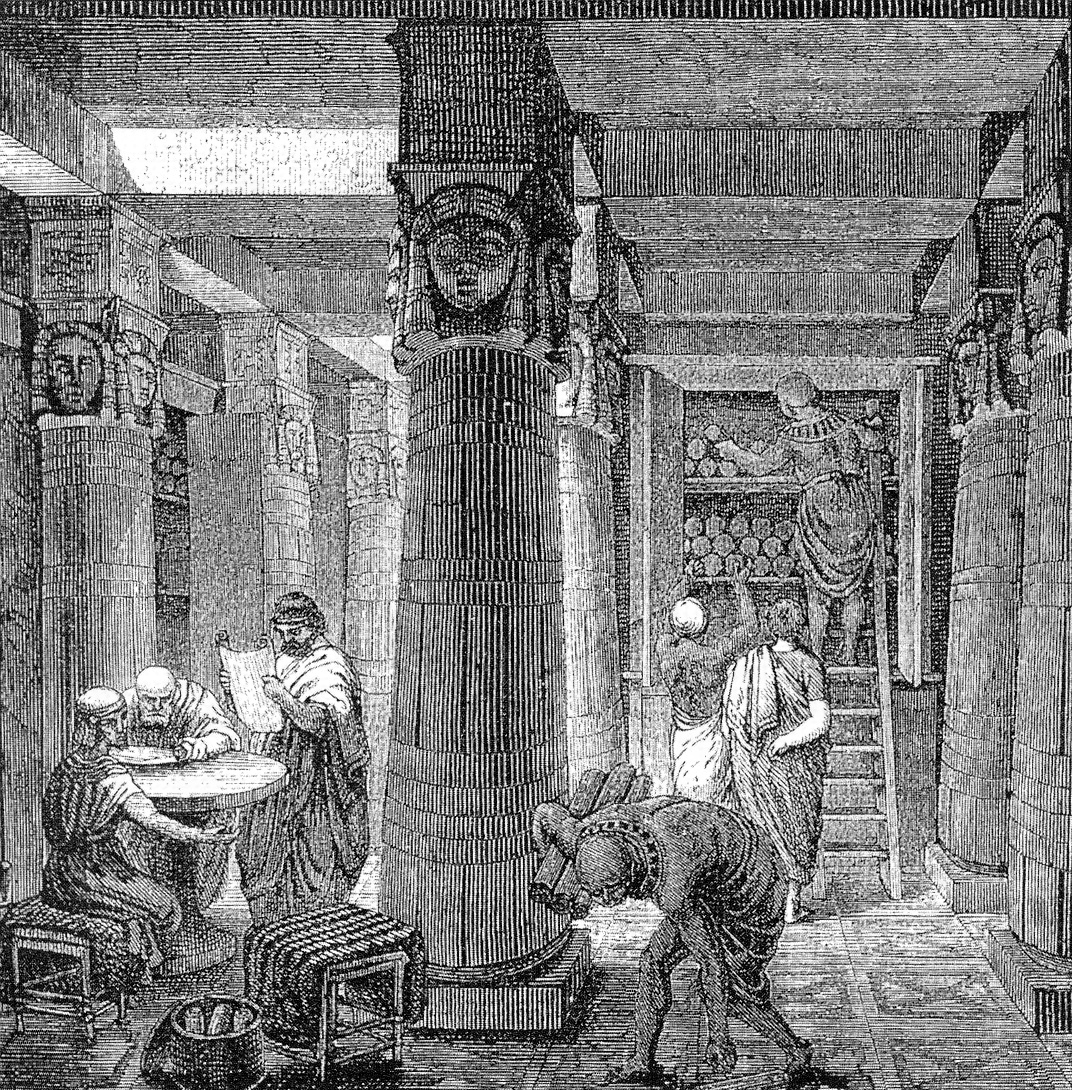 “The Great Library of Alexandria,” 19th century, by O. Von Corven. from “The Memory of Mankind,” Oak Knoll Press. (PD-US)
In 48 B.C., Julius Caesar’s army set fire to dozens of ships in Alexandria’s port. The risky measure was meant to prevent the soon-to-be king Ptolemy XIV from seizing the ships and their vital supplies. Caesar’s daring paid off, but the flames spread through the city’s coastal area, destroying some of the library’s warehouses. Ancient sources believed that the mishap had burned 40,000 papyrus scrolls. But this was a comparatively small number for an institution that may have housed up to 400,000 texts.
Among the library’s precious possessions were some of the earliest written versions of Homer’s epics. Alexandrian scholars sought to standardize the poems with authoritative editions based on similarities and differences between the library’s many copies.
The library lasted several centuries, but it eventually collapsed. Its decline was gradual; war, politics, and neglect were equally responsible. The main building was probably destroyed around A.D. 300. As of today, none of its scrolls survive. Yet its visiting scholars laid the foundations for the Western literary canon, whose influence spread far beyond the city.
Pergamum and Parchment
Around 300 B.C., Greek colonists settled on the western Anatolian coast, where they founded Pergamum. In less than a century, the city became a cultural epicenter. Its eminence culminated when Pergamum’s sovereign, Eumenes II, decided to build a stunning library, partly to declare the city’s superiority over Alexandria.
Pergamum probably never matched the size of Alexandria’s collections. But its librarians’ competitive spirit produced a breakthrough in book technology that eventually bridged the ancient and modern worlds.
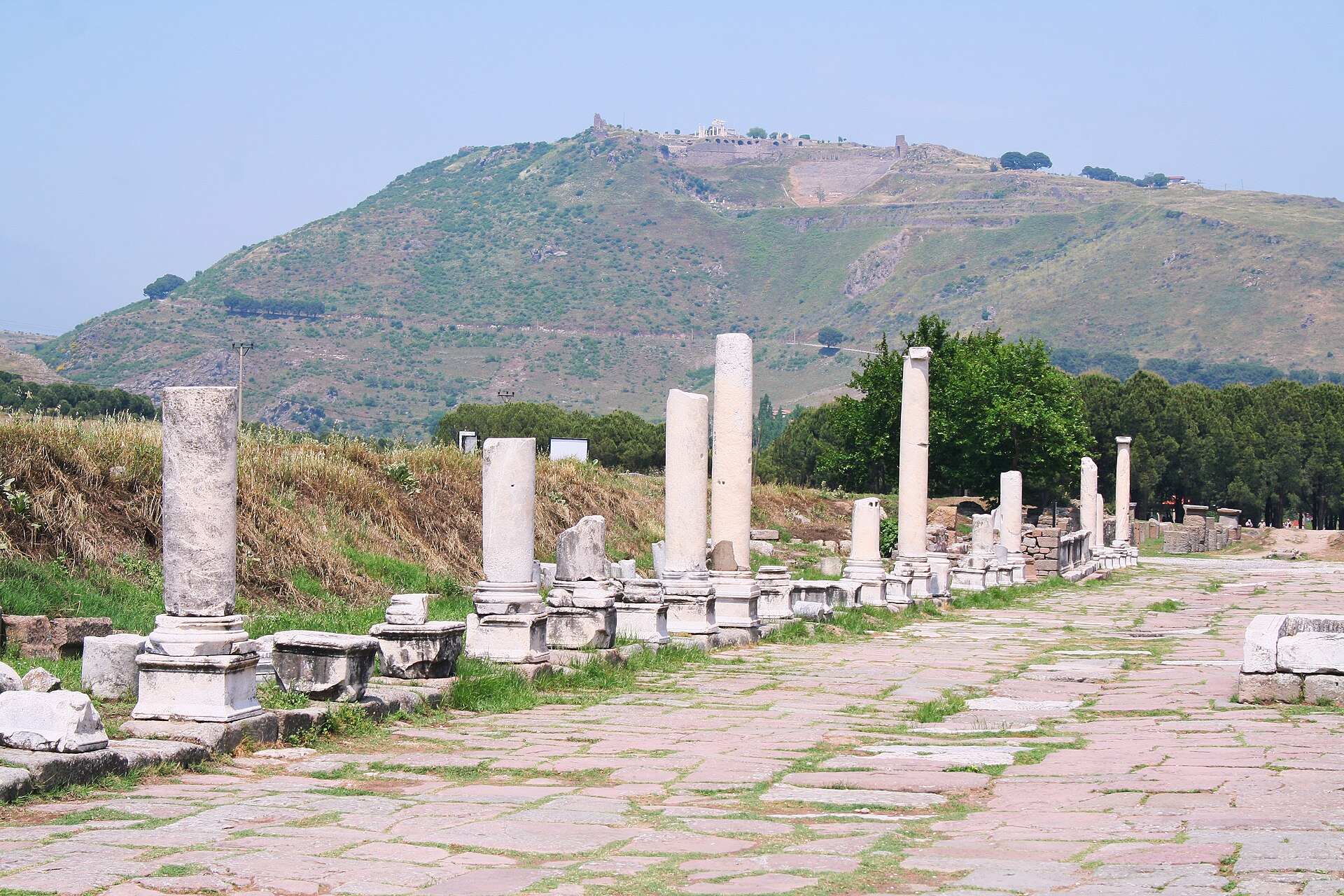 The Pergamum Acropolis at the Sanctuary of Asclepios, in Greece. (Imehling/CC BY-SA 3.0)
Papyrus used in Alexandria was cheaper and more user-friendly than fragile clay tablets. Yet papyrus decomposed in less than 300 years, if it could be sheltered from the elements at all. Papyrus scrolls were also hard to read—consulting different sections of the same copy simultaneously was impossible—and even harder to transport.
To remedy these shortcomings, Pergamum’s librarians began experimenting with “vellum,” also known as calfskin. Treated hides, occasionally derived from sheep or goats, were named “parchment.” The word comes from the city’s name via Latin (“pergamenum”) and French (“parchemin”). Parchment eventually led to a shift from fragile scrolls to more durable codices (stacks of pages bound at one end). Even though “codex” now refers to medieval manuscripts, every book follows the codex format. Virtually all ancient literature comes from parchment texts from the Middle Ages.
History’s First Public Library
In 39 B.C., the statesman Gaius Asinius Pollio refurbished a tattered library in the heart of a war-ridden Rome. Built with Pollio’s war plunder, the structure stood in the “atrium libertatis” (“hall of freedom”), a large public complex of administrative buildings and a grand statue garden.
The library was open to the public without restrictions, as were the garden and an adjacent art gallery. Attendance was doubtless limited to literate Romans who knew how to use the library’s resources. Literacy in turn depended on socio-economic status. But in principle, anyone could enter.
The open-air statues on the way to the library created an elevating atmosphere intentionally designed to inspire passers-by. As the Roman historian Pliny the Elder (circa A.D. 23–A.D. 79) put it, the statues prompted visitors to ponder the lives and works of “those whose immortal spirits speak to us.”
Pliny praised Pollio for “founding a library [that] made works of genius the property of the public.” Not only was its collection available to ordinary Romans, Pollio also incentivized civic participation through poetry readings and other interactive events.
A patron of some of the day’s most promising artists, Pollio may have sponsored a public reading by Virgil, the poetic genius behind the “Aeneid.” The recitation captivated the audience, which included prominent figures. Their support set in motion the prolific career of one of history’s greatest poets.
Preserving the Past
If the Hittite and Assyrian archives were compiled to codify social norms, document complex legal systems, or protect a monarch’s legacy during chaotic times, Alexandria and Pergamum’s libraries turned more actively towards intellectual experimentation, which yielded useful inventions and timeless ideas. With Pollio’s public complex, the library finally assumed a function it still performs: It became a free space for ordinary people to read great literature, appreciate art, and cultivate their spirit.
These five sites were all eventually destroyed. Their remains are a small fraction of what they once contained. Yet their relics herald a crucial lesson: The past can be as brittle as clay, as fragile as papyrus, ever vulnerable to the destructive forces that troubled wisdom-loving librarians on noble quests for preservation.
What arts and culture topics would you like us to cover? Please email ideas or feedback to features@epochtimes.nyc