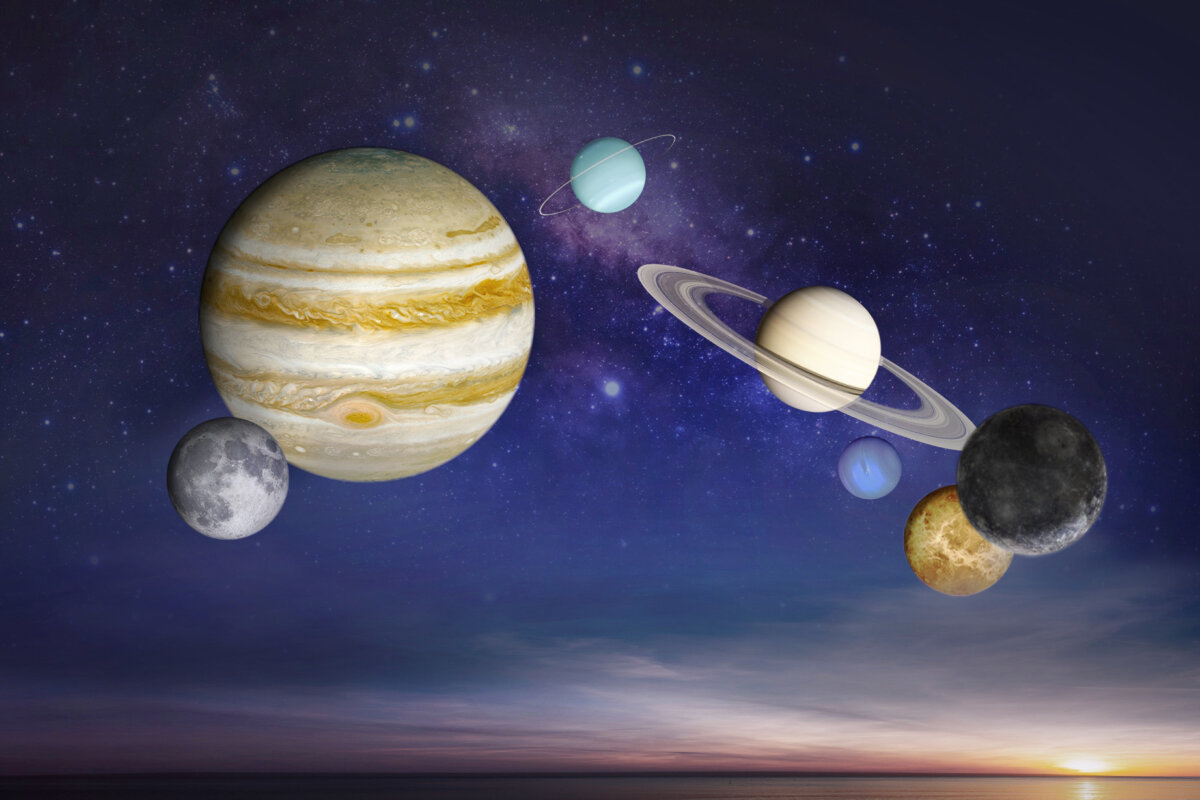
The planets have throughout history predicted the rise and fall of empires, the careers of famous personalities, and new eras filled with discovery.
Today, science looks at events like planetary alignments and conjunctions through a less prophetic—and arguably less interesting—lens. But that doesn’t mean such events, like the six-planet “parade” in late February, have nothing to teach us about the universe.
Visible in the evening sky around Feb. 28, six planets—Jupiter, Uranus, Saturn, Neptune, Venus, and Mercury—will form into a ragged row in that order, from southeast to west. As a bonus, the moon will hang out next to Jupiter’s left limb. Alignments like this are not super-rare, but it’s intriguing to think about what could cause this visually impressive sight.
A Straight Line, in Space?
The planets never form anything close to a true straight line as viewed from the Earth—that would be ultra-rare, to the point of impossibility. In fact, the planets are forever locked in a zig-zaggy row stretched out somewhere in our skies. Like race cars on a grand track, they’ll spread out very widely sometimes or other times crowd close together, and presto, will form a planetary parade.
This wonky formation is actually baked into celestial geometry. The solar system is a flattish disk to begin with because the planets’ orbital planes are already roughly aligned. An astrophysicist might know why that’s the case, but the consequence is that the planets, when seen from Earth, basically follow the ecliptic—the sun’s arc across the sky.
But the kicker is that the planets’ orbital planes aren’t perfectly level with each other, so the planets will seem to bob up or down very slowly along the ecliptic as they orbit and will never align perfectly.
Straightness, of course, also depends entirely on your perspective. Seen from the North Pole, a straight line between three planets could appear as a flattened triangle from the South Pole. An true alignment in a 3D environment is virtually impossible. Thus the undefined nature of space causes headaches for scientists, who must have precision.
Our ancient ancestors, of course, weren’t worried about mathematical precision when they looked to the heavens. It was the human eye beholding nature in wonder, not a micrometer. As observing alignments became a time-honored tradition, astronomers had to figure out how to turn it into an imperfect science.
So they made definitions.
A planetary alignment is now defined as either: one, when three or more planets are grouped on one side of the sun, when viewed from above the solar system; or, two, when three or more planets cluster within a relatively small sky sector. Within this framework there are several classes of alignments, some quite common, some exceedingly rare.
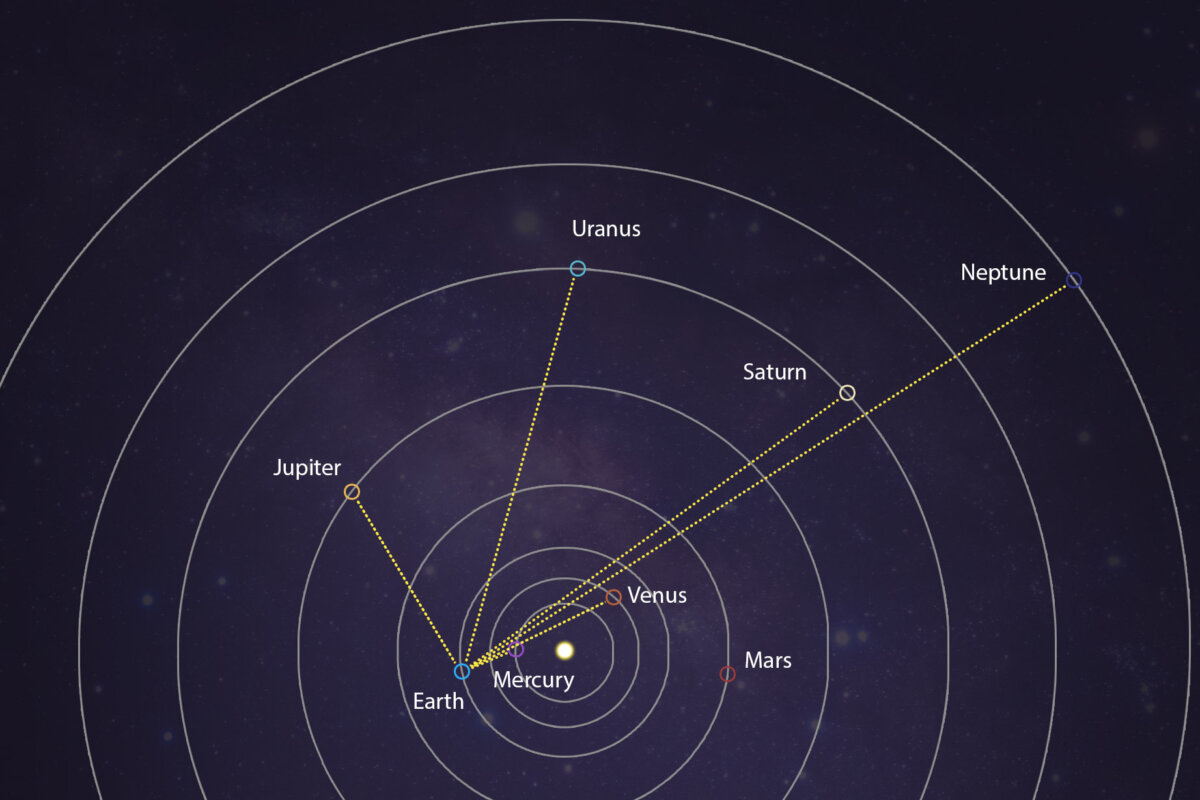
A mini alignment includes three planets, a small alignment has four planets, and a great or full alignment will have seven or more, sometimes including Pluto. The more planets involved and the narrower the sky sector they occupy, the rarer. Only seven times in this millennium will all the planets gather in one quadrant of the solar system.
This month’s is classified as a large planetary alignment (five or six planets). While not ultra-rare, it’s still pretty cool.
Tips for Viewing the 6-Planet Parade
About 30 minutes after sunset, low in the western sky, four planets will be visible to the naked eye, and two will not. While Mercury, Venus, Saturn, and Jupiter will be luminous enough to see without optical aids, Uranus and Neptune will require a telescope or binoculars. All will form a low arc from southeast to west with the moon just to the east and setting sun just to the west, on either end.
Some of the planets offer more viewing challenges than others. The gas giant Jupiter, high to the southeast, will be easiest to spot just right of the waxing moon and will be visible most of the night. Directly west, high in the south-southwestern sky, the dim glow of Uranus will require optics to observe and after midnight will disappear completely.
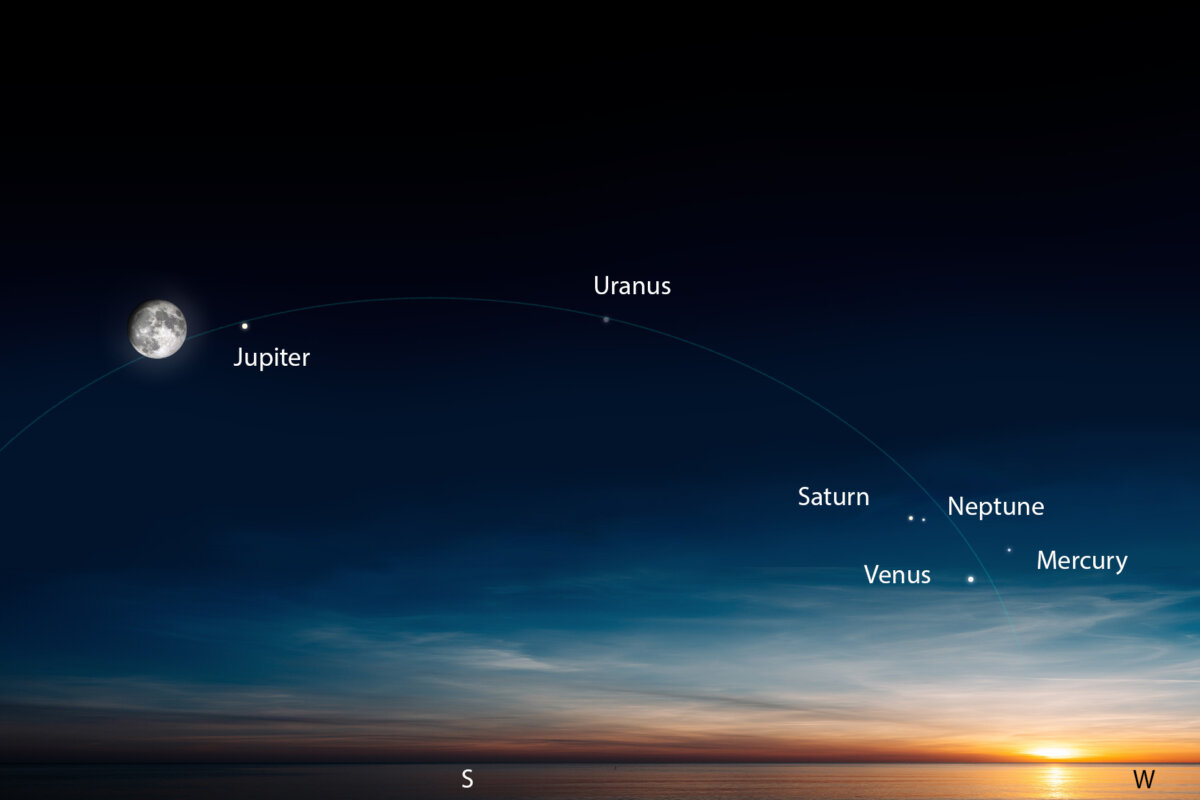
Further west, a gaggle of planets—Saturn, Neptune, Venus, and Mercury—will zigzag slightly higher than and to the left of the setting sun. Low in the western sky, Saturn will be fairly visible while Venus, sitting lower near the horizon, will shine very brightly. Neither will require optical aids, though Neptune will. Lurking hidden, and too dim to see with the human eye, Neptune can be found right next to Saturn’s right limb. The two planets will actually be in conjunction at this time—another ominous event.
Furthest west of all, near the setting sun, Mercury will be nearly obscured by glare. Never use binoculars to view Mercury, since sunlight can damage the eyes. Wait until after sunset—though it won’t stay above the horizon for long, only for about an hour.
Others in the parade will follow soon after. Venus will set an hour after sunset while Saturn and Neptune will hold out for half an hour longer. Only Jupiter and the unseen Uranus will linger throughout the night, the gas giant still looking very visible beside the moon, shining bright.