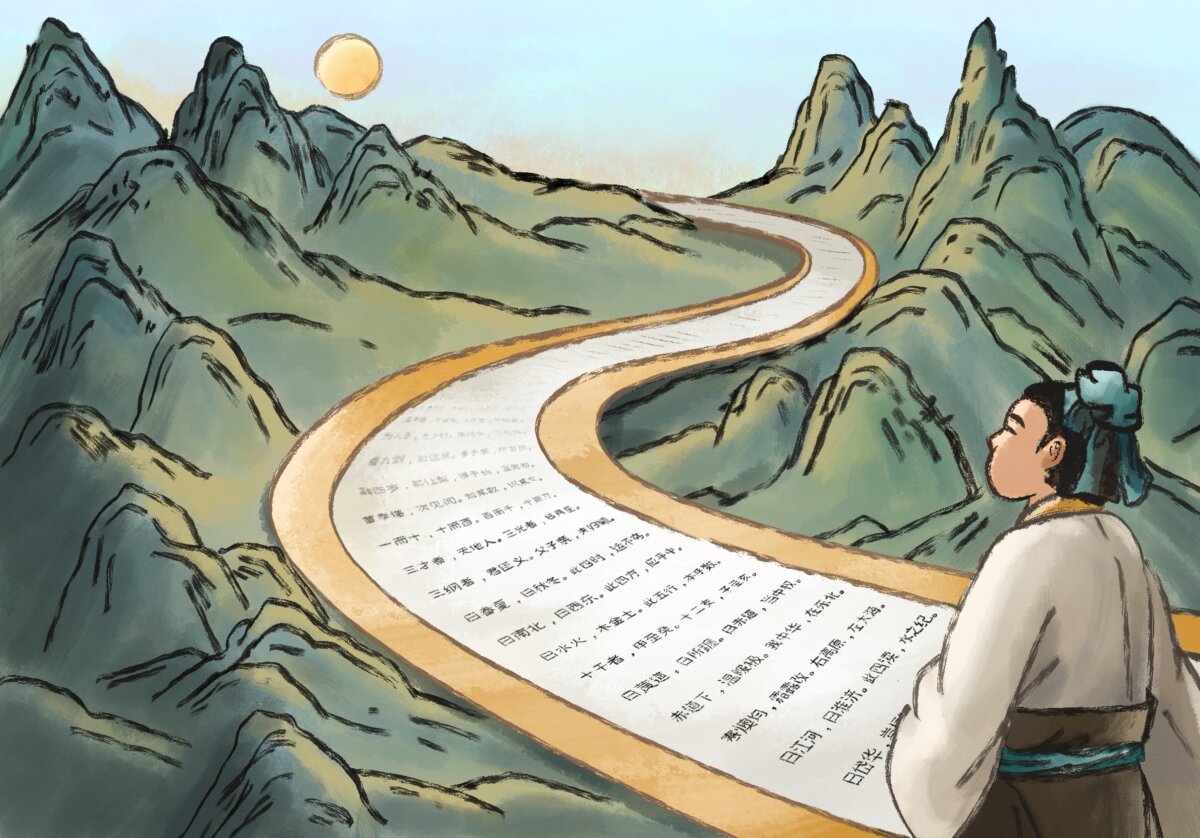
In a world often driven by quick wins and personal gain, imagine a book more than 800 years old that insists that kindness is our birthright and that moral growth is our lifelong mission. “The Three Character Classic” (“San Zi Jing”), a gem of Chinese traditional culture, does just that.
Likely penned by Song Dynasty scholar Wang Yinglin in the 13th century, this short, rhythmic textbook uses simple three-word lines to teach children not just facts but also how to be good people.
It distills Confucian teachings—benevolence, righteousness, propriety, wisdom, trustworthiness—into short, rhythmic lines meant to guide children on their path to becoming virtuous and sensible adults.
Let’s explore how “The Three Character Classic” showcases the moral merits that have sustained Chinese culture for millennia and why its wisdom still resonates today.
The Power of Early Moral Education
“The Classic” opens with a bold claim: “At their beginning, people are kind.” Rooted in the philosophy of Mencius, who was allegedly a student of Confucius’ grandson Zisi and one of the interpreters of Confucianism, this line asserts that kindness is innate, a seed waiting to bloom.
However, the next lines warn: “Natures are similar, characters drift apart. Without proper teaching, goodness gradually fades. The way of teaching, thoroughness is the core.”
Our environment and upbringing shape whether that seed grows or withers. This Confucian emphasis on early education underscores a key moral merit: nurturing a child’s natural goodness is a parent’s sacred duty, requiring consistent guidance to keep them on the path of virtue.
Neighborhood Matters
Where a child lives has an impact on the shaping of his character and his future career choice.
There’s a story of Mencius’s mother, a widowed weaver who moved their home three times to find the right neighborhood for her son Mengzi, later known as the great sage Mencius. The lines in “The Classic” that tell the story read as follows: “In the past, Mencius’ mother chose the neighborhood. When her son wouldn’t learn, she severed the thread on the loom.”
The story says that, living near a graveyard, young Mencius mimicked funerals, and made a game of mourning. His mother, alarmed, relocated to a bustling market. But there, he copied butchers and vendors. Finally, she settled near a school, where Mencius observed respectful rituals and began to emulate them.
Hence, the story that is known as “Mencius’ mother moved three times.” When Mencius was old enough to attend school, he skipped class one day. His mother dramatically cut her weaving, saying, “Learning is like weaving—quitting halfway destroys the whole piece of work.”
Shamed, Mencius devoted himself to study, becoming a Confucian giant, known as “the Second Sage” after Confucius, thanks to his mother’s relentless focus on his moral and intellectual growth.
Parents as Role Models
Then, there’s Dou Yanshan, a scholar and official in the Tang Dynasty who was childless in his 30s. People in ancient times married at a young age and Dou started to worry about his lineage. One night, in a dream, his late grandfather warned him that his past life’s karma was too heavy and that it would leave him sonless and short-lived unless he changed.
Dou took it to heart and he began to lend money to struggling families. He founded private schools for underprivileged children and funded funerals and weddings for the poor.
His good deeds earned him five sons, whom he raised with morality. All five sons passed rigorous imperial tests and became respected officials, making their family a model of virtue.
The lines for Dou’s story read as follows: “Dou Yanshan, with righteous methods, taught his five sons, who became all well-known.”
These stories highlight a core merit: parents must model and teach righteousness, shaping not just their kids but society’s future.
How to Behave in Various Relationships
“The Classic” details how people with various roles in life should act in different relationships. Children chant and memorize these lines, which they keep in mind for their lifetime. They come to know what rituals and rules they should follow in different roles in the family, in work place, and in society.
“Between father and son, there should be affection.
Between husband and wife, harmony.
An elder brother should be kind, and a younger one respectful.
The old and young must observe their proper order,
Which is the principle for friends.
A sovereign should show respect, and a minister should be loyal.
These ten virtues are the moral duties shared by all.
Follow them faithfully, and never go against their order.”
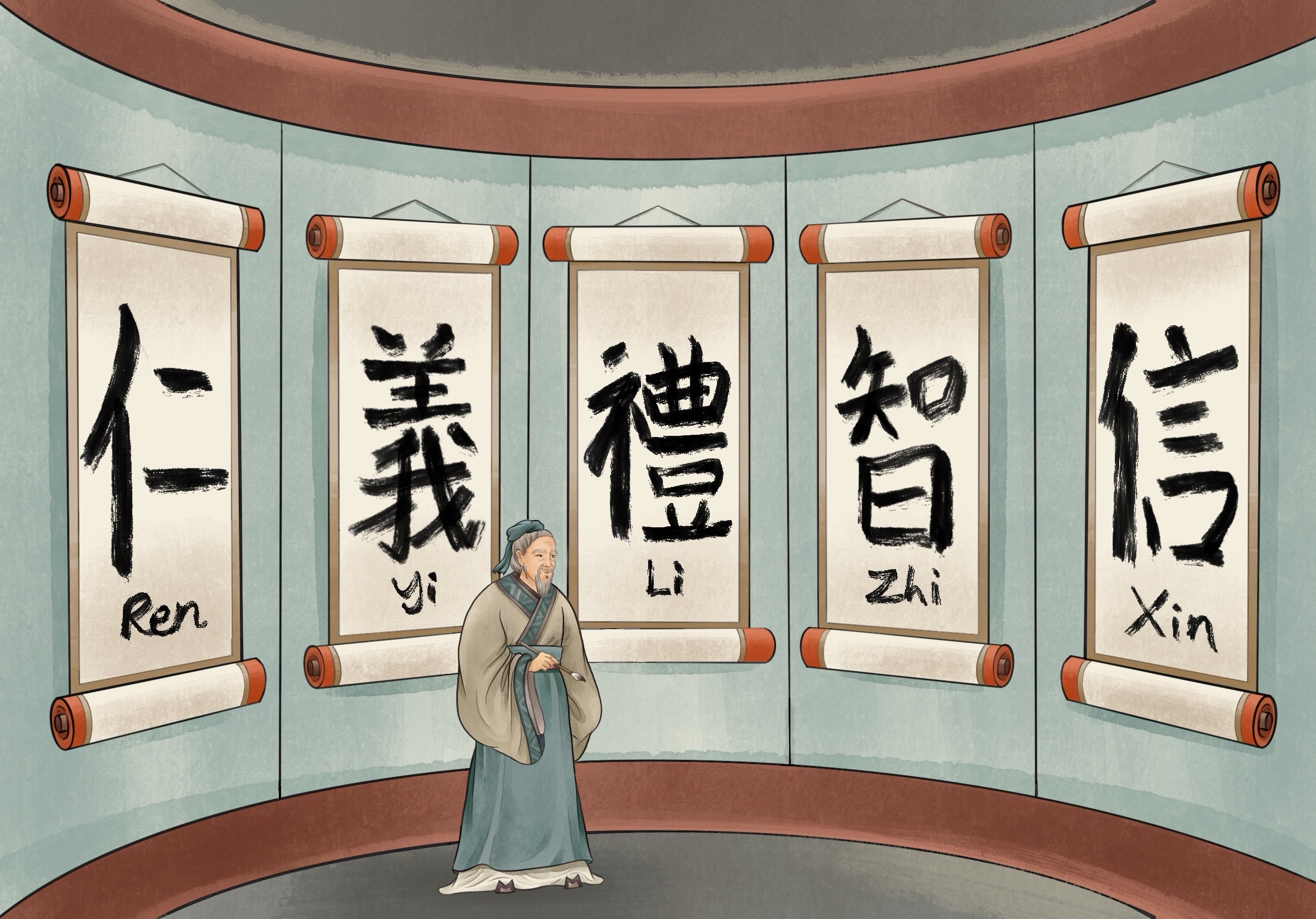
Titled the “Ten Principles of Righteousness” in “The Classic,” these virtues are expressions of Confucius’s core teachings of Ren (goodness), Yi (righteousness), Li (rites), Zhi (wisdom), and Xin (trustworthiness), and regulate how we should behave in society.
Each of us plays many roles—we might be a parent, a spouse, a child, a sibling, a friend, or a boss or employee. At the heart of these relationships is a shared sense of respect and fairness, filial piety, love, harmony, and loyalty.
It’s all about starting with ourselves: when we act with integrity and kindness, our example naturally influences our family, friends, and the people around us. That ripple effect of goodness is powerful and lasting.
Story of Filial Piety
A touching story of filial piety in “The Classic” reinforces how these principles help shape a child’s character.
Huang Xiang, an Eastern Han Dynasty boy, was only 9 years old when his mother died. Though he missed his mother, he took care of his father very well: in summer, the boy would fan the pillow to make it cool and in winter he would lie in his father’s bed to warm it before his father went to bed.
His small acts show how even kids can embody these virtues. His neighbors all praised him and regarded him as a role model for their own children.
Teaching Common Knowledge
Beyond ethics, “The Classic” also serves as a primer in basic knowledge—much like an elementary textbook. It teaches counting from one to 10,000; the four seasons and cardinal directions; the sun, moon, and stars; and the natural order of heaven, earth, and humanity.
It introduces the five elements (metal, wood, water, fire, and earth), geography, agriculture, trade, and the traditional six grains and six domestic animals. As all lines throughout the Classic are composed of three words and rhyme, children can memorize the knowledge easily, coming to understand creation, Earth, and the universe.
As children advance, the book guides them toward the Four Books and Five Classics of Confucianism and the study of history.
Moral learning and practical learning were inseparable—both essential to becoming a complete person.
Moral Cultivation Lasts a Lifetime
The book closes with a warning and an encouragement:
“Diligence brings success;
Idleness brings nothing.
Stay alert on this,
Strive always.”
Moral and intellectual growth, it teaches, is not a phase of youth but a lifelong commitment.
A Message for Today
After the Chinese Communist Party seized power in China in 1949, traditional culture was denounced, especially during the Cultural Revolution. Confucian moral teachings and texts such as “The Classic” were labeled as “feudal superstitions.” And as a result, moral education collapsed along with those teachings. The resulting erosion of ethics in Chinese society has been a painful lesson.
The message of the book remains timeless: human nature begins with goodness, but it must be nurtured through education, self-discipline, and moral example. When individuals cultivate virtue, families prosper, and societies become stable and just.
Perhaps that is the deepest lesson this little book offers the modern world: Goodness is our nature—but it survives only when we choose to practice it.