



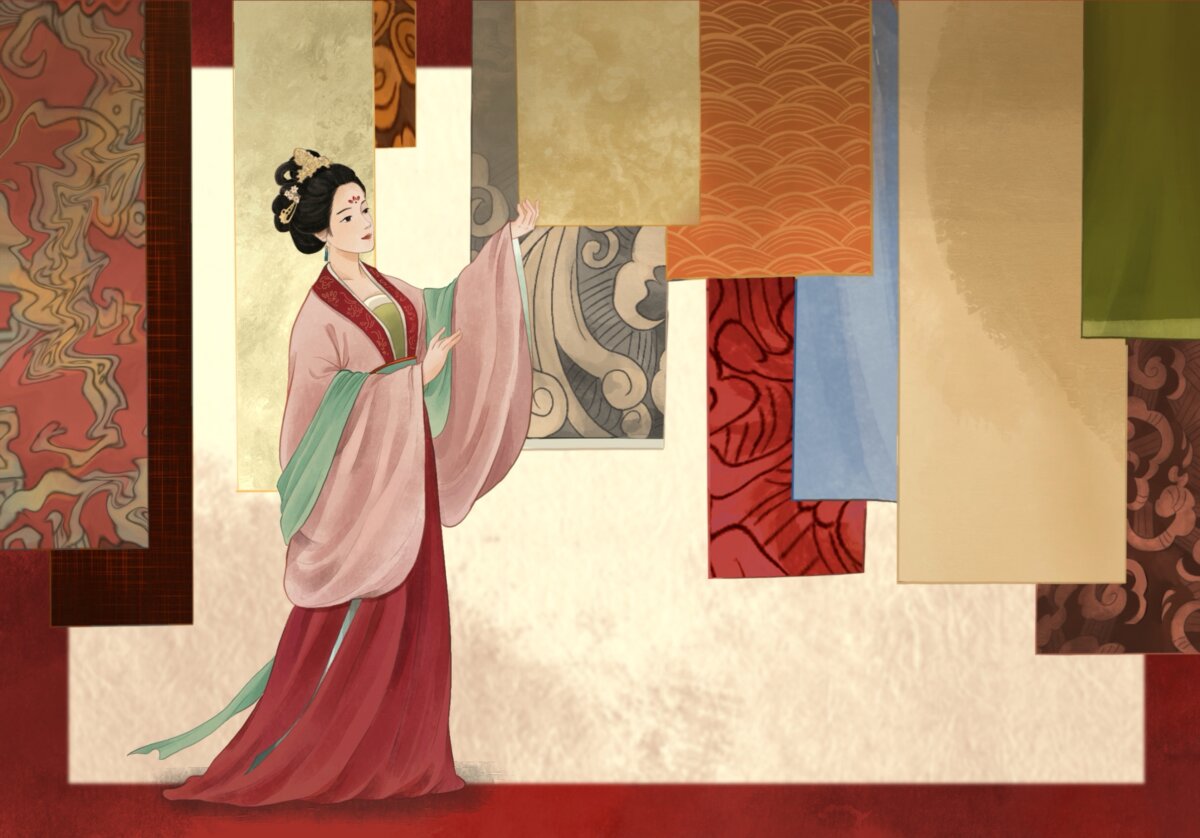
Elegant ladies in beautiful flowing dresses with wide sleeves, a high waist, and exquisite headpieces, showcase the dignity and luxury of China’s Golden Age: the Tang Dynasty.
Clothing from this era was bold, elegant, and sometimes even otherworldly.
The Look: Layers, Flow, and Flair
The Tang Dynasty (618–907) saw China at its absolute peak: booming trade, dazzling culture, world-class poetry, breakthroughs in art and medicine—and, of course, unforgettable fashion.
Thanks to the silk weaving and dyeing techniques that hit new heights, the Tang attire was stunning: rich fabrics in vibrant colors, with patterns so detailed they still amaze textile experts today.
Qixiong Ruqun (The Chest-High Skirt Ensemble)
One of the most iconic Tang fashions was the Qixiong Ruqun, a high-waisted skirt tied just below the bust. The long, flowing lines add to the height and grace of the wearer.
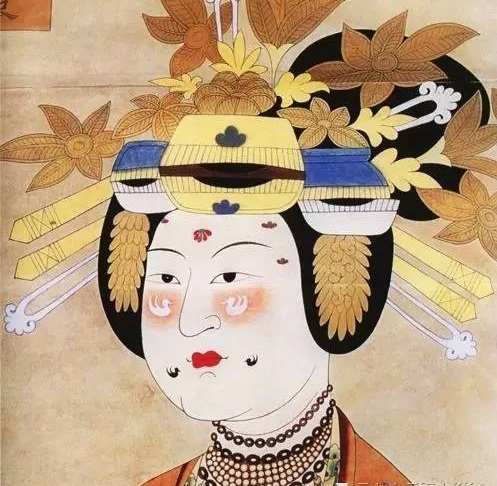
A typical Tang women’s chest-high skirt ensemble is showcased in “Court Ladies Wearing Flowered Headdresses,” a painting by Tang Dynasty artist Zhou Fang, which is now kept in China’s Liaoning Provincial Museum in Shenyang, the capital city of China’s northeastern Liaoning Province.
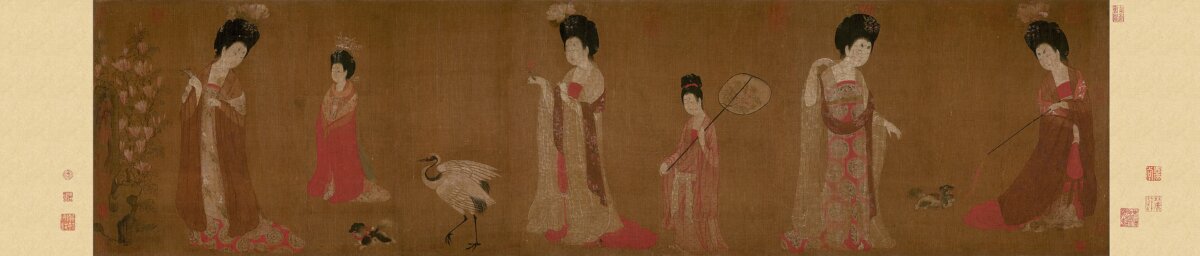
Over time, the Qixiong Ruqun evolved into multiple styles, often layered with sheer outer robes or loose blouses. The use of soft, lightweight fabrics such as silk charmeuse, chiffon, or gauze allowed the skirts to float around the wearer as they moved, giving an ethereal, almost celestial appearance. The Qixiong Ruqun became a hallmark of femininity and elegance throughout the dynasty.
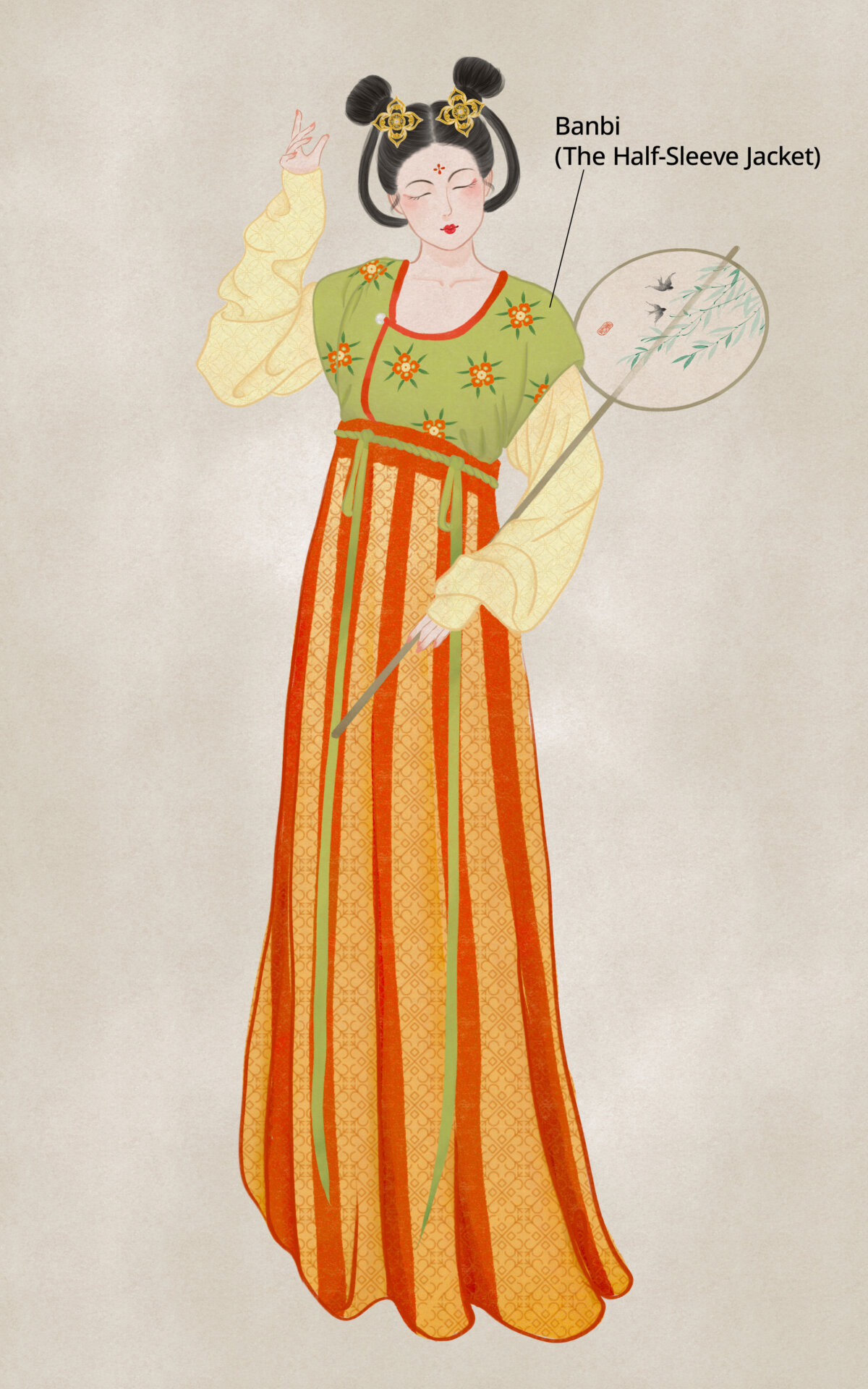
Banbi (The Half-Sleeve Jacket)
The banbi—a short jacket with half-sleeves—was often worn over the qixiong ruqun to layer it up. It typically had a front closing, and was tied or fastened at the chest. Practical yet stylish, it added structure to the flowing skirts beneath. The banbi could be made from fine silk, with embroidered details for noblewomen.
Daxiushan (The Large-Sleeved Robe)
By the mid- to late Tang dynasty, women’s garments became progressively wider and more voluminous. The daxiushan, or large-sleeved robe, reflected this trend. With wide, flowing sleeves often spanning more than four feet in width, it was worn for courtly or ceremonial occasions, signaling nobility and grandeur.
Pibo (The Floating Silk Shawl)
No Tang outfit was complete without the pibo—a long, gauzy silk stole draped over the shoulders or looped across the arms. Usually over two meters long and made from lightweight silk gauze or chiffon-like fabric, the pibo caught the air with every movement, creating the impression of fluttering wings or flowing clouds. In art, women are often shown with pibo trailing gracefully behind them, as though they were celestial beings descending from heaven.
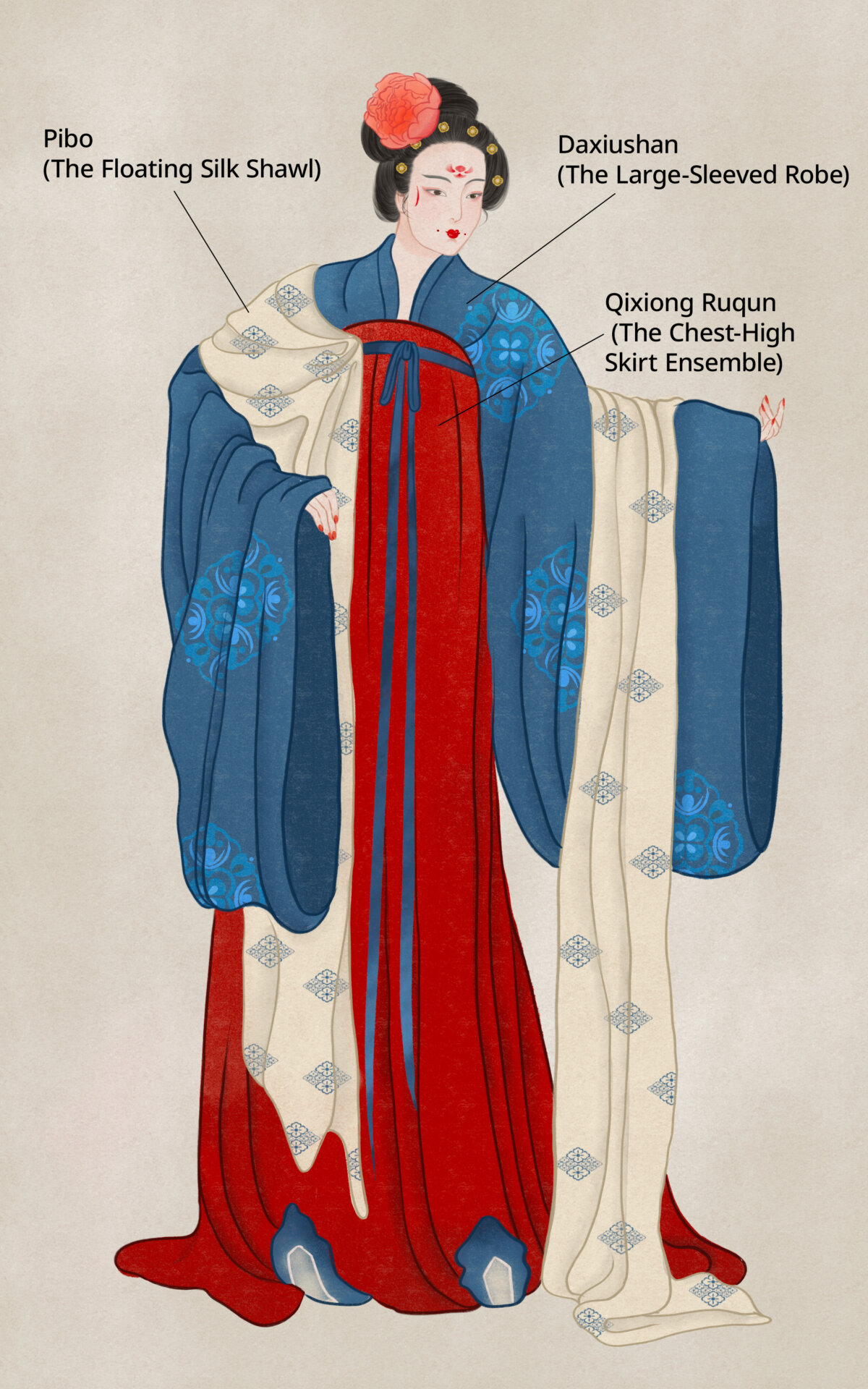
Paintings of Tang court ladies clearly show pibo trailing from shoulder to wrist; museum notes describe thin, gauzy materials. Zhou Fang’s painting “Court Ladies Wearing Flowered Headdresses” is a famous example, and the comparable court-lady depiction at the Cleveland Museum of Art also highlights gauzy stoles and airy fabrics.
Accessories and Ornamentation
Tang women’s attire was not only about garments but also elaborate accessories. Aristocratic women in full regalia often completed the ensemble with ornate headdresses decorated with gold and jewels, known as diancai liyi (“adorned hairpin ceremonial attire”).
Hairstyles were often arranged in tall chignons, sometimes padded to create striking silhouettes. These were adorned with fresh flowers, jeweled hairpins, and buyao—dangling ornaments that swayed as the wearer moved.
A signature detail was the forehead decorations known as huadian, which were tiny decorative motifs pasted onto the forehead, adding charm and sophistication. Paintings like Zhou Fang’s capture these fashions, where towering hairstyles and delicate accessories enhanced the regal yet playful spirit of Tang femininity.
Why the Clothes Were So Gorgeous
Behind all this style was an industry to match. The Tang textile scene was booming. Government workshops and private weaving houses churned out luxury fabrics like brocade, gauze, damask, and silk crepe. Cotton and hemp served everyday needs, but the wealthy flaunted silks in dazzling patterns—peacocks, dragons, jewel-like flowers, and geometric motifs.
Dyeing techniques also flourished. Plants like madder, pomegranate flower, safflower, and turmeric produced brilliant reds, golds, and yellows, while other natural dyes gave rich purples and greens. Textile artisans mastered tie-dye, wax-resist, and clamp-resist printing, producing fabrics so colorful they’d put modern fast fashion to shame.
And one color in particular stole the show: pomegranate red.
Pomegranate Power
Why the obsession with pomegranates? In Chinese culture, the fruit symbolized fertility, abundance, and family prosperity. Its blossoms were fiery and eye-catching; its fruit, round and bursting with glistening seeds, stood for children, descendants, and flourishing households. Plant a pomegranate tree in your courtyard, and it wasn’t just for shade—you were wishing for generations of success.
That symbolism naturally spilled over into fashion. The phrase “falling at a woman’s pomegranate skirt” comes from this era. The story goes that during Emperor Xuanzong’s reign, his beloved consort Yang Guifei adored pomegranate-red skirts. The emperor insisted officials treat her with respect due to royalty, so when ministers found themselves forced to bow, they later joked they were “bowing before the pomegranate skirt.” Over time, the phrase lost its political edge and came to mean being captivated by a woman’s beauty.
Pomegranate-red skirts became iconic—not just gorgeous to look at, but loaded with meaning: health, vitality, and feminine allure.
Tang Dynasty women’s fashion was more than pretty clothes. It was a full expression of an age: confident, innovative, prosperous, and a little flamboyant. The colors blazed, the fabrics shimmered, and the styles mixed elegance with drama. Whether in high-waisted skirts, flowing scarves, or bold pomegranate-red gowns, Tang ladies weren’t just dressing up—they were embodying the grandeur of one of history’s brightest golden ages.
What arts and culture topics would you like us to cover? Please email ideas or feedback to features@epochtimes.nyc
_Liaoning_Provincial_Museum,_Shenyang..jpg)