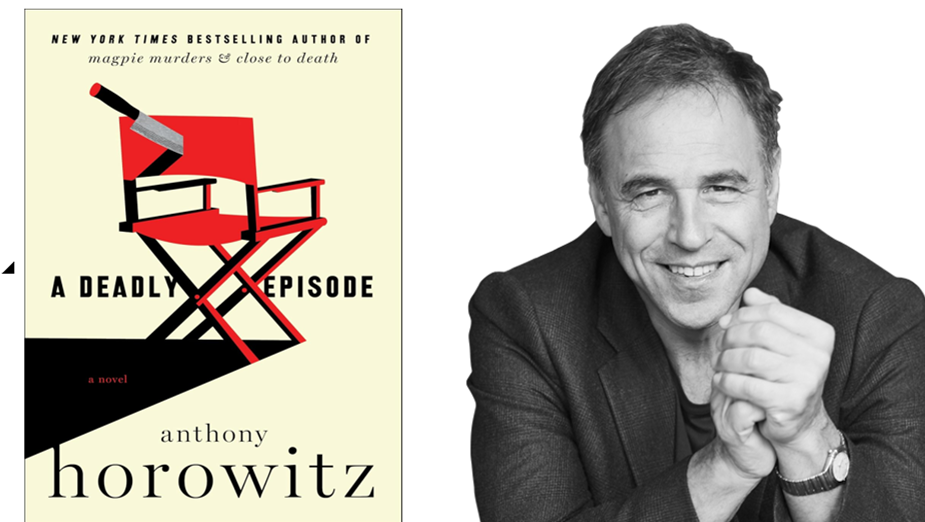
If you have already read any of the previous five books in Anthony Horowitz’s series that feature the brooding and terse detective Daniel Hawthorne, you know the deal.
For the rest of you, there’s something you need to understand before deciding if this series is for you.
Author as Character
Let’s talk self-insertion, or authorial intrusion—when an author chooses to write themselves, or a version of themselves, into their own book.

One example is Philip Roth’s “Operation Shylock.” The book features a character named Philip Roth who travels to Israel to track down an imposter pretending to be Philip Roth (chew on that one for a while).
Kurt Vonnegut Jr. also appeared in some of his works, such as “Breakfast of Champions” and “Slaughterhouse Five,” both absurdist sci-fi classics.
In the Hawthorne mystery series by author Anthony Horowitz, the main character and narrator is an author named Anthony Horowitz.
With me so far? Both Anthonys (the real one and the fictional one) have resumes that are almost carbon copies. They both wrote popular kids’ books starring a teenage 007 clone named Alex Rider, and they both wrote identical television programs for UK TV. They even have a wife with the same name.
Here’s the big difference: The fictional version gets roped into chronicling the cases of a moody, terse, unfriendly private investigator named Daniel Hawthorne, someone he doesn’t even like that much. The format is akin to Sir Arthur Conan Doyle’s Sherlock novels, in which the fictional Horowitz plays the Dr. Watson role.
Showbiz Is Murder
The premise of “A Deadly Episode,” the sixth book in the series, is a bit of a treat for those fans who have read the books from the beginning. The murder takes place near Hastings, on the southern coast of England, during the filming of a production based on the first Anthony Horowitz book, “The Word Is Murder.”
Still with me? “The Word Is Murder” centered around an older woman named Diana Cowper, who was killed a few hours after making the arrangements for her own funeral. That book was so popular in the fictional universe that an ambitious, stylish, and determined independent producer named Teresa de León acquired the rights.
Horowitz is nervous about the whole affair. Although enthusiastic about the source material, de León has handed creative control to screenwriter Shanika Harris and director Cy Truman.
An arrogant Harris seems more interested in inserting her own philosophical ponderings into the dialogue, and Truman wants to become the next Fellini rather than stay faithful to the book.
Horowitz is aghast when he meets the actor who’s going to portray himself: Ralph Seymour, who’s been away from acting for years following a personal collapse. Once considered a rising star, Seymour now appears fragile, obsessive, and socially awkward. It doesn’t help that he looks nothing like Horowitz.
Hawthorne seems unperturbed by it all. At least his actor, David Caine, seems like a good choice—a charismatic, politically outspoken man with a growing international career and a history of environmental activism alongside Shanika.
But Caine’s career takes a hit when someone stabs him to death during filming. When Hawthorne informs Horowitz about the murder, the detective quips, “I suppose it might have been a mercy killing. If the killer had read the script.”
For those of you keeping score, it’s a Hawthorne-Horowitz mystery inside a Hawthorne-Horowitz book about a Hawthorne-Horowitz film.
Handsy
Some writers use a term called “the hand of the author.” It refers to moments in the books (or films) where the author’s presence intrudes on the story. That could be as innocuous as Hitchcock doing a cameo in one of his own films.
It’s more jarring when, say, someone’s political or social agenda is thrust into a story where it doesn’t naturally exist. The bigger the insertion, the more jarring. You have to hand it to Horowitz for his hutzpah. He probably read this rule and said: “Hold my beer.”
In the real Horowitz’s defense, the Hawthorne series is a light comedy and mystery, and the premise is obviously a bit of cheeky fun. But excessive blurring of reality and fiction makes it hard to lose yourself in the storyline.
Ironically, Hawthorne is actually much more interesting than Horowitz. He’s blunt to the point of excessive rudeness without caring about the consequences.
When he expertly tears down the scriptwriter’s take on his character, she replies: “You’re not very nice.” In his working-class accent, Hawthorne retorts: “I know that, love. But at least I’m real.”
“A Deadly Episode” is like having a metaphysical, bright, neon sign constantly shining in your eyes that says, “Some of this is real, some of it I made up!” As a result, Horowitz’s narration often reads like lifelogging (vlogging) more than fiction.
Some will find this enormously fun. It’s a best-seller, so it seems many agree with that perspective.
‘A Deadly Episode: A Novel (A Hawthorne and Horowitz Mystery, Book 6)’
By Anthony Horowitz
Harper Publishing: April 28, 2026
Hardcover, 384 pages
What arts and culture topics would you like us to cover? Please email ideas or feedback to features@epochtimes.nyc