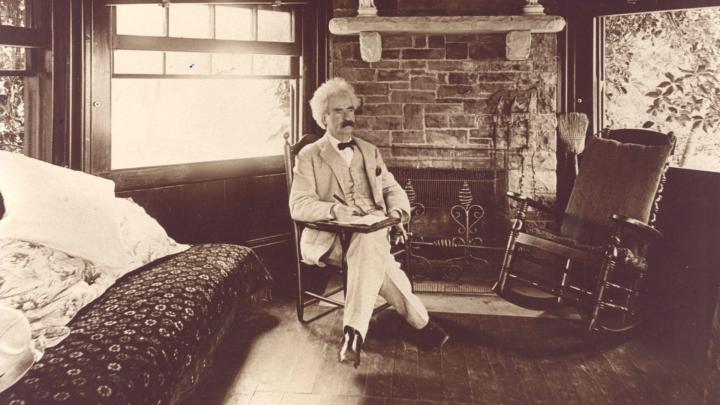
In his short story “Running for Governor,” Mark Twain contemplates the importance of truth by highlighting how dangerous and damaging lies can be. When a man’s reputation is all he has, lies and falsehoods do irreparable damage.
Nominated for Governor
Mark Twain tells how he was once nominated to run for governor in New York. Though he decided that he would run, he was worried about having his name associated with the other candidates, whose reputations in the newspaper were a disgrace.
Yet Twain felt comfortable that his good character gave him an advantage over his competitors, so much so that he grew horrified while reading the paper one morning. One of the pieces read:
“Perhaps, now that Mr. Mark Twain is before the people as a candidate for Governor, he will condescend to explain how he came to be convicted of perjury by thirty-four witnesses in Wakawak, Cochin China, in 1863, the intent of which perjury being to rob a poor native widow and her helpless family of a meager plantain-patch.”
Twain was flabbergasted. He had never been to Cochin China, didn’t know what a plantain-patch was, and had never even heard of Wakawak before. Unsure, shocked, and crazed, Twain didn’t reply to this accusation.
His lack of silence merely stoked the reporters’ fires. The next piece released about him said:
“Will the new candidate for Governor deign to explain … the little circumstance of his cabin-mates in Montana losing small valuables from time to time, until at last, these things having been invariably found on Mr. Twain’s person or in his “trunk?”
Again, Twain found himself at a loss for words. He had never been to Montana. He failed to respond to his slanderous piece and was duly dubbed by that particular newspaper “Twain, the Montana Thief.”
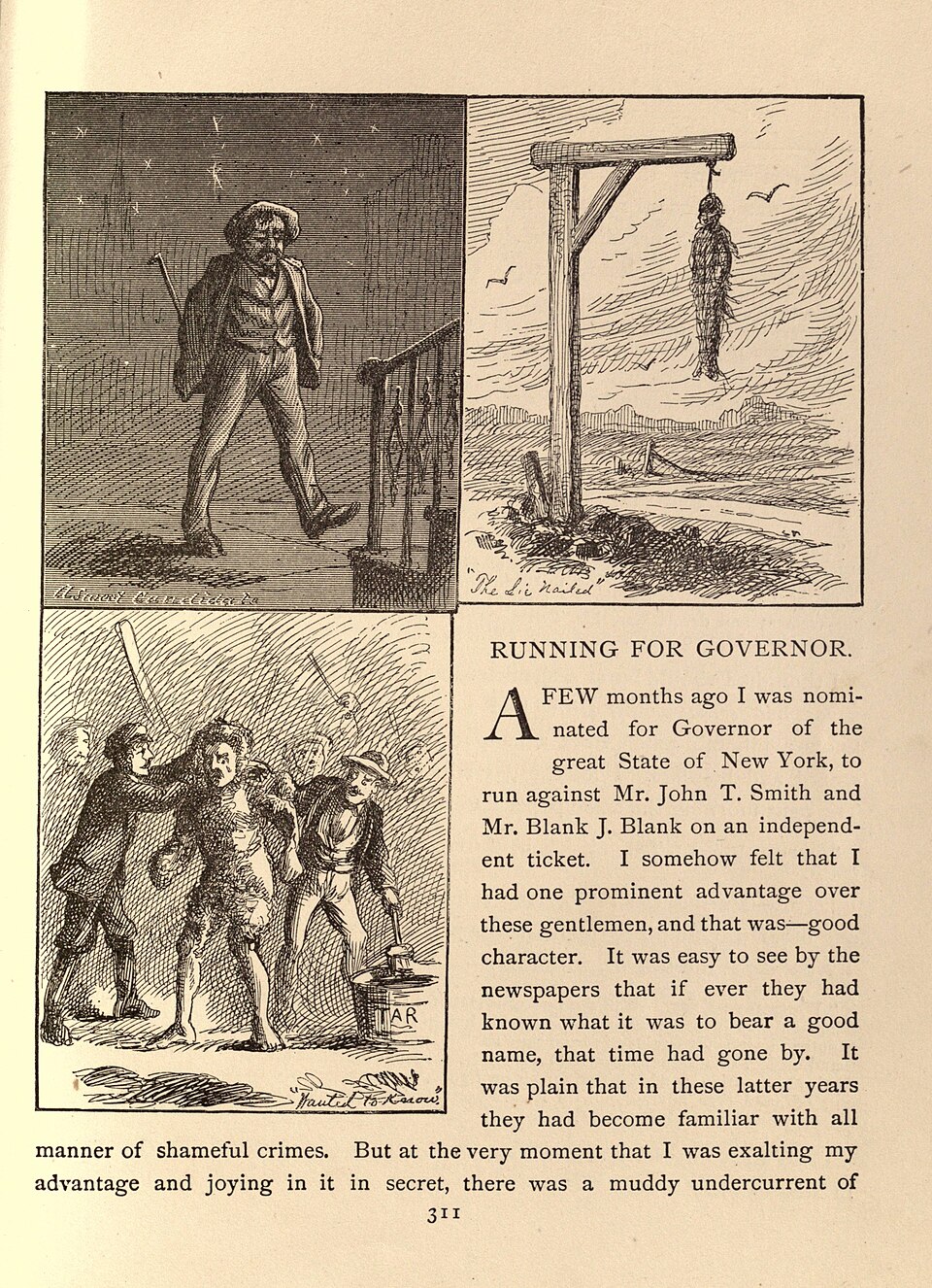 A page from Mark Twain’s “Sketches, New and Old.” (Public Domain)
A Good Name
Twain soon acquires more and more names in the press for the fictional actions of ill repute which they attribute to him. He was called “the infamous perjurer Twain,” then “Twain, the Montana Thief,” “Twain, the Body-Snatcher,” “Mr. Delirium Tremens Twain,” “Twain the Filthy Corruptionist,” and “Twain the Loathsome Embracer.”
Anonymous letters quickly began flooding his mailbox, accusing him of various deeds he hadn’t committed. Yet Twain didn’t know how to respond, since all the claims aimed at him were as comically absurd as they were savagely slanderous.
Thus, through his dealings with the false accusations and defamation flung at him, Twain demonstrates that, even if false accusations are so wildly untrue that they become comical, truth is what matters and should always be upheld. For a good name is all a man has and, if his good name is ruined, so is he.
William Shakespeare explained it perfectly in “Othello” when he wrote:
Good name in man and woman …
Is the immediate jewel of their souls: …
he that filches from me my good name
Robs me of that which not enriches him,
And makes me poor indeed.
Thus, Twain proves the paramount importance of truth by demonstrating the destructive nature of lies for the subject and the liar’s empty reward. While lies tear down and deprive, truth builds up. It clothes both giver and receiver with hope and freedom. Truth is freedom for a man and his good name.
What arts and culture topics would you like us to cover? Please email ideas or feedback to features@epochtimes.nyc