PG-13 | 2h 9m | Faith-Based, Historical | 2026
While glossing over some controversial aspects of Calvinist Methodist preacher George Whitefield’s life—such as his notorious advocacy for slavery—faith-based and hagiographic historical drama “A Great Awakening” tells Whitefield’s story, largely by way of his friendship with Benjamin Franklin.
It depicts how Whitefield’s effect on the American Revolution and an evangelical revival occurred simultaneously. “A Great Awakening” is aimed predominately at receptive Christian audiences.
Those who claim nationalism and hardline religious dogma are on the rise will question the purpose of making this movie at this particular moment in the country’s ongoing evolution. But “A Great Awakening” serves to remind us that most of our current ethical arguments, political debates, and uncertainties are older than the official founding of the United States itself.
Franklin
Of all of Benjamin Franklin’s numerous and varied accomplishments, the makers of “A Great Awakening” appear to have determined that the most important was a speech he made in 1787 at the Constitutional Convention. The screenplay folds history and politics together in such a way that it frames Franklin’s suggestion that assembly meetings be opened with prayer, as the zenith of his life, and a cornerstone of America’s founding.
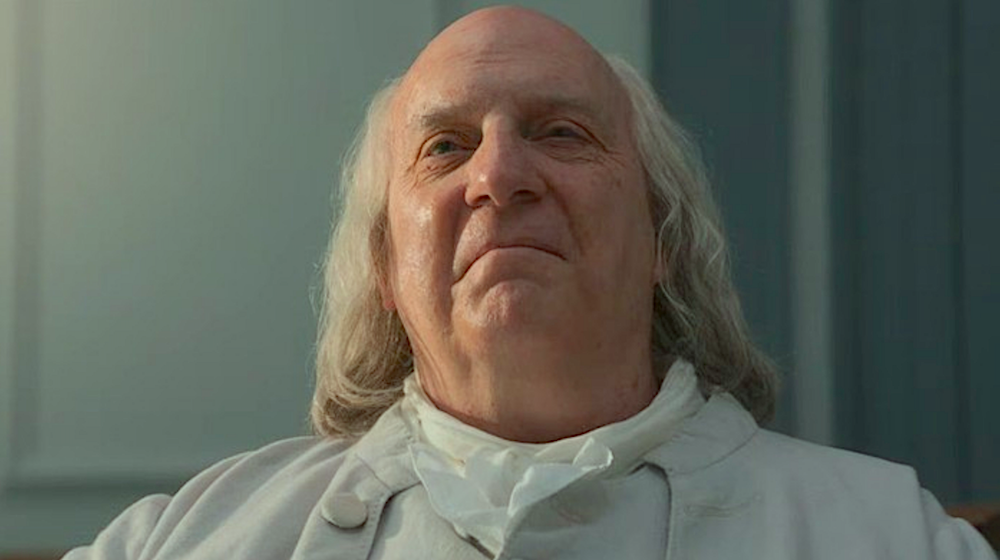
Franklin (John Paul Sneed) is presented as the epitome of rational thinking, scientific inquiry, and philosophical pragmatism, by way of a medley of his greatest-hits aphorisms. Many famous quips are pulled straight from his own “Poor Richard’s Almanac.” Visually, this naturally includes Franklin flying that famous kite, with the key attached, in the middle of a lightning storm. However—who knew Whitefield was by Ben’s side at the time of that electrifying discovery?
It must be said that it’s obviously the movie’s minuscule budget that is responsible for Franklin looking roughly as old in 1739 as he looked 50 years later, in 1787. For the same reasons, while the message is powerful, the acting is unfortunately fairly hammy. For those focused on the message, none of the above will be particularly important.
Whitefield
English Anglican cleric George Whitefield (Jonathan Blair) was a key founder of Methodism. He was also a staunch Calvinist who believed in predestination and unconditional election (how God chooses who will be saved). Much is made of his early desire to be an actor, and having learned to classically project his voice to large audiences—a preacher’s premiere tool.
Like his contemporary and fellow countrywoman, Ann Lee, the founder of the Shakers, Whitefield upset the norms and order of the Church of England. While he was neither defrocked nor exiled, many Anglican clergy were hostile to his emotional preaching and unscripted style. Consequently, many local churches closed their doors to him, forcing him to preach outdoors in fields—a practice that was considered scandalous at the time but did not result in the loss of his holy orders.
Whitefield set sail for America to ministry in the New World colonies. By the time Whitefield arrives in Philadelphia to use his actor’s voice to preach to a main street packed wall-to-wall with throngs of listeners, he’s wafting an 18th-century preacher aura on par with a modern-day movie star.
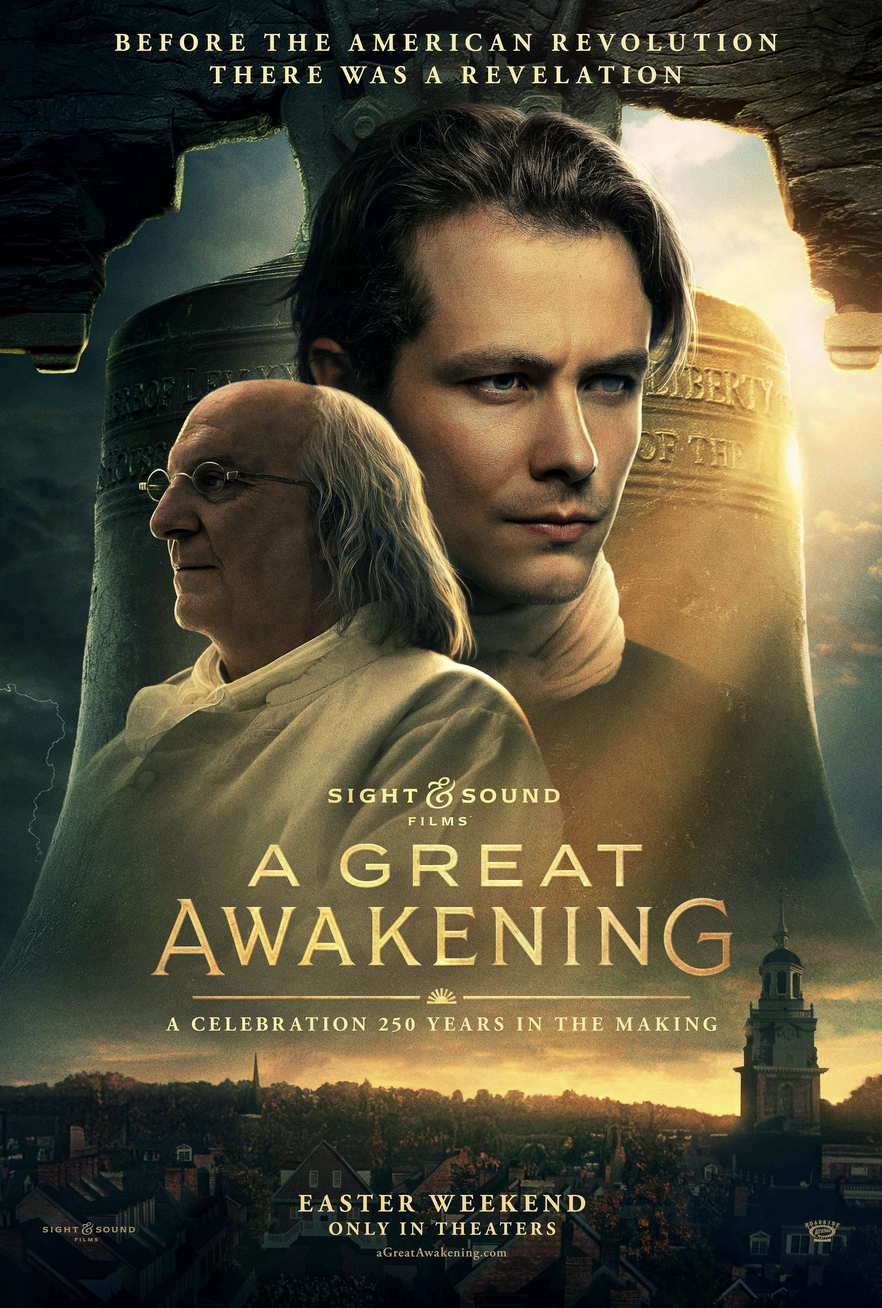
Whitefield Versus Franklin
It takes a while for Whitefield to arrive in America because the filmmakers are more focused on telling his story than Franklin’s. The public is far more familiar with Franklin, while Whitefield’s enduring contributions have more to do with theological matters, particularly those of evangelical and “born-again” Christianity.
Ultimately, the film becomes a debate between the deist Franklin and devout Protestant Whitefield. Franklin believed in the existence of a creator God based on reason, logic, and observation of the natural world, rather than through religious texts, miracles, or revelations. He saw self-improvement and practical deeds that help one’s fellow man as the highest of human callings.
On the other hand, Whitefield insisted that a powerful faith in Jesus of Nazareth was the one and only purpose of humankind. The filmmakers side with Whitefield—which results in a preordained conclusion for the movie. Apparently, Franklin undergoes a major change due to his relationship with Whitefield, over the course of his life.
“A Great Awakening” makes no attempt to hide its stance regarding the separation of church and state. How audience members feel about that will influence whether they choose to view the movie. It is honest and transparent about its mission to influence hearts and minds by reintroducing a mover-and-shaker of the “Born Again” movement—a movement that’s still going strong, nearly 300 years later. For their purposes, the timing is impeccable, hitting theaters over Easter weekend.
‘A Great Awakening’
Director: Joshua Enck
Starring: Jonathan Blair, John Paul Sneed
MPAA Rating: PG-13
Running Time: 2 hours, 9 minutes
Release Date: April 3, 2026
Rating: 3 stars out of 5
Would you like to see other kinds of arts and culture articles? Please email us your story ideas or feedback at features@epochtimes.nyc