A mother gazing at a sleeping child. A daughter pulled close in an embrace. These are not complicated images; and yet, for centuries, painters have returned to them again and again. Perhaps that is because maternal love is not a single feeling but many: tenderness and protectiveness, wonder and weariness, universal and yet intensely private.
The subject has a way of making itself available to every painter personally, regardless of era or style. Maternal love is not a theme that requires research or imagination—it is simply there, in the room, in the studio, in the next moment of an ordinary day. For an artist already trained to look closely at the world, it may be the most compelling thing they have ever had directly in front of them.
The image of a mother’s embrace carries an extraordinary amount within a very small space. There is the physical closeness of the child cradled, held, and pressed against the body of someone who is, for the moment, the whole of their world. There is the gaze, which in the best of these paintings travels in two directions at once: the mother looking at the child with something between wonder and affection, and the child, when awake, looking back with a pure and unconditional love.
This laconic quality is precisely what has made the subject so irresistible to painters across so many generations. Every artist who has approached it has found something slightly different there, some new angle of expression or feeling that the last painter left uncaptured.
The five paintings gathered here approach the subject from different directions but together, they make an argument not just about art, but about love itself. It looks the same whether rendered in England or France, whether the painter is a court portraitist or a devoted father working from life. Some things, it turns out, do not change.
‘The Artist’s Wife, Elizabeth, With Her Daughter’
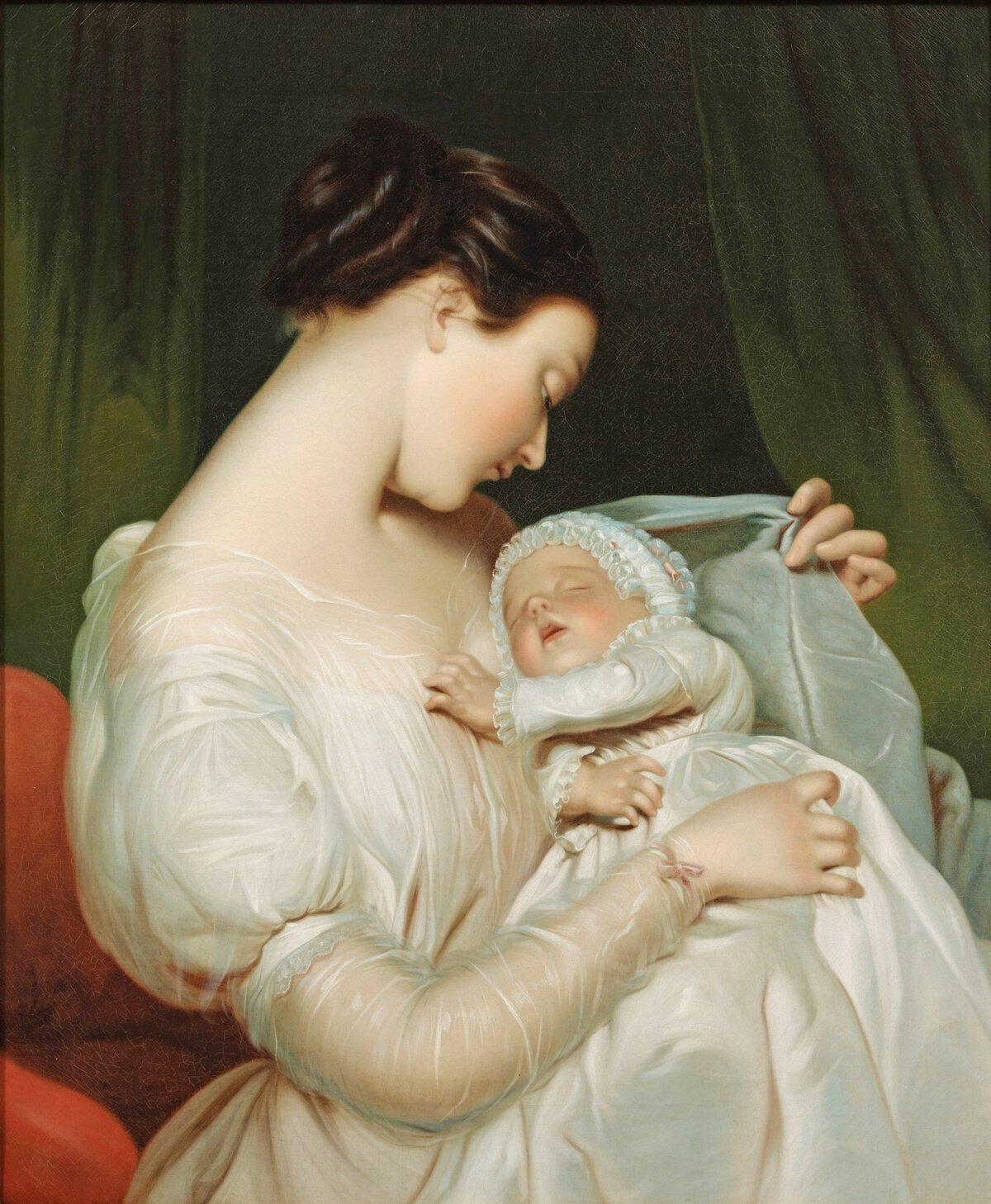
James Sant (1820–1916) was one of Victorian England’s most celebrated portrait painters, renowned for his sensitive depictions of women and children. Sant trained in the Academic tradition and rose to considerable prominence, culminating in his 1871 appointment as Principal Painter in Ordinary to Queen Victoria, a title he held longer than any other artist before or since. His reputation at court was built largely on his tender portrayals of the royal children, most notably his 1870 portrait of Prince Leopold and Princess Beatrice.
Technically, Sant was a master of the academic method of oil glazing: applying multiple thin, transparent layers of paint over a dried opaque underpainting. Each layer was allowed to cure completely before the next was added, a painstaking process that prevented brushwork from muddying and produced the smooth, candescent surfaces his portraits are famous for.
In “The Artist’s Wife, Elizabeth, with Her Daughter,” Sant focused on his own family, painting his wife, Elizabeth, alongside their young daughter. The painting is believed to have been composed around the time of their daughter’s birth in 1852. His mastery of glazing techniques suffuses both figures with an affection that sets the work apart from his more formal portraits. The painting sold at Christie’s in 2006 for over 90,000 pounds ($162,000), a world record for the artist at the time.
What makes Sant’s portrayal of maternal love so powerful is its intimacy: There is no mythological allegory here, no grand gesture, only the unhurried warmth of a private moment between mother and child.
Artist’s Self-Portrait With Her Daughter
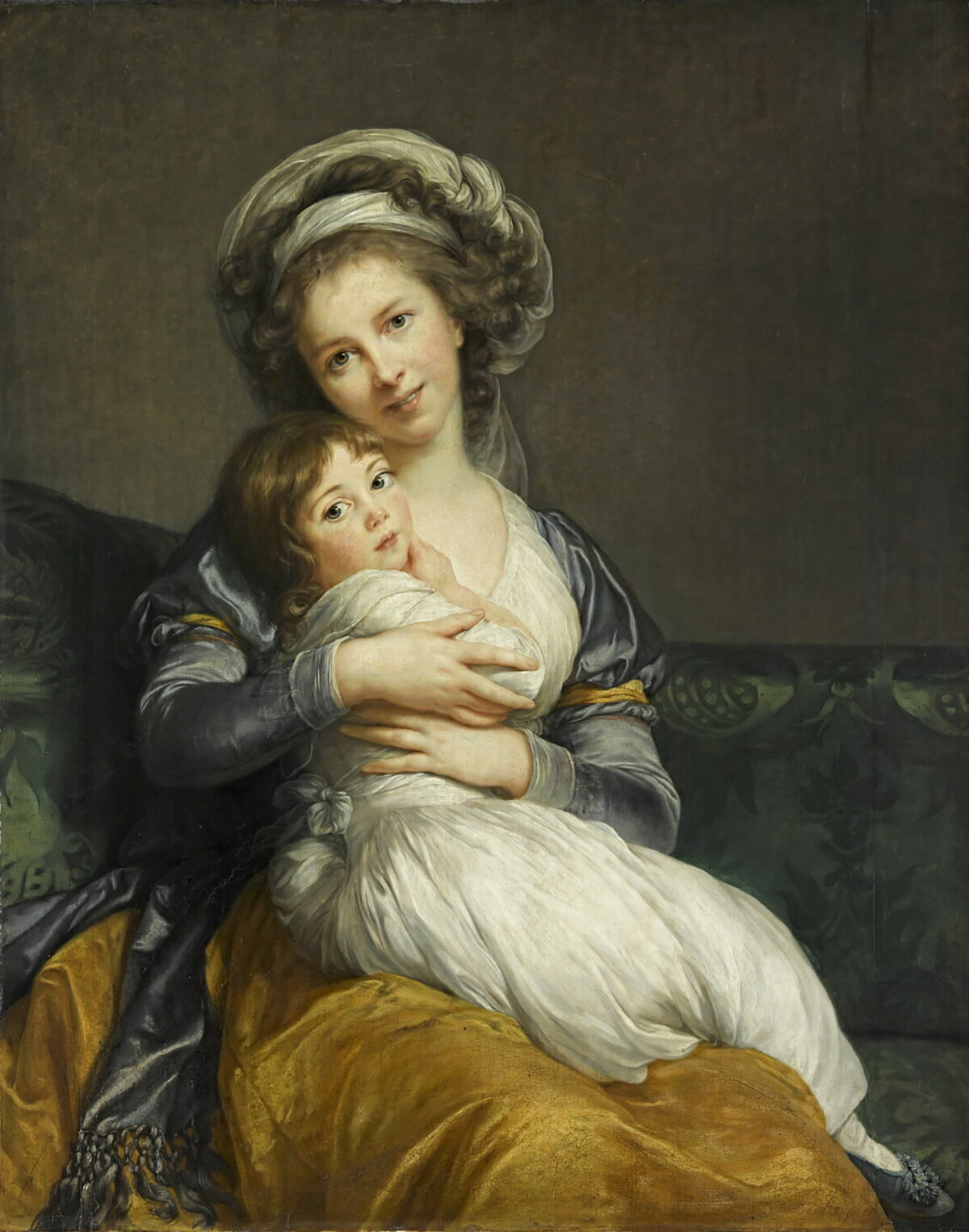
Elisabeth Vigée Le Brun (1755–1842) was one of the most accomplished painters of her era, a remarkable achievement in a profession largely closed to women in 18th-century France. She established herself as the preeminent portrait painter of Ancien Régime society, ultimately completing more than 30 portraits of Marie Antoinette and her family. Her style bridges the worlds of rococo and neoclassicism, drawing on the former’s playful subject matter and warm color palette while embracing the latter’s clarity and restraint.
Painted in 1786, this self-portrait with her only daughter, Jeanne-Julie-Louise—known affectionately as “Brunette”—is considered one of the defining works of her career. Both figures are dressed in the elegant, yet softly draped clothing, reflecting Le Brun’s unique artistic style. This deliberate stylistic choice aligns the work with the neoclassical ideals that were taking hold across Europe at the time.
What distinguishes Le Brun’s vision of motherhood is its directness. She chose to paint herself in an unguarded moment of happiness with her daughter, their cheeks pressed together and a smile on her face. Such expressions were an unusual sight in portraiture of the period, when smiling was considered too informal for the conventions.
‘Maternal Admiration’
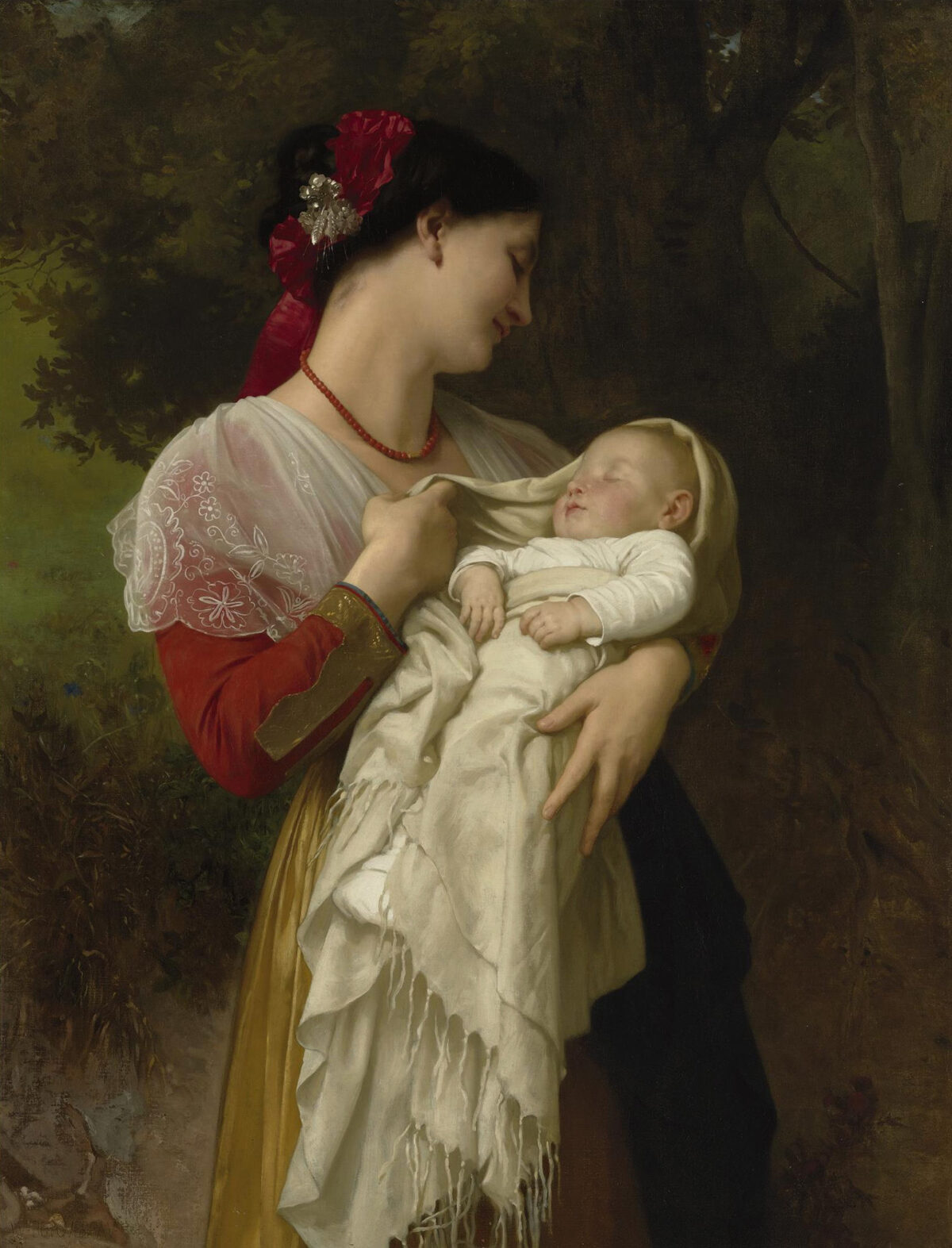
William-Adolphe Bouguereau (1825–1905) was the defining figure of French academic painting in the second half of the 19th century. He worked primarily in the grand tradition of idealized figure painting, weaving mythological and classical references into scenes of modern life, always with an emphasis on the beauty and dignity of the human form. His brushwork was impeccably smooth and polished.
Bouguereau’s “Maternal Admiration” depicts a young mother gazing down at her sleeping child, capturing the feeling of adoration that countless mothers have known. The pair is portrayed against a lush, natural green backdrop that lends the scene a serene, almost timeless quality. Many scholars have noted how this late 19th-century painting deliberately echoes the iconography of the Madonna, drawing on centuries of religious painting to infuse an intimate, secular scene with a kind of profound awe.
Bouguereau’s unique gift for elevating an everyday moment into something approaching the sublime is what makes this image so enduring. In his hands, a mother’s love was not merely tender, but transcendent.
‘Mother and Child’
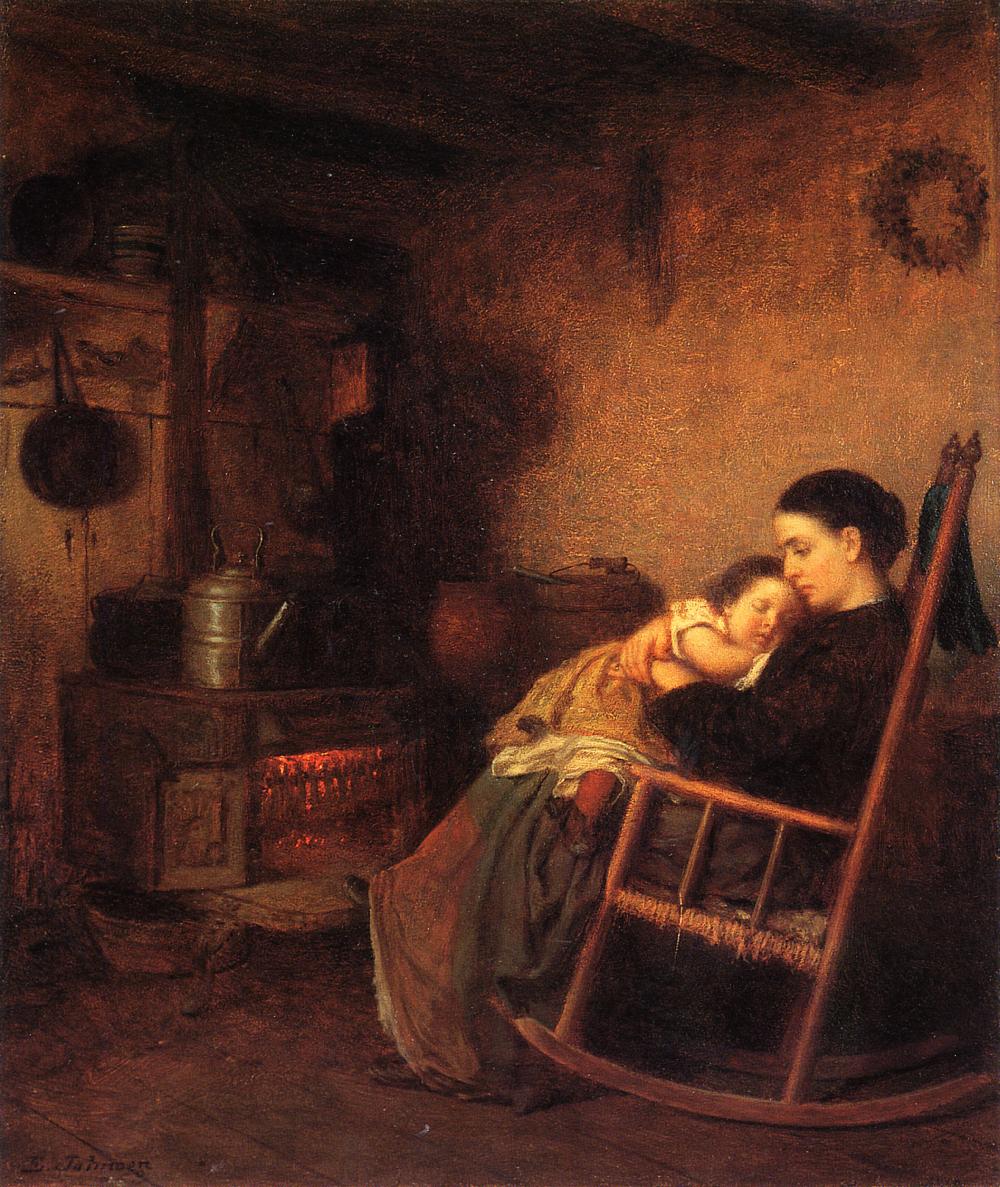
Eastman Johnson (1824–1906) stands as one of the foremost American painters of the 19th century, a central figure in the tradition of American Realism. Trained in Europe, including a period in Düsseldorf and time in the Netherlands studying the Dutch Old Masters, he returned to the United States with a sophisticated eye for light, texture, and the poetry of everyday life. He became celebrated for genre scenes that captured authentic American experience with empathy and psychological depth, from Civil War subjects to intimate domestic interiors.
“Mother and Child “exemplifies Johnson’s realist sensibility. Unlike his European contemporaries, who often idealized their subjects through mythological allusion or classical styling, Johnson favored honesty: modest clothing, rustic or shadowed domestic settings, figures who look as though they have simply been caught in a private moment. Attention to the fall of light and the texture of fabric gives his work a tangible, lived-in quality. This painting, from 1869, shows a mother and child in real time. It is frequently associated with depictions of his wife, Elizabeth, and scenes drawn from his own family life.
Johnson trusted that restraint could say more than grandeur ever could. The love between mother and child is rendered through simple details: a comforting posture, a downward glance, the stillness of a sleeping child held close. It is affection as it actually exists, unperformed, undramatic, and all the more moving for it.
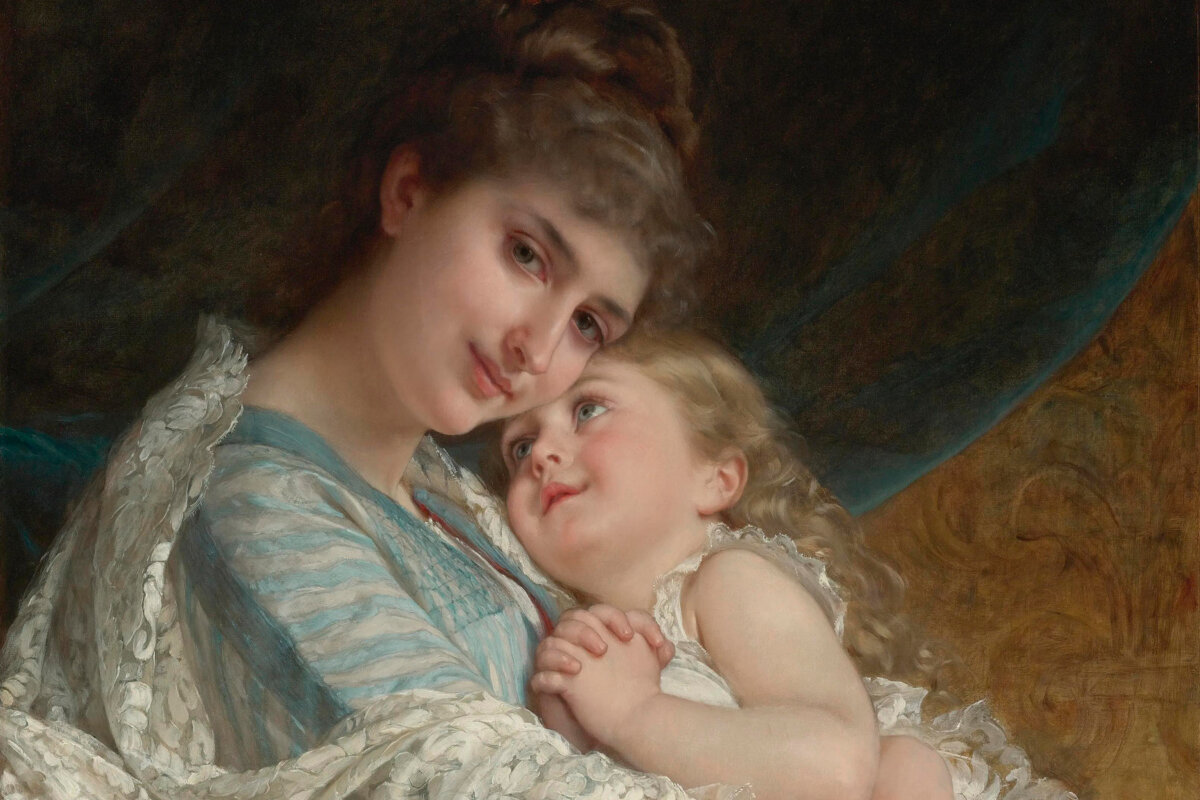
‘A Tender Embrace’
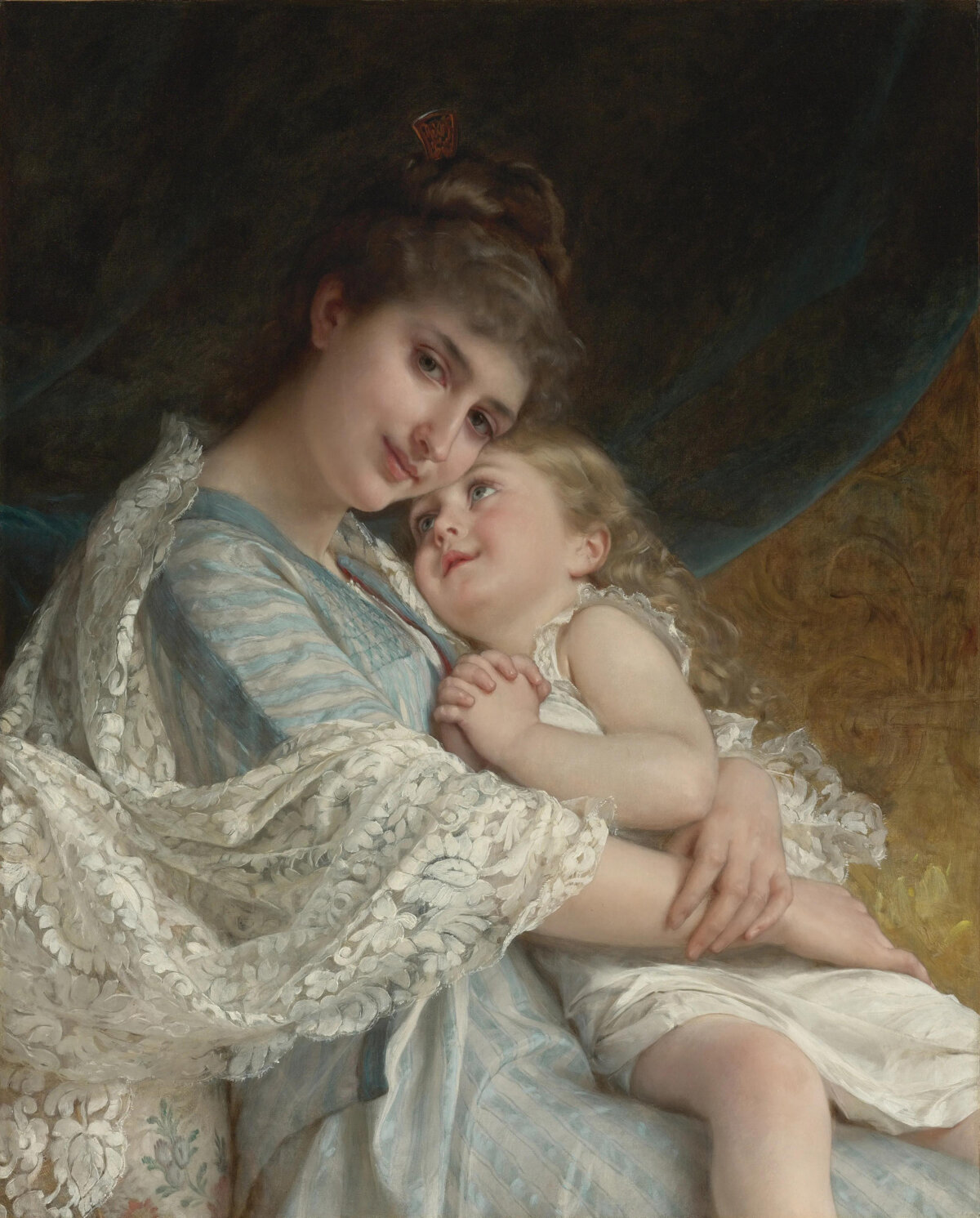
Emile Munier (1840–1895) was a French academic painter whose career unfolded very much in the orbit of William-Adolphe Bouguereau. A close friend and student of his at the École des Beaux-Arts, Munier absorbed the elder painter’s technical ideals: smooth brushwork, carefully balanced compositions, and emphasis on beauty. Munier earned three medals at the Beaux-Arts during the 1860s and exhibited at the Paris Salon from 1869, establishing himself as a skilled and warmly received practitioner of academic painting. He continued producing sentimental genre paintings until his death in 1895.
Munier found his greatest inspiration close to home, in the lives of his own children. His son, Henri, and daughter, Marie-Louise, served as his principal models, with Marie-Louise appearing in several of his most celebrated canvases. Comparing “A Tender Embrace” to Munier’s other works, the little girl appears to be Marie-Louise herself. Whether painting from imagination or from life, Munier’s 1887 canvas carries the warmth of genuine lived experience that can only come from painting those you love.
What arts and culture topics would you like us to cover? Please email ideas or feedback to features@epochtimes.nyc.