In his short story “A Piece of String,” Guy de Maupassant contemplates the great human fault of following one’s emotions or worrying about what others think. He demonstrates the great evil that can be done when one suffers from the prejudiced, unbending opinions of others.
A Piece of String
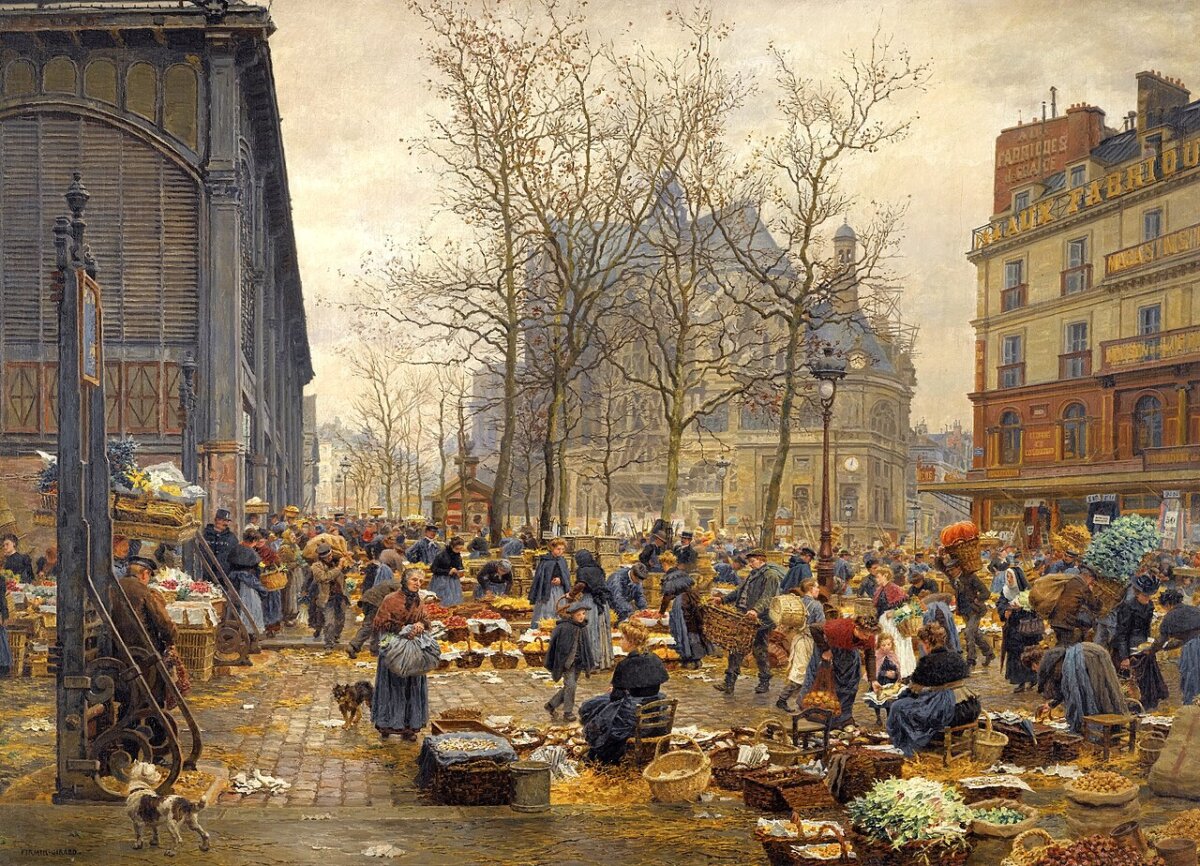
It is market day in Goderville, and Maitre Hauchcorne of Breaute makes his way into town. As he walks along, he notices a piece of string in the road and, “economical like a true Norman,” picks it up.
However, as he picks it up, he looks up to find Maitre Malandain watching him from the threshold of his door. He and Malandain never got along, so Hauchcorne grows nervous that his enemy should see him so cheap as to pick up a piece of string.
Hauchcorne fumbles with the string, trying to put it in his pocket. Having stowed it, Hauchcorne stays bent over and looks at the ground, pretending to look for something he dropped. Not finding the non-existent item, Hauchcorne proceeds into town, glad to be rid of his enemy.
After walking around the market, he finds a table at Jourdain’s, where he rests and enjoys some brandy. While he sits in Jourdain’s, the public crier arrives in the square and announces that Maitre Fortune Houlbreque of Manneville has lost his black pocketbook. If the pocketbook should be found and returned, the crier announces that there will be a reward of 20 francs.
With the announcement complete, people in Jourdain’s resume their meals and conversations. However, Hauchcorne’s peace is soon interrupted by the chief of the gendarmes, who enters the tavern and asks for him. The chief then instructs Hauchcorne to accompany him to the mayor’s office.
A Piece of Evidence
In the mayor’s office, Hauchcorne is accused of taking Houlbreque’s black pocketbook from the road and failing to return it. Hauchcorne denies any such action, but his enemy Malandain is there, claiming he saw Hauchcorne pick up the pocketbook out of the road.
Hauchcorne is flabbergasted and then furious. He tells the mayor: “Ah, he saw me, the clodhopper, he saw me pick up this string here, M’sieu the Mayor.” To verify this claim, he produces the piece of string from his pocket.
Unfortunately, everyone finds his story of the string to be ridiculous and refuse to believe him. They then search Hauchcorne, but, since they fail to find the pocketbook on him, they set him free. Slightly relieved, Hauchcorne grows ecstatic when he hears the next day that someone else found the black pocketbook in the road and returned it to its owner.
Hauchcorne goes around telling the story of how he was misunderstood, declaring his innocence repeatedly. Unfortunately, the more he tells the story, the more he finds that people don’t believe him.
Through this story, Maupassant cautions the reader against believing anything without substantial evidence. For, as in the case of Hauchcorne, no one bothered to question the evidence, who gave the evidence, and whether or not Hauchcorne might, in fact, be innocent.
The story also cautions against worrying too much about what others think, especially when they are wrong.
Charles Dickens wisely advises us in “Great Expectations” when he says: “Take nothing on its looks; take everything on evidence. There’s no better rule.”
Looks can be deceiving, and we should always be critical of evidence (which is often misunderstood or skewed) before we accept it as fact. We should search for truth, rather than follow the one’s or others’ emotions. For truth means freedom for everyone.
What arts and culture topics would you like us to cover? Please email ideas or feedback to features@epochtimes.nyc.