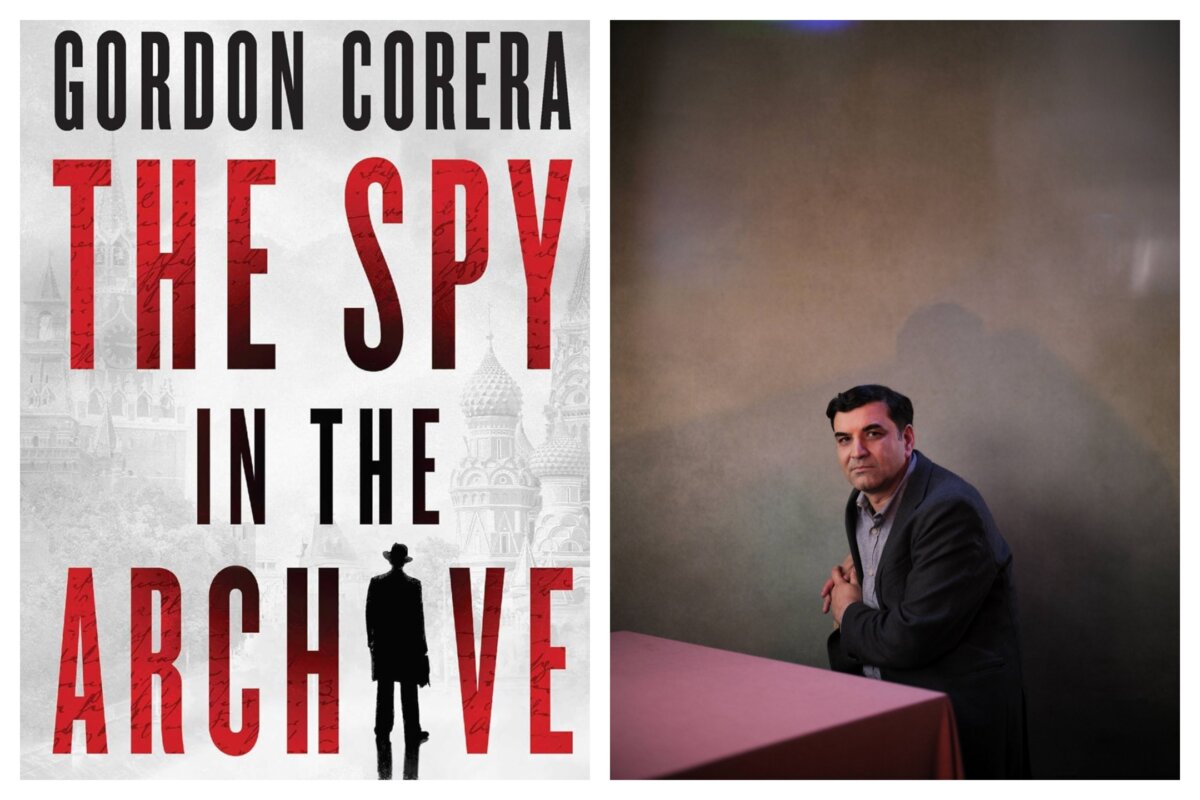
For decades during the Cold War, Vasili Mitrokhin despised the subject of his work: the KGB. It didn’t matter that he was a member of that Soviet organization. Maybe being part of it made his disdain for the KGB all the more visceral. This hatred by the inside man is the plot behind Gordon Corera’s new nonfiction book, “The Spy in the Archive: How One Man Tried to Kill the KGB.”
Corera describes a disheveled old man who finds himself in possession of volumes of state secrets. The accumulated volumes had been a labor of love—or hatred, depending on one’s perspective. The Cold War had pitted the USSR against the democracies of the West. Early on, Mitrokhin had believed in the Soviet way of life, undergirded by the socio-political doctrine of Marxism. But, as Corera notes, it was Mitrokhin’s failure as a KGB agent that led him to uncover the corruption, brutality, deceptions, and, as Mitrokhin identified it, the “filth” of the KGB and the USSR’s communist leadership.
How did he uncover the truth? It was rather straightforward. His failure as a KGB agent led to his demotion and reassignment to the Soviet archives. But Mitrokhin was at home among the piles of papers. As he perused and organized these documents, the truth was soon revealed: The Soviet Union wasn’t a home; it was a prison. He became privy to past and present KGB operations abroad against adversaries, but more importantly, to KGB operations within Russia against its own people. He was now a witness to history, a dark history, and he found himself caught between living as if oblivious to the truth or doing something about it.
‘Culture of Denunciation’
Corera follows the story of Mitrokhin from his youth to his eventual defection. He started out a young believer in the Marxist doctrine and joined the KGB. But his fall within the organization led to his eventual disillusionment with the KGB and the Soviet way of life altogether.
The story isn’t told in chronological order. Corera gives background to the KGB, which began with Feliks Dzerzhinsky and his founding of the Cheka secret police. As the author indicates, although the organization’s name changed numerous times over the decades (including the current name, the Federal Security Service, FSB), “Chekism” has always been its foundation. He also gives the history of how Soviets ensured the people toed the party line through its secret police, but more instrumentally through its “culture of denunciation.”
“The most effective weapon of the Chekist was not the gun but denunciation,” Corera wrote, “the turning of the people against each other so neighbour could not trust neighbour, parents lived in fear of their own children, each required to inform on the other.”
For many young Soviets born into this society—including Mitrokhin—denunciation of one’s neighbor or relative was a noble act that ensured the stability and survival of the state. Corera notes how children were exposed to the propaganda story of young Pavlik, a boy killed for denouncing his family, which the story framed as an act of courage.
Mitrokhin, who eventually came to see the “culture of denunciation” for what it truly was, saw firsthand how the KGB succeeded in turning Russian society against itself, erecting a society founded on the basest survival instinct of fear rather than the most important of the virtues: courage.
The Unforgettable, Invisible Man
The author shows how Mitrokhin’s hatred for the KGB and Soviet culture reached a point where he chose to risk torture, imprisonment, and death in order to expose the truth. He started taking notes each day on all the documents he received, and began a decades-long effort to create his own archive of the KGB’s actions both within and outside of the Soviet Union. But what good is an archive that exposes the truth if it is never published? It was this question that led Mitrokhin to MI6, the British intelligence agency.
Corera’s book is an intimate look at what it took to pull off what seemed like an impossibility. In fact, the British and American intelligence agencies believed the offer of a Soviet exposé was too good to be true. How could the world’s most secret agency allow itself to be so deeply infiltrated and for so long? This process of proof and trust between Mitrokhin and the West is a major aspect of this intriguing story. For his part, Mitrokhin was able to accomplish the impossible simply by being a mere cog in the communist wheel. He was a person whose appearance and personality made him practically invisible.
“The Spy in the Archive” is a thrilling book that anyone interested in the Cold War or espionage, or simply acts of incredible courage, will find worthy of their time. For Cold War buffs, Mitrokhin’s name may be familiar, as the Russian archivist had those volumes published with the collaboration of Britain’s Christopher Andrew. Whether familiar or not, Corera has written a book that is nearly impossible to put down. Though the Soviets viewed him rather forgettable, Mitrokhin was anything but.
‘The Spy in the Archive: How One Man Tried to Kill the KGB‘
By Gordon Corera
Pegasus Books, Jan. 6, 2026
Hardcover; 336 pages
What arts and culture topics would you like us to cover? Please email ideas or feedback to features@epochtimes.nyc