



NR | 1h 35m | Drama, War, Mystery | 2026
The tagline for “American Solitaire” reads: “An American soldier struggling to make sense of civilian life is confronted with the complexities of gun violence in his hometown.”
This is unfortunate as it’s not indicative of the movie’s content. Depending on people’s opinions regarding gun violence and its causes, this could result in audiences either seeing the film or avoiding it for two very different, equally wrong reasons.
There is exactly one present-day civilian gunshot in the entire movie, and it is unheard and off-screen. In actuality, the movie is the latest entry in a long line of superb movies about military-based post-traumatic stress disorder (PTSD).

Some of the standout past PTSD titles include but are not limited to “The Deer Hunter” (1978), “Coming Home” (1978), “Born on the 4th of July” (1989), “In Country” (1989), “First Blood” (1982), “The Hurt Locker” (2008), “You Were Never Really Here” (2017), “Thank You for Your Service” (2017), and “American Sniper” (2014).
Although we don’t know it at first, the lead character, Alexander Slinger (Joshua Close), appears in the opening scene as a preteen, cleaning and assembling a semi-automatic weapon under his father’s supervision. Given the film’s timeline, it likely took place sometime in the early 1990s. This dialogue-free passage is indicative of the rest of the film.
Like the first version of “Jacob’s Ladder” (1990), “American Solitaire” relies heavily on flashbacks. However, while many movies employ this device as a patch for weak screenplays, these two films use it as unreliable narration.
Not Misdirection
Slinger isn’t unreliable because he’s trying to trick, lie to, or misdirect the audience; it’s rather because he can’t determine what’s going on inside his head. Is it recollection, dreams, code, or fantasy?
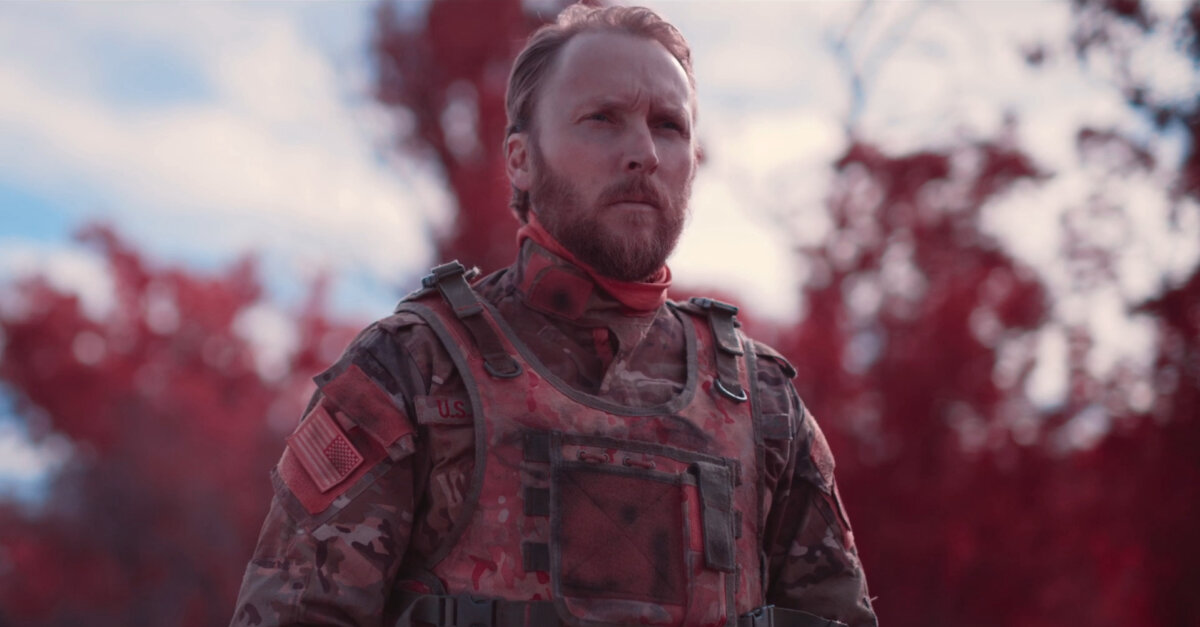
Sometimes it’s easy to tell the difference. For example, there are a handful of scenes in which all of the vegetation (likely set in Afghanistan) is bathed in vivid magenta.
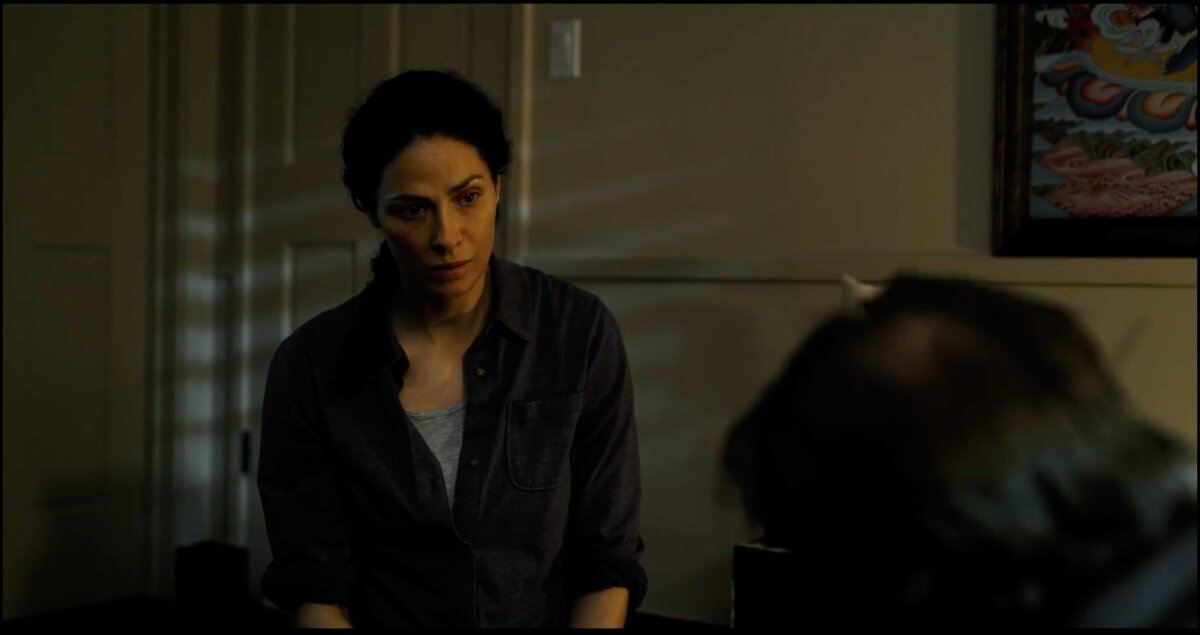
There are portions of the story we know are real and taking place in the present day, but not in chronological order. Slinger is renting a room in a home owned by Athena (Joanne Kelly), a CST member of the National Guard and former Middle Eastern-based soldier.
How the two met is never explained. It’s hinted that she regularly offers temporary housing to veterans “transitioning” from military to civilian life. It’s clear there is a mutual attraction between them. But it’s also something she will not permit to go further, and he doesn’t press the issue.
Slinger is divorced and has a son (Hudson Brooks as John) with whom he’s passive-aggressive. When they play a war-themed video game, Slinger is inordinately over-competitive to such a degree that he flies off the handle if he thinks he might lose. It doesn’t take a genius to determine that playing fake war games after recently being in a real war probably isn’t a good idea.
Ostensibly, Slinger’s lone port in the storm is his best friend Auggie (Gilbert Owuor), a man he served with in the war. At first, Auggie seems content and well-adjusted. He’s in a happy marriage and has a son, Emmett (Jamir Vega), who is the apple of his eye.
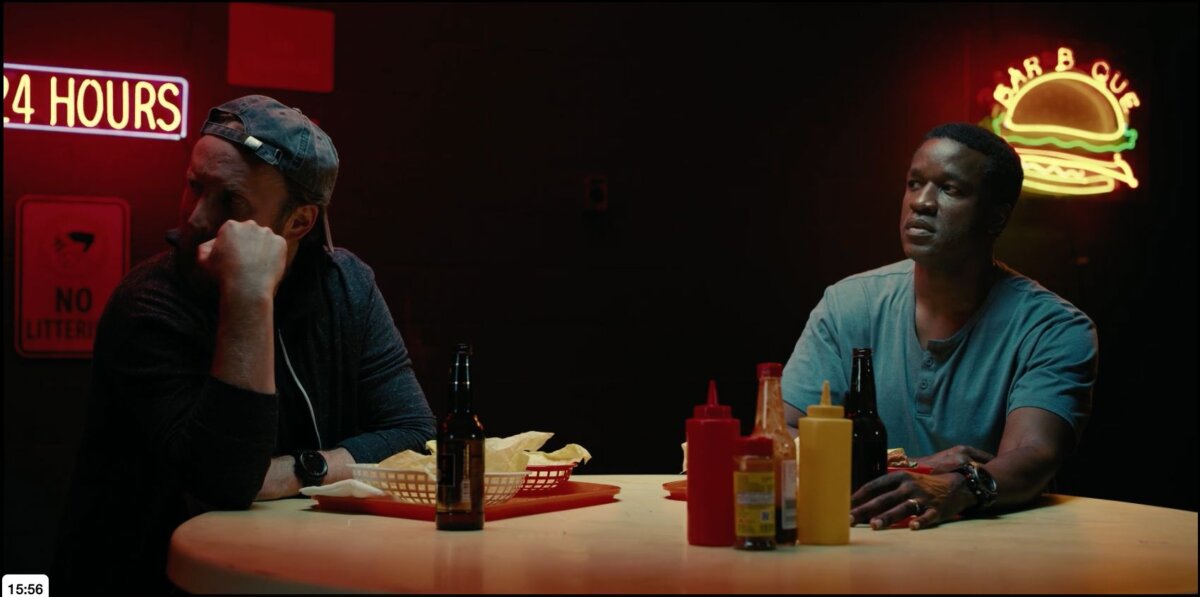
In a scene that follows, Auggie is morose and his marriage is on the rocks. Because these scenes are so close together, we get the feeling that Slinger imagines one or both of them. An event that proves to be the movie’s biggest plot twist soon follows, taking the narrative in a completely different direction.
See More Than Once
One viewing might not be enough. I was fortunate to receive a preview screener and had to watch it twice in order to have it all make sense. This isn’t a complaint—far from it—but rather a heartfelt compliment to writer and first-time feature director Aaron Davidman. I would much rather be challenged by a movie and view it twice to get its intended point than to watch another and figure out the ending halfway through.
My only complaint with “American Solitaire”—and it’s a big one—is with the final five minutes. Davidman gets quasi-political in a documentary-style manner; this has nothing to do with PTSD and is decidedly anti-Second Amendment. Without giving anything away, it is a literal interpretation of the Biblical “turning swords into plowshares.”
For 90 solid minutes, Davidman presents a complex and enlightening look into the psyches of men and women trained to kill the enemy who can’t instantly transform into well-balanced civilians free of lingering issues. To turn it into an anti-gun PSA at the finish line that has nothing to do with soldiers coping with the aftereffects of war borders on insulting to those who have served.
It’s an unfortunate ending to an otherwise remarkable and incisive movie.
The film opens in select theaters on April 17.
‘American Solitaire’
Director: Aaron Davidman
Stars: Joshua Close, Joanne Kelly, Gilbert Owuor, Jamir Vega
Running Time: 1 hour, 35 minutes
Not Rated
Release Date: April 17, 2026
Rating: 3 1/2 stars out of 5
What arts and culture topics would you like us to cover? Please email ideas or feedback to features@epochtimes.nyc
