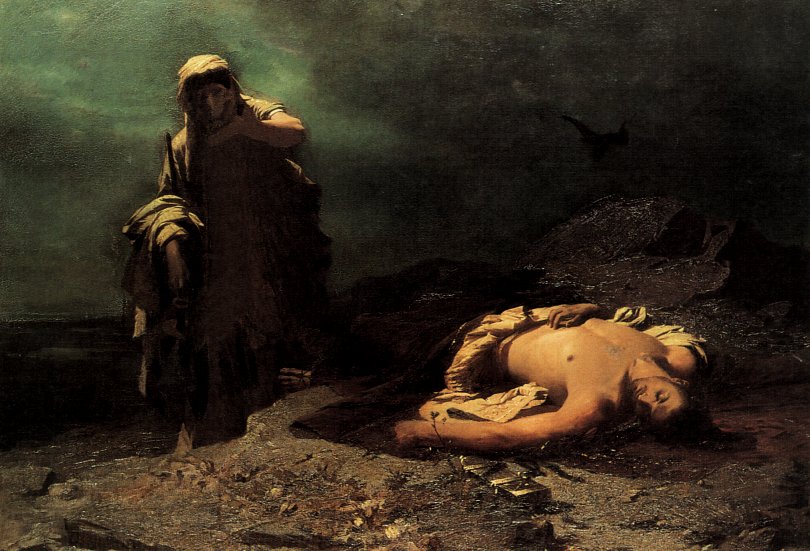
In around 440 B.C., the playwright Sophocles (496–406 B.C.) shook the Ancient Greek world with a play about a young girl who defied a power-loving tyrant. Over 2,000 years since its first live performance, “Antigone” remains one of the most provocative dramas in history, pushing readers to wrestle with fundamental questions about truth, love, and justice.
War and Piety in ‘Antigone’
When the Greek city state of Thebes collapses into chaos after the self-exile of its king, Oedipus, his two sons, Eteocles and Polynices, vie for the throne. They rally armies, fight, and kill each other in battle. Creon, their uncle, assumes the throne. The new king grants Eteocles an honorable burial but declares that Polynices is a traitor and should remain unburied: “It has been proclaimed throughout the city/ That no one shall mourn this man nor give him/ A proper burial. He should be left for all to see, unburied/ His body ripped to shreds by vultures and wild dogs.”
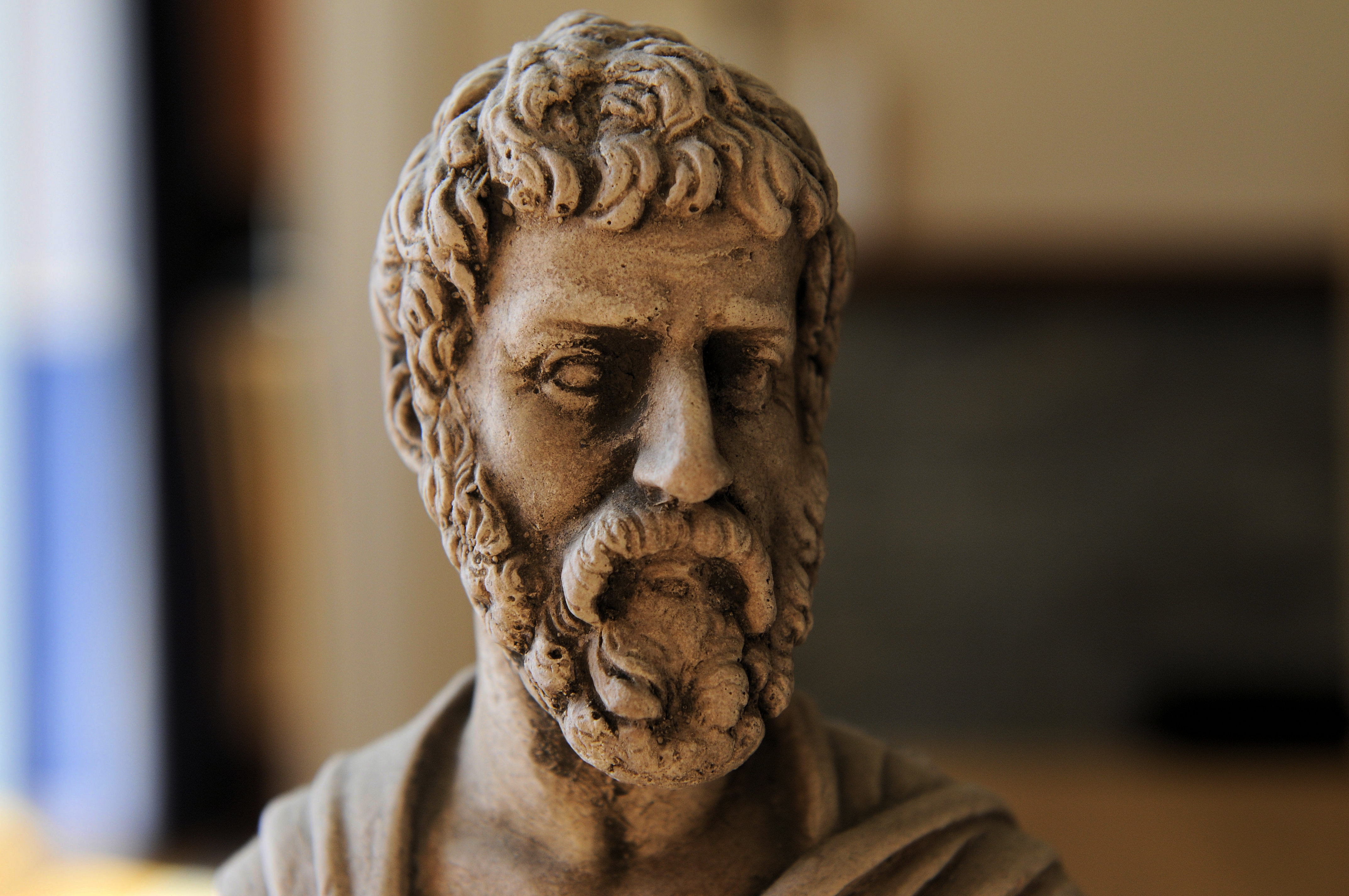 A bust of Sophocles. (sonofgroucho/flickr/CC-BY 2.0)
Ancient Greeks considered denying proper burial to the dead one of the worst possible punishments. A funeral marked one’s passage into the afterlife, where one’s soul could join friends and relatives. In addition to commemorating life and ensuring long-desired reunions after death, burial rites were also meant to extol the gods, who oversaw a soul’s post-mortem existence. The most stirring example of the Greeks’s need to bury loved ones is perhaps in Homer’s “Iliad.” At its conclusion, the defeated king of Troy, Priam, begs for his son’s mutilated body to entomb him as befits a prince.
Antigone’s Refusal
Creon adds a clause to his decree: Disobedience will be punished by death. Everyone acquiesces—everyone, that is, except for Antigone. Sister of Eteocles and Polynices, the young girl refuses to deny her brother a proper burial. Nothing is said about her view on Polynices’s role in the civil war. But she’s his sister, and she loves him dearly. For her, that’s enough to warrant equal treatment for both brothers.
Antigone opposes Creon’s decree by invoking the gods: “I didn’t think your decrees/ Were strong enough to outweigh/ The firm and unwritten laws of the gods.” This statement echoes a fundamental tension in Ancient Greek societies: between politics and religion. In Creon’s eyes, the law must always be obeyed. As he says, “There is no greater crime than disobedience.” Later, he confesses that he doesn’t want to offend the gods. His wish to assert his legal authority ultimately gets the best of his piety.
Unlike her uncle, Antigone doesn’t believe that state law is absolute. In her view, if it contradicts basic human intuitions sanctioned by tradition and divine authority, the law can be infringed. That’s especially true when the law corresponds to the will of one man with questionable motives. Like Antigone, Sophocles’s democracy-loving audience would have found Creon’s attempt to centralize power dubious, if not outright unjust.
The Prophecy
Convinced that she’s on the side of justice, Antigone secretly performs burial rites for Polynices. Creon realizes someone defied his orders. He wants to arrest the criminal to show the people of Thebes that affronts to his authority will have consequences. When a guard returns with his young niece, the king is appalled. Antigone confesses her disobedience unapologetically. Creon sentences her to death.
Tiresias, a seer, enters the scene. Ancient Greeks treated seers as interpreters of their gods’ intentions. Tiresias has been serving Thebes for generations, and his counsel is respected, even by Creon. He warns the king that the gods oppose his sentence, and that he’ll suffer greatly if he doesn’t change his mind. As Tiresias declares, “When a man does wrong, if he makes amends/ And moves forward after his mistake/ He is no longer unwise or unblessed.”
Creon has a chance to soften his iron fist, accept his power’s limits, and avoid catastrophe. But he still clings to his conviction, accusing the trusted seer of insanity and corruption.
When Tiresias leaves, Creon steps back and shares with the audience his predicament: “It would be/ A terrible thing to obey [Tiresias], but no more terrible/ Than to resist him.” He slowly comes around, and finally decides to obey Tiresias, free Antigone from jail, and reverse the course of events. But it’s a change of mind, not a change of heart. He fears that the gods might punish him and revoke his kingship. He says nothing about Antigone’s loyalty to her brother, let alone her righteousness in performing a funeral.
Alas, Creon’s reversal comes too late. Unwilling to succumb to an unjust man, Antigone has taken her life, as has Creon’s son, Haemon, who was engaged to her. After learning of her son’s death, Creon’s wife follows suit. In the final scene, Creon issues a remorseful proclamation of self-pity: “All the things I’ve got are at odds/ And an unbearable fate leaps upon my head!”
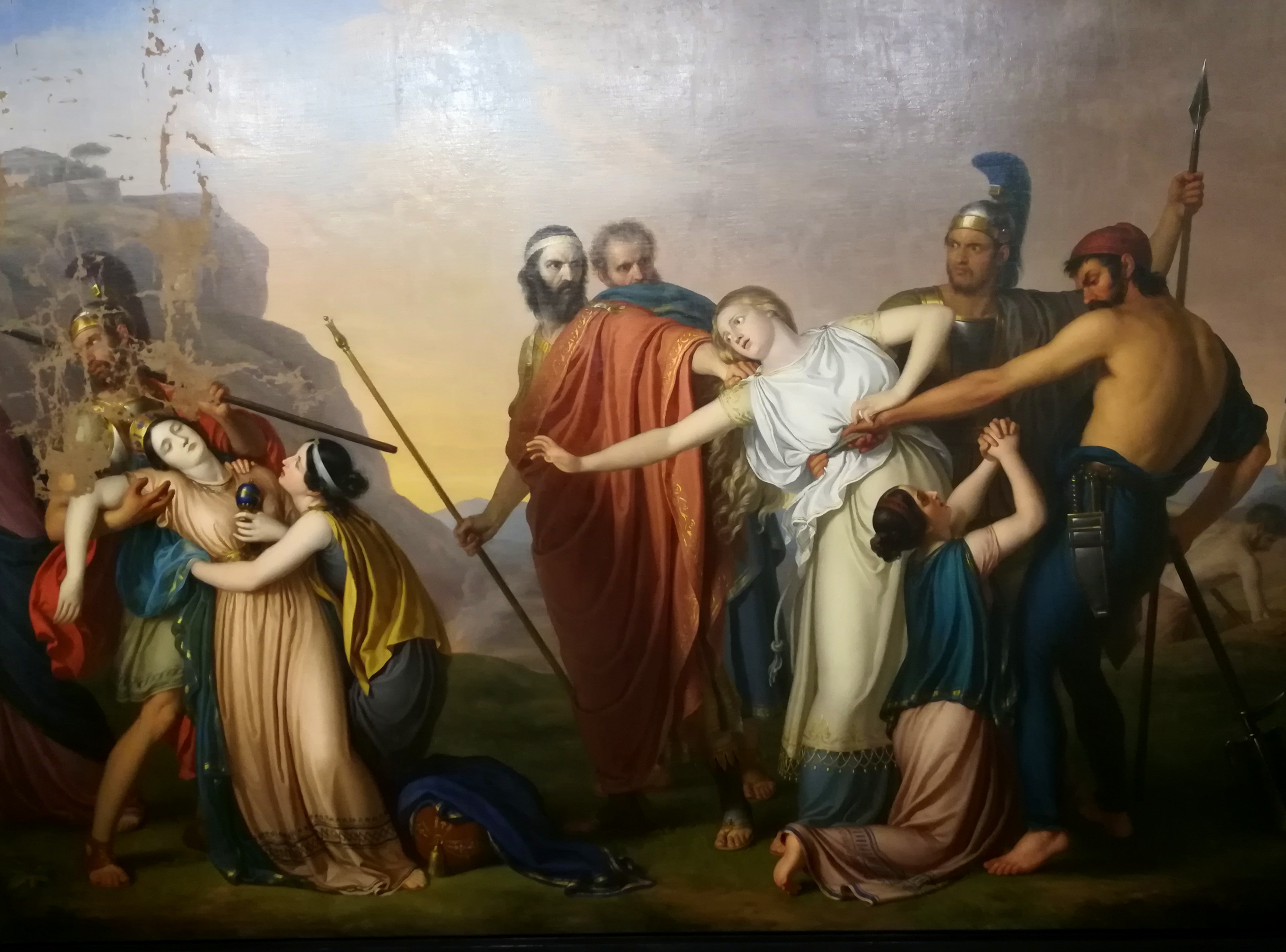 “Antigone Condemned to Death by Creon,” 1845, Giuseppe Diotti. Oil on canvas. (Public Domain)
Antigone’s Virtues
No new law or decree could change what Antigone always held to be true: that she loved her brother, that, as a sister, she must protect him, and that the dead deserve a proper burial. As professor of ancient Greek history Edmund Stewart noted, “Antigone’s actions do not arise from a fit of pique nor are they derived from some adolescent need to rebel against the rules.” Her motive is much nobler and her moral clarity exemplary. She’s unwilling to compromise her values and beliefs, and is ready to uphold them against a tyrant’s forceful threats.
To defend her beliefs, Antigone musters unwavering courage. She overcomes the fear of punishment and ultimately denies Creon the right to take her life. Although classical Greece was the cradle of democracy, it never endorsed the political equality of the sexes. That a young, unmarried girl should publicly challenge a monarch no one had the nerve to provoke must have been a radical statement for a Greek audience.
Sophocles managed to envelop her devotion to her brother in a statement about the value of democracy, the Greeks’s sacrosanct political ideal, making the mythical heroine a controversial but fascinating character for theatergoers and readers alike.
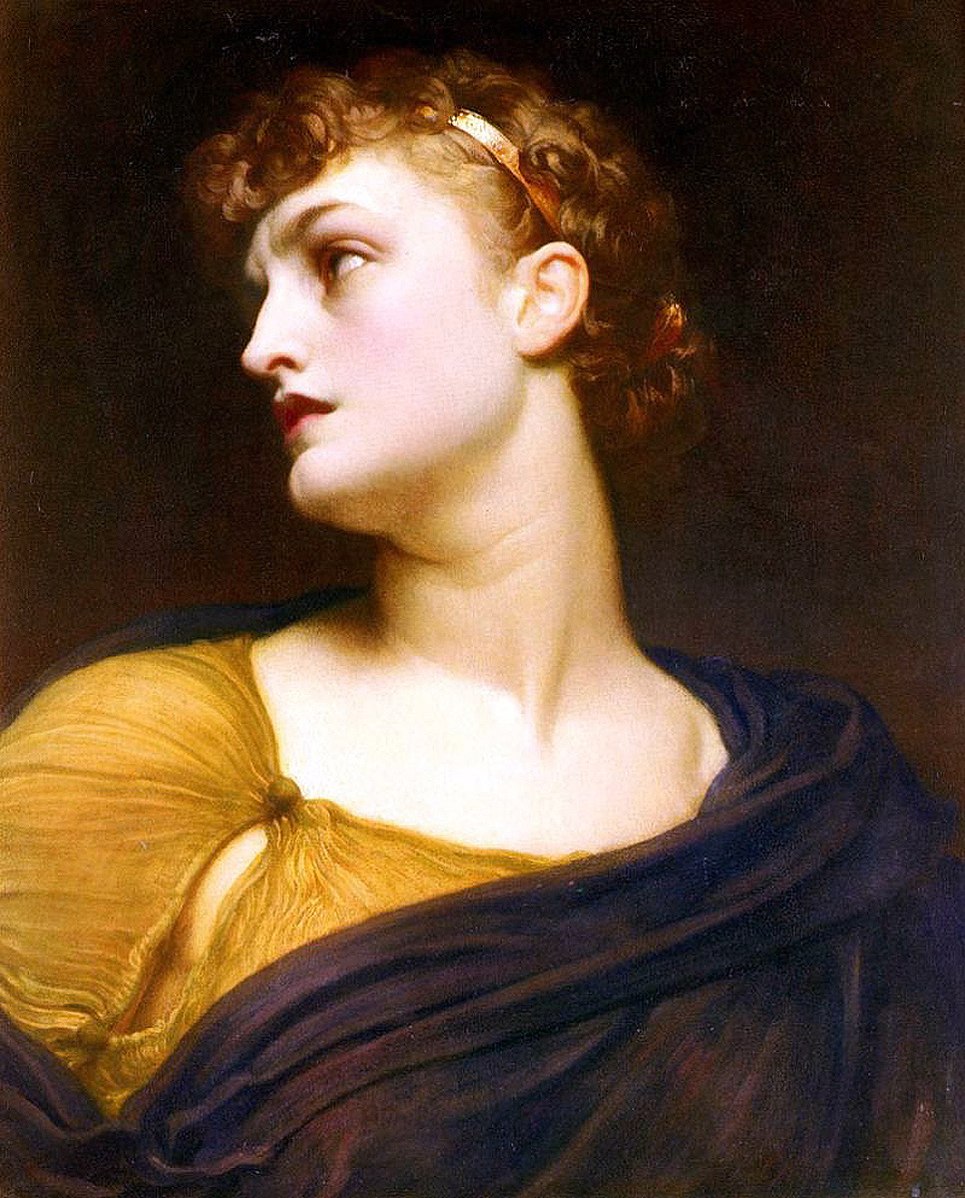 “Antigone,” 1882, Frederic Leighton. Oil on canvas; 23 inches by 19 3/5 inches. (Public Domain)
The Lonesome Tyrant
One of the play’s most chilling aspects is the silence that surrounds Creon. The people around him are either unwilling to speak up or hushed by his aggressive reminders that dissent will result in death. His decisions are questioned, but he refuses to fully consider his interlocutors’ views.
Tiresias is accused and sent off, while Thebes’s council of elders agree to Creon’s angry imperatives. Even Haemon cautiously tries to persuade him that the Thebans pity Antigone, and that the death penalty is far too harsh a punishment. Creon brushes off his concerns. “Will the city now be telling me how to rule?” he asks proudly. His son reminds him that he’s speaking selfishly, as someone who thinks his judgment is absolute and who wants to “walk all over the gods.”
The king chooses to quash dissent by force, but he doesn’t acknowledge that free and honest expression is essential to understanding whether his choices are really as good as he thinks. When ideas can’t be expressed without violent repercussions, those wielding power become blind, until they destroy themselves and everything around them.
Much Worth Living For
In 1977, Natan Sharansky was abducted by the Soviet KGB for leaking top-secret information to U.S. authorities. Sharansky spent most of his time in Moscow’s grim Lefortovo jail reading books from the extensive library that imprisoned intellectuals had been able to compile. His memoir describes the inspiration he felt reading ancient texts. Among the figures that most encouraged him was Antigone. Sharansky reflected:
“Pressed by fate, [Antigone] refused to violate the basic, eternal values, and saw her mission as bringing love, not hate. … All of these characters, it seemed to me, hurried towards me from various countries and across the centuries. ‘You see,’ they told me, ‘there is nothing new in this world of ours. But how much there is worth living for—and if necessary, worth dying for as well.’”
What arts and culture topics would you like us to cover? Please email ideas or feedback to features@epochtimes.nyc