



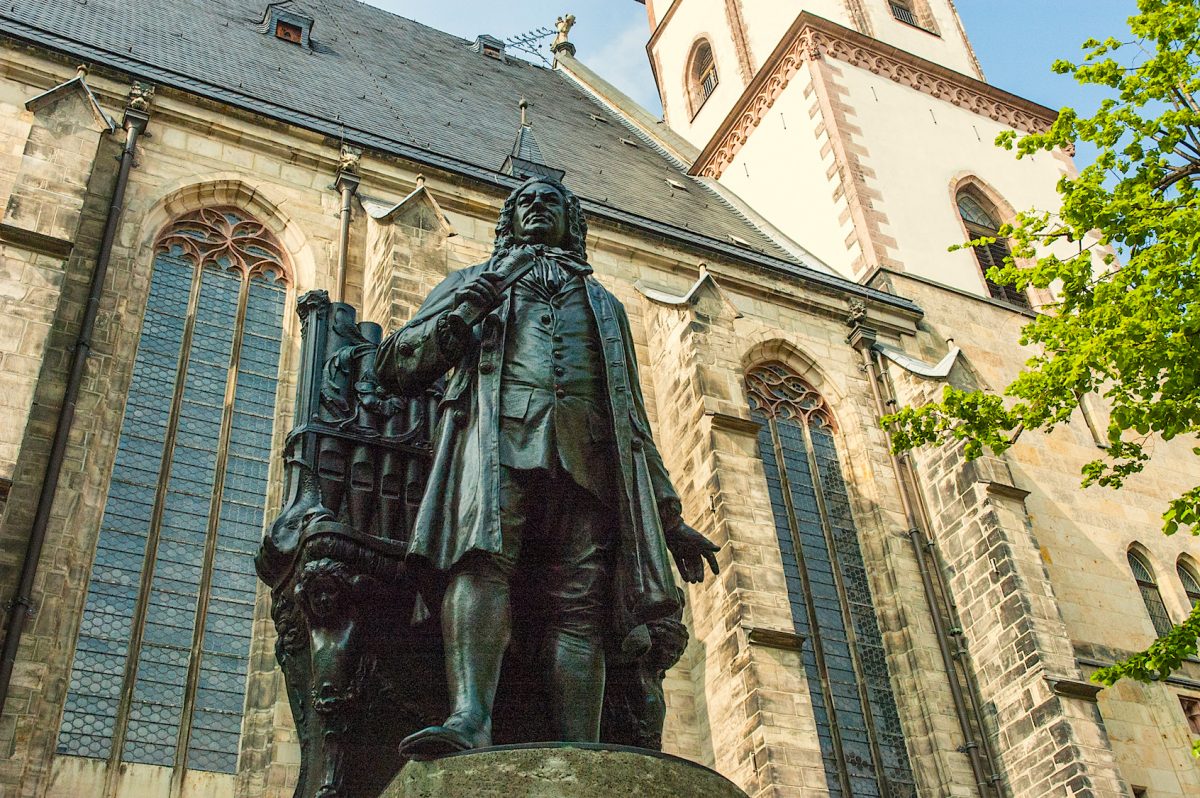
The genius of Bach is also the mystery of Bach. Johann Sebastian Bach left behind no personal letters that shed light on his private life and no diary that explains his process of composing.
Historians continue to search his works for hidden meaning, though. Sometimes it’s numerical, other times theological. But do these findings really convey secret significance, or are they just the imaginary conjectures of theorists?
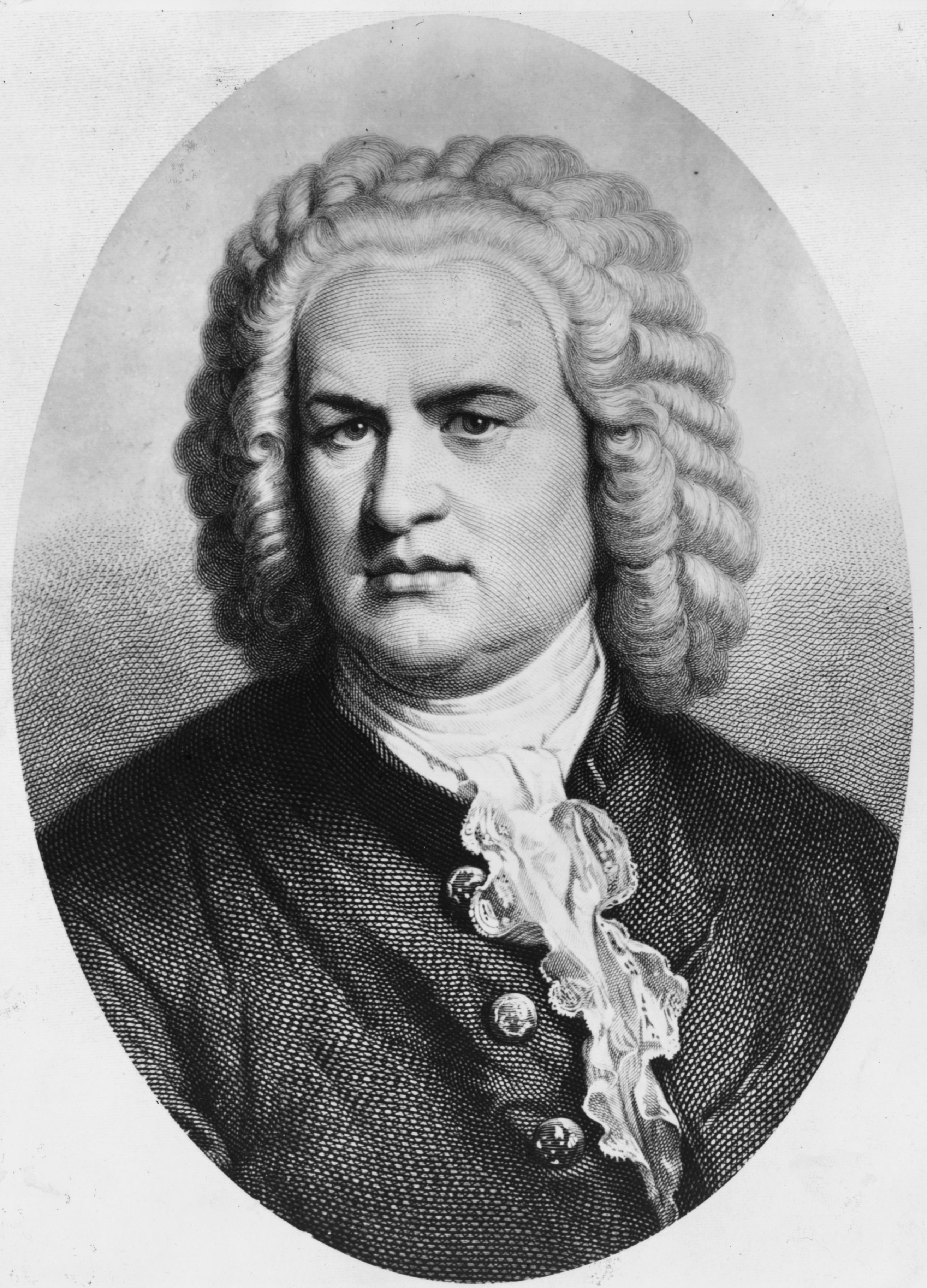 Circa 1722, German organist and baroque composer, Johann Sebastian Bach (1685-1750). (Hulton Archive/Getty Images)
A Birthday Song for the Duke
As a young man, Bach served as a court organist for Duke Wilhelm Ernst of Saxe-Weimar. When the Duke turned 52 in 1713, Bach composed an aria for his birthday. This piece, BWV 1127, contains a recurring base theme with 52 notes, in honor of his patron.
To add to the hidden references, the first letter of the third word in the second line of each stanza, when put together, spells the duke’s name.
Miraculously, this clever composition was unknown until 2005, when a researcher discovered it in a box of documents from Anna Amalia Library in Weimar, Germany.
Ten Commandments, 10 Melodies
In the opening chorus of Cantata 77, Bach incorporates a work by Martin Luther, “Dies sind die heil’gen zehn Gebot” (“These are the holy Ten Commandments”), in a way that many have interpreted as theologically symbolic.
Here, a trumpet enters 10 times, playing 10 distinct musical phrases from the hymn, each representing a commandment. The chorus’s title, “Du sollt Gott, deinen Herren, lieben” (“You shall love God, your Lord”), is taken from the Gospel of St. Luke, as is the text that the choir sings.
The trumpet symbolizes Old Testament law, framing the chorus’s New Testament command to love God and neighbor.
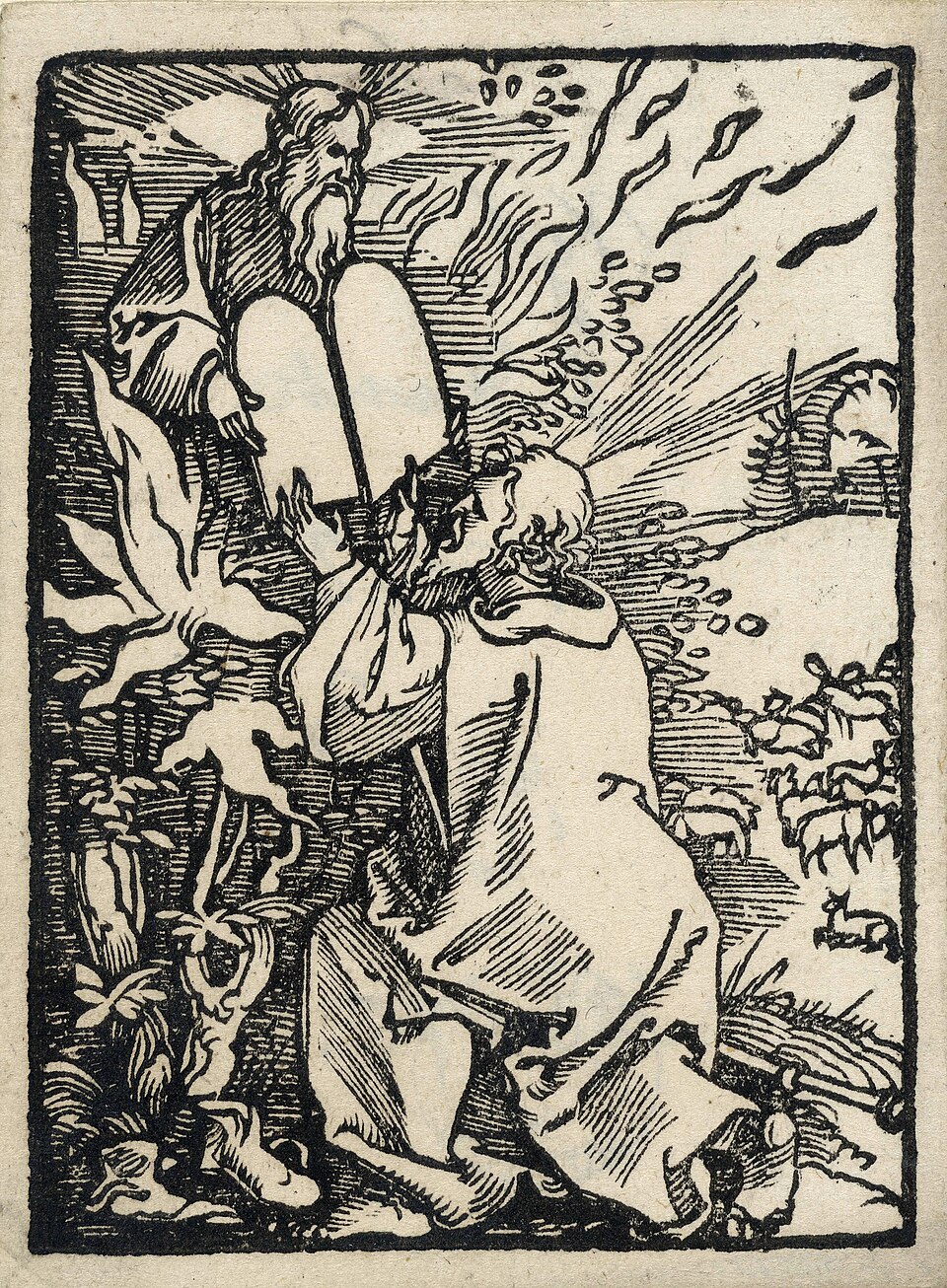 A 1527 woodcut by Hans Sebold Beham depicts Moses receiving the Ten Commandments from Martin Luther’s prayer book. (Public Domain)
The Trinity
Many have noted special symbolism in Bach’s Prelude and Fugue in E-flat major (BWV 552), which serves as the opening and closing movements of his “Clavier-Ubung III,” or German Organ Mass. According to organist virtuoso and Nobel laureate Albert Schweitzer, the work’s triple fugue is “a symbol of the Trinity.”
Schweitzer noted that “the first fugue is calm and majestic,” with “uniform” movement representing the Father. The second fugue disguises the theme, which is “only occasionally recognizable in its true shape, as if to suggest the divine assumption of an earthly form”—the Son. In the third fugue, the theme is transformed through rapid counterpoint. The themes overlap as the work progresses, suggesting the merging of Father and Son in Holy Ghost.
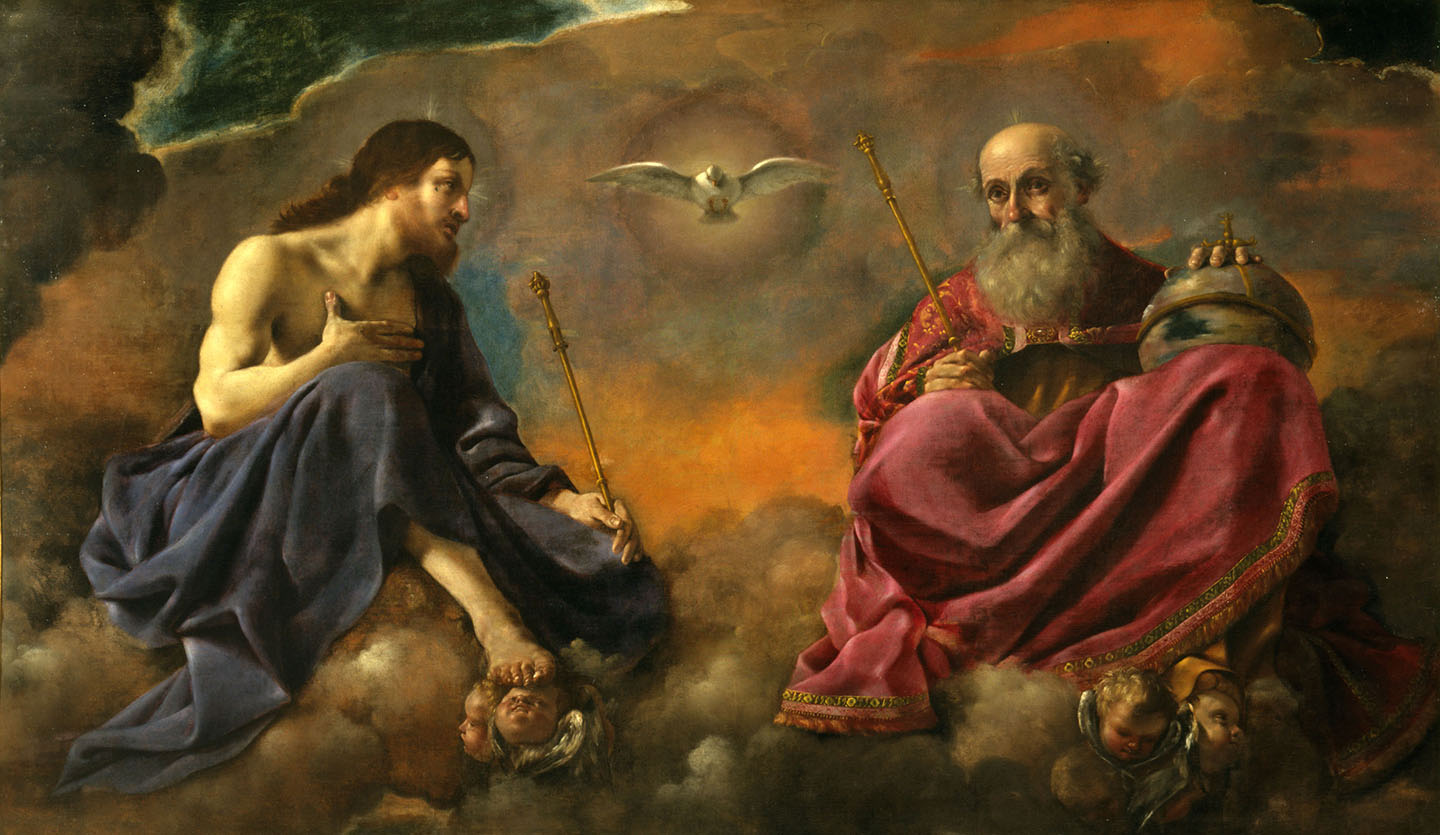 “The Trinity,” circa 1616–1617, by Giovanni Francesco Barbieri. (Public Domain)
A Symbol of the Cross
The set of pieces making up “The Well-Tempered Clavier” contains, among them, the five-voice Fugue in C-sharp minor (BWV 849). It features two melodic lines moving in opposite directions, then meeting to form a cross. The visual contour of this “cross motif” on the staff is matched by its dissonant tone, conveying a state of anguish. This musical motif also occurs in the “St. Matthew’s Passion,” specifically in the chorus, “Let him be crucified.”
A Name of Mystical Significance
Our last numerical occurrence is the most extraordinary of all.
When the letters, B A C H, are converted into numbers corresponding to the alphabet (A=1, B=2, C=3, H=8), the sum adds up to 14. “J.S. BACH” has a numerical value of 41.
These numbers recur as a cryptogram throughout Bach’s works. In several pieces, such as the Brandenburg Concerto No. 2 (BWV 1047) and the Sinfonia in F minor (BWV 795), his name occurs as a musical signature, with B-flat standing for the letter B and B-natural standing for H.
In 1726, he began publishing the Six Partitas making up the first part of his “Clavier-Ubung.” He was 41 years old, and the work contains 41 movements.
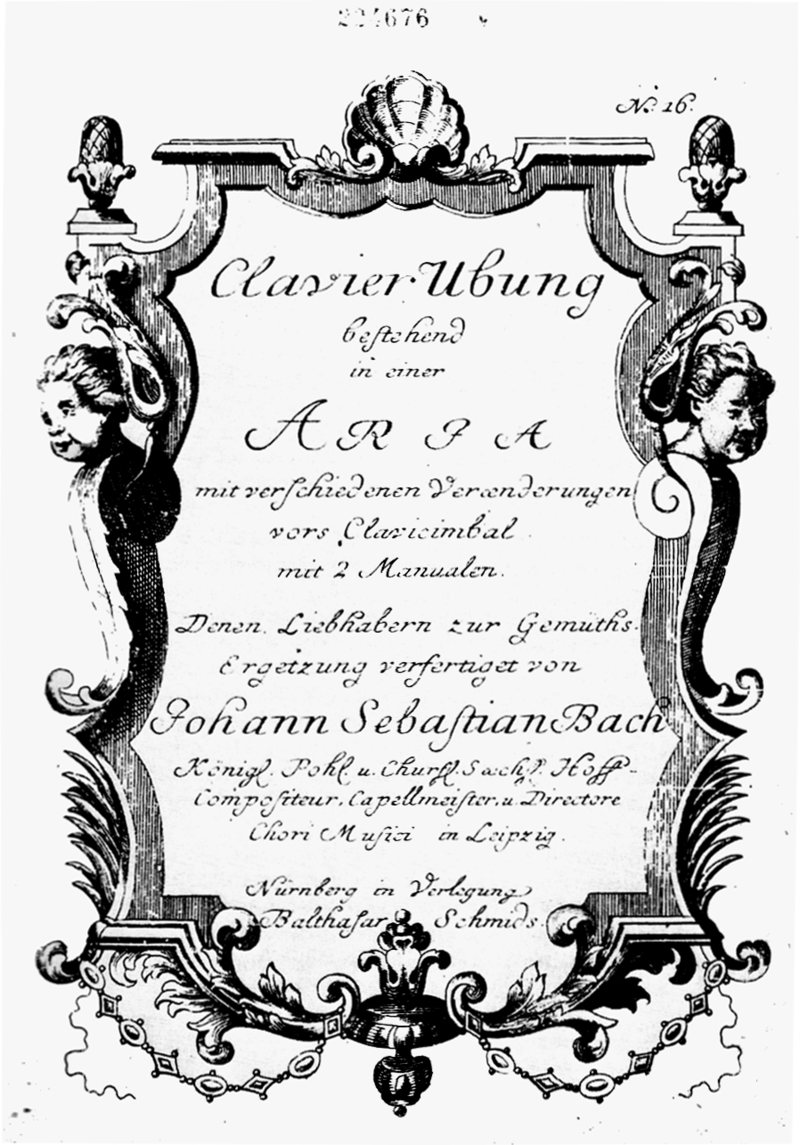 Title page of the “Goldberg Variations” by Johann Sebastian Bach. (Public Domain)
The numerology appears with dizzying complexity in “The Art of Fugue.” In his book “Rethinking J.S. Bach’s ‘The Art of Fugue,’” scholar Anatoly Milka observed something remarkable: The two original manuscript pages of Fugue IV, when laid out together, create a visual effect similar to an ambigram, a type of puzzle that takes on a different meaning when viewed from different perspectives.
First, the main theme of the collection, appearing here for the first time as a melody, has 14 notes. Additionally, Milka discovered that when the two pages are read as if the score were written in landscape layout, what is traditionally read as bar 41 becomes bar 14. What is more, there are 14 notes in this bar, and the letter names in the first notes in the top part of the bar spell B A C H.
Is all this a coincidence? Milka acknowledged the possibility, but went on to say that “it does seem in this case there are simply too many signs, accumulated in one spot, to be considered as created by chance.”
Though no one disputes the importance of these numbers to Bach, questions remain as to what they mean. For some, they are merely a playful little puzzle he incorporated into his works.
But for historian Hans Heinrich Eggebrecht, Bach’s self-inclusion within his own music has cosmic importance. Eggebrecht notes the connection between the B A C H theme as it reappears in the final movement of “The Art of Fugue” and the work’s unfinished nature, as it was written as the composer was dying.
“Only someone with the heart of Bach would, in the face of death, dare to place his ‘I’ as representative of the center of a universal development,” Eggebrecht wrote in Fidelio magazine.
He further identified the tonic key of D-minor that anchors the work with God (Deo). He saw Bach as striving toward a union with his maker.
Enter the Skeptics
Beyond examples with a specific musical purpose, such as the Duke of Weimar’s birthday, claims of deeper symbolism in the composer’s works are often dismissed by critics.
Historian Peter Williams wrote in his biography on Bach, “What will never be free from doubt is whether any such instance is significant and what exactly the significance might be.”
Williams contends that the cross motif is simply a coincidence representing a common combination of notes, and that melodies of the Ten Commandments in Cantata No. 77 represent a “simple allusion … not subtle tokens of theology.”
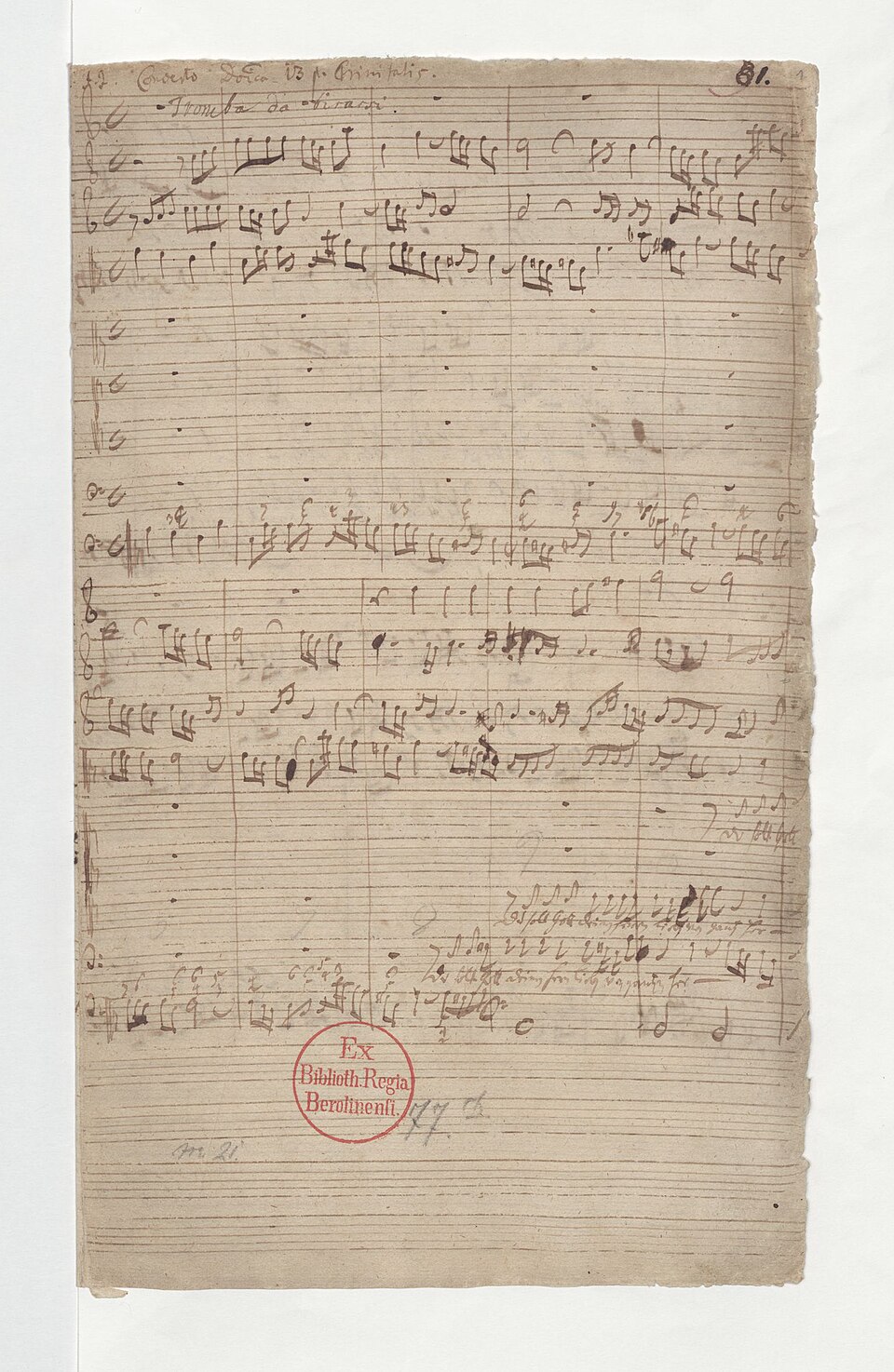 The autograph manuscript of the opening chorus of the 1723 cantata “Du sollt Gott, deinen Herren, lieben” (BWV 77) by Johann Sebastian Bach. (Public Domain)
Absence of proof isn’t proof of absence, though. Perhaps the most fantastic conjecture of all is that Bach—a deeply religious person who obviously delighted in number games and puzzles—never patterned his music in symbolic ways at all.
“Exactly what the significance might be” seems rather obvious: Bach wanted to praise God through music and structured his compositions in deep ways to achieve this. He did more than hide meaning in music. He gave music meaning.
What arts and culture topics would you like us to cover? Please email ideas or feedback to features@epochtimes.nyc
