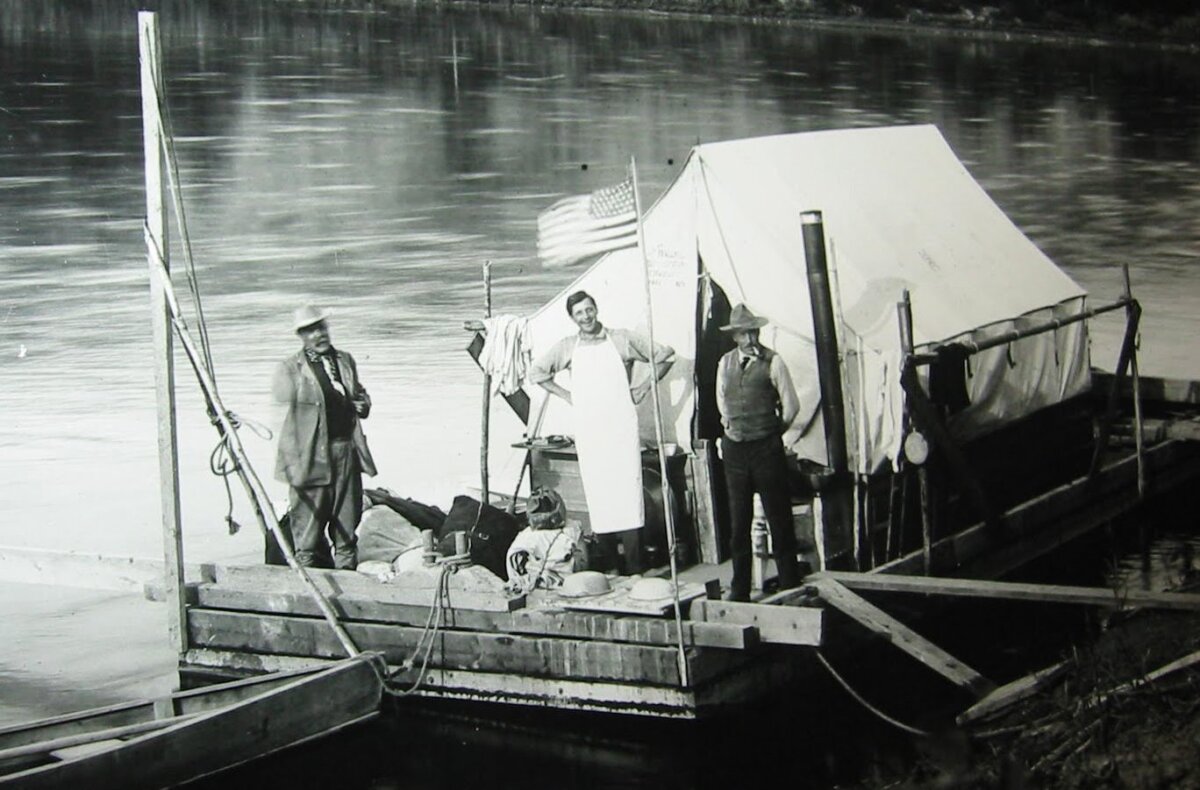
Barnum Brown (1873–1963) found himself holding tightly to a wooden barrel along the coast of South America’s Patagonia region. He couldn’t swim, and the barrel was the only thing keeping him alive after his shipwreck.
The 25-year-old paleontologist had only recently graduated from the University of Kansas and immediately took a job with the American Museum of Natural History (AMNH) in New York City. He also began graduate studies at Columbia University, which he never finished. Much like the barrel that rendered his inability to swim irrelevant, Brown’s determination and nose for discovery made his educational shortcomings unimportant. Brown’s success was based on a potent mix of skill, perseverance, and luck.
An Early Start
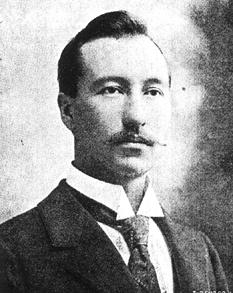
Brown was born in Carbondale, Kansas, in 1873, and began collecting fossils at a young age. He ventured through the area of eastern Kansas, digging in strip-mined areas and sifting through plowed fields. He collected fossils by the pocketful.
“I followed the plows and scrapers, and obtained such a large collection that it filled all of the bureau drawers and boxes until one could scarcely move,” he noted. “Finally Mother compelled me to move the collection into the laundry house.”
During his undergraduate years at the University of Kansas, he joined paleontological classes on trips to eastern Wyoming and the Badlands of South Dakota. He joined the AMNH during the summer of 1896 to visit and dig for fossils in Wyoming’s Bighorn Basin, and much further south in New Mexico’s San Juan Basin. The AMNH, impressed by his skills and work ethic, hired him to join its department of vertebrate paleontology.
A Grand Opportunity
By the time he graduated in 1897, Brown had already requested to join an international expedition to Patagonia. It was not until a year and a half later, having been with the AMNH’s department for some time, that he was called into the office of Henry Fairfield Osborn, head of the department, on a cold December morning. Osborn had a request that Brown had been waiting for.
“Brown, I want you to go to Patagonia today with the Princeton expedition,” Osborn said.
It was 9 a.m. and the boat was scheduled to leave at 11 a.m. Brown acknowledged the rather short notice, but promised he would be on the boat before it left. He would be the museum’s sole representative, and it was the first time he would be out of the country.
It took a month to arrive on the Chilean coast, and the two scientists from Princeton, who were part of the expedition, left shortly after arriving, having completed their work. Brown remained, undaunted, and excavated for another year. Part of his adventures involved a wave capsizing his skiff, leaving him holding a barrel until he reached safety.
By the end of his efforts in Patagonia, he shipped about 4.5 tons of fossils back to New York.
Finding T. rex
It was only a few years later that Brown made his most significant—and arguably most celebrated—discovery.
In the summer of 1902, he excavated at Hell Creek, Montana, in an area that dated back about 66 million years ago to the Late Cretaceous period. He’d had minimal success digging for fossils, but he was soon intrigued by a formation in Hell Creek. It was a sandstone hill that he believed held promising fossils. He struggled to break through the layers, so he took a rather drastic measure and purchased dynamite.
The dynamite did the trick. By the time the dust settled, he could see the outline of a connected fossil, which included “the femur, pubes, [partial] humerus, three vertebrae, and two undetermined bones of a large Carnivorous Dinosaur not described by [Othniel] Marsh [the leading paleontologist working at Yale University],” he wrote. “I have never seen anything like it.”
No one had ever seen one like it. Brown uncovered the first specimen of what would become the most famous dinosaur: Tyrannosaurus rex. It took several months of difficult excavation, but by October 1902, he and his team had freed the last of the dinosaur skeleton. The skeleton was eventually sold to the Carnegie Museum of Natural History in Pittsburgh in 1941.
That excavation season had proved an immense success, and not just because of the new find. He shipped about 7.5 tons of fossils to the AMNH, which included the skeletons of a Champsosaurus and a Triceratops that, according to historian David Randall, “still stand on the floor of the American Museum.”
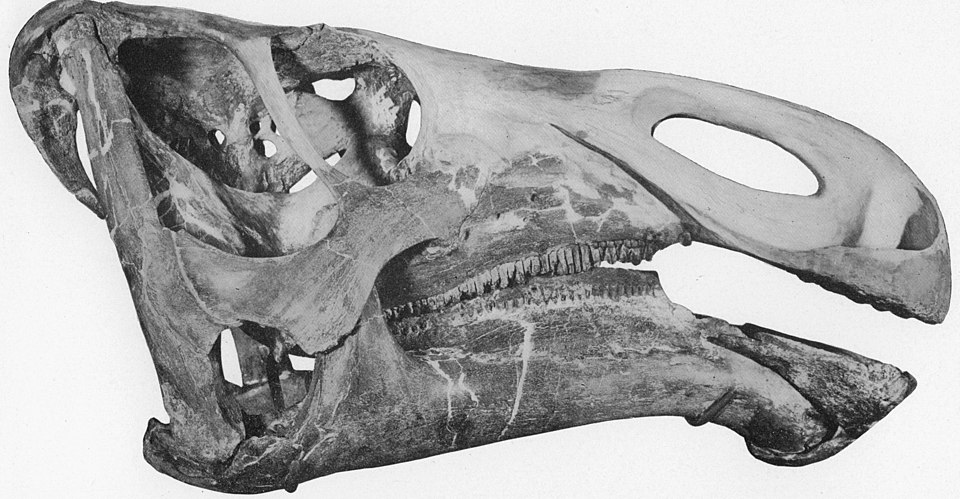
A few years later, Brown discovered another Tyrannosaurus rex in Montana’s Big Dry Creek. This specimen was even more impressive than the first since it included a perfectly intact skull. This particular T. rex remains on display at the AMNH.
His Greatest Find
During these discoveries, he was the museum’s assistant curator of vertebrate paleontology. In 1910, he was promoted to associate curator, a position he held until 1926. In 1927, he was promoted to curator. He held this position for 15 years, and became curator emeritus in 1942 until his death more than 20 years later.
The year 1934 proved to be significant for several reasons. While leading an expedition at the Howe Quarry, near Shell, Wyoming, Brown made an extraordinary discovery: a literal dinosaur graveyard.
“Never have I uncovered a more interesting deposit of prehistoric remains, or seen one where the story of their death and entombment could be read with such clarity,” he stated.
He and his team pulled approximately 4,000 dinosaur bones from an area measuring 45 feet by 65 feet. The total weight neared 35 tons, all of which were shipped to the AMNH. To add a cherry on top of this incredible year, Brown was awarded an honorary doctorate from Lehigh University.
Brown enjoyed a prolific career that led to his numerous monikers, such as “Father of the Dinosaurs” and “Mr. Bones.” And there were several interesting perks that came with his success: In 1940, he provided Walt Disney expert advice on dinosaurs featured in “Fantasia,” and he later assisted the Office of Strategic Services—the precursor to the CIA—by providing information on routes through the Aegean Islands.
His expeditions took him across Wyoming, Montana, New Mexico, Patagonia, Canada, Cuba, Mexico, Burma (now Myanmar), and India.
Brown is considered history’s greatest dinosaur hunter, and it is a title rightfully earned. Of course, such acclaim never caused him to rest on his laurels. Shortly before he died in 1963 at age 89, he hoped to excavate fossils on England’s Isle of Wight, while dangling from a helicopter.
What arts and culture topics would you like us to cover? Please email ideas or feedback to features@epochtimes.nyc