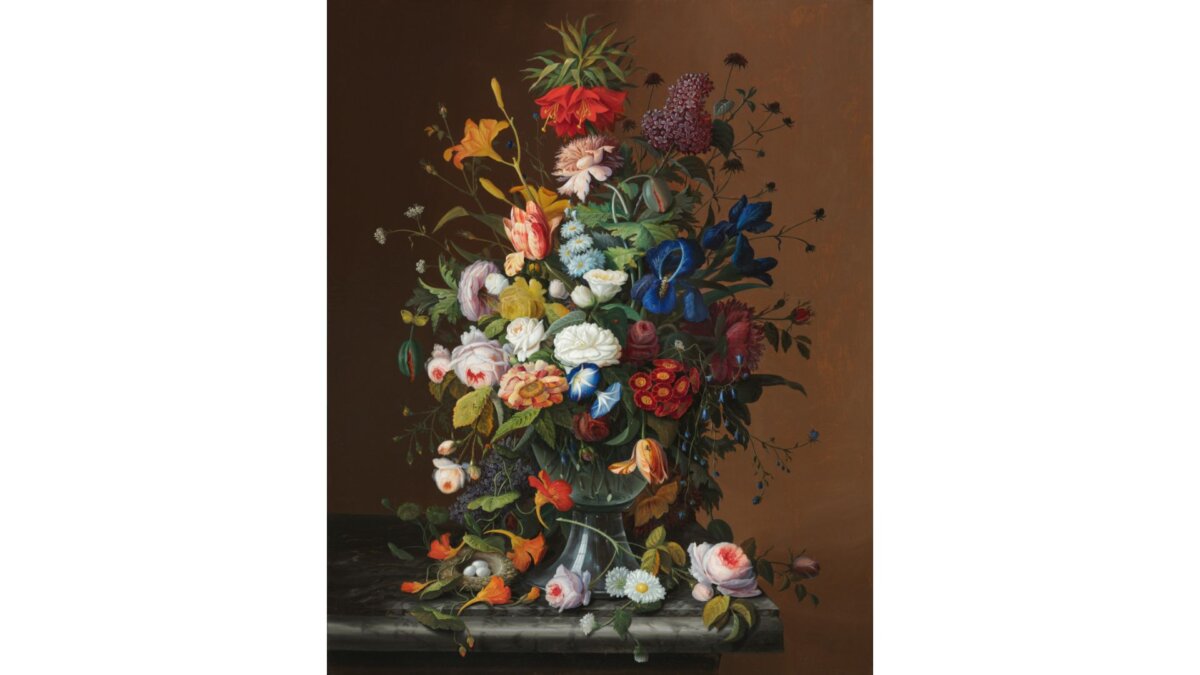
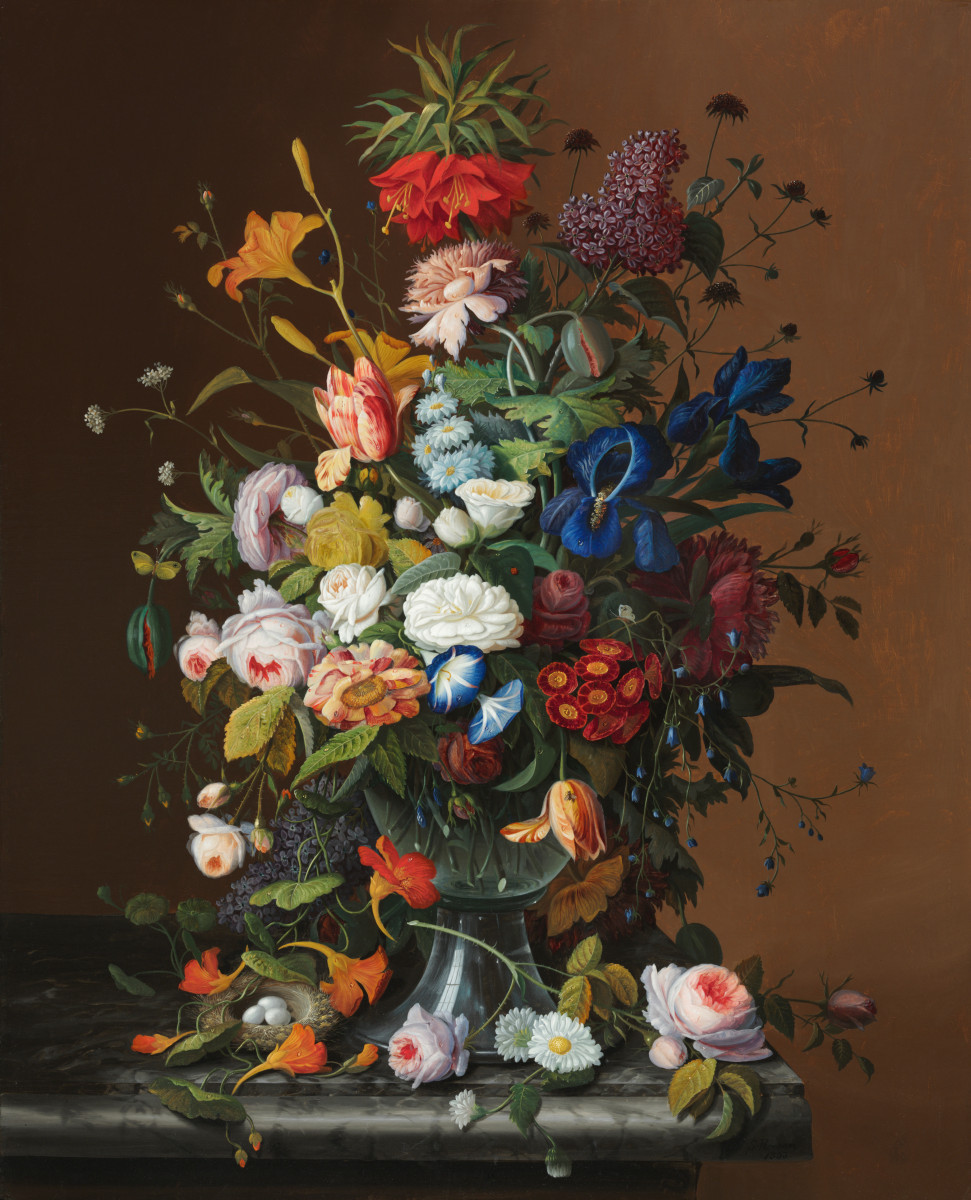
Prussian American Severin Roesen (1816–circa 1872) helped make still-life painting blossom in mid-19th-century America. The artist emigrated with his wife, along with a wave of Prussians during the German Revolutions of 1848 and 1849. Mainly working in Williamsport, Pennsylvania, he established himself as one of the artists who introduced the tradition of still life flower painting to the country, painting more than 300 works.
Roesen’s bountiful still life paintings burst forth with ripe fruit and often fanciful floral bouquets, such as in “Flower Still Life With Bird’s Nest.” In this piece, he rendered a glistening glass vase, and bugs and butterflies that hover among familiar leaves, and blooms, including cabbage rose, camelia, chrysanthemum, daylily, delphinium, German iris, lilac, morning glory, nasturtium, peony poppy, pincushion flower, pink tea rose, primrose, Queen Anne’s lace, red and white rosa mundi, striped tulip, all topped with a crown imperial. It’s a fanciful arrangement, as some of these flowers don’t blossom simultaneously in nature.
European Still Life Flower Painting
One can trace the trajectory of still life flower paintings over the centuries through Roesen’s fantastical painting “Flower Still Life With Bird’s Nest.”
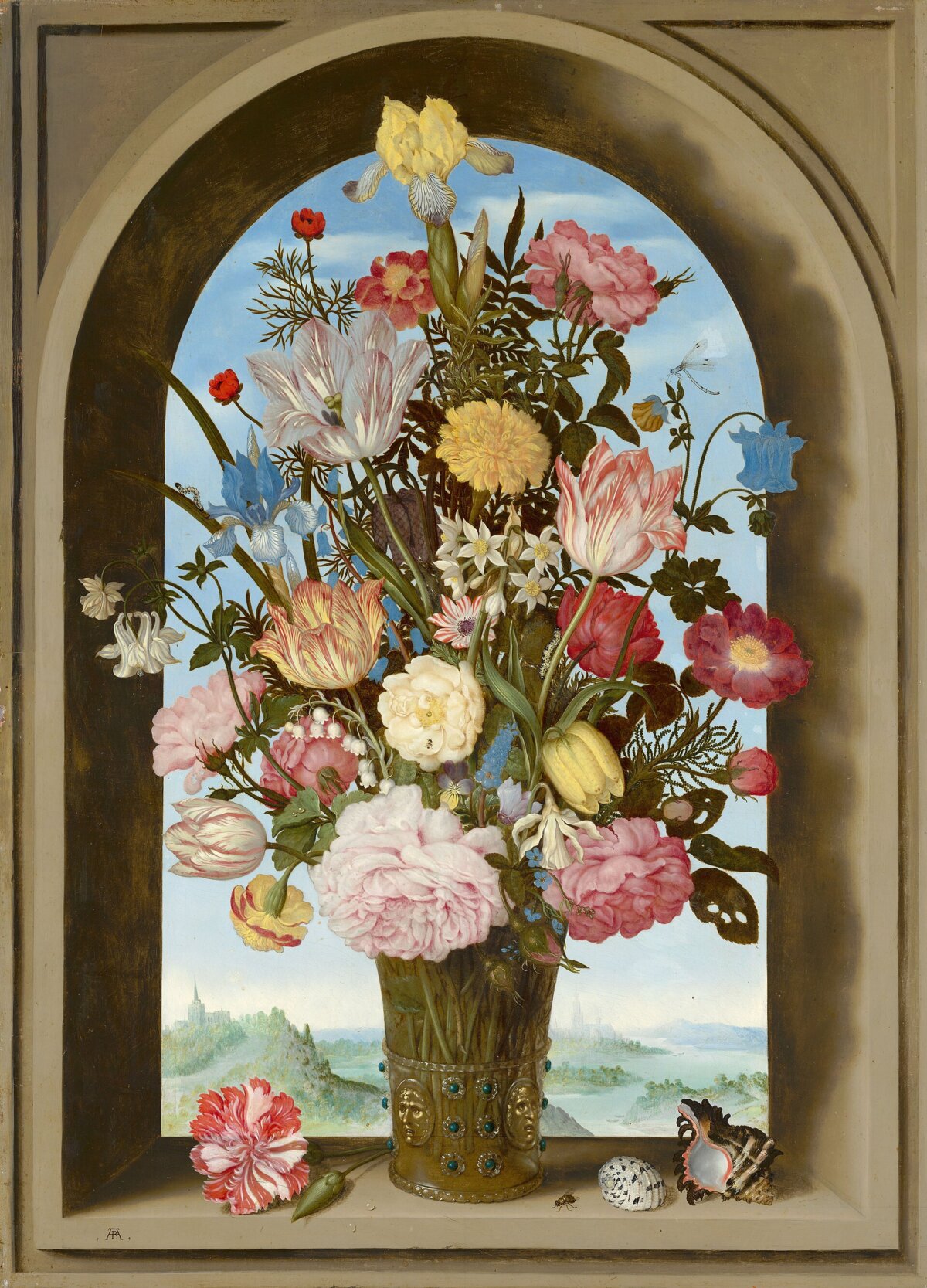
Roesen’s painting draws on elements of early still life flower paintings, such as those seen in “Vase of Flowers in a Window,” created around 1618 by the Flemish artist Ambrosius Bosschaert, a pioneer in the genre. In his fantastical arrangement, Bosschaert depicted 30 different flowers true to nature. But, just like Roesen’s flower arrangement painted centuries later, it’s also unnatural: The bouquet includes blooms that grow and blossom in different seasons and countries that couldn’t flower at the same time.
Although Bosschaert gave the picture a pleasing symmetry, it’s a top-heavy arrangement that would easily topple over in real life. This over-the-top style was typical of early flower still lifes.
In the 1630s, artists moved away from symmetrical still life arrangements, favoring a more informal yet still naturalistic composition.
By the latter half of the 17th century, flower still lifes had grown into spectacle pieces. These fanciful paintings were worlds to be discovered, filled with hidden bugs, flowers, and dramatic light effects. Roesen hid bugs and butterflies throughout the flowers and foliage of his colorful composition.
Still life flower painters of the 17th century often included motifs that reminded viewers of the transience of life, a theme echoed in “vanitas” and “memento mori” paintings popular in the Netherlands. It’s a theme that, naturally, extended to the fleeting nature of flower still life paintings, and one that Roesen embraced in the 19th century with the addition of the bird’s nest in his painting.
Severin Roesen’s still life flower painting is part of “A Nation of Artists,” a joint exhibition at the Philadelphia Museum of Art until July 5, 2027, and at the Pennsylvania Academy of the Fine Arts until Sept. 5, 2027. To find out more, visit ANationOfArtists.org
What arts and culture topics would you like us to cover? Please email ideas or feedback to features@epochtimes.nyc