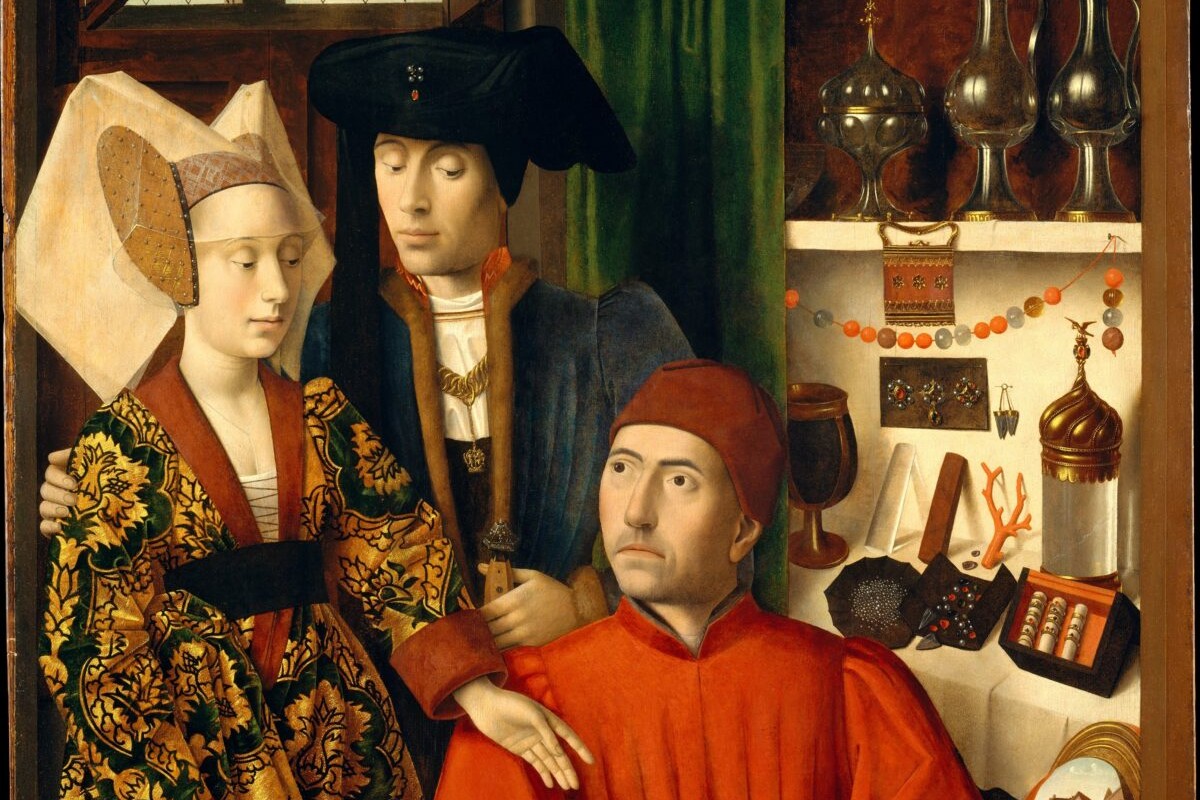
Renaissance painter Petrus Christus depicted true love, the heart of marriage, and more in “A Goldsmith in His Shop.”
Almost every element in the painting points to the virtuosity of the goldsmith or the virtues of holy matrimony.
In the painting, a finely dressed couple eagerly purchases a wedding ring. The man tenderly wraps his arm around his betrothed, while she happily gestures to the goldsmith, who is weighing a ring on a set of scales. Dressed in a rich red robe, the goldsmith concentrates on his customers’ request as he prepares the ring for sale.
On the left side of the workbench, a discarded red marriage girdle (like a belt) symbolizes chastity and a readiness to serve—both are contemporary ideals of a traditional marriage.
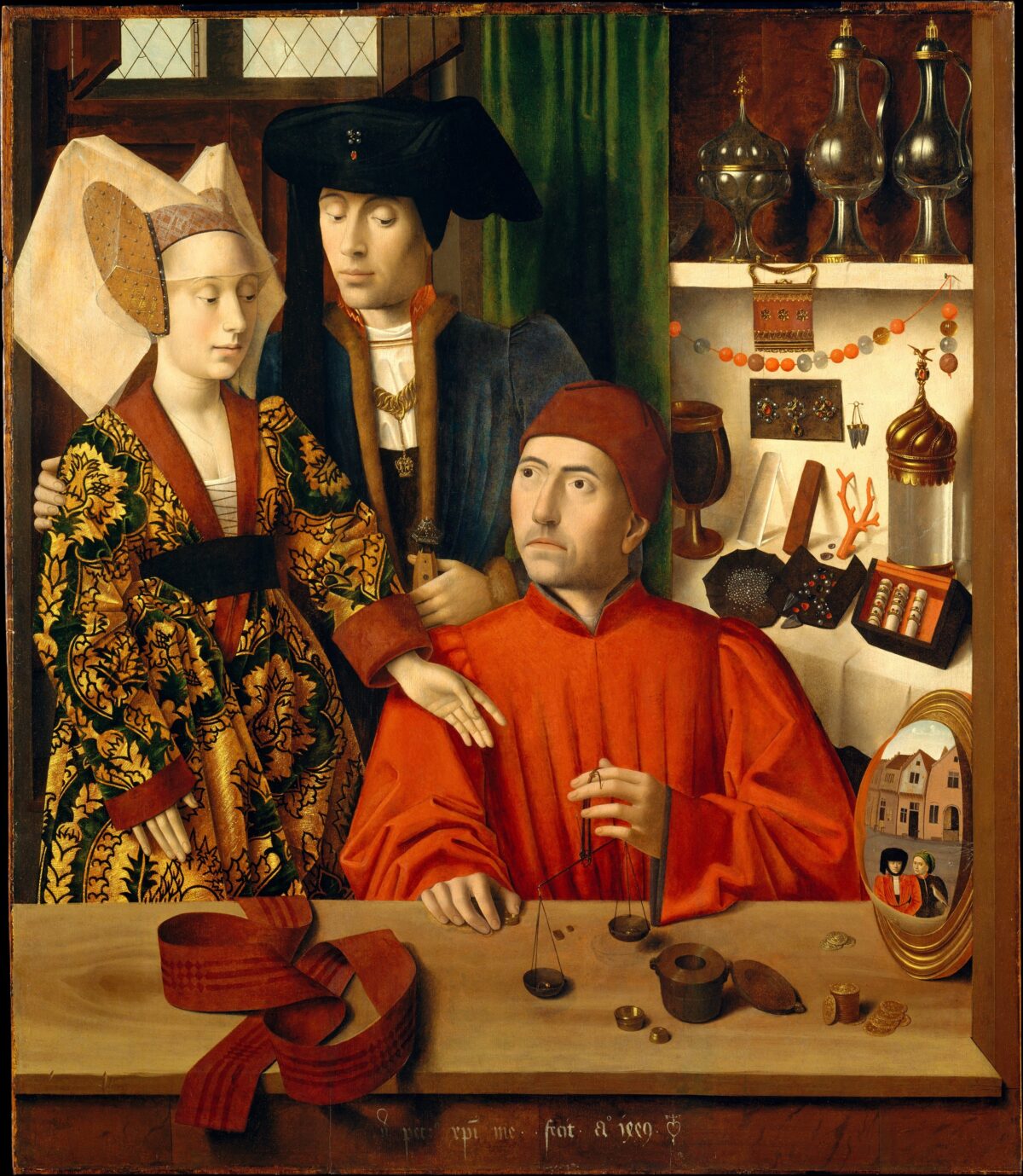
On the far-right side of the workbench, a convex mirror reflects the outside world where two falconers, standing in front of a row of buildings, seem to peer into the goldsmith’s shop. The mirror indicates vanity, and the falconers represent pride and greed. It serves as a symbolic warning of the vices that have no place in a happy marriage.
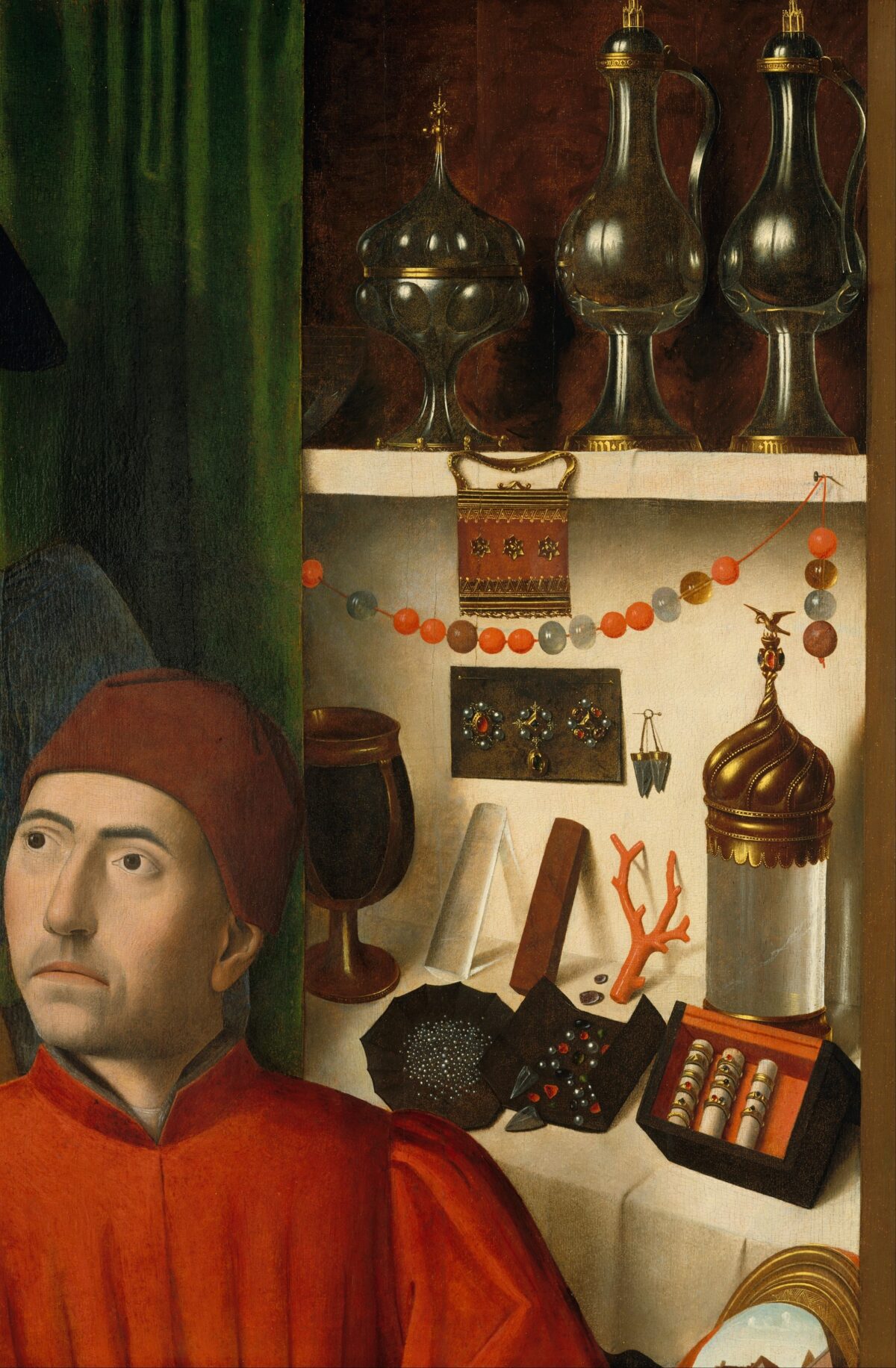
The goldsmith keeps all manner of tools, raw materials, and secular and sacred objects close by on his workbench and shelves. The shelves contain a row of pewter donation pitchers, a coconut-shell goblet, a display of brooches, a pair of fossilized shark teeth, a display box of rings, two small stone plinths, a branched piece of red coral, a string of amber beads, and two open pouches full of gems and semiprecious stones.
During the Renaissance, people believed that plants, gems, and semiprecious stones bestowed more than beauty; they possessed healing or protective qualities. Coconut shell was thought to counteract poison, amber to cure throat ailments, and sapphire to heal ulcers and eye diseases. Ruby was believed to strengthen the mind, dispel depression, and restrain lust. Some objects took on mystical qualities; for instance, fossilized shark teeth were likened to petrified dragon or snake tongues capable of detecting poison.
The goldsmith gazes toward the light source, where the falconers look in. A pile of gold coins near their reflection in the convex mirror warns the goldsmith of vocational vanity, pride, and greed.
A True or Imagined Portrait?
Some scholars believe that the painting is a vocational portrait of the Bruges goldsmith Willem van Vleuten, who worked for Philip the Good, the duke of Burgundy. In 1449, the year the painting was completed, the duke commissioned van Vleuten to create a gift for his great-niece Mary of Guelders to celebrate her marriage to James II, the king of Scotland.
Researchers have further reinforced the possibility that the painting is a portrait, as Christus had corrected the goldsmith’s appearance several times in his underdrawing, indicating that he was creating someone’s likeness rather than an imaginary figure.
Regardless of the goldsmith’s identity, Christus conveyed the successful craftsman and the hard-won virtues required for a happy marriage.
What arts and culture topics would you like us to cover? Please email ideas or feedback to features@epochtimes.nyc.