As the sun sets on Sept. 20, 2026, Jews begin Yom Kippur, the “Day of Atonement.” For Jews, this holy day marks when Moses descended Mount Sinai after receiving Yahweh’s forgiveness for the people of Israel, after they committed idolatry.
Jews commemorate Yom Kippur through ascetic practices, such as fasting, and by attending five prayer services held in the synagogue throughout the day. According to the late rabbi, author, and philosopher Jonathan Sacks (1948–2020), “The question God asks [Jews] on Yom Kippur is not, ‘Are you perfect?’ but ‘Can you grow?’”
A Personal Homage to Faith
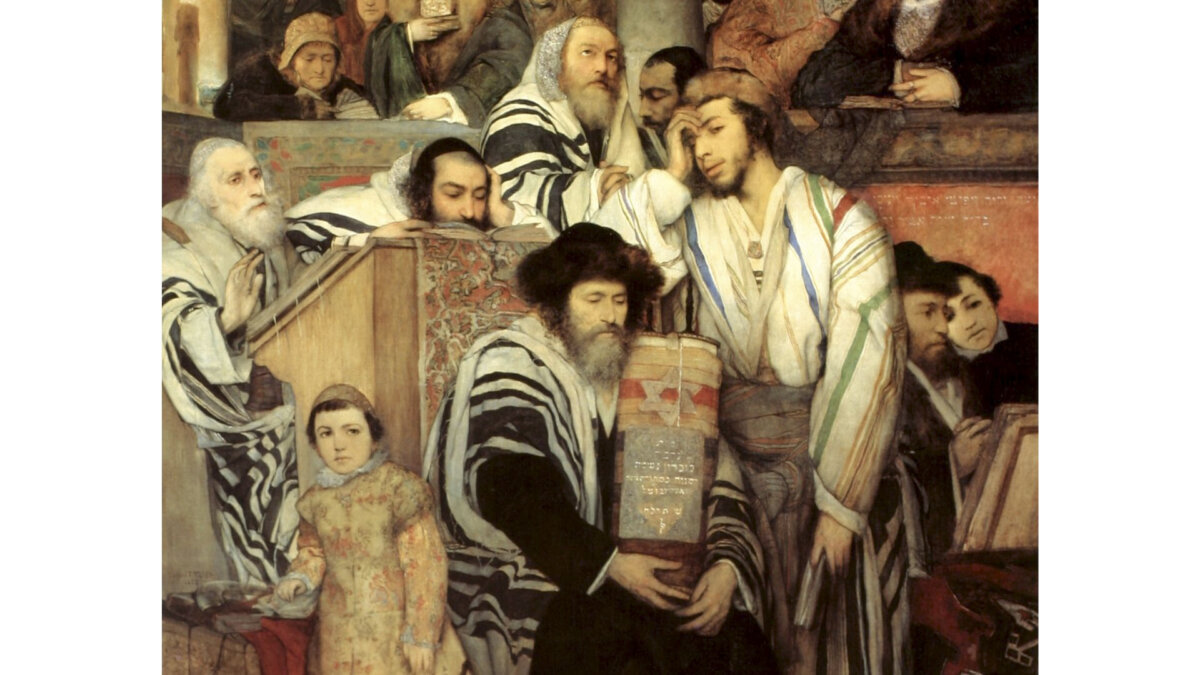
One can imagine that Polish painter Maurycy Gottlieb (1856–1879) meditated on such questions while painting “Jews Praying in the Synagogue on Yom Kippur,” especially because he depicted himself three times. In the lower left, he’s the young boy dressed in ornate golden brocade attire, wearing a pendant, and resting his hand on an open prayer book. He stands next to a pile of sacred manuscripts and the “shofar,” a ceremonial horn (usually a ram’s horn) blown to announce the end of Yom Kippur.
On the far right, he’s an older boy dressed in black, studying with an elder, indicating his diligent sacred study. He might be approaching the time of his “Bar Mitzvah.”
To the right of the “bimah,” the lectern where the Torah rests, Gottlieb is an adult deep in contemplation. He leans one arm on the bimah and holds his head, and the other hand keeps his place in a prayer book. He’s wearing a colorful “tallit,” the tasseled prayer shawl, and the same pendant he wore as a boy, hinting at the faith he’s held since boyhood.
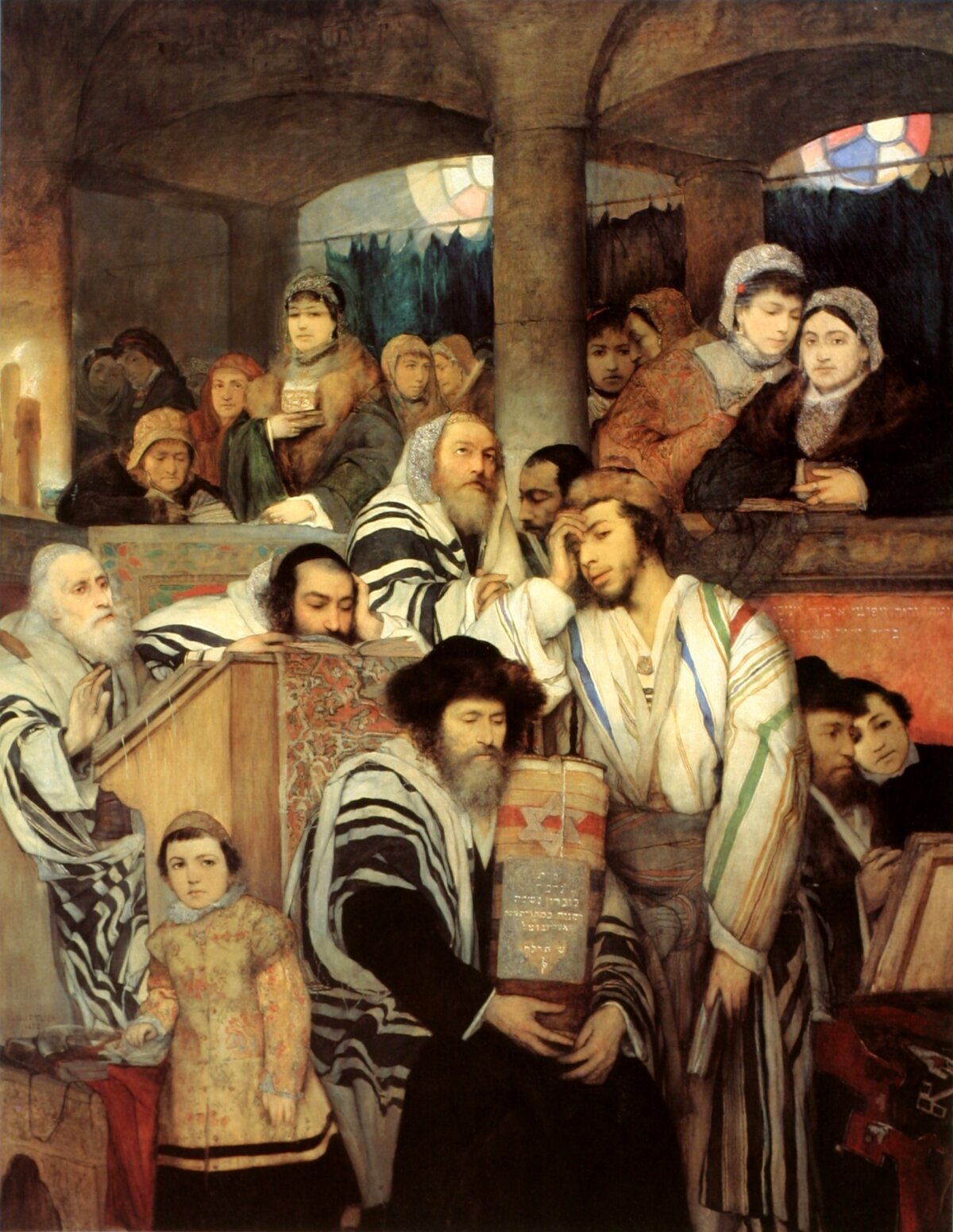
In addition to his own presence, Gottlieb also surrounded himself with people from his youth in Drohobycz, in the Commonwealth of Poland (modern-day Ukraine). His sweetheart, Laura Rosenfeld, appears twice, standing in the gallery reserved for women. On the left, she’s poised, holding a prayer book, and, on the right, Gottlieb rendered her standing and supporting her mother.
In the center, the rabbi holds the cylindrical Torah scroll close. While most of the male figures wear a “kippah,” a cap that covers the crown, the rabbi wears a “streimel,” a traditional hat with a wide brim of fox, minx, or marten fur, which is reserved for special occasions.
Gottlieb inscribed his own epitaph on the Torah scroll mantle: “Donated in memory of our late honored teacher and rabbi Moshe Gottlieb of blessed memory 1878.” (Moshe was the artist’s forename in Hebrew). He died unexpectedly a few months later, some say of a heartbreak from his sweetheart marrying another.
Cherishing Jewish Life
Gottlieb reverently rendered life in the synagogue and the solemnity of Yom Kippur in this painting.
Polish artist Leopold Pilichowsky (1869–1933) wrote:
“Gottlieb was the first Jewish artist who perceived the poetry and beauty of Jewish life in exile. He was the first who saw in the lives of the poorly dressed Polish Jews, in their women and children, a highly developed rhythm, beauty, character, and type of culture. He understood, with his artistic knowledge and instinct, that the tallit can be used by the artist to create lines no less beautiful than the Greek or Roman toga.”
Gottlieb’s “Jews Praying in the Synagogue on Yom Kippur” is also all the more poignant as the artist died young, at 23. It therefore acts as a stark reminder of the importance of self-reflection and repentance, as this transient life can take an unexpected turn through God’s grace.
What arts and culture topics would you like us to cover? Please email ideas or feedback to features@epochtimes.nyc.