Through his writing, illustrations, paintings, and sculptures, Frederic Remington (1861–1909) evoked the Old West. His art reflects life on the frontier so vividly that many people assume that he was a Westerner—an impression that his publisher, Harper’s Weekly, happily embellished. But Remington was an Easterner, a born-and-bred New Yorker.
Remington’s love for capturing the West began when he traveled to Montana Territory in summer 1881, an experience that ignited his successful career and lifelong passion for sketching cowboys, cavalrymen, and Native Americans.
Remington may now be known more for his sculptures than for his famous paintings, yet he never intended to be a sculptor.
According to the Frederic Remington Art Museum, he was quite content as a painter. But one day, his friend, the playwright Augustus Thomas, observed Remington repositioning figures in a composition with such ease that he declared that his friend had “the sculptor’s degree of vision,” which inspired Remington. Another friend, the sculptor Frederick Ruckstull, further encouraged him with a supply of materials, and so Remington began to sculpt.
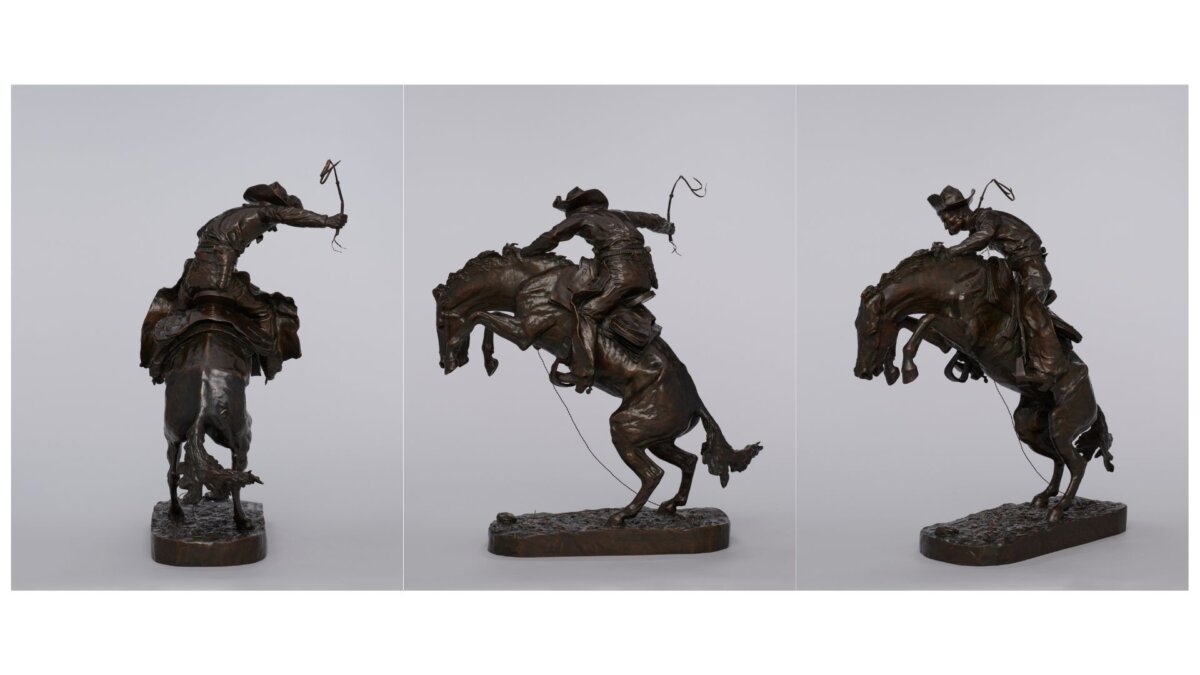
Of his 22 bronzes, “The Broncho Buster” was the first and is believed to be based on his famous illustration “A Pitching Broncho,” published in Harper’s Weekly on April 30, 1892.
In “A Pitching Broncho,” Remington created a tangible tension between the cowboy and horse—a tension known only by those who have sat in the saddle, or, as Remington wrote: “Only those who have ridden a broncho the first time it was saddled, or have lived through a railroad accident, can form any conception of the solemnity of such experiences. Few Eastern people appreciate the sky-rocket bounds, grunts, and stiff-legged striking.”
Remington successfully transferred that dynamism and tension into three dimensions. He took 10 months to make the model in clay because of the complex composition of the rearing horse, which was a feat to render without it toppling. “The Broncho Buster” bronze was finally cast in 1895, at the Henry-Bonnard Bronze Co. in New York City.
That very first bronze design became Remington’s most famous, and it endures to this day as an emblem of the Old West, as does all of his work. This sentiment was echoed by President Theodore Roosevelt in October 1907: “The soldier, the cowboy and rancher, the Indian … will live in his pictures and bronzes, I verily believe, for all time.”
Roosevelt himself owned a copy of “The Broncho Buster” after the Rough Riders presented him with a bronze in 1898 when they returned from battle. Remington said it was “the greatest compliment” he ever had received.
An original cast of the piece is in the Oval Office, presented as a gift to the Carter administration.
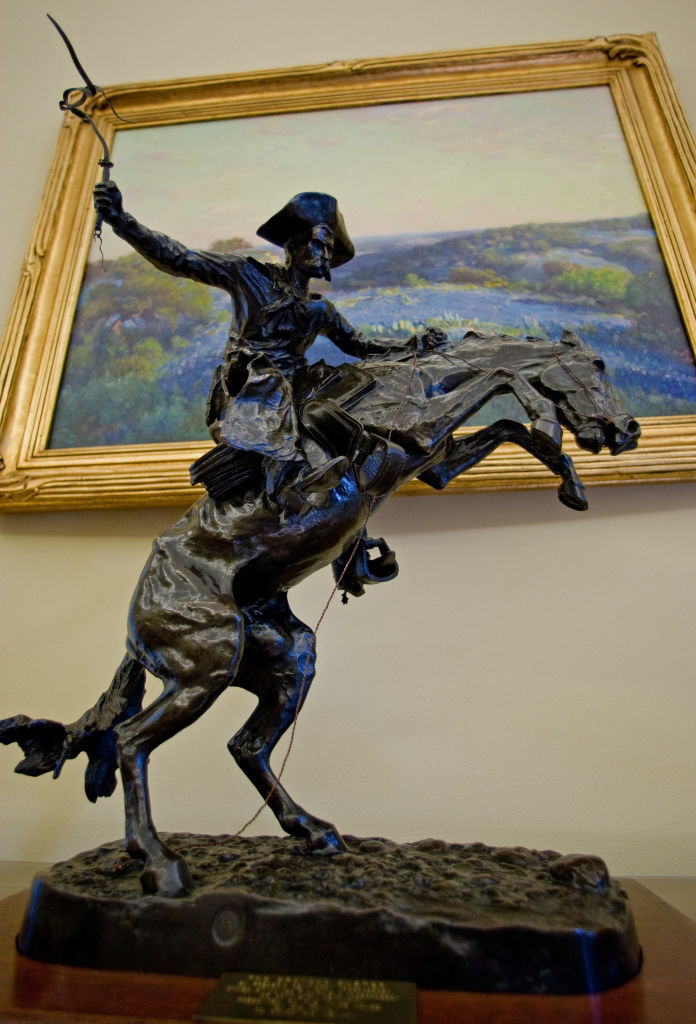
One of Remington’s 1895 ‘The Broncho Buster’ bronzes can be seen at the Frederic Remington Art Museum.
What arts and culture topics would you like us to cover? Please email ideas or feedback to features@epochtimes.nyc.