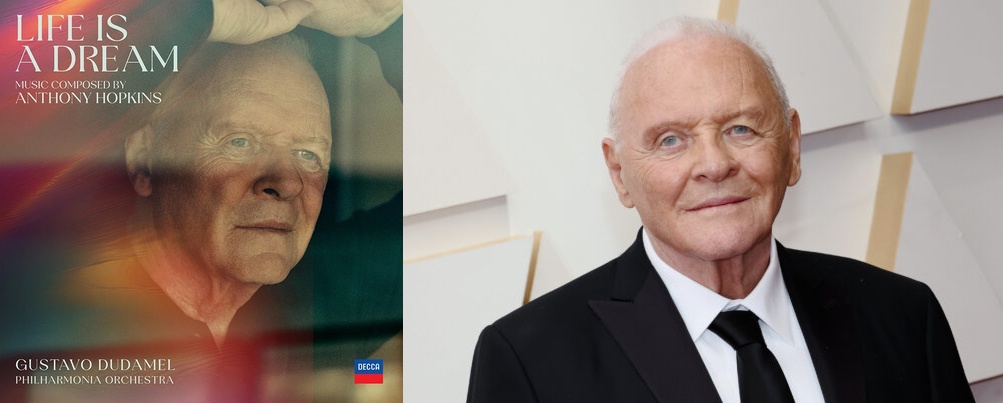
To begin with, let’s dispense with the false but understandable assumptions: This album is no amateur playing at music, not a vanity project from a musical wannabe who happens to be a major film star. These are viable concert works from a composer who knows how to shape melodies, how to assemble harmonies to enhance them, and when to let rhythm have its say. Most compelling of all, he knows how to make an orchestra sing.
Sir Anthony Hopkins is, of course, one of the most celebrated actors of the last half-century. Two Oscars, four British Academy Film Awards (BAFTA), the British equivalent of the Oscars, and the iconic portrayal of Hannibal Lecter attest to that. But he has often said that music was his first love and that he “had to settle for acting.” He returns to his first love with “Life Is a Dream,” a collection of a dozen orchestral works composed by Hopkins over several decades.
It’s not the first time his music has been recorded. In 2011, Andre Rieu made Hopkins’s “And the Waltz Goes On” hugely famous in an album of that name, and shortly afterward, the City of Birmingham Symphony Orchestra released an album called “Composer,” comprising nine Hopkins pieces. (That album is no longer available, but you can hear excerpts on Spotify.) “Life Is a Dream” is the most extensive representation of Hopkins’s music so far.
As might be expected given the composer’s primary vocation, the music tends toward cinematic. Broad orchestral gestures and bold timbres dominate. There is also a certain degree of film-music pastiche. The opener (“Fanfare and March”), for example, conjures the soundtracks of military movies from the 1930s and ’40s, as Hopkins himself admits in the liner notes. “Margam,” whose title is taken from the area of Wales where he was raised, is outright film music, composed by Hopkins for his movie, “August” (1996), set in his native Wales. Unashamedly a tender musical memoir, Hopkins says he wrote it as “a recollection of my idyllic childhood.”
“And the Waltz Goes On” is here as well, and this evocative piece of sophisticated nostalgia needs to be. To leave it out would be like omitting the “Moonlight Sonata” from a collection of Beethoven’s best-known piano scores.
“And the Waltz Goes On” is based on a melody that Hopkins jotted down in the green room of a theater in Liverpool, England, in 1964. Zooming ahead to the 21st century, Hopkins composed the atmospheric “Farewell My Love” in 2025. A solo piano molds solemn commentary into a full-blooded theme that the orchestra picks up and brings to a climax. Along the way, the composer skillfully employs woodwinds in highlighted spots of color.
The pianist for “Farewell My Love” is Argentina’s Sergio Tiempo. He returns in fine virtuosic fettle as soloist in the album’s most ambitious piece, “1947: Suite for Solo Piano and Orchestra.” It’s in three parts, each one a sonic picture of an aspect of Hopkins’s childhood memory in the summer of 1947. An expanded percussion session of such things as anvil, brake drum, and whip, takes us to the “Circus” (Mvt. I), followed by a walk down “Bracken Road” (Mvt. II), an homage to the big-band ballads of the era, and “The Plaza” (Mvt. III), a picture of the movie house where young Anthony gawked at the stars on the screen, unaware that he would someday be one of them. It’s all about “the bright lights, excitement, and magic of the silver screen,” Hopkins wrote.
Two orchestral pieces composed by Hopkins for women in his life—his wife and niece—etch gentle melodies into the orchestral fabric. Special note must be made of the deeply moving “My Fatherland,” a stunning arrangement of Welsh folk songs, sung by the Bach Choir and Boy Choristers of Winchester Cathedral in Winchester, Hampshire, England.
In 2024, Hopkins composed a pair of tone poems for the Royal Philharmonic Orchestra inspired by a story by W. Somerset Maugham: “The Eagle” and “Samsara.” Scored for choir and orchestra, they show a compositional talent that is fresh and original, despite advancing age.
Sir Anthony Hopkins will turn 89 on Dec. 31. His film legacy is obviously secure, and it can only be hoped that symphony orchestras around the world will program his music, thus cementing his musical reputation as well.
Memo to orchestra administrators everywhere: Don’t stick these pieces in the corner of a pops program. Place “Margam” on a program devoted to UK composers like Ralph Vaughan Williams and Frederick Delius. Let “And the Waltz Goes On” open a program that also includes Maurice Ravel’s “La Valse.” Program “The Eagle” and “Samsara” on a concert matched by the exoticism of Nikolai Rimsky-Korsakov’s “Scheherazade.” Let your audiences fall in love with new music once more.
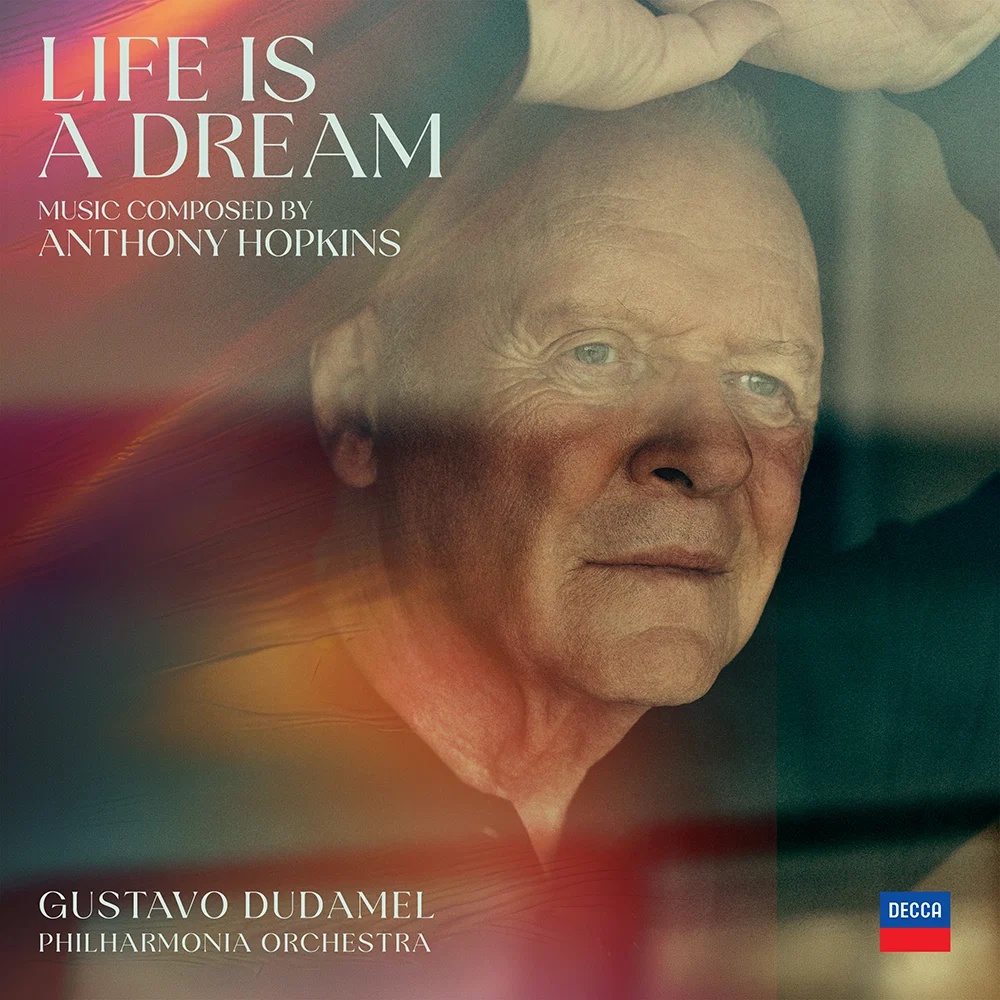
‘Life Is a Dream’
By Anthony Hopkins
The Philharmonia Orchestra conducted by Gustavo Dudamel
Decca Records: 2026
What arts and culture topics would you like us to cover? Please email ideas or feedback to features@epochtimes.nyc