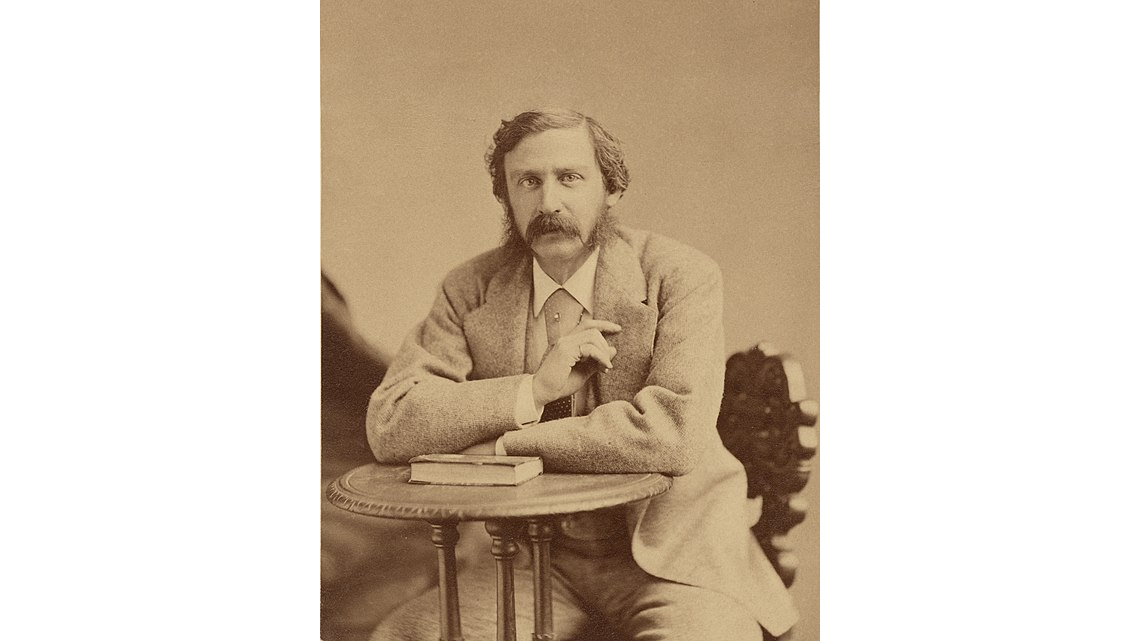
Before Mark Twain became the dominant literary voice of the American frontier, Bret Harte briefly stood at the center of national attention as the writer who turned California’s rough mining camps into literature. In doing so, he helped define what later critics would call the “local color” movement, stories rooted in specific regions, filled with dialect, detail, and sharply observed character.
An Early Architect of Western Storytelling
Born Francis Brett Hart in Albany, New York, in 1836, Harte came of age in a household marked by early loss and financial constraint. His formal education was limited, but he read widely and developed a strong literary instinct early on.
At 18, in 1854, he traveled west to California, arriving during the lingering aftermath of the Gold Rush. The great rush of 1849 had subsided, but its cultural aftershocks—boomtowns, shifting fortunes, and makeshift communities—still shaped much of the state.
Harte tried a series of jobs: printer, teacher, courier, and briefly, miner. The physical labor of mining didn’t suit him, but observation did. He was drawn to the personalities around him: gamblers with sudden philosophies, drifters reinventing themselves weekly, and rough laborers capable of unexpected generosity. California’s mining camps and frontier settlements became his richest source of material.

By the early 1860s, Harte was working in journalism in Northern California. During this period, he publicly condemned the 1860 massacre of Wiyot Indians near Humboldt Bay. This stance made him unpopular among local residents and distinguished him from much of the contemporary press. His reporting revealed a willingness to challenge prevailing attitudes and confront the harsher realities of life in the developing West.
His breakthrough came in 1868 with the short story “The Luck of Roaring Camp,” published in The Overland Monthly, which he edited. The story centers on a crude mining settlement transformed by the arrival of an orphaned baby. What made it striking to readers on the East Coast was not simply its setting, but its emotional framing with miners portrayed not as mere roughs, but as men capable of tenderness and redemption.
A year later, the short story “The Outcasts of Poker Flat” expanded that approach. In it, gamblers and social exiles are stranded in the Sierra Nevada and forced to confront their moral reckoning. The story’s blend of irony, sentiment, and frontier grit helped establish Harte as one of the most widely read American writers of the late 1860s.
His fame peaked with the 1870 poem “Plain Language From Truthful James,” better known as “The Heathen Chinee.” Intended as satire on anti-Chinese prejudice in California, it was widely misread as reinforcing the very stereotypes it aimed to criticize. Despite, or because of, that confusion, it became one of the most circulated poems in the United States at the time, was reprinted in newspapers nationwide, and made Harte a household name.
By the early 1870s, Harte’s literary reputation had reached extraordinary heights. He was among the most talked-about writers in the country, and his financial prospects reflected that status. Around this period, The Atlantic Monthly reportedly negotiated a literary arrangement with Harte that was later often described as worth $10,000 annually, a remarkable sum for a writer of the era. The agreement underscored how highly his work was valued in elite literary circles, even though the precise details have been interpreted differently by biographers.
But success proved difficult to sustain. Harte left California and moved east in 1871, expecting to build on his literary fame. Instead, he struggled to regain his earlier momentum. Critics began to argue that he was repeating the same mining-camp formulas, relying on sentiment and stock characters rather than expanding his range.
Before Twain, There Was Bret Harte
It is here that comparisons with Mark Twain (1835–1910) become unavoidable.
Twain and Harte shared certain origins: Both came out of journalism, both drew heavily on Western life, and both used humor and vernacular speech to shape a distinctly American literary voice. For a brief period in the late 1860s, Harte often received as much attention in Eastern literary circles as Twain. However, Twain’s trajectory would ultimately prove expansive in its long-term cultural impact.
But their artistic instincts diverged sharply. Harte often shaped frontier life into moral fables, where rough characters revealed hidden decency. Twain moved in the opposite direction, stripping away romantic ideals to expose vanity, cruelty, and absurdity. Harte sought meaning and redemption in the West’s rough edges; Twain more often used the same landscape to question human pretension.
The two men initially maintained cordial relations, and Harte’s early encouragement and professional support helped Twain gain visibility in influential literary circles. But the relationship deteriorated over time, particularly as Twain’s fame eclipsed Harte’s. Twain later expressed harsh judgments of Harte in private correspondence and autobiography, including the famously cutting nickname “The Immortal Bilk,” reflecting his belief that Harte was unreliable in personal and financial dealings.
Whether fair or not, the comparison became fixed in American literary history: Harte as the early architect of Western storytelling, Twain as its enduring master.

By the late 1870s, Harte’s career had shifted away from the United States. He accepted diplomatic posts, serving as U.S. consul in Krefeld, then part of the German Empire, and later in Glasgow, Scotland. These positions provided stability but further removed him from the literary center of gravity in America. He continued writing, but the cultural momentum had moved on.
Harte spent most of his final years in England, including time in Surrey, where he continued to write and maintain connections to the literary world. When he died in 1902, his reputation in the United States had diminished considerably, overshadowed by Twain’s rise into the national canon.
Despite that, his influence never fully disappeared. Writers associated with regional realism and Western fiction, particularly Jack London and others who used regional settings, vernacular speech, and local experience as central elements of fiction, owed something to Harte’s early example of placing local detail and moral complexity at the center of storytelling.
Bret Harte’s legacy rests as much on talent as on historical timing. For a brief but influential period, he captured the imagination of a country still defining its frontier identity. While later generations favored Twain’s sharper irony and broader scope, Harte remains the writer who first proved that the American West could be more than geography or myth—it could be literature.
What arts and culture topics would you like us to cover? Please email ideas or feedback to features@epochtimes.nyc.