While Richard Evelyn Byrd Jr. was enjoying his 10th birthday on Oct. 25, 1898, in Virginia, Roald Amundsen, a young Norwegian explorer was stuck aboard a Belgian ship in Antarctica. Separated by thousands of miles and experiencing two different worlds though on the same planet, destiny would eventually pit these two explorers against each other in a race for what would be one of Earth’s last unconquered regions. But that would not happen for nearly another 30 years.
On this October day in 1898, the 26-year-old Amundsen was hoping to survive aboard the ice-locked ship. The Belgica, a whaler retrofitted as an expedition ship, had been stranded in place since March, and it did not appear she would be released from the icy grip anytime soon. The young Norwegian had joined 18 other sailors, along with a cat, to explore the southern region of the globe. In January, Amundsen was given a clear view on the dangers of the Antarctic when one of the sailors was knocked overboard and lost to the frigid depths.
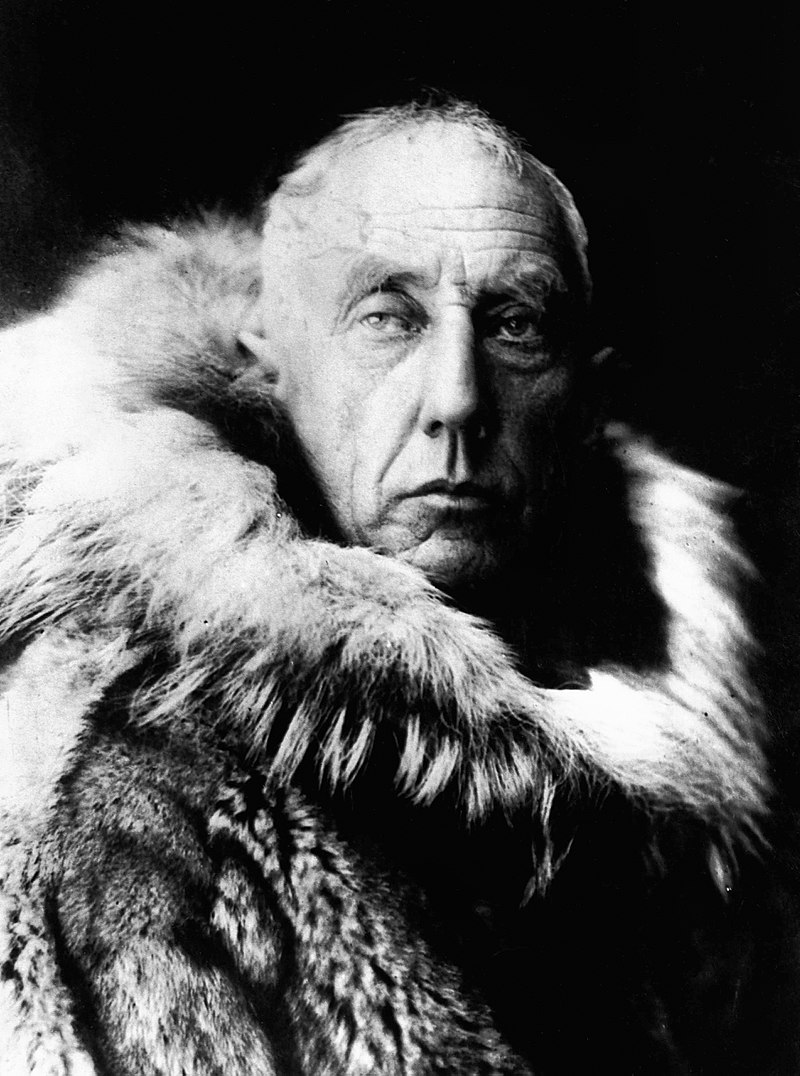
Amundsen was mentally prepared for the length of the Belgian Antarctic Expedition. He informed his brother in a letter that “the trip will last for 2 years and will be very interesting as it is the first of its kind.” Indeed, Amundsen had been preparing to explore the frozen regions of the globe since a young boy. He read about the 19th-century polar explorers, their adventures, their close calls with death, their failures, and their triumphs.
As a boy, Amundsen often slept with his window open during bitterly cold storms to prepare himself for the elements of the polar regions. After abandoning his medical career, he turned to seal hunting in the Nordic Seas and winter treks to the Norwegian mountains. More than anything, he wanted to be a polar explorer. But now it came down to surviving his first attempt.
Byrd Arises
As a 13-year-old, Byrd got his first taste of adventure. The Philippines now belonged to the United States after America defeated Spain in the Spanish-American War. Byrd sailed there, and the sea voyage and the experience of the exotic islands left a lasting impression. Just as Amundsen resolved to become a polar explorer at a young age, Byrd resolved to pursue a career in the U.S. Navy.
Upon his return home, Byrd entered the boarding school of Shenandoah Valley Military Academy. He then studied at the Virginia Military Institute and University of Virginia, altogether from 1904 to 1908. He earned one of Virginia’s appointments to the U.S. Naval Academy at Annapolis and graduated in 1912.
Although Byrd was assigned to several ships after graduation, including the yacht of the secretary of the Navy, an ankle injury sustained during his studies at the Naval Academy kept him from command of his own vessel. The problem with the injury actually forced him into a brief two-month retirement. Upon his return in the summer of 1916, he was installed as an inspector-instructor.
By this time, the war in Europe had been raging for nearly two years. Byrd, nearing 30 years old, saw an opportunity to advance in the relatively new U.S. Naval Aviation Forces. He moved to Pensacola, Florida to complete his training and become an aviator. Although he was not sent to Europe, he still received several promotions—lieutenant and lieutenant commander—though both promotions were temporary.
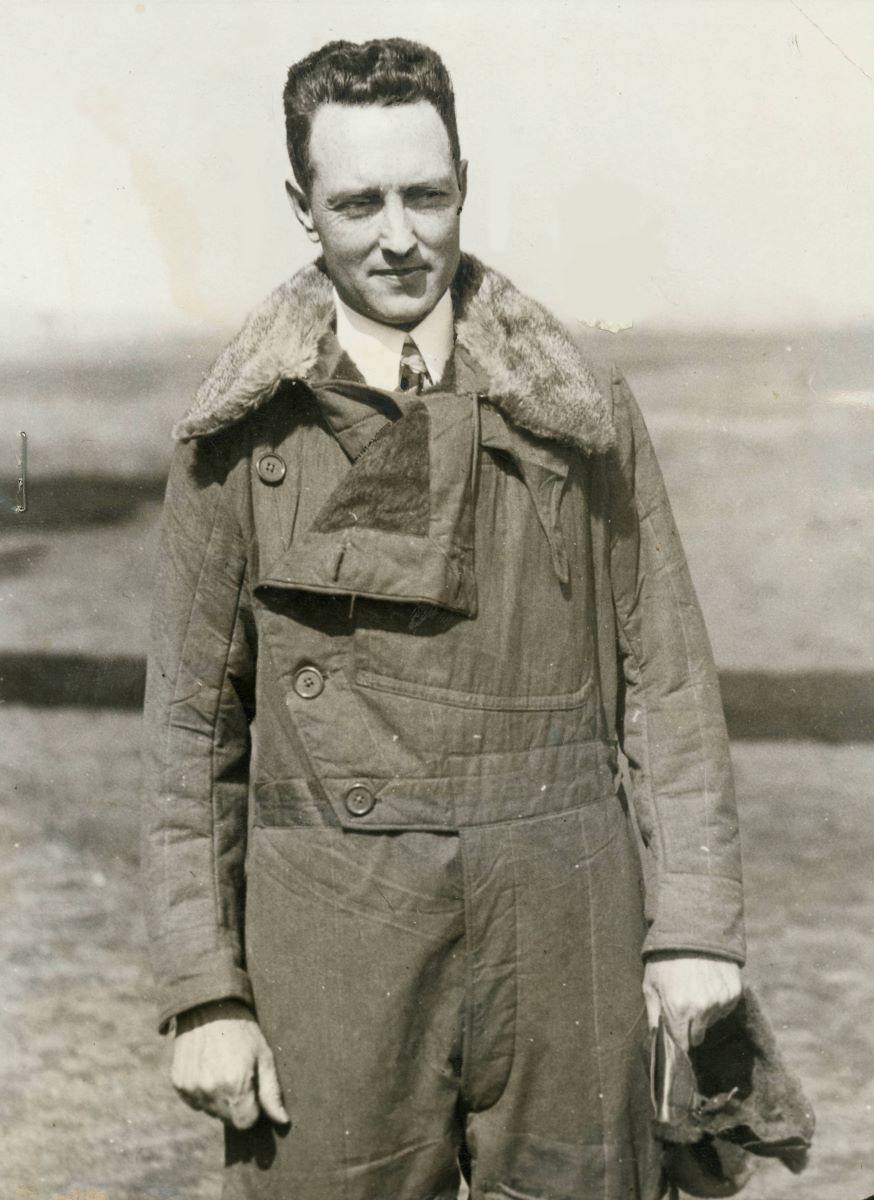
After the Great War ended, he was sent to Washington to work for the director of naval aviation and prepare for the department’s transatlantic flights, which were ultimately abandoned.
Amundsen’s Adventures
For Amundsen, he and his other sailors from the Belgica survived their Antarctic expedition. The first thing they did once their ship was free was to escape the icy continent altogether and sail north to Chile. But Amundsen was hardly discouraged from visiting Antarctica again.
Having sailed along the globe’s most southern region, Amundsen decided his next big adventure would be along the globe’s most northern region. In 1903, Amundsen pursued his childhood ambition of sailing through the near mythical Northwest Passage. He also wanted to know if the northern magnetic pole had moved since it was first located in 1831.
The Norwegian explorer purchased a 47-ton ship called the Gjoa and hired a crew of six men. From 1903 to 1906, the seven became the first to successfully sail the Northwest Passage. Although he did not locate the magnetic pole, he did prove that it had moved from its last location. The pole had actually moved 30 miles further north.
Amundsen had planned to create an expedition to be the first to the North Pole, but in 1909, the American polar explorer, Robert Peary, became the first to reach it. Amundsen thus turned his attention back to Antarctica with the intention of being the first to reach the South Pole. He encountered stiff competition from British explorer Robert Falcon Scott.
In 1911, Amundsen and Scott began their individual expeditions in pursuit of the South Pole. After wintering in the Antarctic, Amundsen set about 10 days before Scott. It was a head start that again put Amundsen in the record books. He placed the Norwegian flag at the South Pole on Dec. 14, 1911. His expedition returned to their camp site on Jan. 25. The historic journey had covered approximately 1,400 nautical miles in 99 days. Scott reached the pole on Jan. 18. His return journey ended in tragedy, as he and his four expeditioners died while trying to return to their camp.
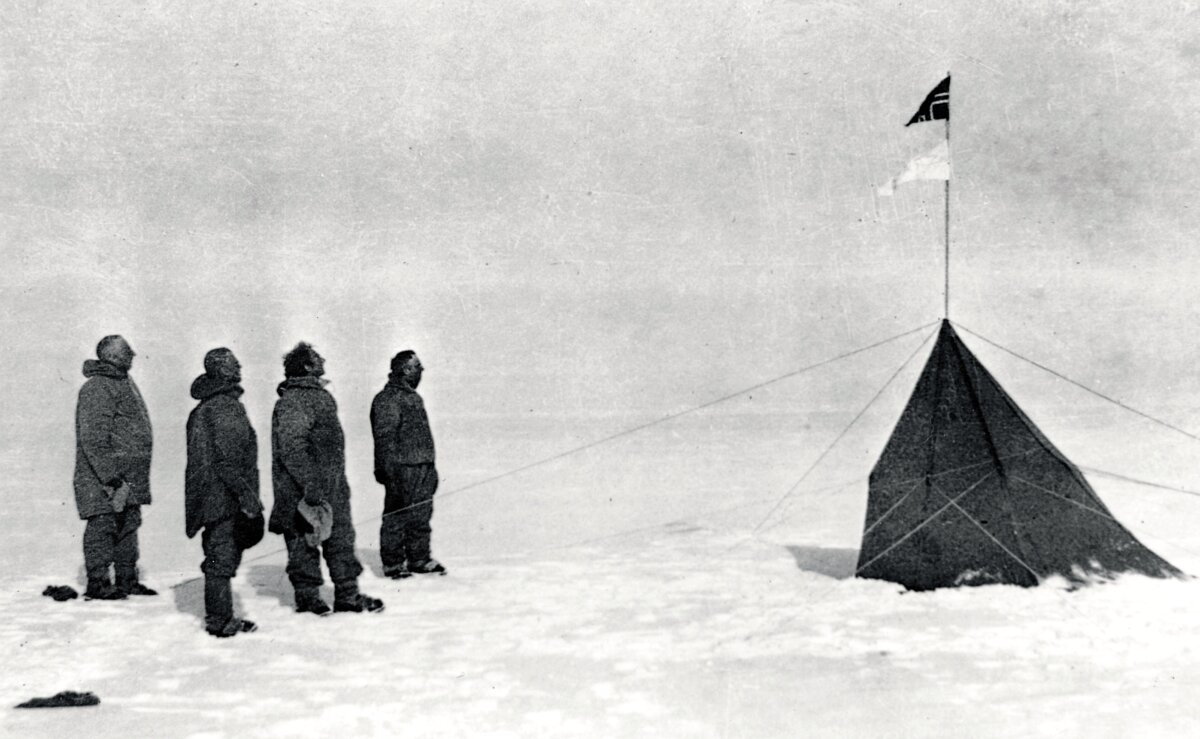
Amundsen’s name became household. His congratulations ranged from England’s King George V to America’s President Theodore Roosevelt.
Byrd’s First Polar Experience
During WWI, Norway remained neutral, though it considered itself a “neutral ally” of Great Britain. Amundsen participated in this neutrality through commercial shipping, which ultimately benefited the Triple Entente of Britain, France, and Russia.
A few years after the war, Byrd and Amundsen neared each other geographically, as Byrd was sent to England in 1921 to assist in the creation of a dirigible as a member of the Navy’s Bureau of Aeronautics. In fact, Byrd had played a significant role in ensuring legislation passed to create the bureau. After the dirigible’s completion, Byrd was scheduled to navigate it. Fortuitously, he missed his train to get to the dirigible and was thus replaced with another navigator. Had Byrd not missed the train, he would have likely been killed, as the dirigible exploded.
Byrd, who had been reverted back to lieutenant, returned home and was assigned the task of opening air stations. In 1924, he was promoted to lieutenant commander. Of course, as a technically retired member of the U.S. Navy, this promotion took an act of Congress.
He was soon assigned to the dirigible Shenandoah, which was created for and scheduled to fly over the North Pole. A storm, however, had significantly damaged the airship, and the expedition was canceled. Despite the setback, another expedition was set into motion the following year.
The U.S. Navy recalled Lt. Cmdr. Donald MacMillan for an Arctic expedition. MacMillan was also a successful explorer who had joined Peary on his trek to the North Pole in 1909, although his badly frozen feet kept him from reaching the pole on that expedition.
The 1925 MacMillan Polar Expedition, sponsored by the National Geographic Society, was orchestrated to search for land in the Polar Sea, as well as test radio transmissions while sailing along Greenland. Byrd was placed in command of the aviation unit of the expedition with the plan to fly over the North Pole. The weather in the region, however, thwarted these plans, though Byrd was able to survey previously uncharted territory.
Byrd and Amundsen in Spitsbergen
Nonetheless, Byrd was determined to accomplish the feat. Interestingly, Amundsen had made plans to do the same, though he planned his journey to be more extensive, reaching from Norway’s island of Spitsbergen to Alaska in an airship.
Byrd, however, would have to conduct this expedition without the funding of the U.S. Navy. He therefore turned to wealthy individuals, like John D. Rockefeller Jr. and Edsel Ford. Having obtained the necessary funding, and having formed his team, which included naval aviation pilot Floyd Bennett, the Byrd Expedition sailed out of the New York harbor on April 5, 1926 for Spitsbergen.
The Byrd Expedition arrived at Spitsbergen on April 29. Amundsen and members of his crew were already there, though they were awaiting the arrival of their airship, Norge. Amundsen made it clear that he and Byrd were not in competition, but this didn’t change the fact that whoever flew over the North Pole would achieve an accomplishment that would etch their name into history—more so than they already had.
Byrd Takes Flight
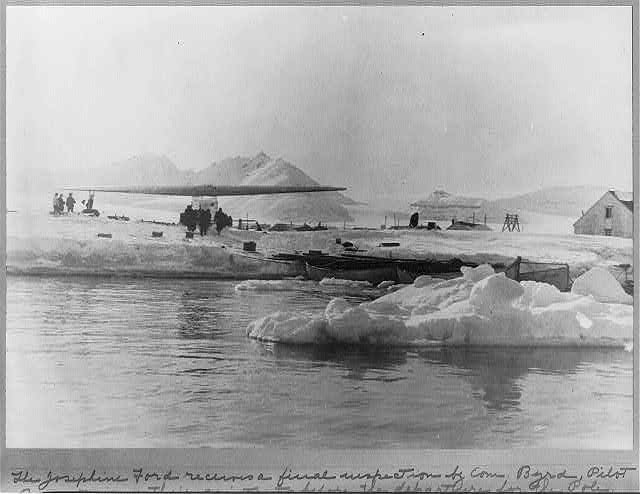
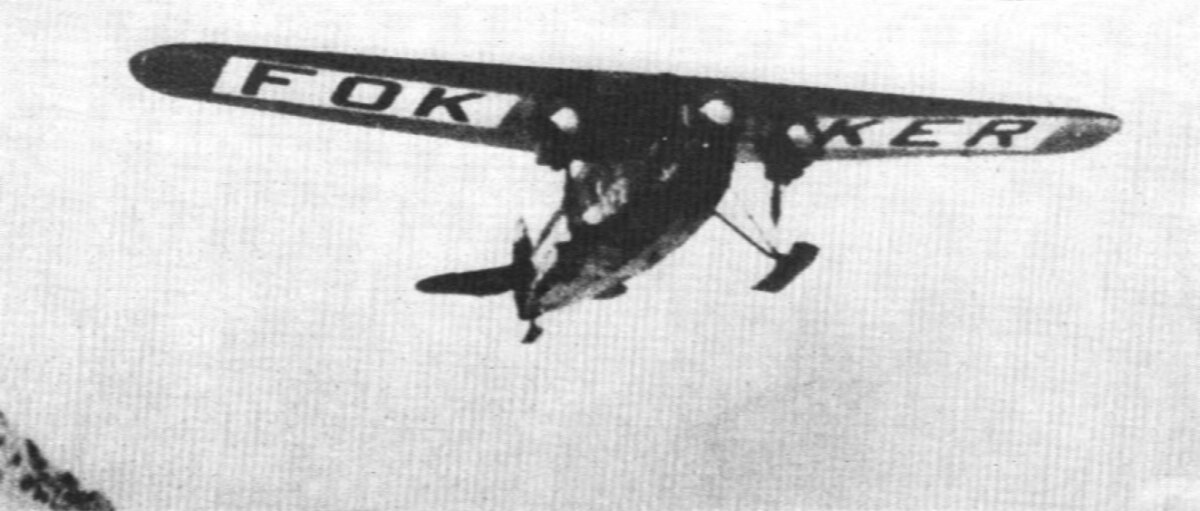
Byrd arrived with the Fokker F.VII Tri-Motor airplane, which he had christened the Josephine Ford, after the daughter of his sponsor.
The final preparations for the flight to the North Pole were being assembled. The snow, however, was so deep that it appeared the plane would not be able to lift off. Their first attempt had failed, and Byrd was certainly concerned that the entire expedition would literally not get off the ground.
On May 7, Amundsen’s Norge arrived. Time was indeed of the essence. According to Byrd, he and Bennett “decided that [they] would give the plane the full power of her three motors and to get off the snow or crash the plane. … [They] were in the plane dressed to go and ready to take whatever fate had in store for [them]—ignominious failure, or a great opportunity for a great adventure over the unknown.”
It was during this week in history under the bright midnight sun, at just past midnight Greenwich time on May 9, 1926, that Byrd and Bennett lifted off from Spitsbergen in search of the North Pole.
Claiming the Pole
After more than nine hours in the air, Byrd and Bennett neared the North Pole, at which time Byrd took four sextant observations, which according to a National Geographic Society report, “confirmed his dead reckoning position of the Pole.”
The North Pole remained visible to the aviators for approximately two hours. It was during this time that Byrd and Bennett became the first to fly over the North Pole. Shortly afterward, the two aviators encountered a bit of bad luck when the sextant “slid off the chart table, breaking the horizon glass.” The two professional aviators, however, utilized their ability for dead reckoning to successfully find their way back to Spitsbergen. The flight to and return from the North Pole took almost 16 hours.
After the expedition was reviewed by the National Geographic Society’s Board of Trustees, it was determined that Byrd’s “carefully and accurately kept” records “substantiate in every particular the claim of Commander Byrd that on May 9, 1926, he reached the North Pole by airplane, thus being the first person to reach the North Pole by aerial navigation.”
On May 11, Amundsen and his crew boarded the Norge and flew from Spitsbergen to Alaska. During this flight, Amundsen, too, flew over the North Pole. To Byrd’s eternal glory, however, he had beaten the great Norwegian explorer by mere days. Both Byrd and Amundsen continued their exploring, although the Norwegian tragically died in 1928 in a plane crash over the Arctic Ocean while looking for a lost airship.
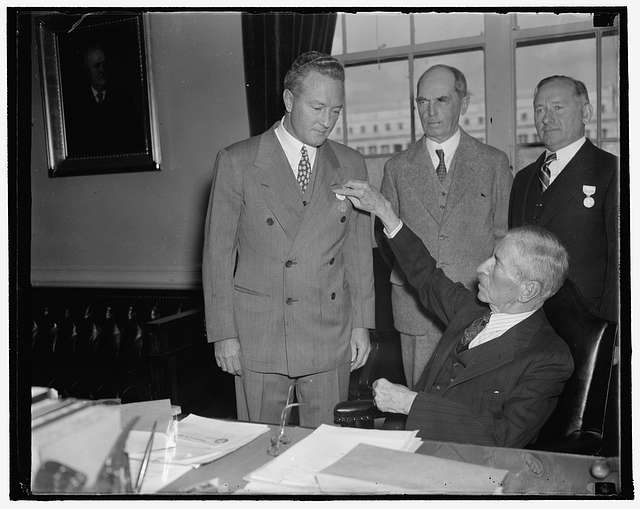
For Byrd’s North Pole efforts, he was awarded the Medal of Honor. He would become even more famous for his many South Pole expeditions, which included the first flyover of the South Pole.
Despite Byrd being credited for the North Pole flyover, there continues to be controversy over whether or not he accomplished the feat. As Byrd biographer Lisle Rose wrote in “Explorer: The Life of Richard E. Byrd,” Byrd had too much to lose to make a false claim. If he had made any false reports in his documentation, the author stated that “the world’s leading polar explorer” would have caught it.
“If there had been any unusual feature to be found in the polar sea ice field between Amundsen’s farthest north penetration the summer before and the pole itself—a small, ice-encrusted island or two, perhaps, or even a point of rock in an open area of water—and Byrd had not reported it because in fact he had not been there, Amundsen would have revealed it in a heartbeat,” Rose noted. “[Byrd] thus had to try for the pole—to go all the way—or risk utter disaster in claiming a feat he had not, in fact, accomplished.”
Never miss a This Week in History story! Sign up for the American History newsletter here.
What arts and culture topics would you like us to cover? Please email ideas or feedback to features@epochtimes.nyc