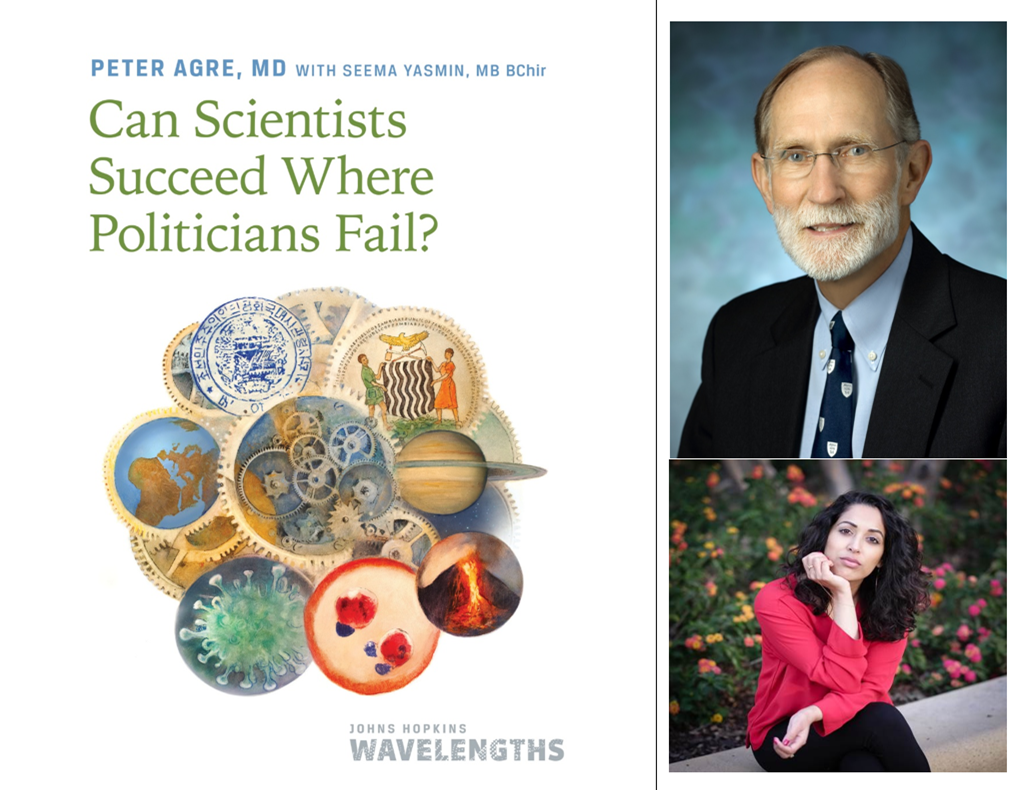
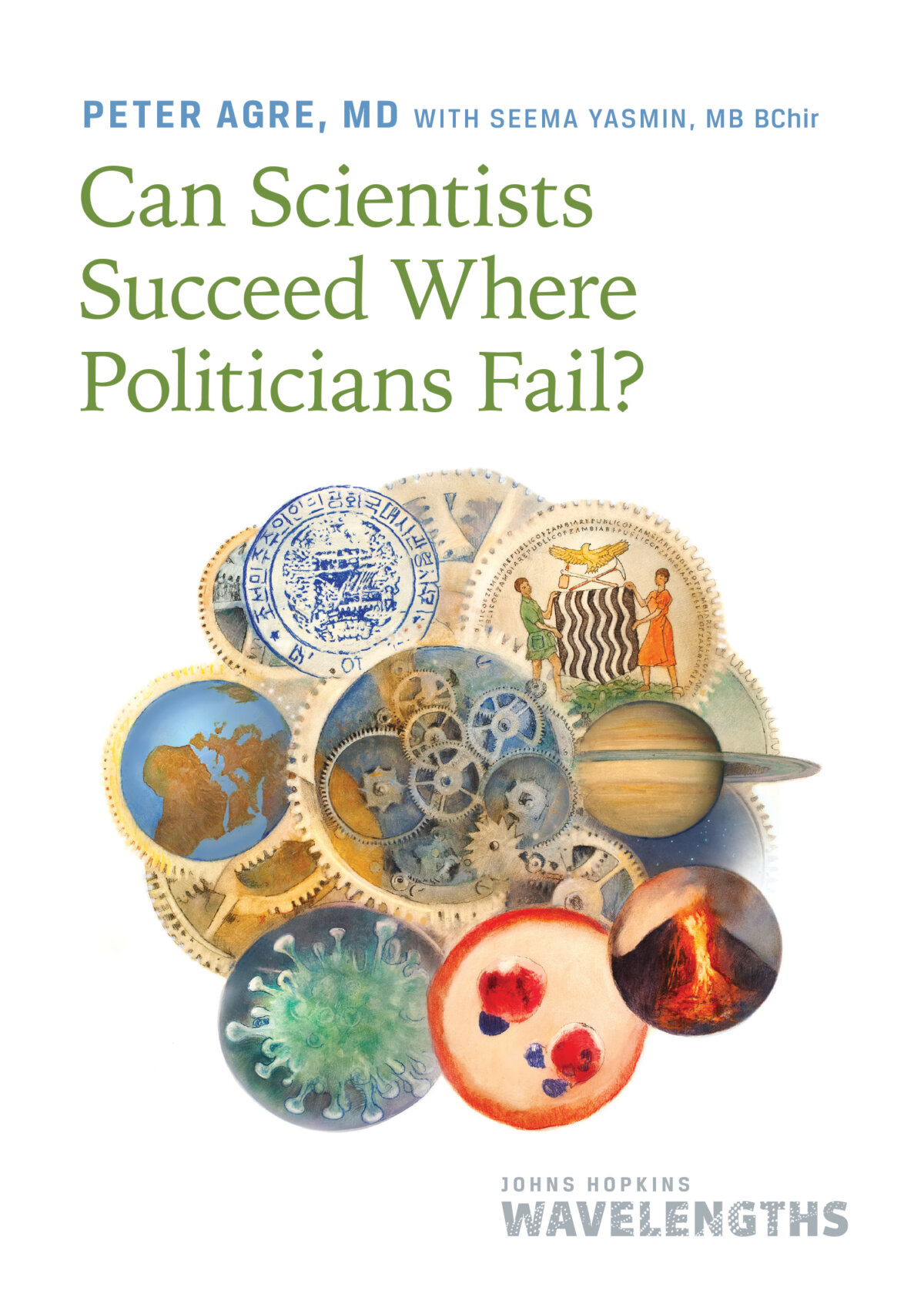
The concept of Peter Agre’s new book, “Can Scientists Succeed Where Politicians Fail?” is certainly bold: how scientists have the potential to serve as global ambassadors for peace. In his view, scientists are infinitely more capable of handling diplomacy and securing cooperation among rival nations than political leaders.
“Where politicians fail to reach consensus, scientists push for peace, ease stalemate negotiations, and remind us that challenges connect humanity more than they divide,” he wrote in the book’s introduction.
As a scientist, Dr. Agre certainly commands respect. A physician and molecular biologist, he won the 2003 Nobel Prize in Chemistry (shared with Roderick MacKinnon) for his discovery of aquaporin proteins, which form the channels that enable water to flow in and out of cells.
His term as the 2009 president of the American Association for the Advancement of Science (AAAS) enabled him to travel globally and meet heads of state.
While Dr. Agre has no shortage of entertaining stories to share about his trips to such nations as Cuba, Iran, and North Korea, he never provides an affirmative answer to his book’s provocative title.

Indeed, “Can Scientists Succeed Where Politicians Fail?” would have been more successful if it was packaged as a straightforward autobiography rather than put forth as a wobbly mix of anecdotes and agitprop.
Dr. Agre claims that he first saw the possibility of becoming a “science diplomat” as a teenager in 1964. His father, the chairman of the chemistry department at Augsburg University in Minnesota, brought Linus Pauling to the campus and the family home. Pauling had won the Nobel Prize in Chemistry in 1954 for his research into the nature of the chemical bond.
But the young Agre was more inspired by Pauling’s 1962 Nobel Peace Prize for his activism against nuclear weapons testing. Two years later, Dr. Agre took a high school camping trip through Scandinavia and the Soviet Union that further encouraged him to wonder about making medical science his “global diplomatic path.”
The Nobel Prize and AAAS presidency enabled Agre to pursue that idealistic teenage dream. But his diplomatic initiatives only produced cordial encounters with a few high-ranking leaders where he was mostly a passive observer.
Meeting World Leaders
In a 2009 visit to North Korea, he was given a tour of Pyongyang classrooms by “Great Leader” Kim Jong-il. At the end of the conference, he was handed a speech that he was expected to read.
He met Fidel Castro in Havana in 2011. During the meeting, the then-retired Cuban leader talked nearly nonstop for three and a half hours on subjects ranging from Cuba’s medical profession, to his formative years, to his favorite books (which included Gore Vidal’s “Lincoln”).
In 2012, Agre was in Tehran, Iran, for a scientific conference when he was summoned for a hastily arranged meeting with Iran’s then-President Mahmoud Ahmadinejad. Despite the Iranian leader’s reputation for corrosive anti-American rhetoric, Dr. Agre found him “docile” and noted how he talked about cooperation among nations.
Dr. Agre mentions that at least five Iranian nuclear scientists were assassinated between 2007 and 2021 and points to the Mossad, Israel’s intelligence agency, as being responsible. However, he seems curiously blasé regarding the concerns by the United States and European nations that Iran’s nuclear activities carried a bellicose military aspect.
It’s obvious that Dr. Agre views the political world through a progressive lens. This is quite pronounced in his discussion of sub-Saharan Africa.
He reminds the reader how science “enabled Western colonialism for centuries, from advanced navigational instruments that allowed enslavers to chart oceans to quinine itself … [in] the malaria-inflicted regions of Africa where they staked claim to the land of the native populations.”
He’s also unhappy at how Western governments and nonprofits supposedly force their healthcare and wellness agendas on African populations. He ignores the many positive results of these efforts, most notably the eradication of smallpox.
‘Tripoli Six’
Ultimately, Dr. Agre’s thesis is tripped up by the case of the “Tripoli Six.” From 1999 to 2007, five Bulgarian nurses and an Egyptian-Palestinian physician were jailed and tortured in Libya on charges they infected pediatric hospital patients with HIV.
British biochemist and Nobel Laureate Richard Roberts teamed with Robert Putnam, a member of the National Academy of Sciences and former dean of Harvard University’s Kennedy School of Government, to lobby Libyan leaders for the release of the prisoners. Dr. Agre wrote a letter to Libyan dictator Col. Muammar al-Gaddafi on their behalf.
But ultimately, their freedom was secured by politicians from the European Union and Bulgarian President Georgi Parvanov, not the scientists.
To his credit, Dr. Agre is keen observer of the many cultures he encountered, and he provides some interesting insider views of how celebrity-level scientists are feted.
Journalist Seema Yasmin has co-author status on the book, and one can assume her deft writing skills kept Dr. Agre’s recollections and theories from veering into academic starchiness. This is notable in sections on the history behind several significant medical breakthroughs in the fights against malaria and hepatitis B.
‘Can Scientists Succeed Where Politicians Fail?’
By Peter Agre with Seema Yasmin
Johns Hopkins University Press: Oct. 21, 2025
Paperback, 265 pages
What arts and culture topics would you like us to cover? Please email ideas or feedback to features@epochtimes.nyc