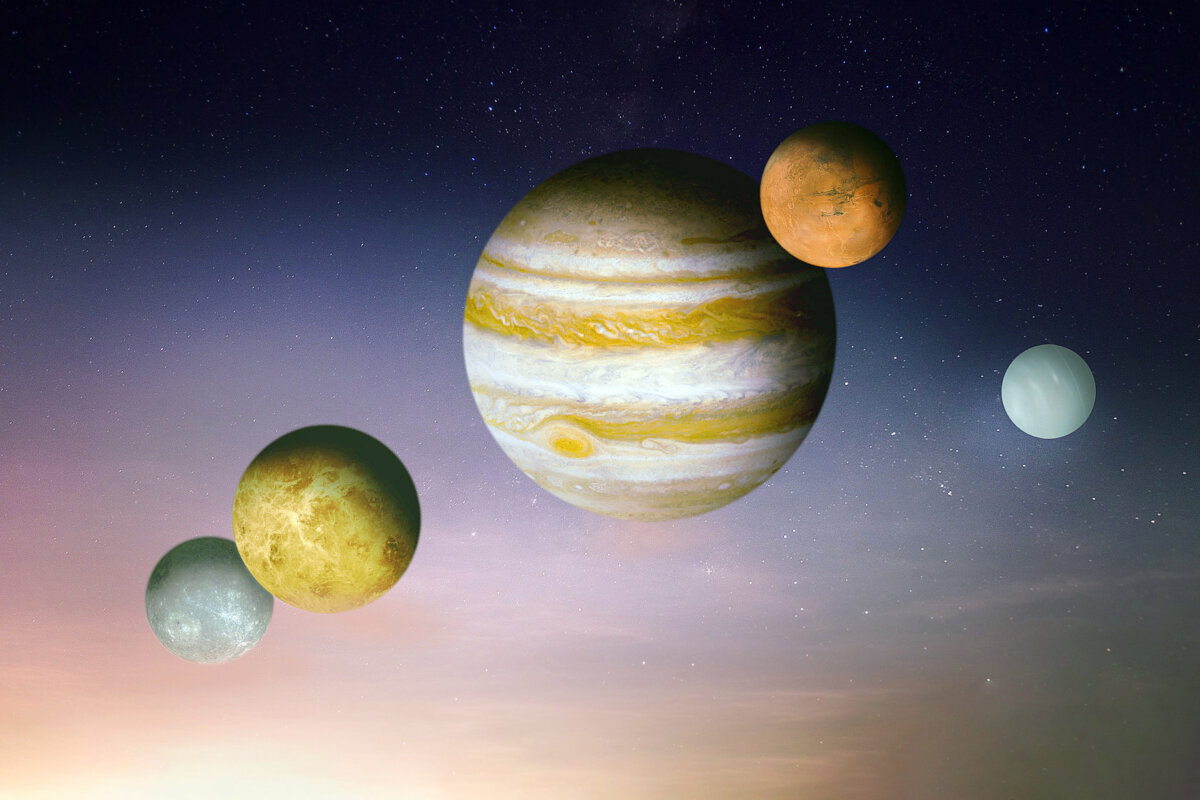
The pop-up notification will push onto smartphones next month, scrambling avid star -watchers to scout for a “planet parade” in the night sky using their astronomy apps.
From Nov. 12–28, a parade of planets, or planetary alignment, will string together five celestial bodies along a vast trail stretching nearly two billion miles long. For observers on Earth, the lineup will fit neatly inside a single field of view. Weather permitting, most locations on Earth with an open sky will gain front-row seats.
Uranus, Mars, Jupiter, Venus, and Mercury will form a ragged row along a superhighway in space. For anyone hoping to observe a perfect straight line, astronomers will point out that the planets don’t square up like that; while their orbital planes lie basically flat with one another, they aren’t perfectly flush, which explains why the planets wobble up and down as they travel the arc of the sun, or ecliptic. And that’s why alignments are never mathematically straight.
Scientists realized that people didn’t care about mathematical precision in alignments throughout history. The loose lines were straight enough for cultures to see them as important omens. They predicted floods and the downfall of empires. So alignments were defined loosely: either when three or more planets gather on one side of the sun, or when more than two planets are visible within a narrow sky sector.
On Nov. 14, Uranus will be the first to rise when the planets meet those definitions. This ordinarily dim ice giant, the seventh planet from the sun, will reach its yearly maximum brightness. It will be nearly in opposition to the sun—the planetary equivalent to a full moon. So, like full moons, Uranus will rise at sunset and reach its peak around midnight. Yet this vanguard of the parade will, as always, understate its presence; viewers will need binoculars to find the faded blue smudge of Uranus in the constellation Taurus.
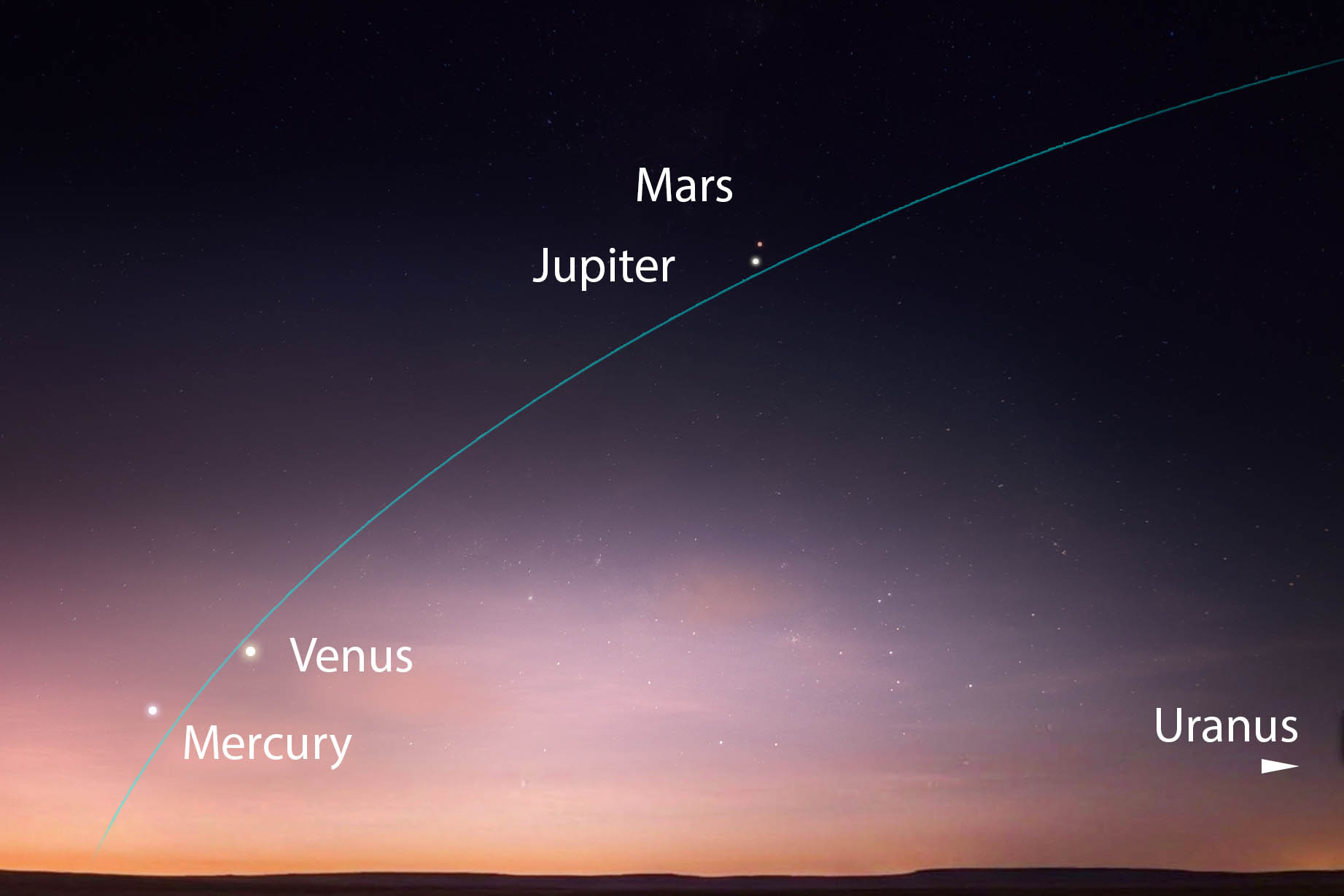 A depiction of the planetary alignment on Nov. 14, 2026. (The Epoch Times/Shutterstock/ANON MUENPROM)
Hours will pass and it will seem like the rest of the parade got left behind. Then Mars and Jupiter finally arrive, emerging from the smog of the horizon around 3 a.m. Trough the naked eye (no binoculars needed), one will observe the red planet looking like a rusted copper penny next to the unblinking white glare of the gas giant. They will sit tightly wed within constellation Leo the Lion. With Mars sitting just a finger’s width west of Jupiter, the duo will qualify as a planetary conjunction, the highlight of the night.
Viewers will have to wait until pre-dawn before the final flourish, as the parade is expected to favor early risers. Just after 4 a.m., the brilliant “morning star” Venus will rise in the dark, followed by the sun-hugger Mercury to the east at 5:15 a.m. They will anchor themselves inside the constellation Virgo. This exclusive club of inner solar system planets rises as the sky softens to the east, always at risk of being washed out by the light at dawn.
The viewing window for the full lineup of five planets is very slim, since Uranus sets promptly at sunrise. In many locations, the parade vanguard will have already dipped well below the horizon.
The busy morning commuter probably won’t see much, however; planetary alignments are quiet serenades. But while they were once mainly just for backyard astronomers and NASA scientists, they are now becoming less exclusive as the availability of astronomy apps has grown. With apps like Stellarium Mobile and Star Walk 2, you can just point your phone at the stars and the names and positions of the planets appear. Presto.
For just a few days next month, a stellar necklace stuttering for millions of miles will make Earthly distractions fade. The stressful news, scam ads, and mindless scrolling on social media will all dissolve into the timeless scrolling of the heavens. There’s nothing like a parade in the sky to make our increasingly complex world seem small.