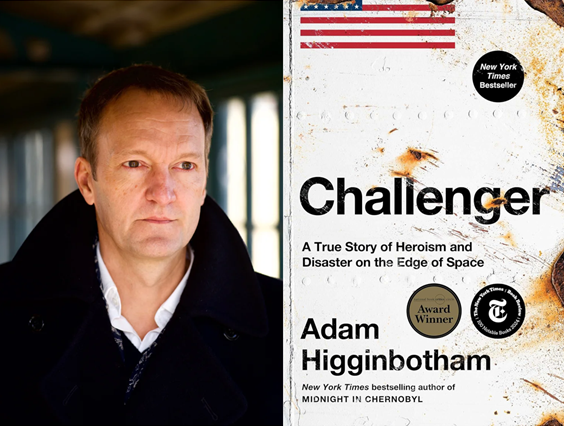
The Challenger disaster occurred 40 years ago this year. On Jan. 28, 1986, the Space Shuttle Challenger disintegrated 73 seconds into the 25th launch of the Space Shuttle program. It was mission STS-51-L. All seven people aboard were killed, including Christa McAuliffe, the first participant in the Teacher in Space Project.
“Challenger: A True Story of Heroism and Disaster on the Edge of Space” examines the tragedy. In this award-winning book, British-American writer Adam Higginbotham gives a comprehensive look at NASA, its culture in 1986, the events leading up to the launch decision, and the aftermath of Challenger’s loss, including the investigation into the causes of the loss.
The book opens with the 1967 Apollo 1 capsule fire on Launch Complex 34, which killed its three astronauts. Its relevance is due to similarities with Challenger’s loss. Both in 1967 and in 1985-86, NASA had “Go fever”—the desire to launch as quickly as possible, even when that meant compromising safety. Problems with the Apollo capsule were ignored until they led to disaster.
Higginbotham shows how NASA recovered from that disaster, utilizing design changes and a new emphasis on safety. He follows the Apollo program through initial success to national boredom with the program (including criticism that it was wasting money better spent on Earth) to its eventual end at Apollo 17.
He shows what NASA chose next—a reusable spaceplane to transform access to space into airline service. Budget cuts forced NASA to scale back its design and partner with the Air Force to get extra funding.
The result was the Space Shuttle, a manned vehicle that used solid rockets to get to orbit. The Space Shuttle had no crew recovery system, a first for manned spacecraft. It was also dependent on a bleeding-edge engine, thermal protection, and computer technology for success. NASA oversold its capabilities and reusability to get funding.
The result was a chronically underfunded program that blew past deadlines and exceeded budgets, while remaining critically short of spare parts. Nevertheless, NASA doubled down on the promises, recruiting new astronaut classes to meet the predicted launch rate.
The new recruits broke the old test-pilot template for astronauts. The “Thirty-Five New Guys” included women and minorities, most of whom weren’t pilots.
Subsequent chapters follow both the X-15 program (which also had an in-flight fatality) and the Space Shuttle program through the first 24 missions before the fatal mission STS-51-L.
These chapters capture the atmosphere of NASA during the early years of the Shuttle program. The first launch was nearly four years late, and the Shuttle was declared “operational” after the fourth mission. At that point, it was still an experimental vehicle, but NASA had trapped itself by its aggressive overselling of the program. Launch cadence pressure increased throughout this period until NASA began ignoring safety.
Higginbotham follows the careers of the seven individuals who flew on STS-51-L. They included five astronauts, a civilian payload specialist from Hughes (a satellite company), and the “teacher in space,” Christa McAuliffe. She proved a charismatic ambassador for NASA; McAuliffe was an everywoman who came across as your neighbor, someone you would have coffee with.
From there, he looks at the launch and what went wrong. He captures the enormous pressure to launch. The country was waiting for the teacher in space to get to space. President Reagan was supposed to talk about the space program in his State of the Union speech. There’d been a series of launch scrubs for stupid reasons. No one wanted another stupid reason not to launch.
Instead, NASA ignored a good reason to scrub the launch. Morton–Thiokol engineers urged that the launch be postponed due to the effect of cold on the solid rockets.
Ignoring Safety
Marshall Space Flight Center management turned safety rules upside down. They forced the Thiokol engineers to prove it was unsafe to launch, instead of demonstrating whether it was safe to launch. When Rockwell International engineers, the builders of the orbiter, recommended against launching, they were ignored.
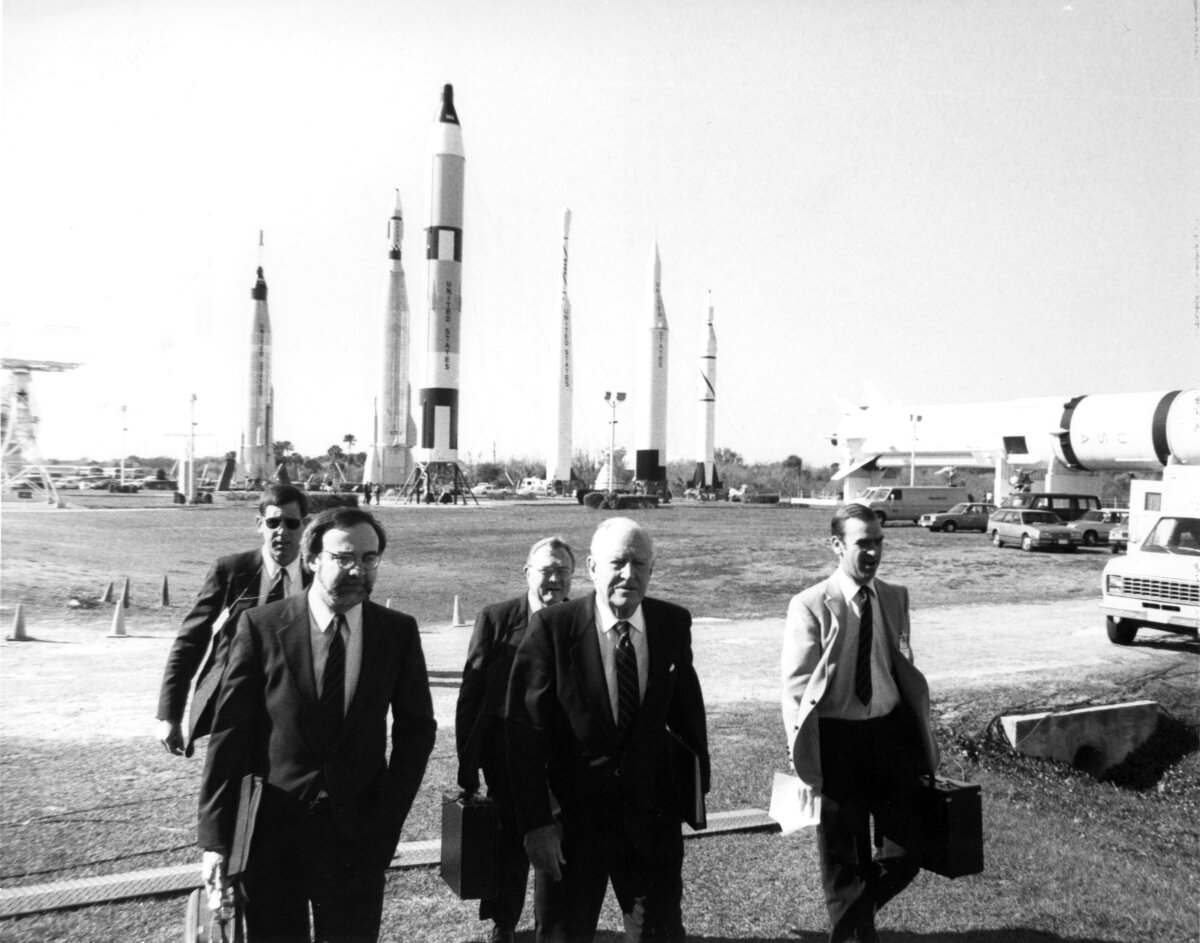
Higginbotham then shows the aftermath. NASA gave the impression of covering up the cause. Reagan commissioned the independent Rogers Committee to investigate. It included Richard Feynman, then dying of cancer.
The commission quicky found the cause: a leak in the solid rockets due to a design flaw. While NASA accepted the commission’s recommendations (including a blistering appendix by Feynman), they were eventually forgotten. This, unfortunately, led to a similar catastrophe with another orbiter, Columbia, in 2003.
“Challenger” is an excellent analysis of what happened and why. Higginbotham gets the technical details right without getting bogged down in jargon.
The author captures the mood of the program in the months leading up to Challenger perfectly. (I can attest to this, since I was employed in Mission Control during that time.) Most people saw the increasing willingness to take larger risks, yet few were willing to risk careers to shout “stop!”
Higginbotham also captures the tragedy’s traumatic effect on the nation. Christa McAuliffe had become America’s sweetheart. Those who lived through it—many of whom watched the launch live—will never forget. For anyone under 40, this book is worth reading.
‘Challenger: A True Story of Heroism and Disaster on the Edge of Space’
By Adam Higginbotham
Avid Reader Press, Simon & Schuster: Jan. 27, 2026
Paperback, 576 pages
What arts and culture topics would you like us to cover? Please email ideas or feedback to features@epochtimes.nyc