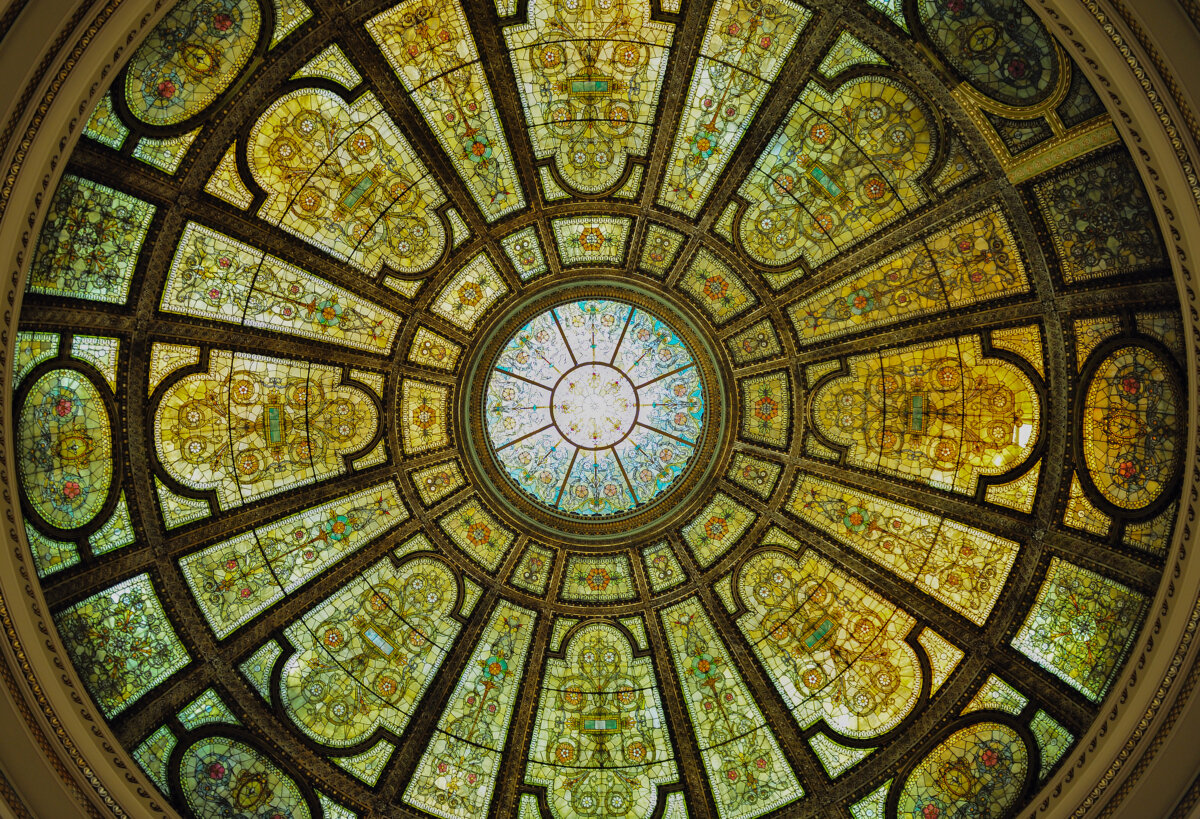
Limestone has often been the sedimentary rock of choice for the construction of extraordinary structures, primarily because of the stone’s durability and workability. The Chicago Cultural Center’s walls, made of Indiana limestone, are 3-feet thick. The masonry structure, adorned with symmetrically aligned arches and columns, sits atop a granite base. (Roy Harris/Shutterstock)
What was once Chicago’s main public library has become an art exhibition center and prominent reception and event venue in America’s third-largest city. The circa-1897 building was designed by the Boston firm Shepley, Rutan and Coolidge.
The building’s restrained exterior of limestone block, conveying classical Greek and Roman design elements, contrasts with the lavishly palatial interior. Rooms modeled after esteemed sites such as the Doge’s Palace in Venice, Italy; the Palazzo Vecchio of Florence, Italy; and the Acropolis in Athens, Greece, have earned the structure the informal moniker “The People’s Palace.”
The building offers two entrances, a four-story north wing on East Randolph Street and a five-story south entrance on East Washington Street. Many of the interior spaces in each wing are stunning in their various marbles, carvings, and mosaics.
The Chicago Cultural Center is known for primarily showcasing a dramatic dome in the building’s two wings. These beautiful, artistic focal points were also designed for practicality. Individually, they serve as skylights, allowing illumination into the spaces during the day. Public buildings were just becoming equipped with electric lighting in the late 1800s.
Listed on the National Register of Historic Places, the Chicago Cultural Center underwent a thorough renovation from 2021 to 2022. Most original materials were saved and restored.
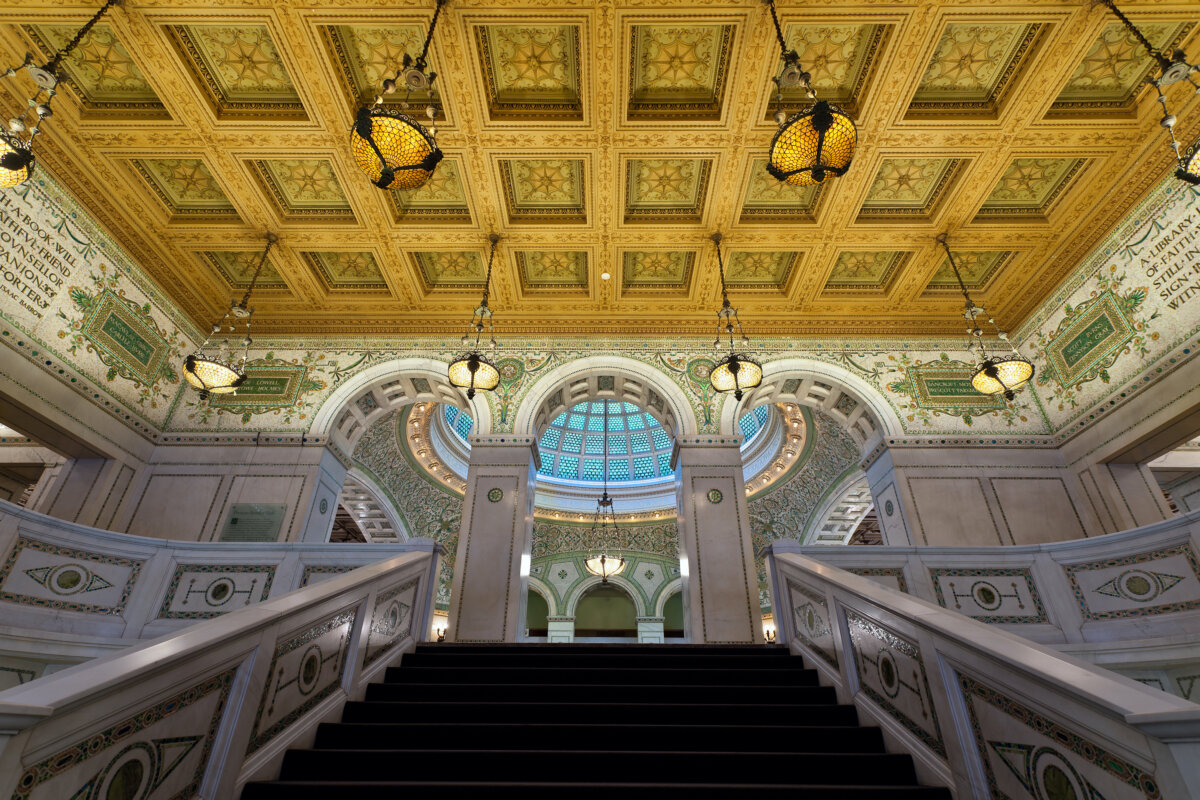
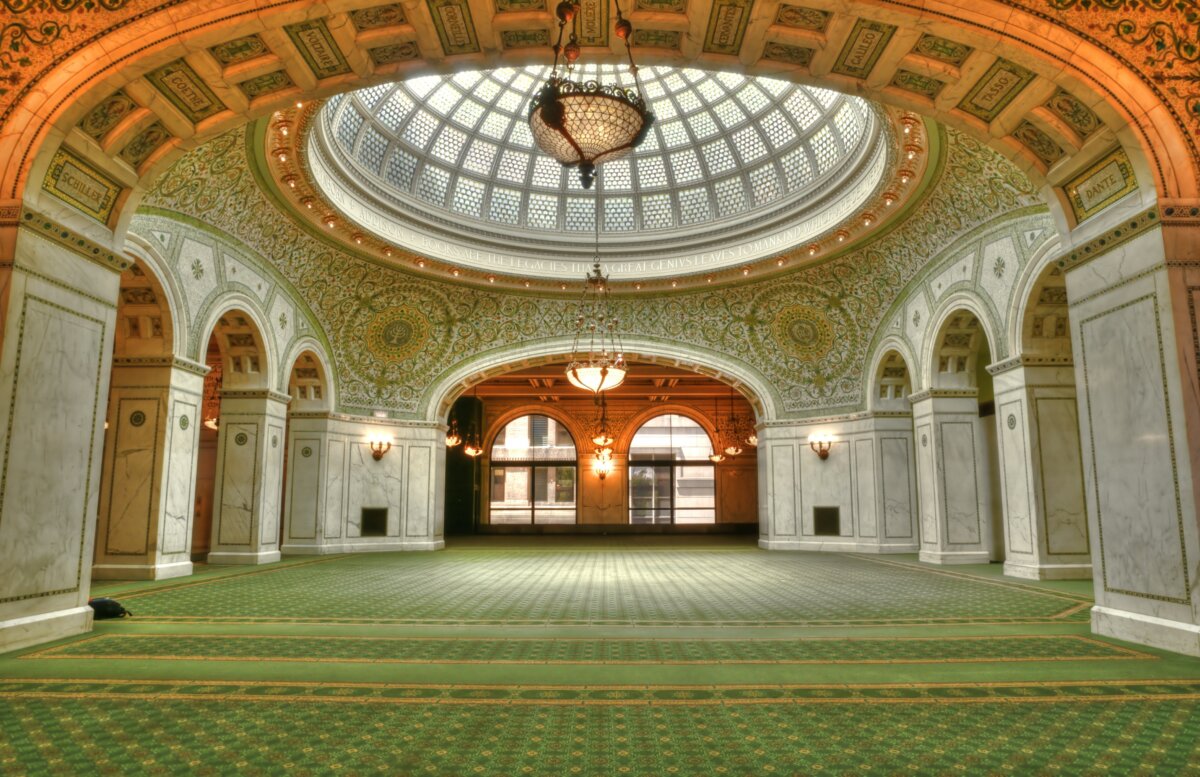
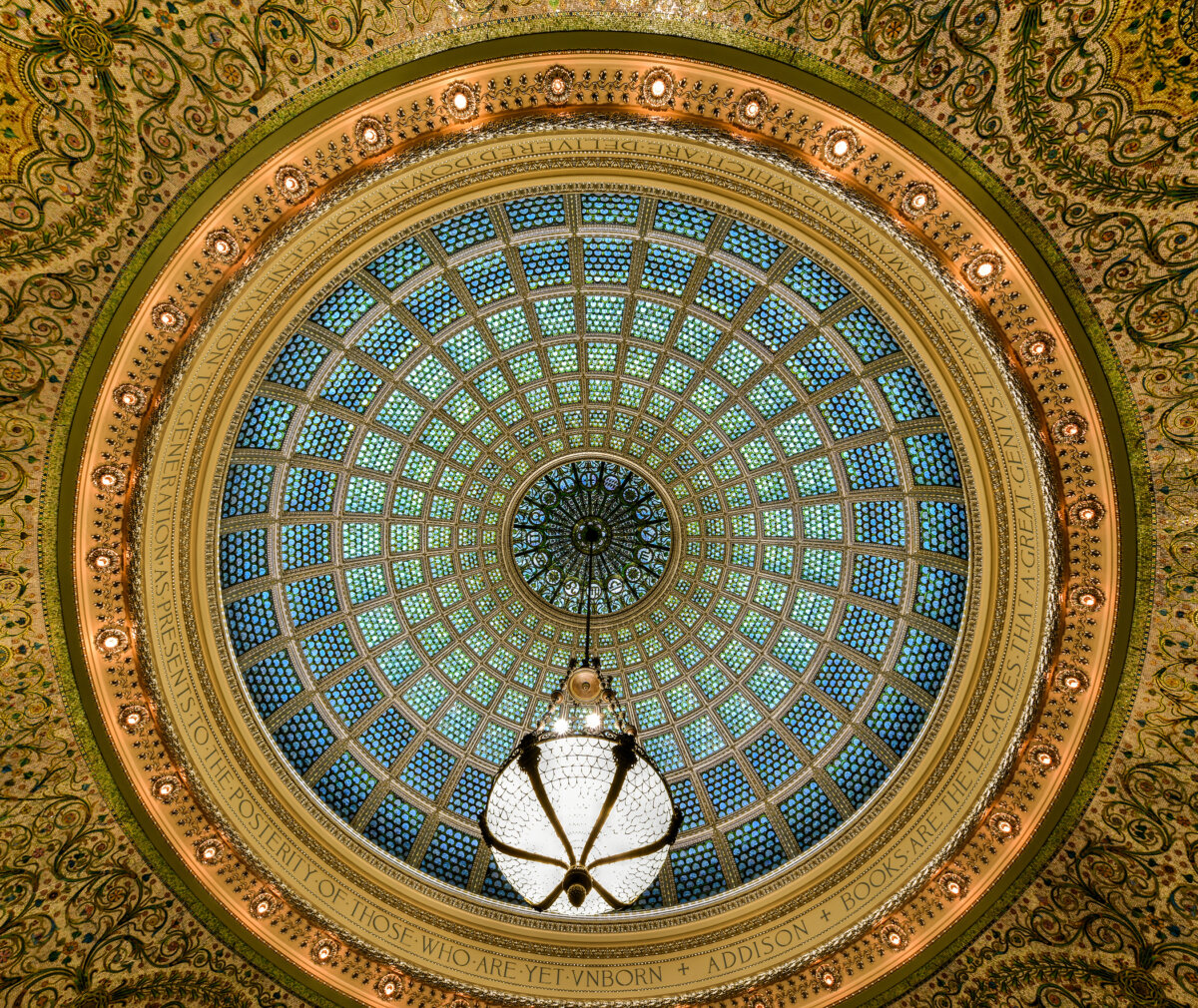
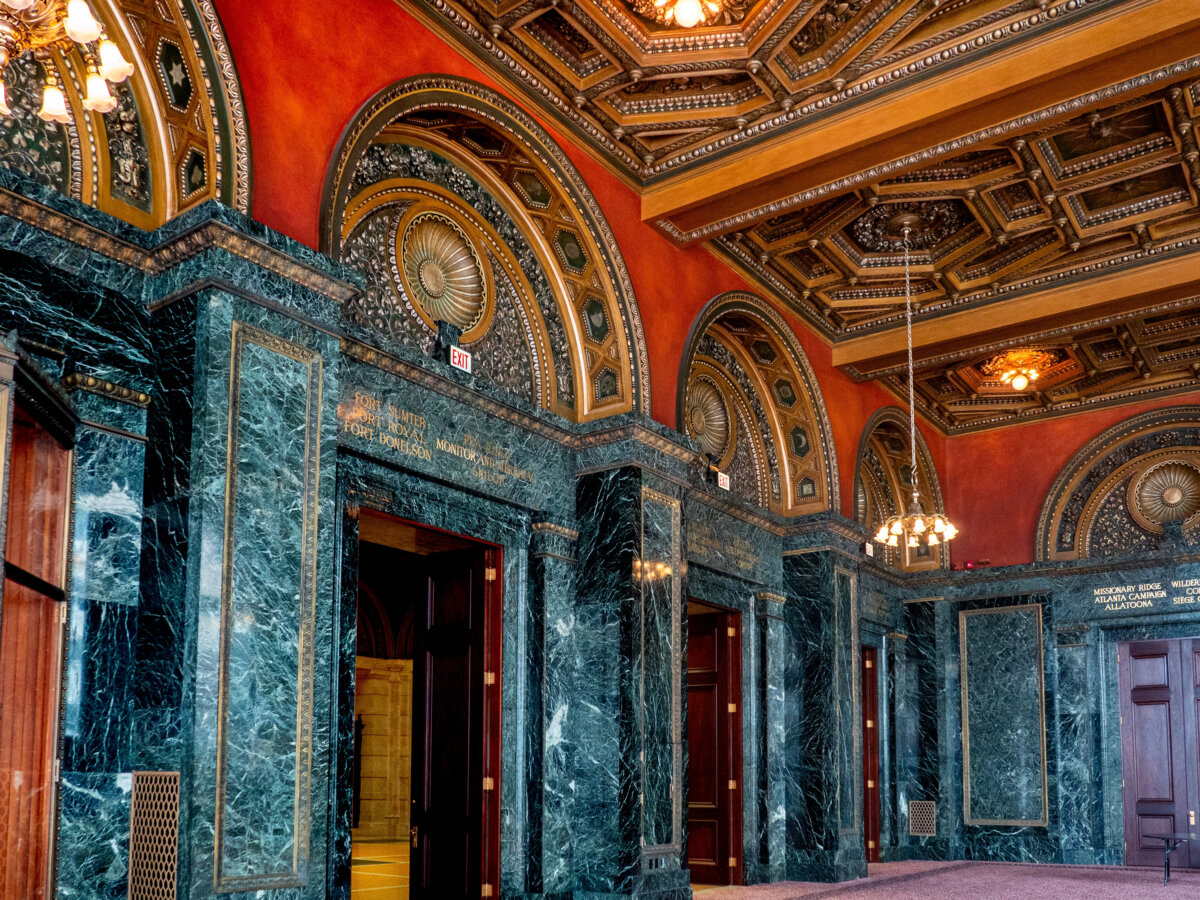
This corner view of the Chicago Cultural Center displays neoclassical architectural accents such as lion’s head mascarons, intertwined with swags and ribbons within the entablature; a cornice featuring decorative corbels atop a trim of dentil molding; beaded trim; square block columns with ornamental-layered capitals; and fluted columns with Ionic capitals. (James Conkis/ CC-BY-SA-4.0) This wide, white, Italian Carrara marble staircase inlaid with green, Irish Connemara marble is just inside the building’s Washington Street entrance and was intended as an opulent introduction to Chicago’s main library when it was completed in 1897. It leads to a coffered ceiling landing that opens through majestic arches to the Preston Bradley Hall. Glass mosaic patterns and quotes by famous literary figures are above the white Carrara marble walls. (Rudy Balasko/Shutterstock) The spectacular mosaic display surrounding the room’s core glass dome is made of favrile glass (hand-blown art glass), mother-of-pearl, and semiprecious stones. Even the room’s arches, supported by Carrara marble pillars, are bejeweled with mosaic designs, primarily scrolls and rosettes. The room’s lighting fixtures, wall sconces, and chandeliers were designed and constructed by the Tiffany Glass and Decorating Co. of New York. (Saurabh13/Shutterstock) The dome in Preston Bradley Hall contains more than 30,000 individual pieces of glass. Considered the world’s largest Louis Comfort Tiffany art glass dome, its design is a presentation of 12 zodiac signs. The dome is 38 feet in diameter and its art glass is installed in more than 200 sections of a cast-iron frame. The circular base border of the dome includes lighted rosettes. (Felix Lipov/Shutterstock) Featuring nine pairs of 14-foot-high mahogany doors, as well as cherrywood-lined display cases, the Grand Army of the Republic Hall was initially used as a museum for Civil War artifacts. The hall’s name originated as a way to honor Union veterans. In fact, the wood cases once displayed such memorabilia as Ulysses S. Grant’s saddle, Gen. William T. Sherman’s uniform, and George Custer’s hat. Its variegated, dark green marble columns and walls are trimmed in bronze. Silver leaf embellishments in the metal and plaster ornamentation within the half arches and coffered ceiling represent different Civil War regimental symbols. Most are outlined in such classic molding design trims as bead or rope. (bodhichita/Shutterstock) Inside the Grand Army of the Republic Hall is a stained-glass dome created by the firm Healy and Millet. Measuring 40 feet in diameter, the dome highlights a myriad of floral patterns. The more than 60,000 pieces of glass are contained in 145 curved cast-iron panels. (Songquan Deng/Shutterstock)
What arts and culture topics would you like us to cover? Please email ideas or feedback to features@epochtimes.nyc.
A 30-plus-year writer-journalist, Deena C. Bouknight works from her Western North Carolina mountain cottage and has contributed articles on food culture, travel, people, and more to local, regional, national, and international publications. She has written three novels, including the only historical fiction about the East Coast’s worst earthquake. Her website is DeenaBouknightWriting.com