



“We are alike, though we think we are different,” says Kalama Becker, whose Ph.D. thesis carries the sub-title: The Case of Brazilian Immigrants in Japan.
When she told her thesis adviser that she is one-of-a-kind, and that she marches to her own drummer, he cautioned, “You may be a pioneer, but you know how we find pioneers on a trail with arrows on their backs.”
Kalama was born and raised in Buffalo, NY, till she was 19.
Her mother still lives in the house. In her teens, three events woke her up.
She says, “I was run over by a truck. I rode solo from Buffalo for 9,000 miles, including 22 states, to Mexico and back. I searched for my birth mother—Shirley and Richard Becker were not my biological parents.”
Later, when she met her biological mother, Kalama heard the story of why Jayne, at age 42, gave her baby up for adoption.
In the '70s fashion, in their open marriage, Jayne had a child by someone other than her elderly husband whom she did not want to burden.
Ironically, within a week after Jayne gave Kalama up, her niece was born, and the child gave such joy to the elderly husband that Jayne regretted having given her own child away.
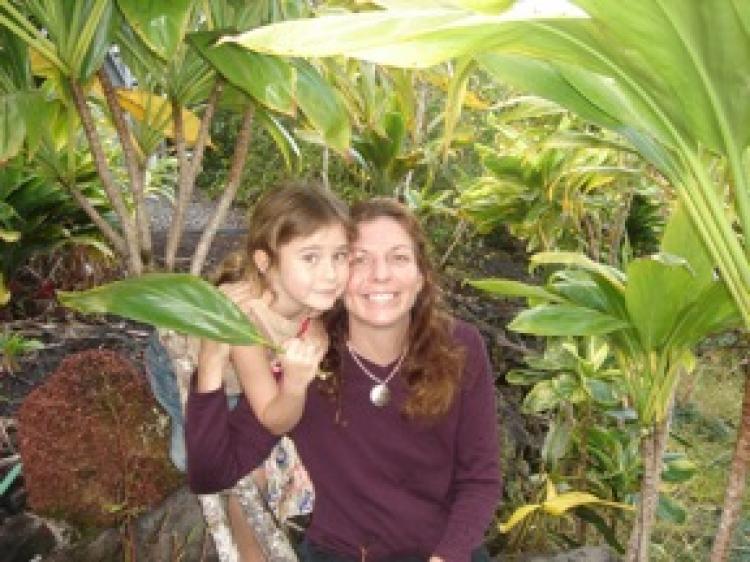
Kalama and her own child, Malia, come to EcoVillage in the warm season. The rest of the year they live in Hawaii, where they have a house, and Kalama teaches in the University of Hawaii’s Department of Communication.
