This year, the Eastern Orthodox Church commemorates “Pascha” (Easter) on April 12, according to the 2026 Julian calendar.
At Pascha, Greek Orthodox Christians worldwide greet one another with a hearty “Christos Anesti! (Christ is Risen!) Alithos Anesti! (Truly He Has Risen!).” And in their churches, they jubilantly sing the “Paschal Troparion,” or “Christos Anesti” hymn, a stanza of the Divine Liturgy that celebrates the miraculous resurrection of Jesus Christ from death to eternal life:
Christ is risen from the dead,
by death trampling death,
and to those in the tombs granting life!
As the congregation sings on, icons throughout the church illuminate the Divine Liturgy, and ignite sacred flames in faithful hearts. At Pascha, the “Anastasis” icon deepens their faith.
The Byzantine world depicts the Resurrection, or the Anastasis in Greek, as the “Harrowing of Hades” or the “Descent of Christ in Limbo,” when Christ tramples the gates of Hades and delivers the righteous from the bondage of death.
Chora’s Anastasis
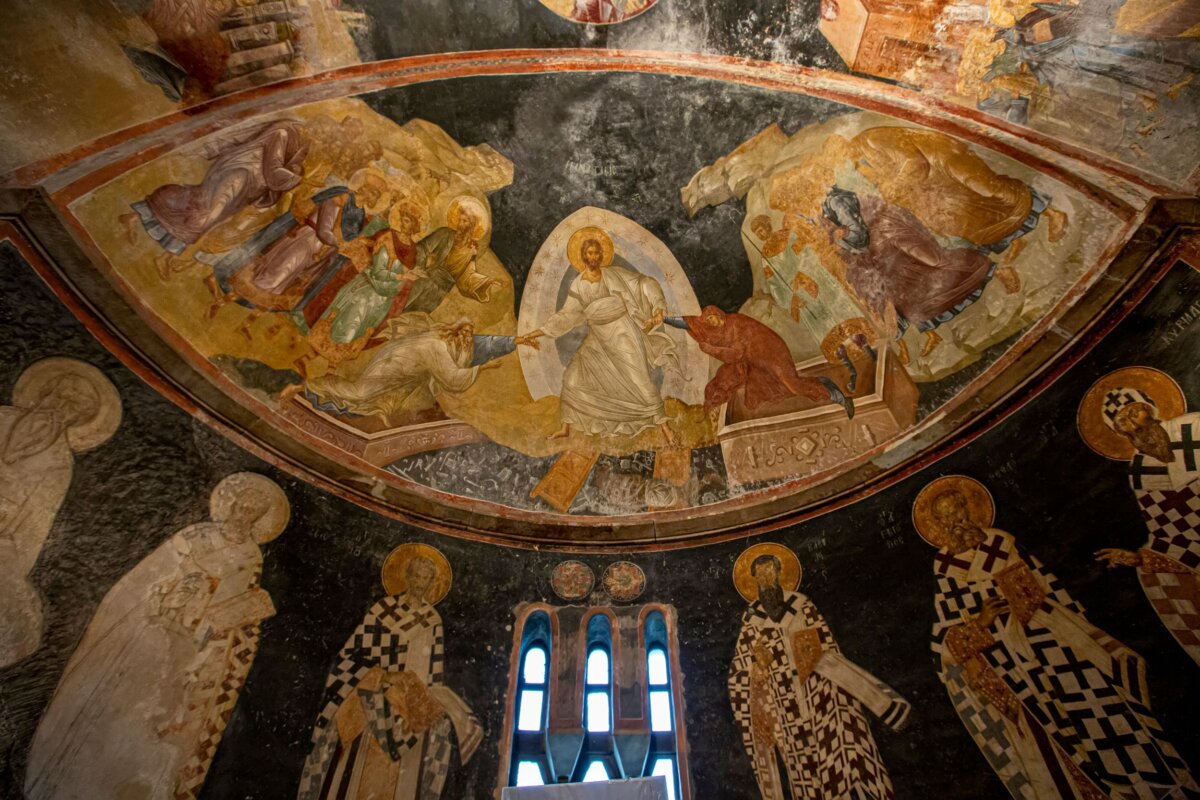
One of the world’s finest frescoes of the Anastasis was created around 1320 in the former Church of the Holy Savior of Chora, in Istanbul, Turkey.
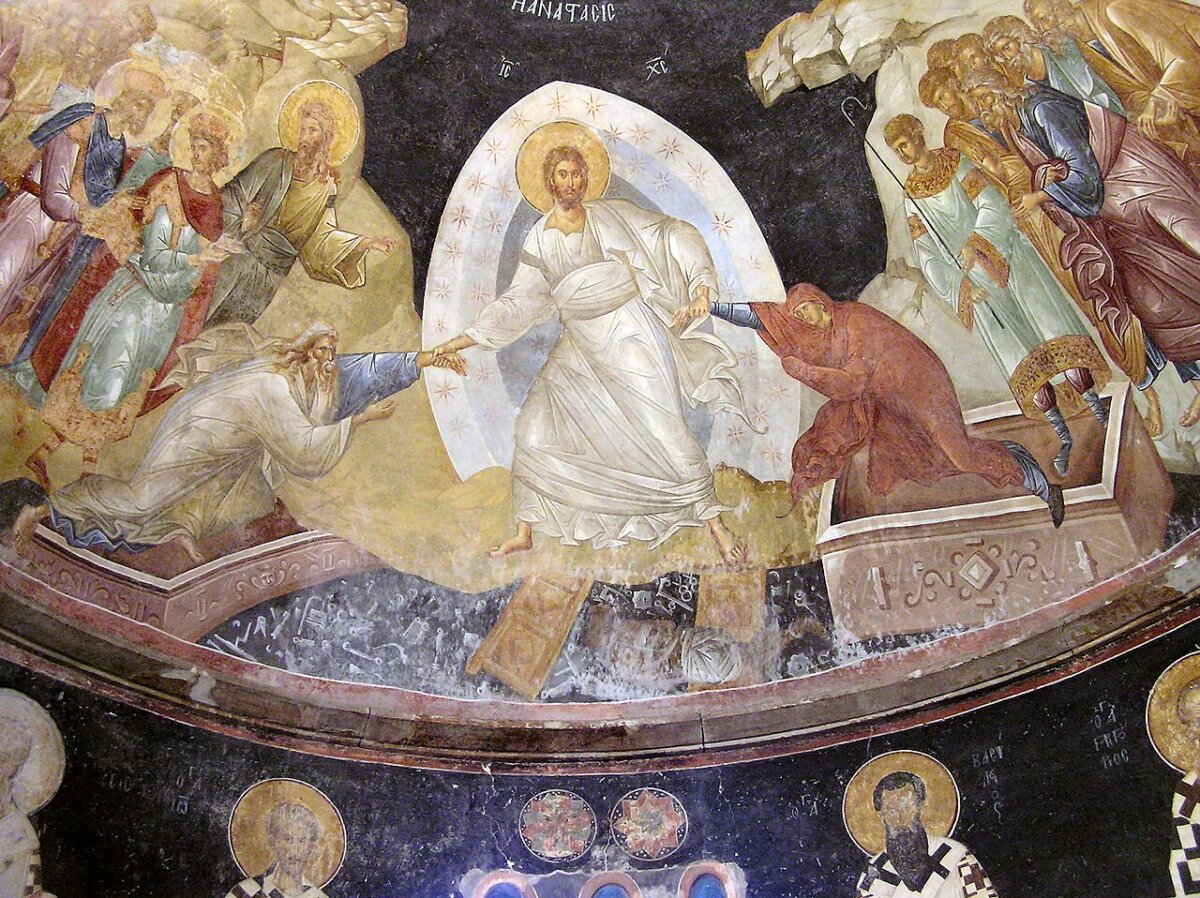
In the late-Byzantine fresco, a golden halo encircles Christ’s head, and a luminous almond-shaped energy field, called a mandorla, envelops his body. Both motifs symbolize his divine majesty and herald this miraculous event. Having trampled the gates of Hades and crushed Satan, Christ stands victorious, pulling Adam and Eve from their tombs. In a magnanimous gesture, Christ rescues them by their wrists rather than their hands, symbolizing that humankind cannot save itself—God alone grants salvation.
Flanking the central trio, righteous figures from the Old Testament all await their salvation from the brink of Hades’s abyss.
In “’Never as Gods’: Icons and Their Veneration,” theologian Constantine Scouteris wrote: “Icons have always been understood as a visible gospel, as a testimony to the great things given man by God the incarnate Logos.”
Reflecting on Pascha
In his 2025 Paschal video message, Archbishop Elpidophoros of America said:
“We are called to be the light of the world and not to hide our glowing goodness beneath baskets of self-indulgence and selfishness. Rather to be lampstands in the dark corners of the world and bring the warmth and illumination of love to every human being.”
What arts and culture topics would you like us to cover? Please email ideas or feedback to features@epochtimes.nyc.