



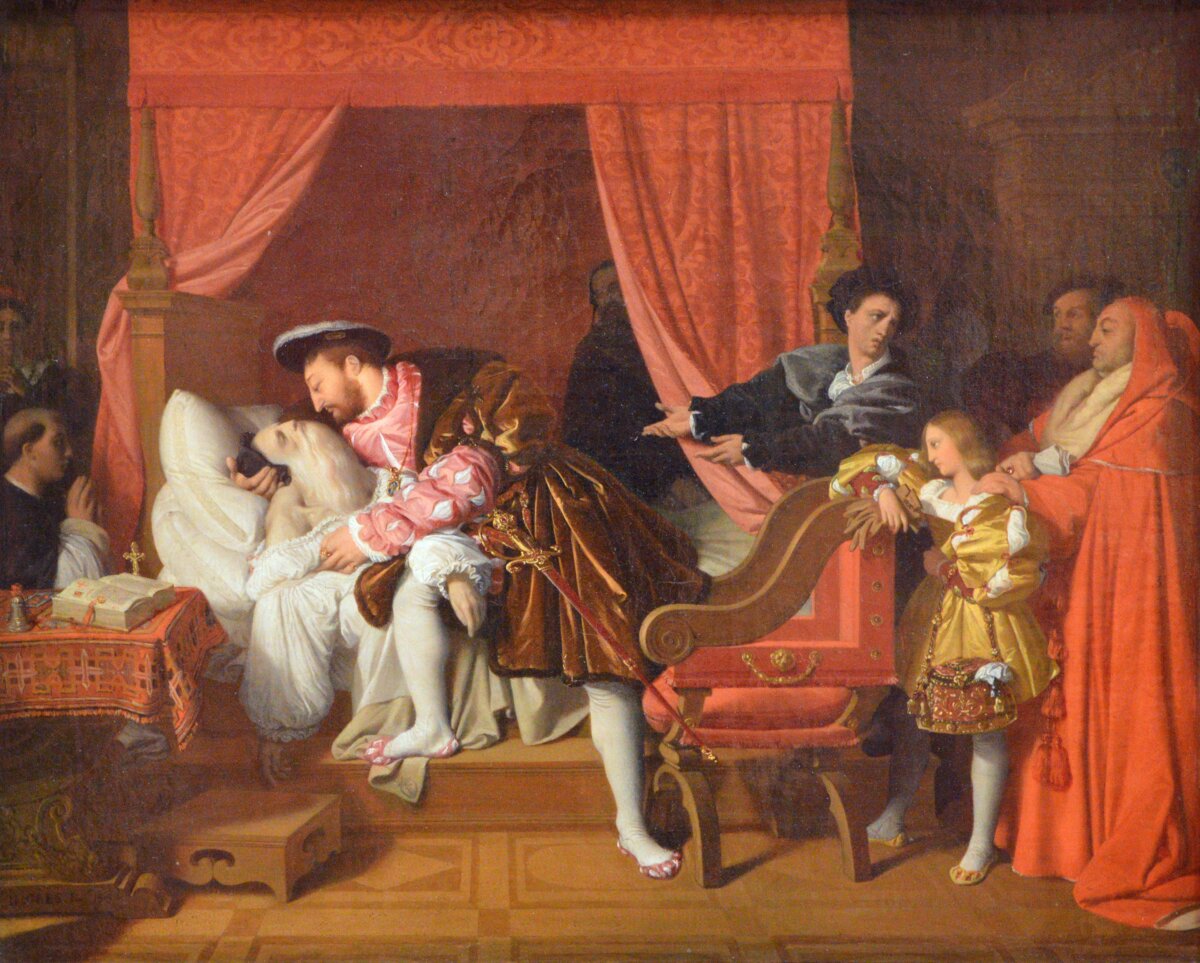
The scene of Leonardo da Vinci (1452–1519) on his deathbed has, for many centuries, been venerated beautifully in both writing and painting. Historians have hotly disputed the image depicting his dying hours, in which he is shown surrounded by his disciples and with his head cradled in the arms of King Francis.
The temptation to immortalize Leonardo as a grand artistic and scientific genius has overtaken both public and professional imaginations to the point of obsession. What is not contested about his death, but often left out of the glittering myths and movies, is his request for a priest and his last recorded words: “I have offended God and mankind because my work did not reach the quality it should have.”
How to reconcile this sincere regret with a legacy of paintings that today sell for hundreds of millions of dollars and designs and inventions centuries ahead of their time? His confession is likely reflecting the fact that he completed fewer than 20 paintings and abandoned many more in favor of his scientific pursuits, the vast majority of which never amounted to more than unpublished descriptions and sketches.
Yet the 7,000-plus pages of his notebooks that have survived (with 20,000 pages more still missing) provide insight into his personal and professional goals; they demystify many of the interpretations behind his work and reveal the ultimate goals he felt he had yet to achieve.
A Gifted Outcast
The name Leonardo comes from the provincial town where he was born out of wedlock. It was believed for centuries that his mother, Caterina, was a peasant. Recent findings reveal her to have been a slave belonging to and later emancipated by Leonardo’s father, a wealthy notary. Owning slaves was not uncommon for the wealthy at that time. Being an illegitimate child prevented, or freed, Leonardo from following his father’s career path as a notary.
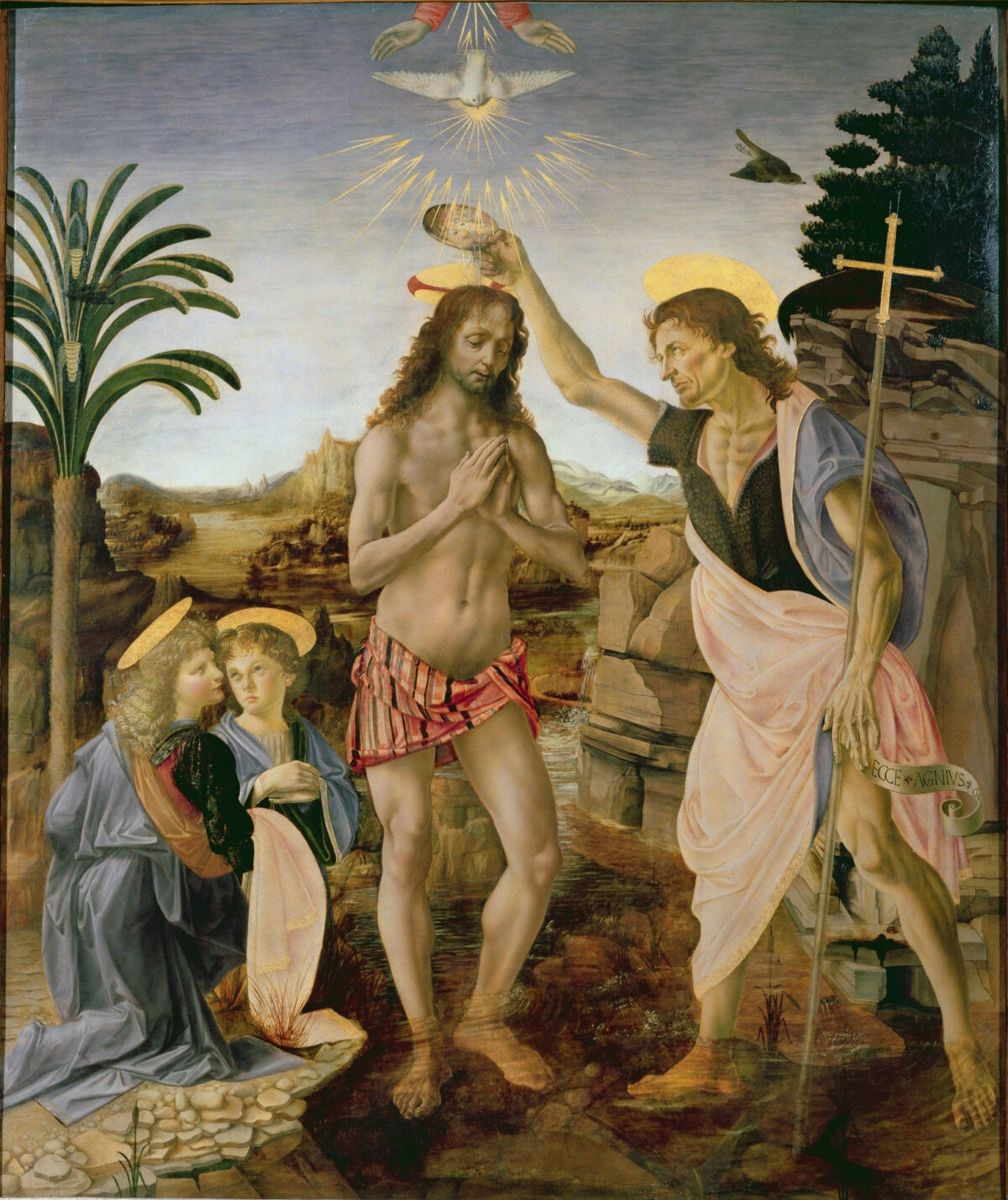
Leonardo’s artistic talent was fortunately recognized by his father. He soon presented the teenager’s drawings to the Florentine painter, sculptor, and goldsmith Andrea del Verrocchio. Impressed with the boy’s talent, Verrocchio was soon humbled by Leonardo’s brilliance in painting the assignment of an angel in “The Baptism of Christ” (circa 1475). In fact, the teacher resolved to move away from painting and focus on sculpting.
However, Leonardo’s connection with his teacher continued to develop. He remained in Verrocchio’s studio an uncommonly long time, from 1469 to 1477, before accepting his first commissions.
The Scientific Method in Art
By the early 1480s, Leonardo had developed a habit of daily journaling. Oddly, he wrote from right to left. It’s been speculated that he was leaving riddles and symbols buried in this work. The reality might have been that he was left-handed and wrote backward simply to avoid smudging wet ink.
The artist averaged three pages of journaling per day until his last years, when he became too ill to write. He left behind volumes of brilliant but often unfinished and unorganized collections of inventions, drawings, scientific observations, and philosophical musings. Today, his writings are spread across Milan; Rome; Turin, Italy; Paris; Madrid; London; and within the personal collection of Bill Gates.
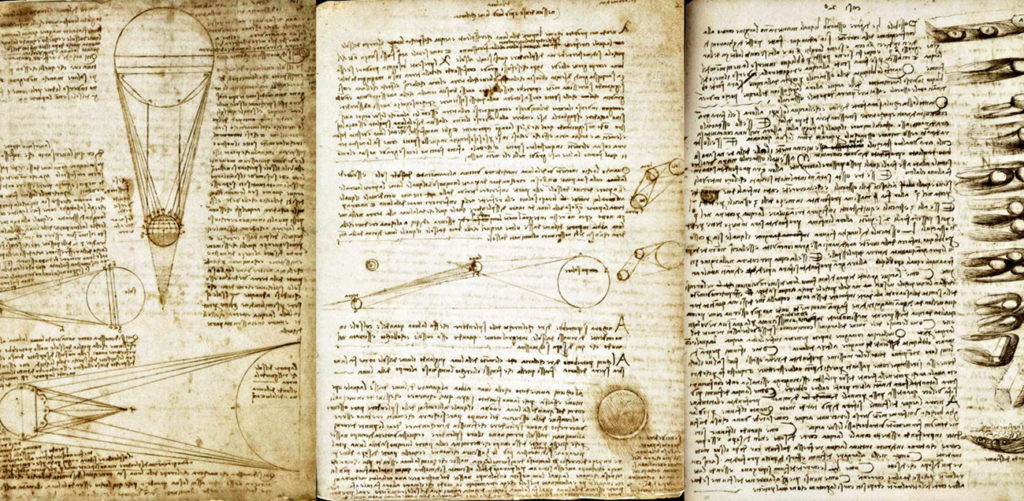
This daily ritual rarely included any venting of his personal feelings, but it did reveal his restless curiosity. Leonardo studied the natural world. Anatomy and engineering fascinated him. His writings show a compassion for animals and a clear desire to leave a lasting impression on the world.
One entry reads: “A man who does not become famous is no more than wood smoke on the wind or foam upon the sea. I intend to leave a memory of myself in the minds of others.”
His study of human anatomy led him to dissect 30 cadavers in an era when the practice was shunned by the church. This was before the advent of refrigeration, making the process all the more unpleasant and unsanitary. Yet his sketches of muscles and ligaments contain a seemingly microscopic level of detail. His study of dental anatomy was more precise and thorough than anything published for the next 150 years, surpassing research well into the 19th century.

He based his beliefs and conclusions on a meticulous approach of rigorous observation. He repeated examinations in search of consistent results. This was revolutionary for the time and laid the groundwork for what became standardized as the scientific method.
Once he mastered all his crafts, Leonardo compared and ranked the benefits of each art form. He noted that colors and musical chords both possess harmonies that exist simultaneously, while poetry was “a painting which is heard but not seen.” He felt that musical harmonies are fleeting, while those of colors in a painting endure.
Perhaps most revealing is his comparison of the quiet elegance of painting to the noise and mess of sculpting. It’s not difficult to imagine how these preferences informed the commissions he embraced and those he avoided. Ultimately, his deep love for painting proved to be a lesser priority along his career path.
The Milanese Court
Leonardo’s 1482 letter to Duke Ludovico Sforza (1452–1508) describes with great enthusiasm his designs for various military weapons, fortifications, and strategies that might have contributed to the duke’s reign. At the letter’s close, he briefly mentions his skill in painting. The duke, rather than granting Leonardo’s request to bolster his military forces, assigned him to be master of events and entertainment at his court.
Although this task might have seemed beneath Leonardo’s potential, it sparked another formative chapter of his life often overlooked by history. It conveniently provided him an opportunity to combine all of his artistic, musical, and engineering talents.
The duke’s court became one of the most important centers of cultural progress during the Renaissance. Leonardo was now overseeing processions and plays. He designed costumes and composed and performed music. With his mechanical wizardry, he devised trapdoors, trapezes, sound machines for wind and thunder, and marvelous rotating set designs.
Accounts from audience members give the impression that his theatrical works were as compelling as everything else he attempted. His genius revealed itself further with each new undertaking, although not without additional abandonments and disasters.
Unfinished Business
Despite his solitary nature, Leonardo was always a charming and beloved member of whichever court or company he belonged to. His genius was readily recognized by all who knew him. He chose to keep appointments with his devotees and this is, perhaps, the reason he produced so few finished works with such luxuriously long timelines.
His decision to choose quality over quantity also shows the degree of perfectionism that determined whether he would embrace or abandon a work. When he decided that a commission wouldn’t provide a worthy opportunity to display his skills, he graciously explained and declined the commitment.
Leonardo remained ambivalent, open, and yet curious in his spiritual beliefs throughout his life. This fits naturally with his methodic, patient approach to perfecting whatever he pursued. Yet after all his explorations and cultivation in art and engineering, his deathbed confession and request for a traditional Catholic funeral deflate many of the sensational and esoteric rumors haunting his work today.
He was relentless in his determination to discover the divine in every detail of life. Although many questions about his personal life and work remain unanswered, it’s clear through the magnetism of his paintings and scientific pursuits that he meant to inspire curiosity and reverence for the divine wherever possible.
It is only because he perceived so much and was so far ahead of his time that Leonardo did not live to see the bounty of his tremendous contributions.
What arts and culture topics would you like us to cover? Please email ideas or feedback to features@epochtimes.nyc.
