
Thomas Edison’s 1879 invention of the lightbulb may have been the impetus behind a longstanding Christmas tradition, but it was actually a marketing ploy by his company vice-president that started it all.
Edison’s lightbulb was patented in 1880. Edison, Edward Hibberd Johnson, and others invested $35,000 to create the Edison Lamp Company to sell the bulbs, though no one yet knew the value of lightbulbs because homes had yet to be equipped with electricity. Edison named Johnson the company’s vice-president and that turned out to be a genius move by the brilliant inventor.
Johnson was a talented engineer, but he was also a shrewd businessman and savvy promoter who had a knack for turning Edison’s inventions into cash. Two years earlier when Edison invented the phonograph, Johnson took it on a successful promotional tour, selling tickets to demonstrate it before curious crowds.
Could “lighting” strike twice? What happened next changed the way millions worldwide celebrate Christmas.
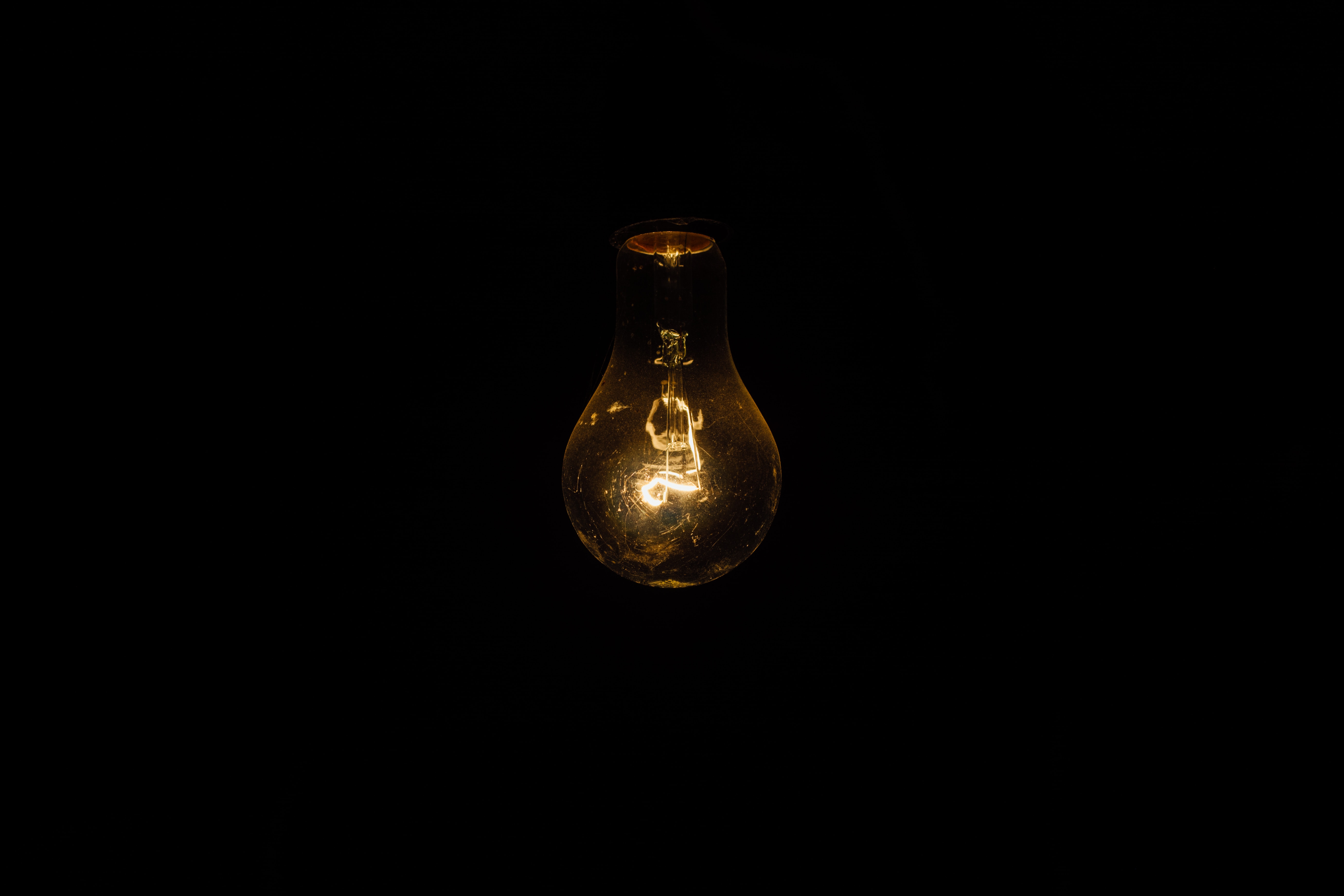 The simple lightbulb ushered in the age of electricity, revolutionizing modern life. (Rodion Kutsaiev/Unsplash.com)
An Illuminating Idea
Prior to Edison’s invention of the incandescent light bulb, wax candles were sometimes used to illuminate Christmas trees. Not only was this a serious fire hazard, families using candles on their trees could only burn them for a few minutes. Illuminated trees were only visible for a short period on Christmas Day.
Johnson had been experimenting with electricity for house lighting and decided to apply what he’d learned by giving his children a unique Christmas tree adorned with colored electric lights.
In 1882, the Edison protégé lived with his wife and three young children on East 36th Street in New York City. His idea was simple. He set an evergreen tree by a street-side window of his upstairs parlor and strung together 80 hand-wired red, white and blue egg-shaped bulbs all around it. He then placed the trunk of the tree on a revolving pine box pedestal. The pedestal included a crank that provided an electric current powered remotely by a generator in the Edison Electric Company office. As the pedestal rotated, alternating colors turned on and off, delighting his children.
Johnson was the first person to use electricity to light a Christmas tree and the first to use electricity from a remote location.
Never one to miss a promotional opportunity, Johnson then called a reporter for the Detroit Post and Tribune, W.A. Croffut. The veteran reporter described the first electric Christmas tree as “picturesque,” “uncanny,” and “a superb exhibition.” “I need not tell you the scintillating evergreen was a pretty sight—one can hardly imagine anything prettier,” he wrote after visiting the Johnson residence.
A Christmas Tree Encore
Johnson’s brightly illuminated tree intrigued hundreds of pedestrians who stopped to admire the unique, twinkling tree from the sidewalk. The following year Johnson duplicated his first private electrically-lit tree when he decorated a 45-foot tall tree with 225 red, white and blue bulbs at the 1883 Foreign Exhibition in Boston. He also created a revolving bandstand that rotated the 2-ton tree.
In 1884 Johnson delighted his children again at their home with a 6-foot-tall evergreen tree festooned with 120 brightly colored bulbs. That December, a reporter from the New York Times visited, reporting, “The tree was lighted by electricity, and children never beheld a brighter tree or one more highly colored than the children of Mr. Johnson when the current was turned and the tree began to revolve.”
The Times concluded, “Mr. Johnson’s experiments have proved most satisfactory in almost every respect and he has promised to make a connection with one or two of his neighbor’s houses that they may also be lighted with electricity.”
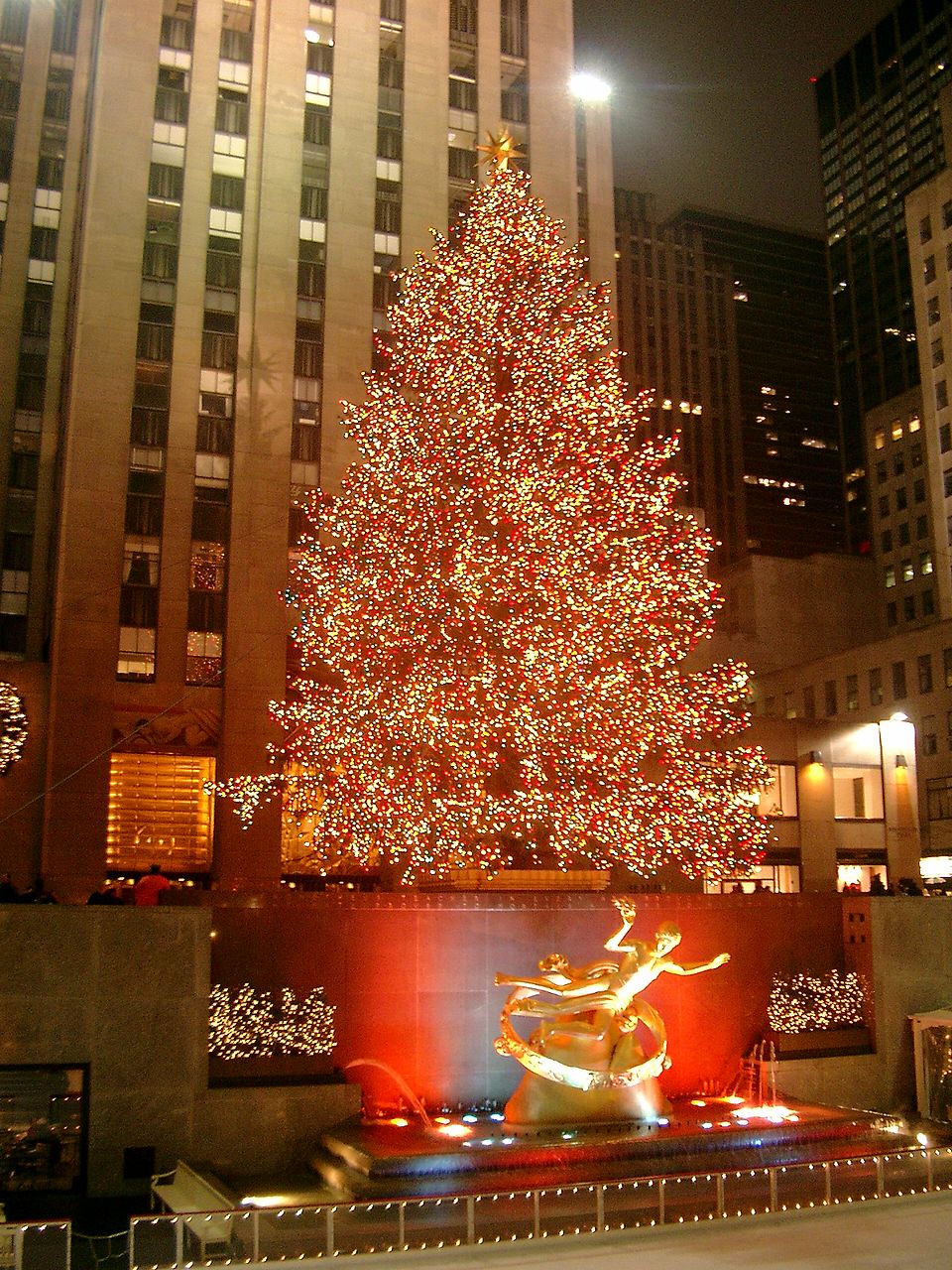 Electric lights on Christmas trees, like this tree in New York City’s Rockefeller Center, are a given in the 21st century. (Urban~commonswiki/CC BY-SA 3.0)
A Bright Past and Present for Christmas Lights
Johnson was the spark for the use of electric Christmas lights but widespread usage was still several years away. Electricity was still not widely available and hard wiring individual bulbs was expensive.
President Grover Cleveland was the first president to place multi-colored electric lights on the White House Christmas tree in 1894. It wasn’t until 1903 when first American Eveready and then General Electric began offering Christmas lights with pre-wired porcelain sockets, miniature glass bulbs and a screw-in plug that electric lights on Christmas trees started gaining prominence in American households.
The electrification of rural households and further technological advances of Christmas lights in the 1930s and 1940s made bulbs more powerful, longer lasting, and less expensive, further increasing their popularity and usage across the country.
 Two girls from Tacoma, Wa., under a Christmas tree with their dolls, Dec. 25, 1899. Electricity and its subsequent use in tree decorating made a lasting impact on Christmas traditions. University of Washington. (Public Domain)
Retail and industry analysts report that about 150 million sets of Christmas lights are sold annually in the United States. Thanks to Thomas Edison and “The Father of Christmas Lights,” the holiday illumination market promises to grow and glow for the foreseeable future.
What arts and culture topics would you like us to cover? Please email ideas or feedback to features@epochtimes.nyc