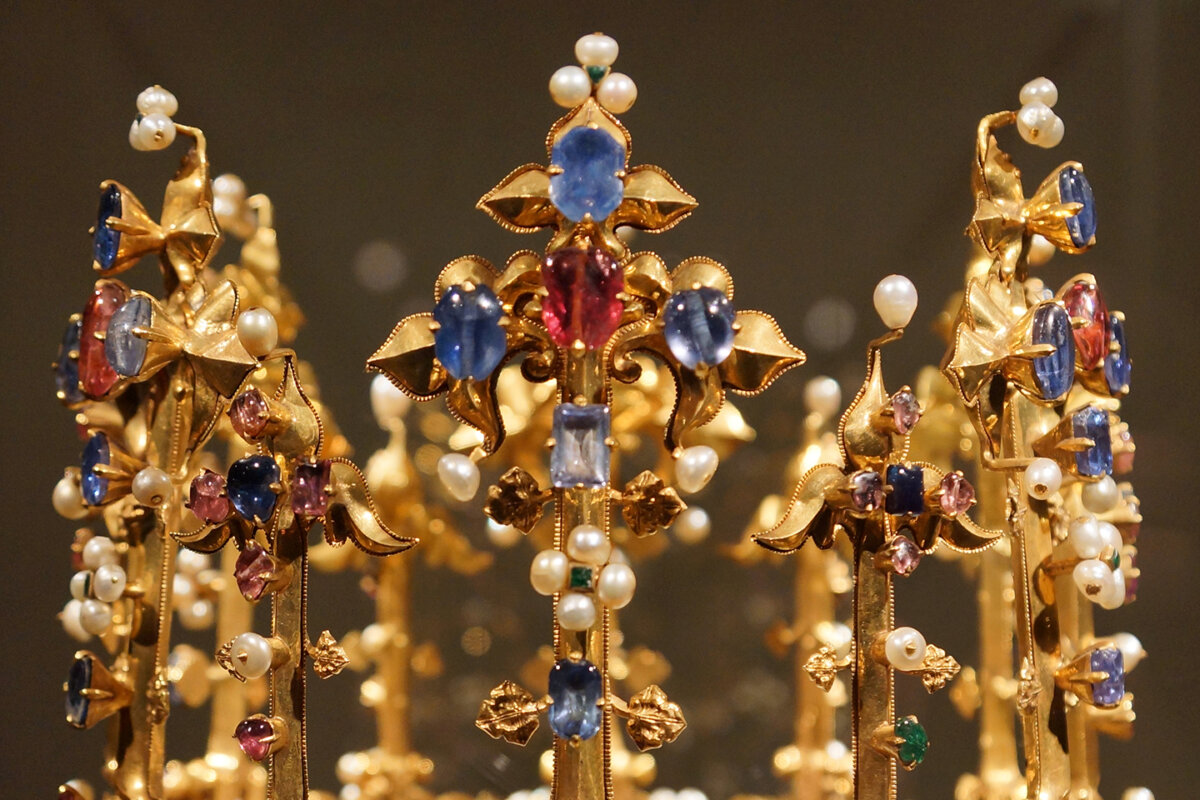
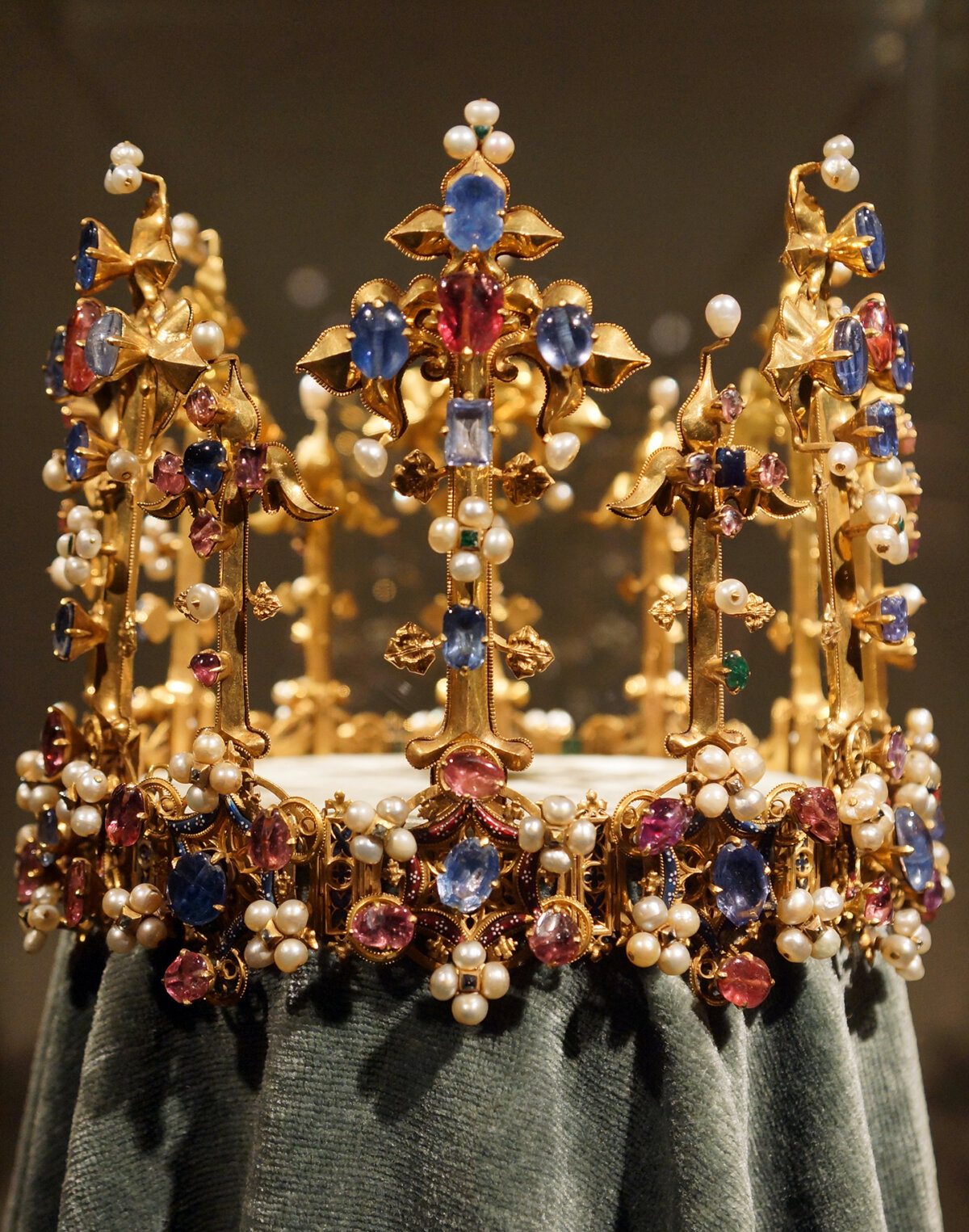
The oldest surviving crown of England is not in the Tower of London or anywhere in Great Britain for that matter. Instead, it lives in the Treasury of the Munich Residence in Germany. It is known by several different names: the “Bohemian” or “Palatine” crown as well as the “Crown of Princess Blanche.”
It was constructed around 1370 to 1380, and its continued existence for over 600 years is rather miraculous. Over the centuries, many medieval jewels were taken apart, with metals melted down and stones reset and recut as fashions changed. The crown’s soaring majesty displays great technical skill and an abundance of precious stones. References to such three-dimensional goldsmith works can be found in art of the period, but one would almost doubt that such objects had truly existed if not for survivors such as this.
The Crown Bearer
The general consensus among scholars is that the crown’s original wearer was Anne of Bohemia (1366–1394). She was the daughter of Charles IV, Holy Roman emperor and king of Bohemia. In 1382, Anne married King Richard II of England, and gemmologist Karl Schmetzer and economic geologist H. Albert Gilg concluded in a recent article of Journal of Gemmology (2020) that it is most likely that the crown was made for her after the marriage. However, the Munich Residence does state the possibility that the crown originated with Richard II’s grandfather, King Edward III.
Richard II had been crowned at the age of 10 in Westminster Abbey. The Abbey still displays a historic portrait that depicts the king as an adult with coronation regalia. Dating from the 1390s, it is the earliest known portrait of an English monarch. Unfortunately, the decorative details on the crown done in raised gesso were removed in an 1866 restoration, though one can still appreciate the crown’s form. The gold band that encircles his head is adorned with fleurons, elongated flower-shaped elements.

Remarkably, there are 14th-century accounts of the Munich Residence’s crown. The first documentation is found in an inventory of Richard II’s jewels and plate, where it was valued at 246 pounds. Richard II’s disastrous reign came to an end in September 1399; Anne was already deceased. Forced to abdicate, he was succeeded by his cousin, who became King Henry IV. A November 1399 inventory of items from Richard II’s royal treasury transferred to Henry IV records the crown as well.
Blanche of England (1392–1409) was the daughter of Henry IV. In 1402, she was married to the future Elector Palatine Louis III of the House of Wittelsbach. The crown was part of her dowry, as evidenced by records from July 1402.
Blanche died young, but the crown remained in the Palatine Treasury in Heidelberg, Germany, albeit in 1421, Louis III pawned it to a monastery for 3,000 guilders. At an unknown date, the loan was repaid and the crown was returned to Louis III.
The crown continued to appear in 16th-century inventories. In 1720, the capital of the Palatinate was relocated from Heidelberg to Mannheim, along with the ruler’s residence and treasury. The crown featured then in Mannheim inventories.
The crown’s final move was made in 1778. A year before, the current elector of Palatine had succeeded as elector of Bavaria, uniting the two lands. The royal court and treasury were transferred from Mannheim to Bavaria’s Munich. The treasury was determined to belong to the state in 1818. When the Wittelsbach dynastic kingdom ended in 1918, their former royal palace opened to the public as a museum two years later.
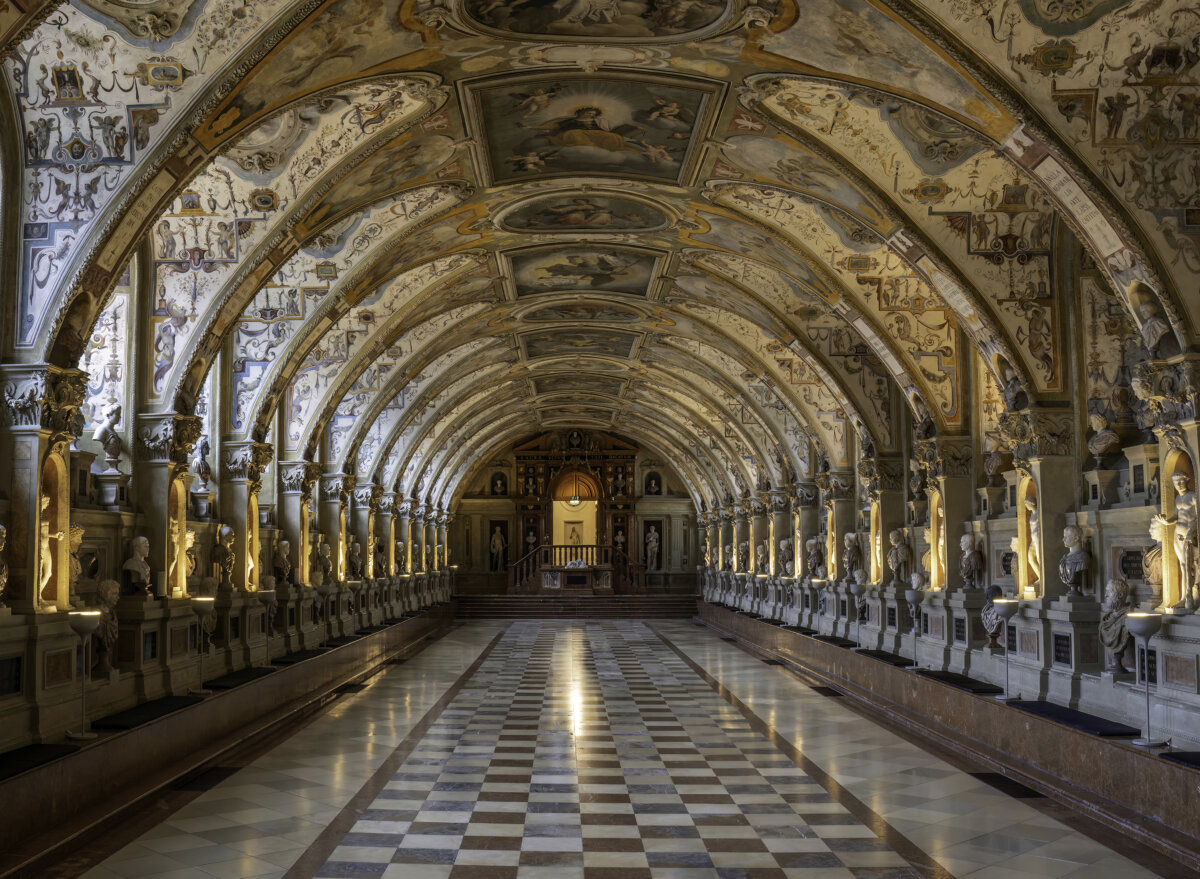
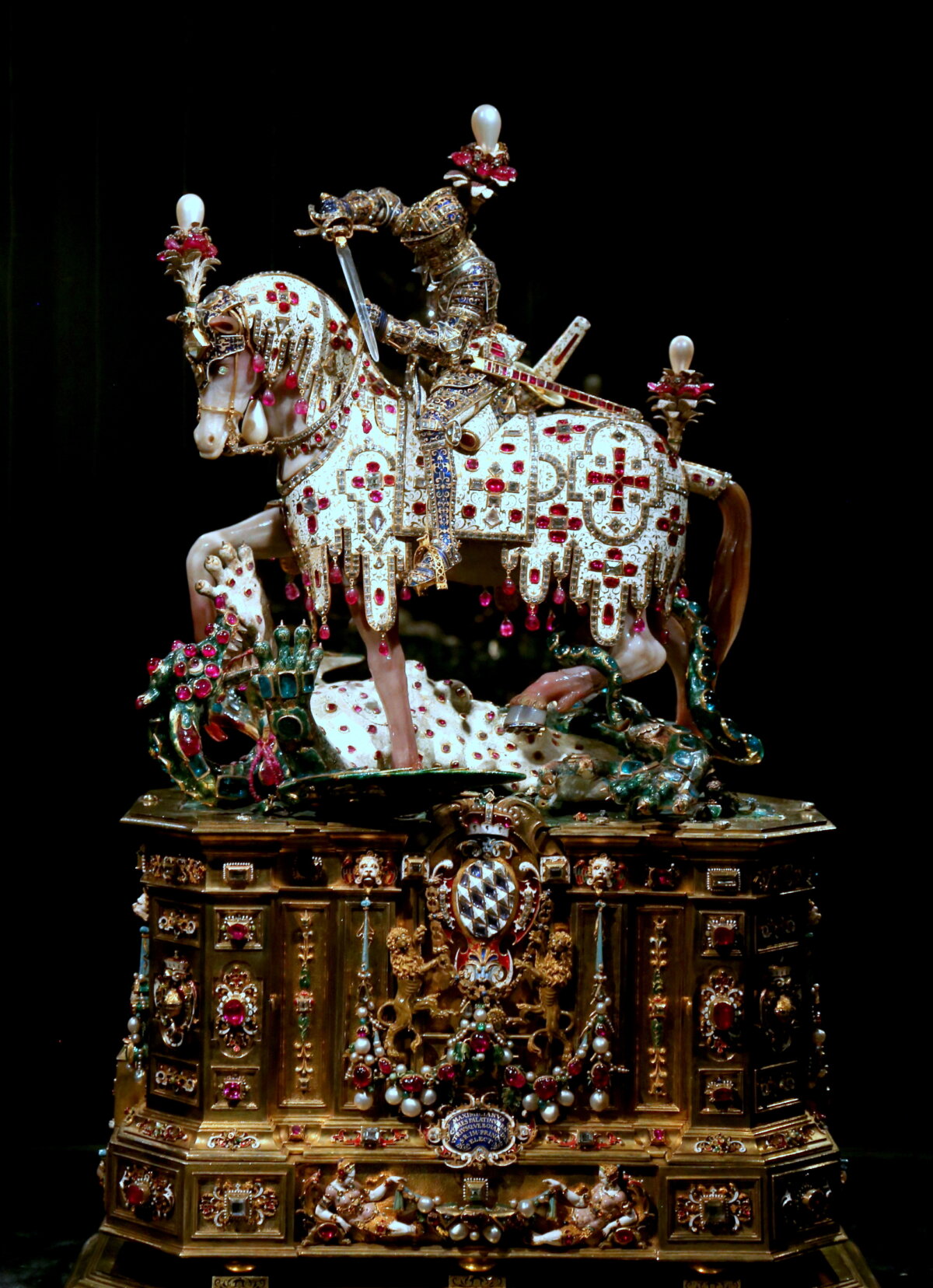
The vast complex that is the Munich Residence is resplendent. It features preserved state apartments decorated with furniture, paintings, tapestries, and gilded architectural details. It is also renowned for its treasury, which contains rare historic objects in gold, jewels, enamel, crystal, and ivory. Its highlights include a “Statuette of St. George” as well as the “Crown of Princess Blanche.”
Scientific analysis has confirmed that the crown’s decoration includes blue and pink sapphires (the latter could be termed rubies), pink spinels, garnets, emeralds, diamonds, and pearls. Proportionately harmonious, the crown is equal in diameter and height. There are 12 fleurons. They terminate in a fleur-de-lis, or lily, motif and alternate in size. The six larger ones are around seven inches tall while the other six are approximately five and three-fourths inches tall.
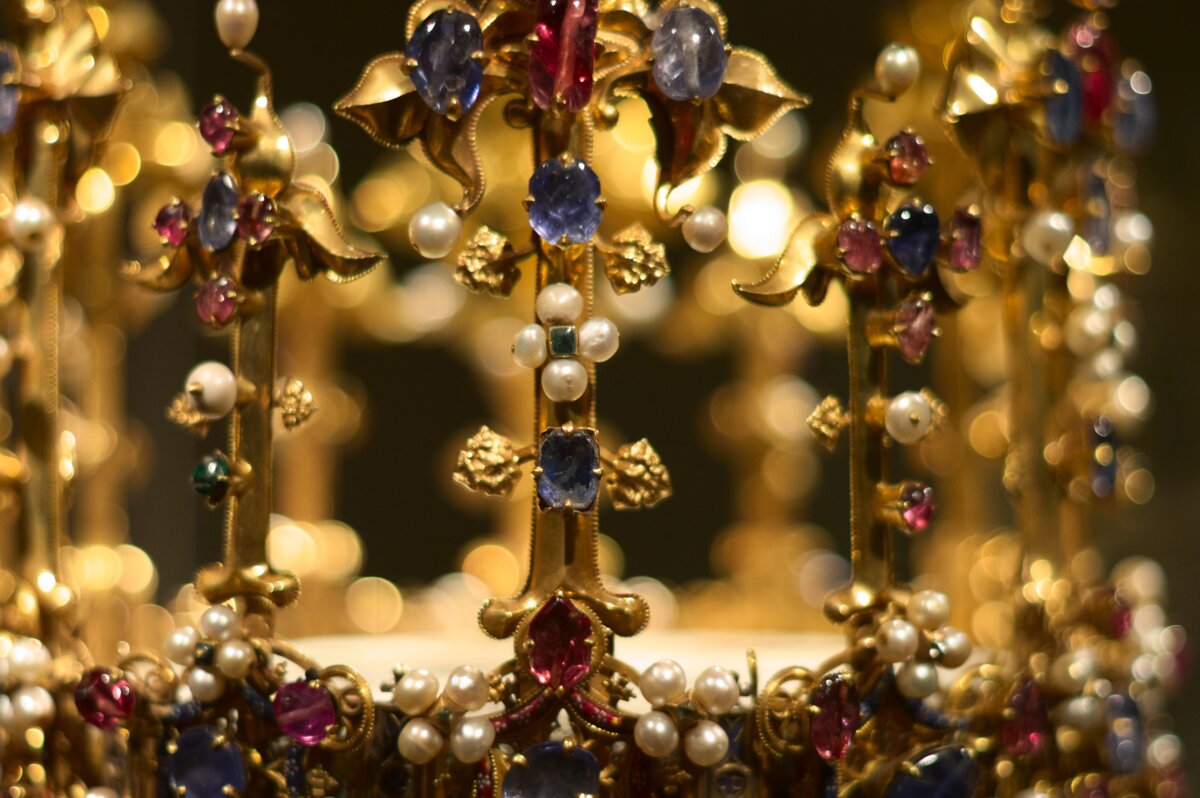
England’s Second Oldest Crown
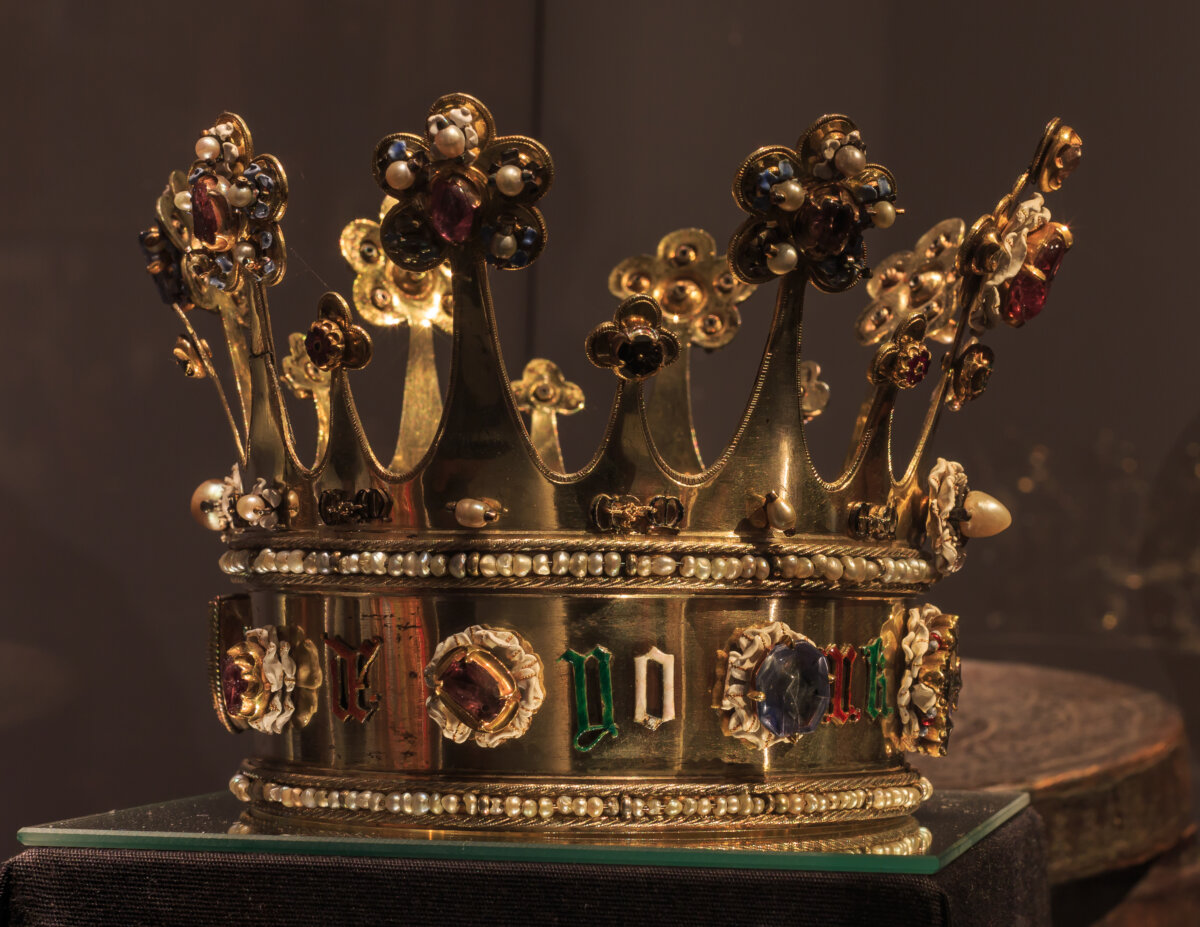
The crown is one of the few extant examples of a royal jewel from the Late Middle Ages (circa 1250–1500). The second oldest surviving English crown is a small coronet that belonged to Margaret of York (1446–1503), the sister of King Edward IV and King Richard III. She wore it when she married Charles the Bold, Duke of Burgundy in 1468.
Six years later, she gifted the bejeweled coronet to Aachen Cathedral so that it could crown a statue of the Virgin and Child. It remains in the German cathedral’s treasury. While beautiful, with its enameled Yorkist white roses, the couple’s joint coat of arms, and their initials joined by a lover’s knot, it has a heavier profile than the soaring openwork of the Munich Residence’s crown that seems to defy gravity.
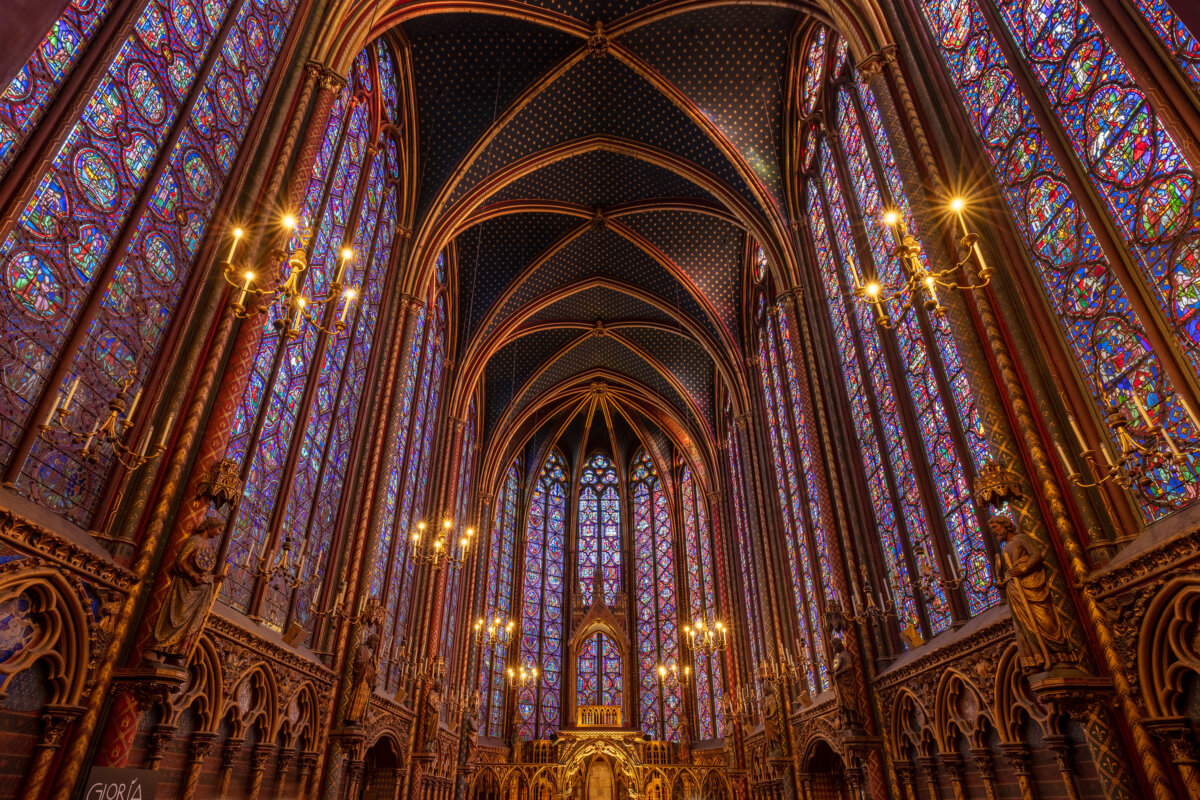
The Gothic goldsmith style of the “Crown of Princess Blanche” evokes ecclesiastical Gothic architecture. Saint-Chapelle in Paris, built for King Louis IX in the middle of the 13th century, is considered a “jewel box.” The crown’s fleurons are evocative of the chapel’s elegant, elongated windows in miniature.
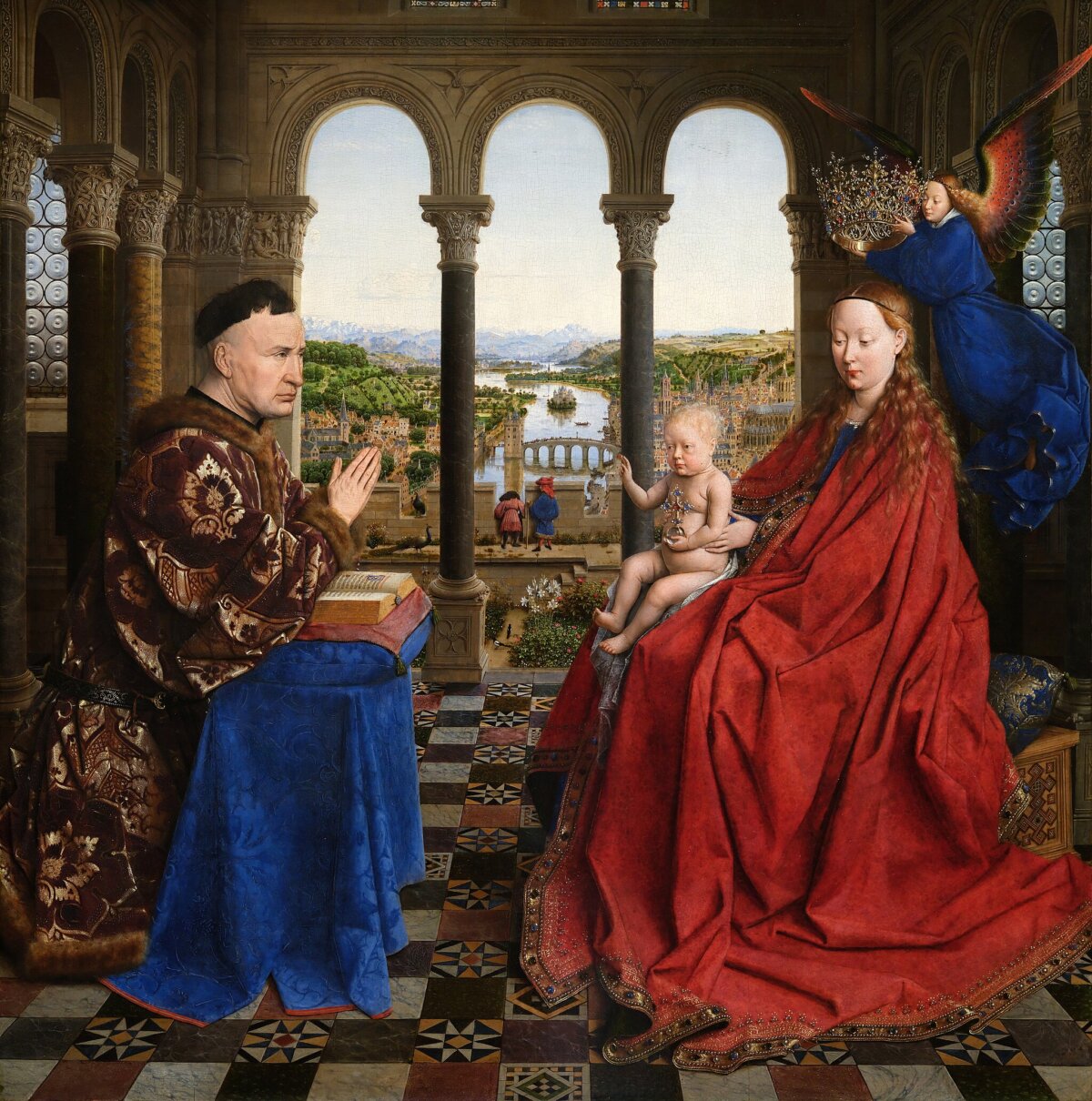
A visual connection between architecture and jewelry can be seen in the Louvre’s “The Madonna of Chancellor Rolin” from around 1430 by Jan van Eyck (circa 1390–1441). The Flemish artist was an early master of oil paint, a medium that facilitated painting exceptional details. Van Eyck’s work is renowned for its incorporation of bejeweled objects. He would have been able to observe actual jewels in his role as court painter and diplomat.
On the righthand side of the Louvre’s painting, van Eyck depicts an angel crowning the Virgin Mary with an object reminiscent of the Munich Residence’s crown. Behind the Madonna and Child is a divine cityscape replete with Gothic spires that mirror the fleurons.
The Crown of Princess Blanche has only traveled back to England once, in 1988 for an exhibition at The Royal Academy of Arts. While its days as an object of regal adornment are long past, it remains a powerful symbol of royal history.
What arts and culture topics would you like us to cover? Please email ideas or feedback to features@epochtimes.nyc