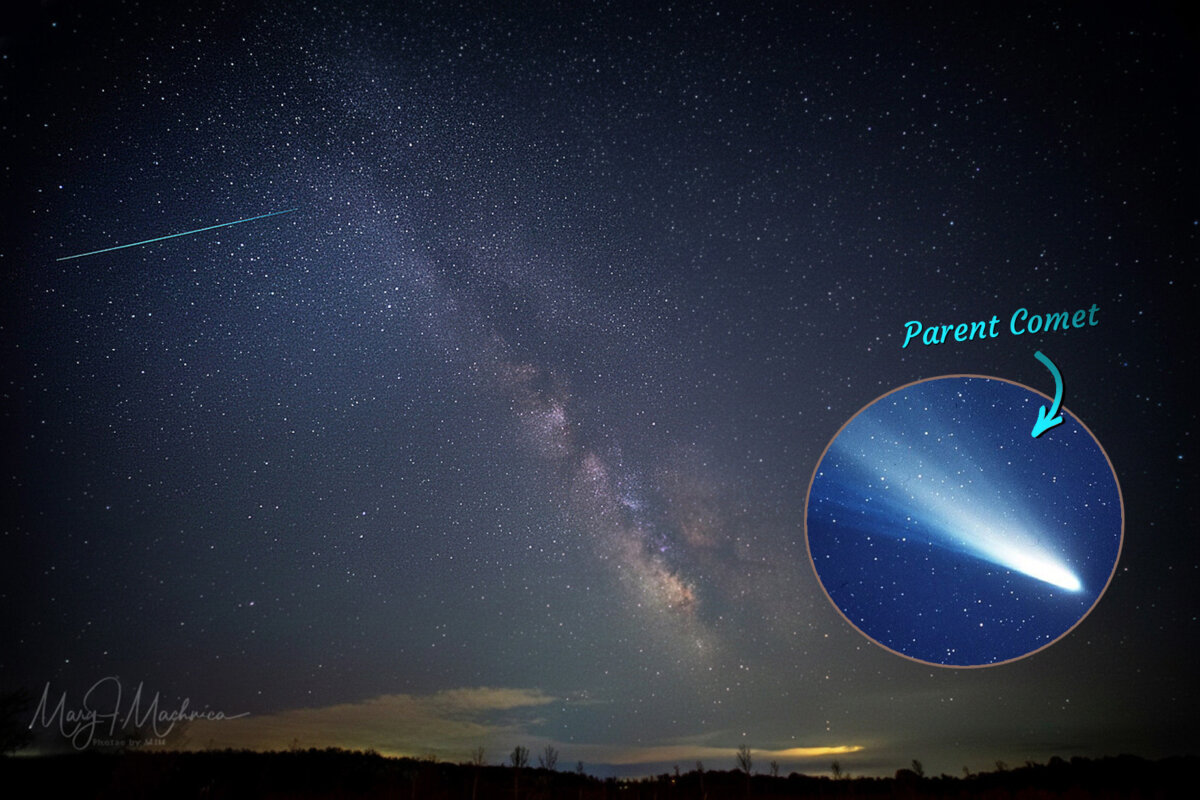
Meteor season is back, so let’s talk about shooting stars.
These sporadic shots of light are caused by space debris striking and burning up in Earth’s atmosphere, sometimes leaving long tails of glowing ionized gas. They accumulate robustly in May, when the planet enters a vast steam of particles in space—the ancient wake of Halley’s Comet.
Many volatile encounters with the sun have, over the eons, caused Halley’s to shed meteoroids. Though the comet’s 76-year orbit ensures we won’t see it again for several decades, its placeholder, the Eta Aquariid meteor shower, is a token reminder that returns faithfully each May.
This year we can expect the Eta Aquariids to peak for several days roughly around May 5. (Space debris is messy business, so meteor predictions are notoriously hard to pin down!) We might see them sputtering to a lesser or greater degree anytime between April 15 through May 27, however, signaling that Earth’s yearly meteor drought—between January and late April, after the Quadrantids—is over.
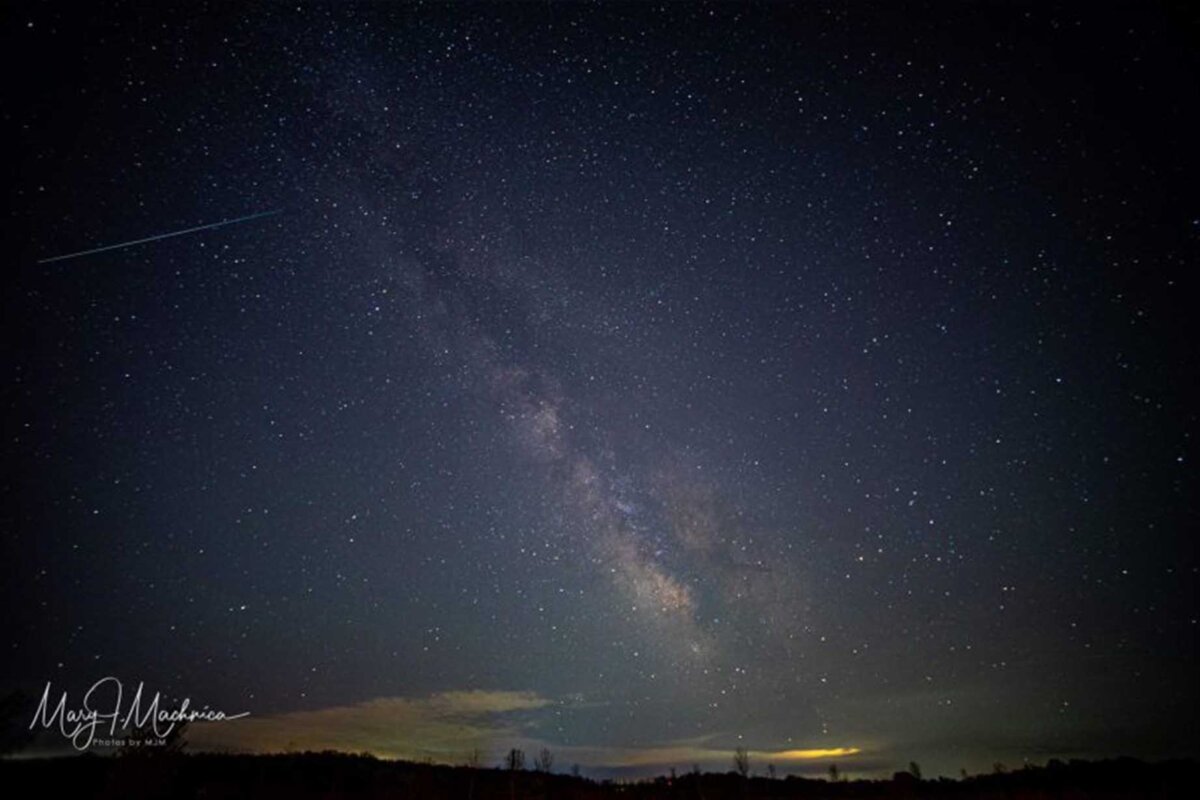
Traditionally, the Eta Aquariids have served up some of the highest volumes of meteors of any shower in the year, with 50–60 meteors falling per hour under ideal dark skies. Many leave long, streaky tails—called persistent trains, or simply fireballs—that can last for several seconds or even minutes after falling.
The bad news for those in the Northern Hemisphere hoping to watch the Eta Aquariids, though, is that they will be more visible south of the equator; however, those in the southern United States may still be able to see some. Unfortunately, we won’t witness ideal dark skies this year; light pollution from the waning gibbous moon in early May will surely wash out many meteors around peak, so fewer will be visible.
But for anyone planning to watch the Eta Aquariids, astronomers want you to know that predawn is ideal. That’s when the meteors’ radiant (the point from which they seem to originate) will rise highest in sky this year, offering the most real estate for searching as they fan out in all directions. The Eta Aquariids’ radiant starts to climb after midnight and peaks shortly before sunrise.
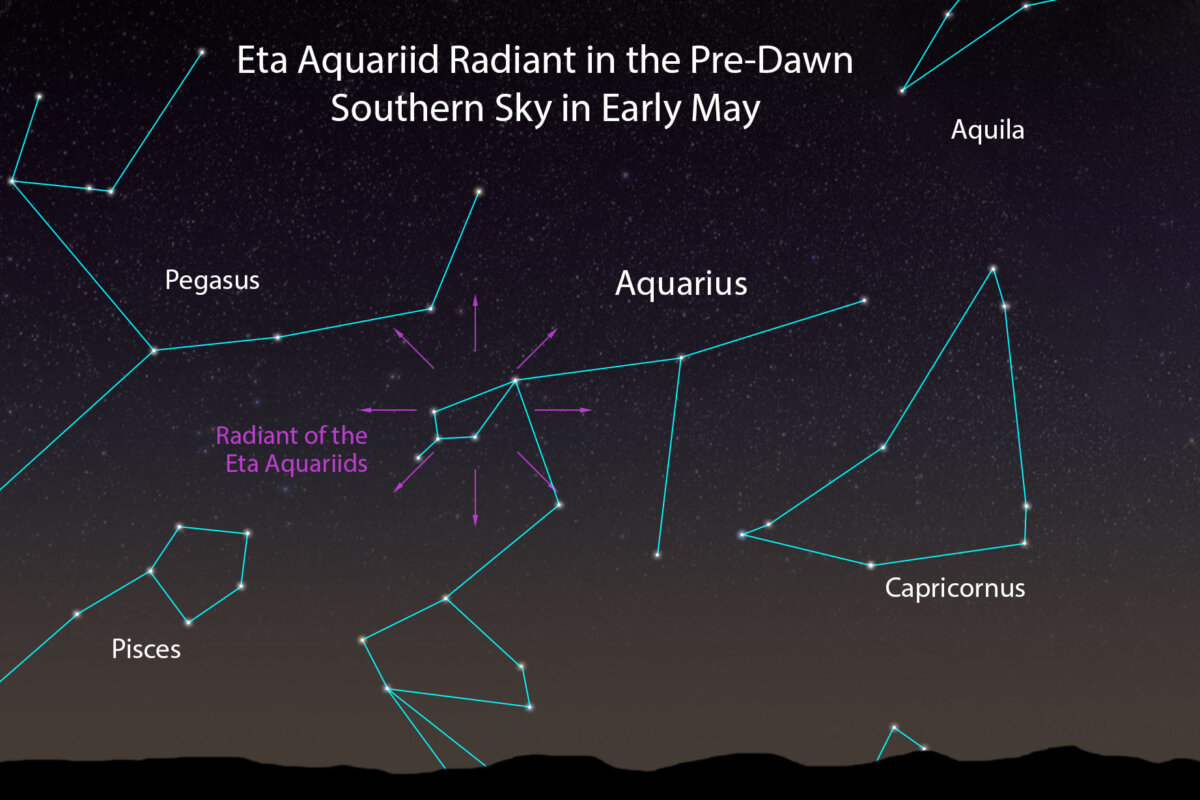
If you were to rewind all the Eta Aquariids backward in time you would find them meeting at a point located in constellation Aquarius the Water Bearer, hence the name Aquariid. But it’s a common error for novice meteor spotters to seek meteors there. Instead, experts advise observers to lie back and scan the entire sky; meteors will shoot far and wide, leaving longer tails the farther away from the radiant they travel.
It might seem logical, then, to think these meteors originate from constellation Aquarius, but that’s not the case. Even though their radiant is forever locked near the star star Eta Aquarii—which is 168 to 183 light-years away—the Eta Aquariids’ home is our solar system. That’s over 100 million times closer than Eta Aquarii, yet when they actually strike Earth’s atmosphere they’re only 60 miles away.
A more logical source, according to astronomers, is Comet Halley, an object that loops the sun in a retrograde orbit once every 76 years. The last time it visited the inner solar system was in 1985–1986 though it’s been sighted historically as early as 240 B.C. In 2023, Halley reached its farthest-away point and began swerving inward again. It’s destined to return in 2061.
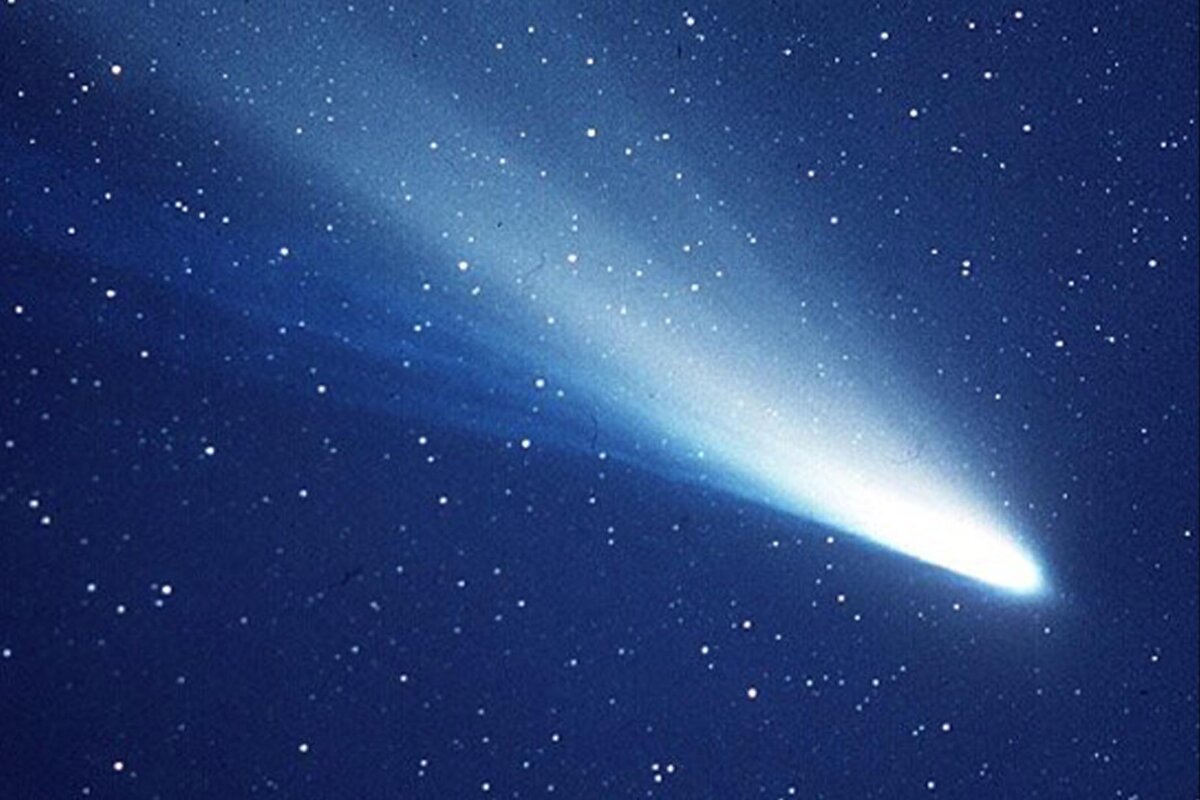
Once Halley arrives, it will begin doing what comets always do when near the sun. Its solid nucleus will turn volatile and start glowing as an envelope of gaseous matter, called a coma, forms around it. The comet’s nucleus starts out as a packed conglomeration of matter in deep space, but agitation from solar radiation loosens it up, breaking off debris that stretches for millions of miles. These trails are the birthplaces of meteors.
There are, in fact, two meteor showers tied to Halley’s Comet. While Halley’s outbound orbit crosses Earth’s path in May, spawning the Eta Aquariids, it’s inbound orbit causes another shower in October, the Orionids, named after constellation Orion.
But all this still fails to explain why meteors seem to radiate from constellations light years away when meteors themselves are practically on our doorstep. It’s just a trick of perspective. Likened to railroad tracks converging on a point on the horizon, meteors travel along a track of their own—their orbit around the sun. So when we cross them they seem to converge on a point fixed in the stars. Their connection with Aquarius is just coincidental.