



“Conceit and Nursing cannot exist in the same person, any more than new patches on an old garment,” wrote Florence Nightingale in her first annual address to the nurses of the Nightingale School at London’s St. Thomas’ Hospital in 1872. Shy and socially awkward, Nightingale remained humble despite her personal achievements.
Though she’s most remembered today for the sanitation reforms she instituted during the Crimean War (1853–1856), her influence continues to be felt in a surprising number of ways.
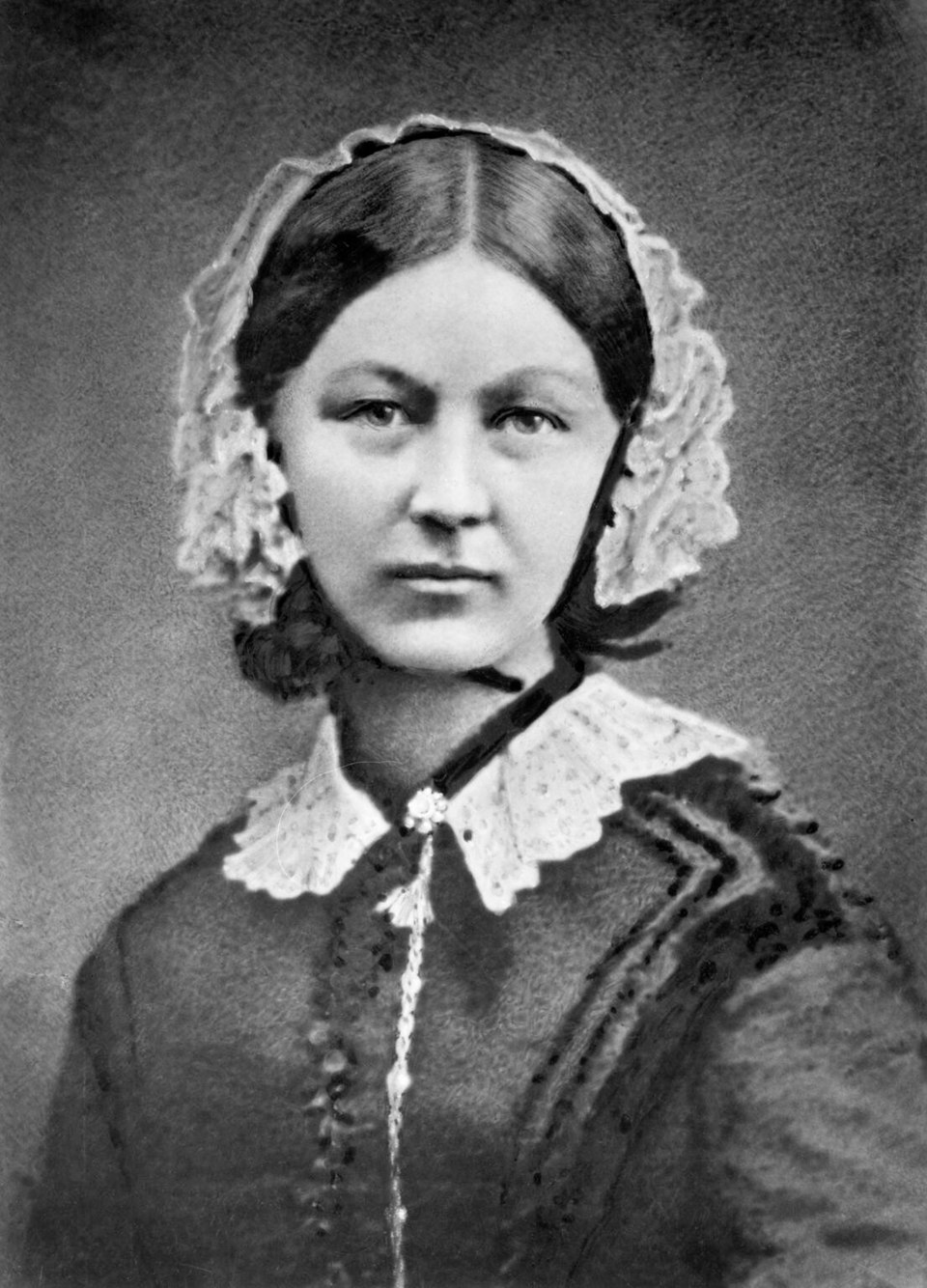 An 1860 photograph of British nurse Florence Nightingale by Henry Hering. Nightingale captivated the public with her reliance on statistics and her administration of proper sanitation and hospital management. (Public Domain)
Horrors in the Crimea
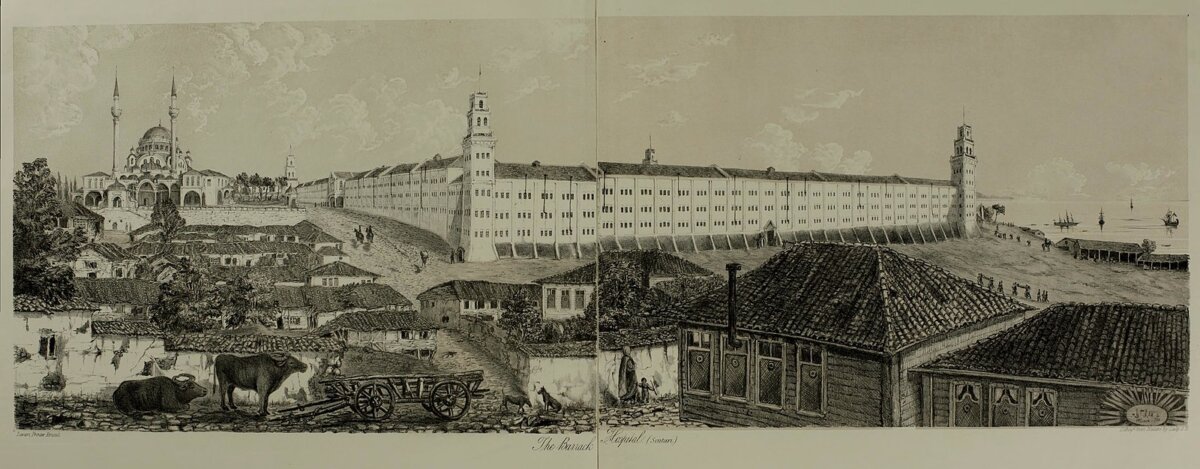
In 1854, Nightingale arrived at the Scutari Barracks (now the Selimiye Barracks) in Uskudar, Istanbul. As barracks for the British army, it was insufficient. As a hospital, it was horrific.
The barracks had been built over a large sewer, so the well water was foul. Strong winds blew sewer fumes through the unventilated, unheated building. The square was piled with filthy heaps of trash. Because the intended latrine towers were overfilled, open tubs in the wards functioned as makeshift latrines. However, the orderlies never had time to empty either.
There were no rooms, no beds, and no medicine to treat the wounded, yet sick soldiers poured in from across the Black Sea. The barracks was built to house about 1,200 people, but in one day more than 1,700 patients arrived, and at its peak, 4,000 patients were housed there at one time.
As she later wrote in her groundbreaking book, “Notes on Nursing,” much of the disease-related suffering was caused by poor hygiene, not disease symptoms. She wrote that the term “nursing” has traditionally signified “the administration of medicines and the application of poultices,” when “it ought to signify the proper use of fresh air, light, warmth, cleanliness, quiet, and the proper selection and administration of diet.” With these principles in mind, Nightingale began the overwhelming task of transforming the fetid barracks into a place where healing was possible.
Today, we would think of the problems in the Scutari Barracks in terms of germs. But basic forms of germ theory had yet to be generally accepted. While Nightingale wasn’t thinking in terms of germs, she did have ideas about how to organize the hospital to implement and prioritize cleanliness.
A Holistic Approach
Though Nightingale’s remedies to these sanitation problems are now the stuff of legend, the hospital staff didn’t see it that way when she arrived. The male doctors resented her proposed changes as an attack on their profession. Gen. Sir John Burgoyne noted that she wasn’t “amiable in ordinary intercourse with her equals or superiors,” and that “she likes to govern.” Essentially, the men in authority felt that she was bossing everyone around.
Nightingale went about purchasing much-needed supplies. She acquired clean linens and shirts, soap, and kitchenware. She set her nurses to changing sheets regularly, scrubbing floors, and washing their hands—a new concept at the time. She opened the closed windows to increase ventilation and ordered the sewers flushed out. Patients were given fruit to eat. Thanks to these simple improvements, the hospital’s mortality rate fell from 60 percent to 2 percent.
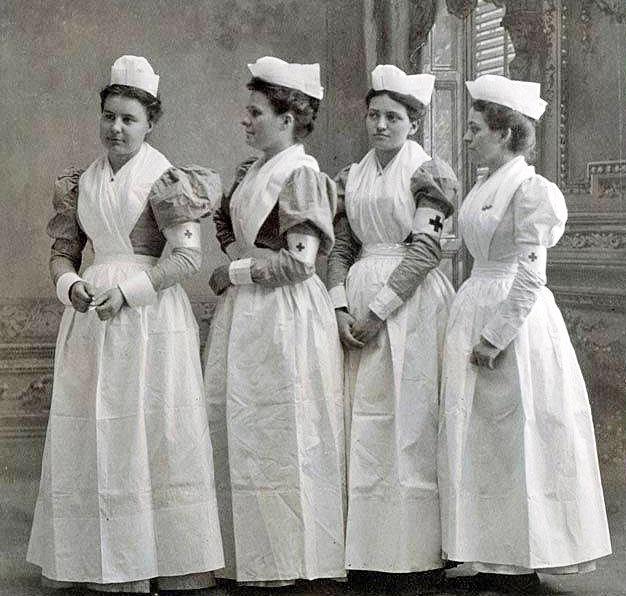 While the nurses Nightingale trained would have been British, these American Red Cross Nurses of three decades later were likely instructed to employ Nightingale’s now-widely accepted hygiene techniques. (Public Domain)
This holistic philosophy was blended with modern mathematical approaches. She systematized record-keeping practices at the hospital, employing a team to collect meticulous data on every dying, injured, and sick patient who came through.
The Lady With the Lamp
After criticizing her communication skills with superiors, Gen. Burgoyne noted that “she bestow[ed] all her tenderness upon those who depend upon her.” She was known for her kindness and empathy to wounded soldiers. In the evenings, she would sit, listen, and talk with them. “Always sit within the patient’s view,” she once wrote, “so that when you speak to him he has not painfully to turn his head round in order to look at you.”
Every night, Nightingale made her rounds holding a paper lantern. This image of her was later immortalized by Henry Wadsworth Longfellow in his poem “Santa Filomena”:
Lo! in that house of misery
A lady with a lamp I see
Pass through the glimmering gloom,
And flit from room to room.
And slow, as in a dream of bliss,
The speechless sufferer turns to kiss
Her shadow, as it falls
Upon the darkening walls.
When she returned to London, “the Lady with the Lamp” was celebrated as a national hero. She was showered with awards, and Queen Victoria gave her a brooch of gold and diamonds.
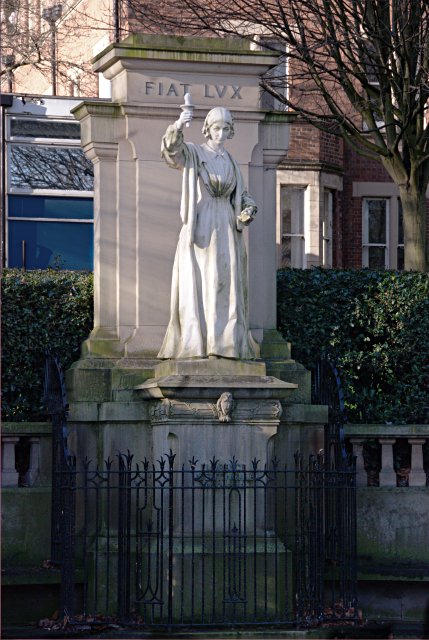 The London Road statue of Florence Nightingale was created in 1914 by Countess Feodora Gleichen. It depicts the famous nurse carrying a lantern on her evening rounds. (Jerry Evans/CC BY-SA 2.0)
A Nurse in Need of Nursing
Within a few years of her return, Nightingale began to suffer from poor health. Her symptoms included chest pains, headaches, and fatigue. During her time abroad, she had contracted what was then called Crimean Fever. It could have been brucellosis, a bacterial infection caused by contact with infected animals or animal products. Others speculate that she suffered from Chronic Fatigue Syndrome. Whatever the cause, for the next 50 years she lived as a bedridden recluse.
Despite her ill health, Nightingale continued to influence current events. In 1859, she published “Notes on Nursing.” In 1860, St. Thomas’ Hospital in London opened the Nightingale Training School for Nurses, the first institution of its kind. A little over a decade later, Nightingale began submitting annual addresses to the trainees.
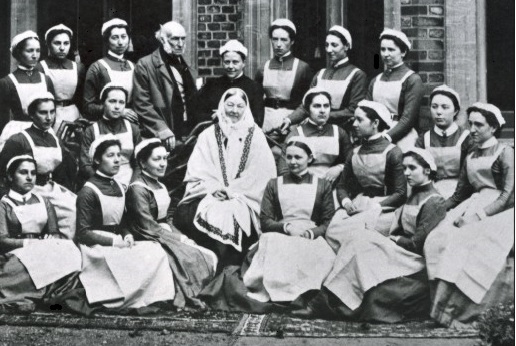 Despite her infirmities, Florence Nightingale (C) mentored and taught generations of women to be effective, professional nurses. (FormerBBC/CC BY-SA 4.0)
During this time, she put her experience with statistics to effect. She teamed up with experts to create charts that visualized medical data to nonspecialists. The most famous of these is the “polar-area diagram,” or “Nightingale Rose diagram,” a statistical method for illustrating the causes of death among soldiers. She convincingly argued to skeptical authority figures that more soldiers died from preventable diseases than battlefield wounds and that an army of healthy soldiers is more efficient.
She also pressured policymakers in British Parliament to improve their data-collecting methods on public health. For her contributions to the field, the Royal Statistical Society elected her as its first female member.
Death and Legacy
Nightingale died of heart failure in 1910, at age 90. Her last wish was to be buried in a family grave close to her home. She declined an offer to be interred at Westminster Abbey. Today, the Nurses’ Memorial Chapel in the abbey is dedicated to Nightingale.
Each year, the International Red Cross awards the Florence Nightingale Medal to nurses who demonstrate “exceptional courage and devotion” to victims of wars or disasters, and to pioneers in public health and education.
 (L–R) Matron Sadie MacDonald displays her 1953 Florence Nightingale Medal to Mrs. A.S. Roe, Sir Peter MacCullum, and Mr. John Park. (Public Domain)
In her lifetime, her name lent itself to a good deal of merchandise. Nightingale’s image appeared on postcards, lithographs, and posters. People named their babies after her. Florence Nightingale dolls even appeared, a trend that continues today. Mattel recently introduced a Barbie in her honor.
In her lifetime, though, the only thing she ever officially allowed her name to be used for was the “Nightingale Fund.” It was established to found the nursing school at St. Thomas’ Hospital. The small lamp she carried has lit the future of public health.
What arts and culture topics would you like us to cover? Please email ideas or feedback to features@epochtimes.nyc
