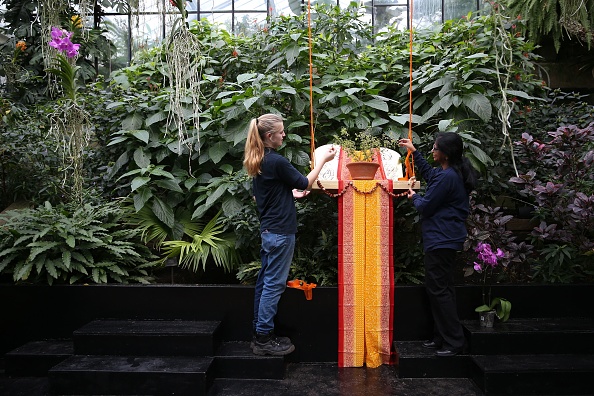
Forget kale. Forget chia seeds that wedge themselves between your teeth like clingy boyfriends. The herb you really want in your life is holy basil, Ocimum tenuiflorum, otherwise known as tulsi. This herb is worshipped as a goddess, revered by Ayurvedic practitioners for over 3,000 years, and moonlighting as a natural stress reliever with more gravitas than your yoga teacher.
A Herb With Heavenly Credentials
In India, tulsi is the botanical embodiment of Lakshmi, goddess of wealth and prosperity. Every good Hindu household gives tulsi its own prime real estate, which is a carved pedestal in the courtyard, complete with morning prayers and maybe even a sprinkle of holy water.
Legend has it that Brahma, the creator god, lives in its branches, the sacred Ganges flows through its roots, and Vishnu himself is powerless in the face of a single tulsi leaf. Talk about high-stakes gardening.
And if that wasn’t dramatic enough, dried tulsi stems are fashioned into prayer beads. It’s the rosary of the subcontinent, except instead of dusty incense, you get a whiff of clove-like eugenol oil.
From Greeks to Pesto
Of course, tulsi’s glamorous cousin, the standard kitchen basil, also has its own storied past.
The Greeks called it “basilikon,” meaning “king,” because the Greeks never saw a plant they couldn’t crown. St. Helena allegedly followed a trail of basil to find the remnants of the True Cross, while Italian maidens popped basil pots in their windowsills to advertise their availability (think of it as medieval Tinder, swipe right if he shows up with a sprig).
But where common basil ended up on pizzas, tulsi went on to become the “Queen of Herbs” in Ayurveda, and that’s a much more enviable gig.
Stress, Immunity, and the Science Bit
Now to the part where the white coats weigh in. Tulsi is biochemically busy. Studies suggest it’s an adaptogen, which is science-speak for “herb that helps you cope when life is basically a bin fire” or, its technical meaning, “a substance, typically an herb, that enhances the body’s ability to resist stressors, increases vitality, and improves work capacity and concentration by normalising physiological functions and minimising stress reactions.”
A systematic review of 24 clinical studies found that tulsi may help alleviate stress, anxiety, and fatigue, while also boosting immunity and potentially improving blood sugar and cholesterol levels.
There’s also intriguing evidence that compounds in tulsi, particularly eugenol, have anti-inflammatory and antioxidant properties that could help everything from arthritis to viral infections.
One study even suggested eugenol might interfere with the SARS-CoV-2 spike protein, making holy basil the herb equivalent of an overzealous nightclub bouncer yelling, “Not tonight, mate” to COVID.
Now, before you start mainlining tulsi tea like espresso, let’s acknowledge the caveat: most of these studies are small, many are preliminary, and some involve more lab rats than humans. So tulsi looks promising, but don’t sack your GP just yet.
How to Use It (Without Summoning a Goddess by Accident)
The simplest way is tulsi tea. Steep the leaves or purple flowers in boiling water for ten minutes. The flavour? Bitter, peppery, slightly clove-like. Not quite a flat white, but surprisingly soothing. If you can handle the taste raw, you’re braver than I am.
Supplements and oils are also out there, but doctors warn they aren’t well-regulated, so maybe skip unless you enjoy roulette with your liver.
Gardeners say tulsi loves sun, hates frost, and will grow into a two-metre shrub if it’s happy. Bonus points if you sing to it. There was an old French superstition that basil only sprouted if you sowed it while swearing. The phrase semer le basilic even became slang for “to rant.” Which is how we end up with centuries of gardeners (and later, comedians) gleefully embellishing the image of people shouting obscenities at their seedlings.
Herbs Are Never Just Herbs
Tulsi feels like the herb you need after a family Christmas when Aunt Maureen asks if you’ve thought about Botox. It’s also the herb you need after you accidentally reply-all on a work email or, after any Tinder date where the chap “forgets” his wallet.
And because life is not an Instagram wellness reel, it’s nice to think there’s a plant out there that doesn’t just look pretty on avo toast but also says, “You’re fine. Breathe. I’ve got you.”
In Summary
Tulsi is ancient and sacred. You can worship it, drink it, or grow it. So next time you’re eyeing the vodka, remember that holy basil is standing in the corner in a sari, rolling her eyes, and reminding you that she’s been calming frazzled humans for thousands of years. Goddess-approved, stress-relieving, and with a side of mythic sparkle, tulsi truly is the herb we didn’t know we needed.