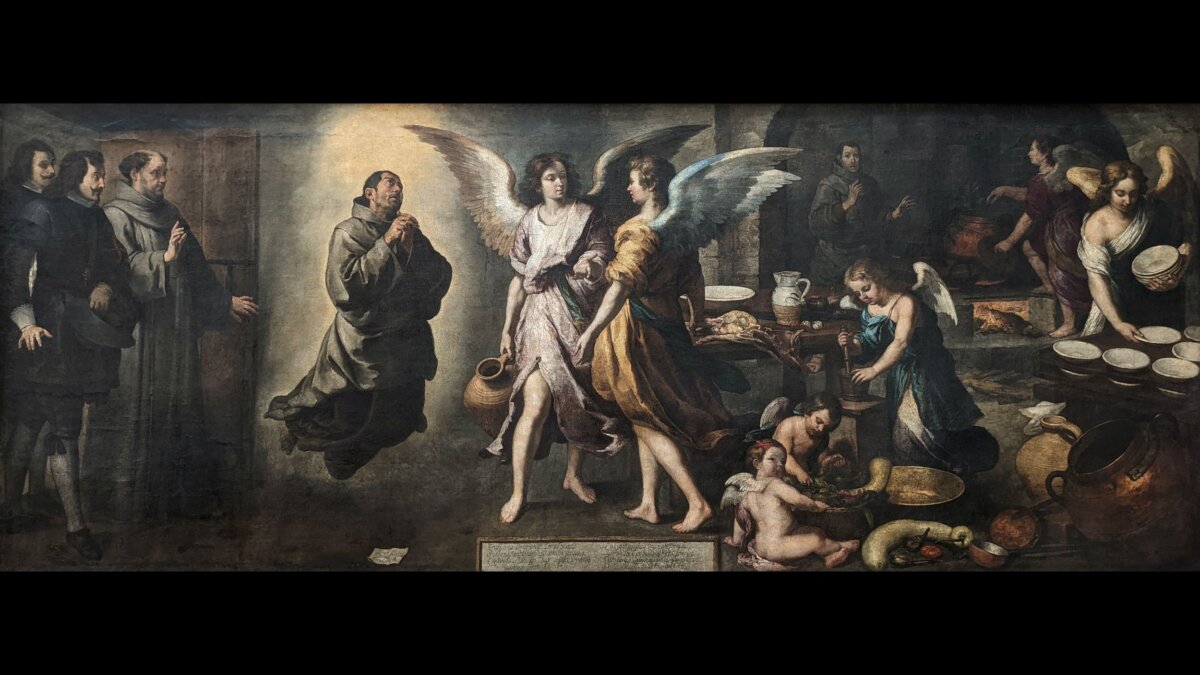
The Monastery of St. Francis in Seville, Spain, commissioned renowned artist Bartolomé Esteban Murillo (1617–1682) to paint 13 works of art highlighting Franciscan saints. Among the paintings is “The Angels’ Kitchen,” which tells of a visit by celestial beings to assist one humble lay brother in his chores. Murillo was praised as a storyteller, and this painting tells a wondrous story.
Little is known of St. Giles, one of the first followers of St. Francis of Assisi, who lived hundreds of years before Murillo’s time. “The Angels’ Kitchen,” also known as “The Levitation of St. Giles,” is based on an account that the artist was familiar with. Francisco Pérez, a Franciscan lay brother in the monastery in Seville, spent his life as a kitchen assistant in the monastery. A simple man, the lay brother was given the task of preparing food in the friars’ kitchen. On this day, he began to pray and was soon wrapped in spiritual ecstasy. His whole body rose, or levitated, higher and higher as he prayed. When he awoke, his kitchen chores were miraculously finished.
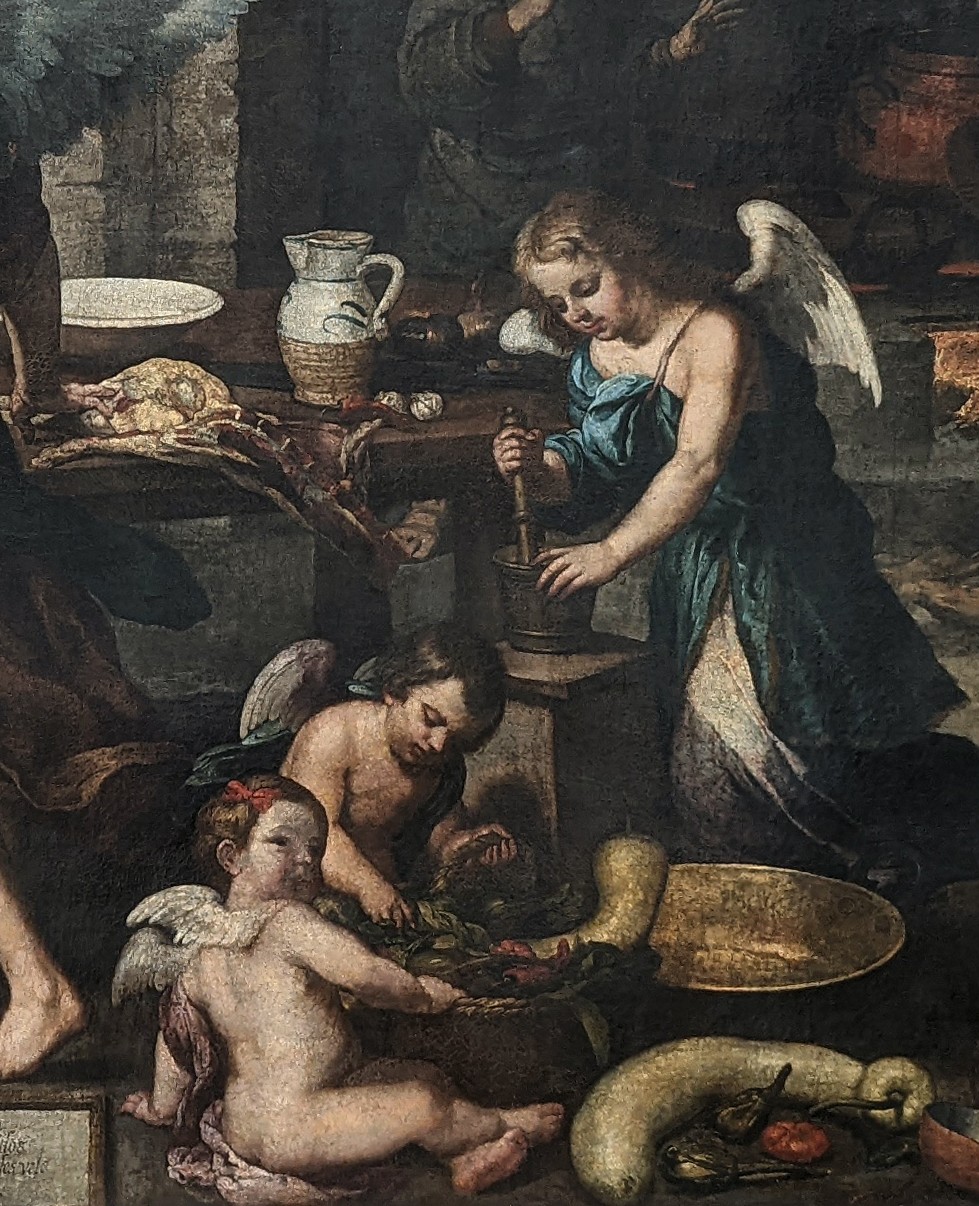
On the left of the painting are those who see the miraculous happenings in the kitchen. The monastery’s abbot has brought guests for a meal. He opens the door of the kitchen to a wondrous sight. Bathed in light and levitating in a state of ecstasy is Brother Giles. The viewer moves to the right to see an angelic being holding a water or wine pot and talking with another angel. As the eye moves down to the floor nearby, putti are engaged in preparing a meal, near another angel grinding food or spices. At the far right of the painting, another angel is setting the table for the monastery’s guests. A table of food and dishes present a lovely still life.
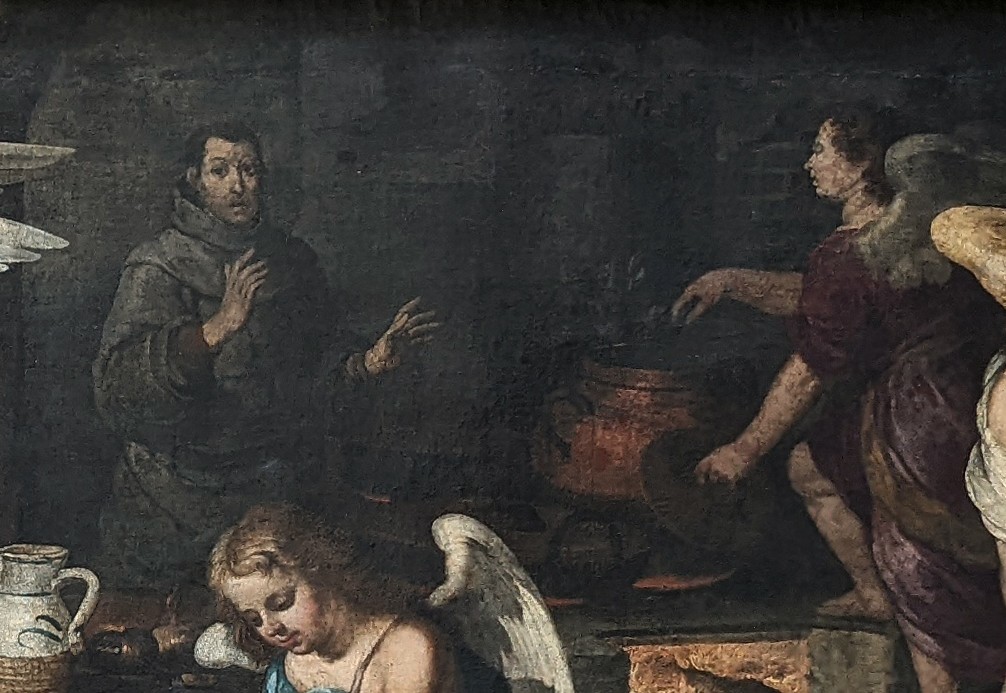
In muted tones in the background, Murillo placed another image of Brother Giles under an arch talking with an angel. Portrayed as if in an another time-space, Giles is telling the angel what his chores were for that day or perhaps expressing amazement at what he sees.
A Spiritual Realm Made Real
The painting is of the monastery’s actual kitchen. The composition presents a miraculous scene as real and tangible, including the food, kitchenware, and even the physicality of the angels. The two angels in the center are a transition between the world we see and a higher spiritual dimension that Brother Giles has entered during his levitation. Religious scholars contend that levitation is not a technique of mind control, but a sign of holiness. Without a pure and upright spirit, it cannot happen.
In the center foreground, a plinth (a block or slab usually at the base of a column or statue) names Francisco Pérez, who was the monastery’s cook and known for his piety, as the St. Giles of legend.
This is known to be one of the few paintings that the artist signed and dated.
Murillo’s career flourished during the Golden Age of Spanish Baroque art. Born in Seville and orphaned at a young age, he painted to make a living and studied under renowned Spanish artist Diego Velázquez. He remained humble and spiritually devout throughout his life and was favored by the Spanish aristocracy.
To Murillo, the spiritual dimension was as real as the tangible world. The Electric Light Company website has called the painting “an unusual fusion of the miraculously spiritual with the everyday environment of the working kitchen.” French art critic Michel Butor called the painting one of his “105 decisive masterpieces of Western art.”
Would you like to see other kinds of arts and culture articles? Please email us your story ideas or feedback at features@epochtimes.nyc