




CHICAGO—Many have hailed Shakespeare’s (1564–1616) understanding of human nature as a big reason for his plays’ popularity more than 400 years after his death. But another important reason for his enduring appeal is his ability to tell a powerful tale. “Hamlet” is a prime example of the great English writer’s storytelling prowess, which stands out in Chicago Shakespeare Theater’s production of “Short Shakespeare: Hamlet.”
The tragedy “Hamlet,” written between 1599 and 1601, was originally a four-hour production. Adapted from that lengthy work by Roger Warren, Chicago Shakespeare Theater’s presentation has been trimmed to a fast 75 minutes. In doing so, the play has lost none of its fascinating plot, brilliant language, or psychological insights.

What the adaptation succeeds in doing is cutting to the chase by focusing on Hamlet’s suspenseful journey of discovery. The story unfolds like a murder-mystery thriller that could have been an edge-of-your-seat nail-biter flick directed by Alfred Hitchcock.
The murder mystery begins with a ghost. The Danish Prince, Hamlet (Jaylon Muchison), has a terrifying experience when his dead father speaks to him and reveals a shocking secret. Hamlet’s father, the king, was murdered by his brother—Hamlet’s uncle, Claudius (Scott Aiello). To make things even worse, Claudius, who has married Hamlet’s mother, Gertrude (Jessica Dean Turner), is now wearing the crown that should have been Hamlet’s inheritance.

The ghost commands Hamlet to avenge the murder. Consumed by grief, anger, and moral confusion, Hamlet embarks on a quest for justice that spirals into a journey of self-discovery.
As part of Hamlet’s effort to exact revenge and bring his father’s murderer into the open, he feigns madness. Has he become so depressed that he is truly mad or is he faking it? Is he considering suicide when he asks, “To be, or not to be?,” or is it a ruse? The answer may be suggested when he says, “The play’s the thing/ Wherein I’ll catch the conscience of the King.”
The story of this bare-bones version is the same as that of the longer play. The characters are the same, and what’s especially wonderful about this cut-to-the-chase version is that its structure makes us more aware of the thriller-like plotting while still providing the extraordinary phrases that have become part of today’s art, literature, and discourse.
Blabbermouth Polonius (Joe Foust), who can’t help but give everyone advice they never asked for, still gets laughs from the audience when he tells Hamlet that “brevity is the soul of wit,” and when he dispenses unsolicited wisdom such as “to thine own self be true” and “Neither a borrower nor a lender be.”
Directed with masterful split-second timing by Edward Hall, the minimalist set and present-day costuming by Michael Pavelka bring “Hamlet” into the present as do contemporary technical effects such as iPhones, wireless headphones, and rock music. In addition, the ensemble delivers some exceptional performances, including Foust, who has some of the funniest comic moments as Polonius.
There is also a welcome difference between this and many previous productions of “Hamlet.” Portrayed with fiery intensity by Muchison, this prince doesn’t just stand at center stage and speak the speech “trippingly on the tongue.” He moves in close to the audience for intimate exchanges. His interaction gives theatergoers the feeling that they are involved in Hamlet’s inner conflict and the action of the play.
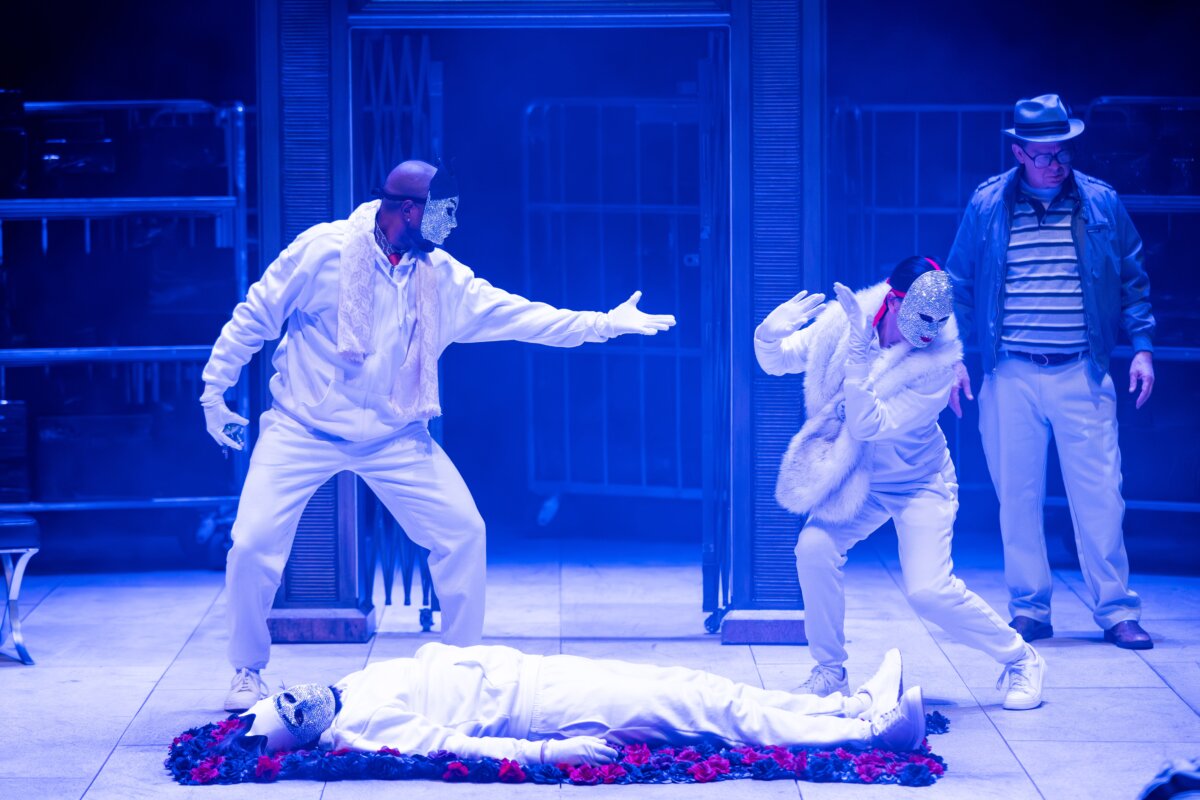
At the production I saw, the audience sat in rapt attention, riveted by Muchison’s admonitions and confessions. He breathed life into famous Shakespearean expressions that include “one may smile, and smile, and be a villain,” “There is nothing either good or bad but thinking makes it so,” and the line that suggests Shakespeare’s belief in God: “There are more things in heaven and earth, Horatio/ Than are dreamt of in your philosophy.”
Those familiar with the longer version of “Hamlet” will still appreciate this extraordinary production. And for those who have never experienced the “Something is rotten in the state of Denmark” and wonder why there’s so much fuss over a late 16th-century English writer, “Short Shakespeare! Hamlet” is a wonderful introduction to the greatest English playwright of all time.
Note: There is a post-show conversation with the cast after each performance.
What arts and culture topics would you like us to cover? Please email ideas or feedback to features@epochtimes.nyc
“Short Shakespeare! Hamlet”
Jentes Family Cortyard Theater,
Chicago Shakespeare Theater
800 E. Grand Ave., Chicago
For Information: 312-595-5600 or visit ChicagoShakes.com
Runs: One hour, 15 minutes (without intermission)
Closes: Feb. 28, 2026
