
In his fairy tale “The Angel,” Hans Christian Andersen shows that a life is defined by the actions which fill it. A life filled with acts of love and kindness is precious and joyful, even amid hardships.
Andersen explains that, when a good child dies, an angel comes down to take the child up to Heaven. Before they leave the earth, the angel flies with the child over all his or her favorite places. Then, the angel gathers a bouquet of flowers from earth and takes the child up to Heaven.
In Heaven, God gives the child wings and embraces the flowers. He then kisses His favorite flower in the bouquet, giving it “a voice, [which] can join in the glorious everlasting hymn of praise.”
The Angel’s Arrival
In this story, Andersen describes one particular instance when an angel flies down to receive a child who has died. The angel then flies around to all the places that the child loved most.
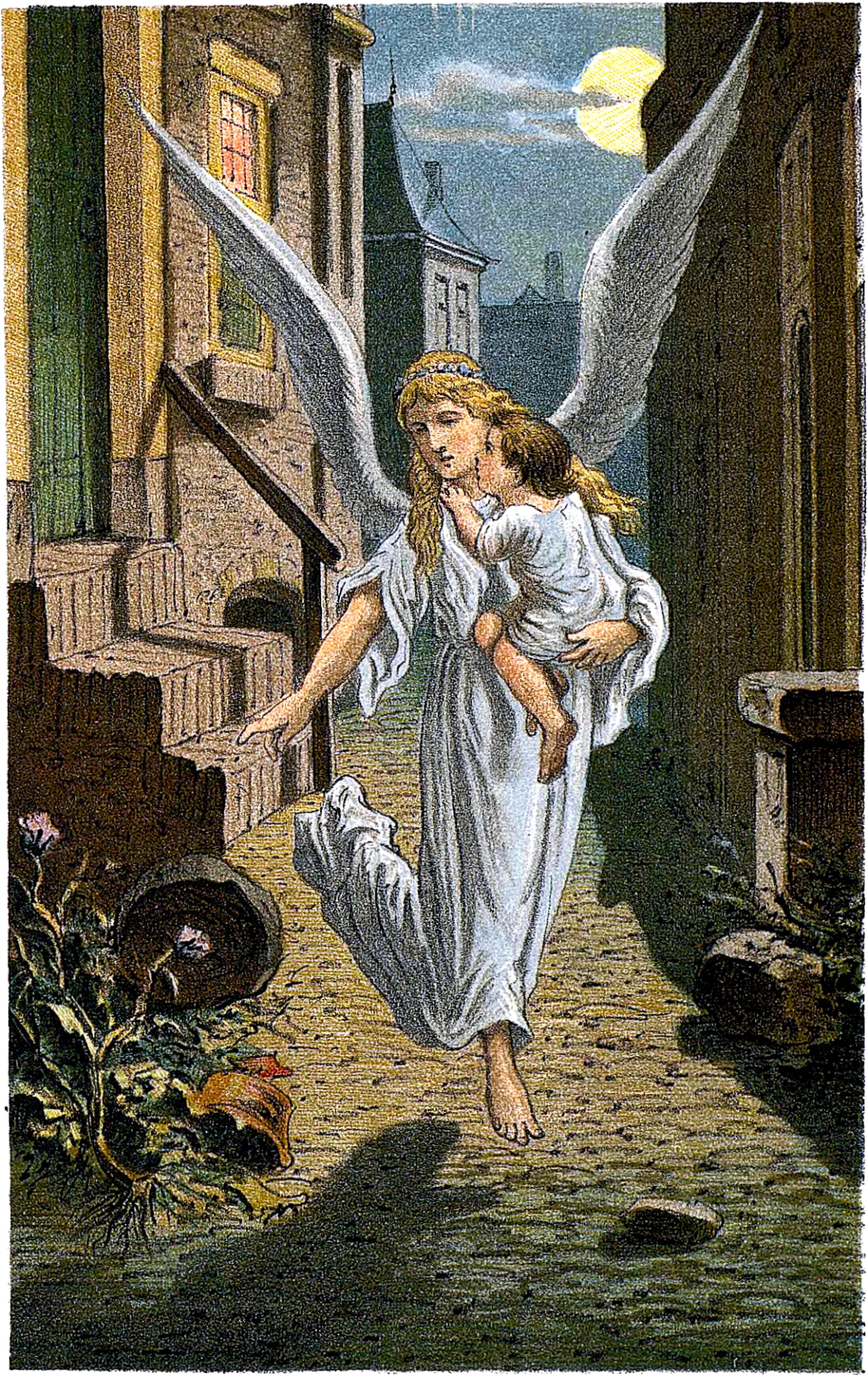
As they visit these places, the angel asks the child which flowers they should pick to present to God. The child sees a broken rosebush with withering blossoms and cries to the angel: “That poor bush! … Let’s take it so that it may bloom again up there in God’s garden.”
Having collected the roses and a few other unappreciated flowers, the angel is ready to fly directly up to Heaven with the child. However, the angel takes the child to a narrow, cluttered alleyway instead.
A Blooming Love
Amongst the rubbish heap in the alley, the angel shows the child a broken flowerpot, which holds soil and the remains of a withered flower. The angel explains, “We shall take that with us. … As we fly onward, I will tell you about it.”
The angel then tells the child how this withered flower was once the most precious treasure of a small, sick boy, who lived in a dark cellar in the alley. The little boy was so weak that he never went outside and rarely got to see any sunlight.
One day, the neighbor’s boy brought the sick child a bouquet of field flowers. In the bouquet, the little invalid found a flower which still had a root attached to it.
Excited to see signs of life, the sick boy put the flower in soil and tended to it with loving care. The flower grew and blossomed, bringing “more happiness than the richest flower in the Queen’s garden.”
Unfortunately, the angel explains, that sick little boy eventually died, leaving the poor flower alone. Now, the angel and the child will carry this much-loved flower up to be renewed by God.
The child hears this story as they continue their journey to Heaven, but he wonders how the angel knows this story.
Through the child’s kindness and the angel’s wonderful story, Andersen shows that a poor life full of love and care is far more meaningful than any rich, comfortable life could be. By simply caring for a flower and rejoicing in its beauty, a small child can find infinite happiness and contentment.
This story teaches children that, when they perform acts of love and kindness, they water and tend the flowers that reside in their hearts and in the hearts of others. Through their vigilant, loving tending, they make their own lives bloom with beauty, worth, and fulfillment, even during difficult times.
What arts and culture topics would you like us to cover? Please email ideas or feedback to features@epochtimes.nyc