In today’s humanities, there are things you’re allowed to say and things you are not. One isn’t allowed to say that a major work of literature makes the case for Western civilization’s superiority—not racial superiority, but civilizational superiority—over primitive culture. To hide that fact, scholars ignore whatever is necessary to make their point. In the case of Joseph Conrad’s “Heart of Darkness,” they ignore a scene that, in its author’s words, “locks in” the meaning of the entire book.
“Heart of Darkness” is well known as an indictment of Western colonialism. Britannica describes the 1899 novella thus: “Heart of Darkness examines the horrors of Western colonialism, depicting it as a phenomenon that tarnishes not only the lands and peoples it exploits but also those in the West who advance it.”
Conrad’s frank description of his white characters’ views of Africa, including liberal employment of racial epithets as European explorers then used them, has drawn sharp criticism, most famously from Nigerian author Chinua Achebe. In 1975, he lambasted the book as “racist” in its depiction of Africans as the primitive “other.” The only thing preventing Achebe from outright condemnation of the book was its averred status as anti-colonial.
The novella’s story follows the journey of Marlow, an Englishman hired by a Belgian ivory-trading company (referred to only as “the Company”) to pilot a boat up the Congo River to connect with and relieve from duty a company agent named Kurtz.
Kurtz, a legendary ivory trader in the deepest heart of Africa, has reportedly gone insane and thrown off the trappings of civilization to make himself a “god” over the natives, who worship him as one. Shortly after Marlow makes contact, as they begin their trip downriver, Kurtz dies with these now-famous words on his lips: “The horror, the horror.”
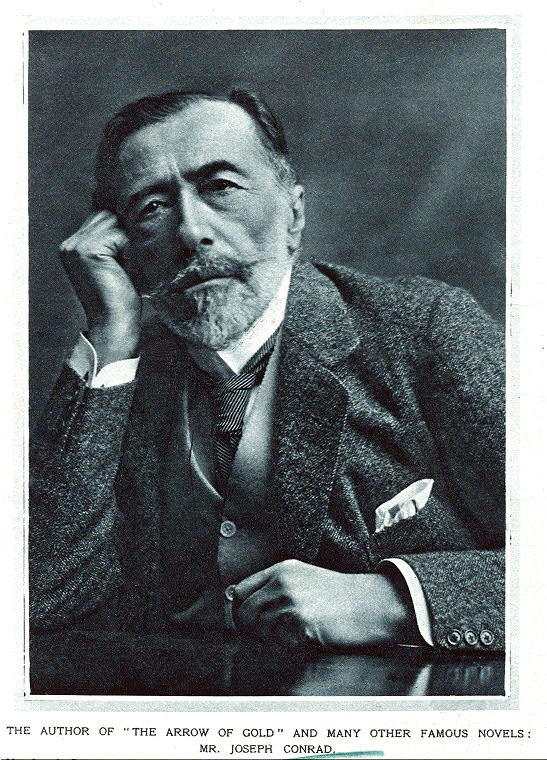 Joseph Conrad, author of “Heart of Darkness.” (Public Domain)
The plot is generally construed to symbolize the “horror” of European colonization of Africa, and that might very well work as Marxist literary theory, provided that one part of the story is left out: the ending.
Right from the book’s publication, the ending of Conrad’s novella has been ignored by critics and commentators. The author complained about this in a letter to a friend dated May 31, 1902, remarking:
“I call your own kind self to witness … the last pages of Heart of Darkness where the interview of the man and the girl locks in—as it were—the whole 30000 words of narrative description into one suggestive view of a whole phase of life and makes of that story something quite on another plane than an anecdote of a man who went mad in the Centre of Africa.”
Nobody listened. What did the author know, anyway? To this day, the ending is generally dismissed as unimportant, or at least inessential. The ending is lopped off the film “Apocalypse Now,” director Francis Ford Coppola’s Vietnam paraphrase of the story, complete with Kurtz and “the horror, the horror.” It’s left out because it doesn’t fit the theme of the white man’s oppression of another culture. The academy ignores it, too. In a widely viewed Northeastern Illinois University video, Associate Professor Kristen Over summarizes the story, while assuring us that its theme is the “greed, racism, and corruption” of European colonists.
Wrapping up the retelling, she notes that Marlow “returns Kurtz’s papers to the fiancée he left behind.” This part of the tale, which takes three seconds on the video and is treated as a mere postscript, occupies five pages in most editions of Conrad’s book. Although it’s just five pages of the novella, the ending of any work of fiction is no postscript.
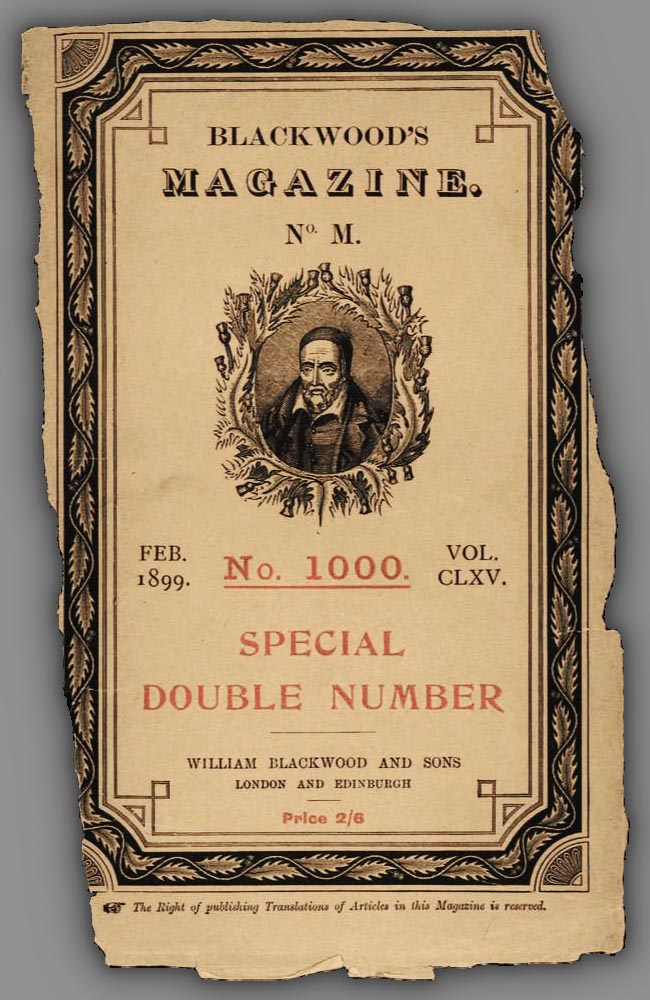 “Heart of Darkness” was first serialized in Blackwood’s Magazine in 1899. (Public Domain)
Marlow describes meeting the fiancée:
“She came forward, all in black, with a pale head, floating towards me in the dusk. She was in mourning. It was more than a year since his death, more than a year since the news came; she seemed as though she would remember and mourn forever. … I laid the packet (of papers) gently on the little table, and she put her hand over it. ‘You knew him well,’ she murmured.”
Kurtz was a “remarkable man,” Marlow says, in response to the fiancée proclaiming, “It was impossible to know him and not to admire him.”
After paragraphs of mutual praise for Kurtz, Marlow makes the mistake of saying he had heard Kurtz’s last words. Of course, she asks to know what they were.
“’Repeat them,’ she murmured in a heart-broken tone. ‘I want – I want – something – something – to – to live with.’”
Of course, Kurtz’s last words were “The horror, the horror.” Marlow realizes he can’t tell her that. She continues:
“’His last word – to live with,’ she insisted. Don’t you understand I loved him – I loved him – I loved him!’”
Marlow pulls himself together and says: “The last word he pronounced was – your name.” She responds with “an exulting and terrible cry. ‘I knew it – I was sure!’”
Marlow’s lie is the cornerstone of what Conrad had to say in the novel. It would have been cruel and uncivilized to tell a heartbroken fiancée the fact of her beloved’s terrifying last words, so Marlow lies. This is significant for a number of reasons, not the least of which is that Marlow had, earlier in the book, pronounced a strong personal distaste for lies.
The moment Marlow realizes the superiority of a civilized lie over a brutal fact is the moment that, as Conrad put it, “locks in” the entire narrative, giving the story cohesion. In putting kindness above other values, he honored civilization.
A Lesson From ‘Heart of Darkness’
How does this color the rest of the novella? In looking back over earlier events, one now grasps Conrad’s theme of the desirability of civilization’s inherent artifice. “Artifice” generally carries a negative connotation, but here it’s meant in the same sense that an artist transforms materials into art. Civilization makes of humanity more than it is in its natural state. It’s superior to the facts of bare life, mud huts, and cannibalism that Marlow left behind in Africa. Without making ourselves more than what we are in biological reality—without the artificial overlay of civilization—we are primitive and backward, like the superstitious African natives who eat each other and call Kurtz a “god.”
Sorry, Achebe and Marxist literary theorists. “Heart of Darkness” condemns the primitive and extols the civilized. It exposes the ugliness of the fact that people in a primitive state can be brought to eat other humans and lifts up the need to be better than our bare selves through what Plato called the “noble lie” of civilization.
Conrad doesn’t use that term, but it’s cognate with his meaning. Plato also recognized the need to lift humanity from its natural baseness to nobility through myth—a form of lying.
An early scene in “Heart of Darkness” foreshadows this point. As he begins his trip up the Congo, Marlow encounters a living example of the civilized lie. It’s the Company accountant, decked out in “a high starched collar, white cuffs, a light alpaca jacket, snowy trousers, a clean necktie, and varnished boots.” The effect astonishes Marlow. None of it is necessary; all of it contradicts the facts of the environment. It’s artifice on parade. This causes Marlow to make a comparison to what surrounds them: the facts of the unadorned biological human condition.
A scene in which Marlow throws a dead body from the boat into the river so his cannibal crew will not eat it shows that Marlow is aware of the true heart of darkness in primitive man. It is a bare fact that humans can eat humans, but it is better to contradict that fact and pretend otherwise.
When referring to London, Marlow calls it both “the greatest town on earth” and a “whited sepulcher.” The latter phrase comes from the Gospel of Matthew, where Jesus compares hypocrites “like unto whited sepulchers, which indeed appear beautiful outward, but are within full of dead men’s bones, and of all uncleanness.” While the phrase is a condemnation in the Bible, Conrad’s description emphasizes how lies are the very thing that make London such a great town. Its artifice covers the mere biology underlying human life.
We are jungle creatures in our natural state. That’s a fact. We eat each other and sleep in the mud. But by contradicting that state through the pretense of such things as kindness, good manners, fine clothes, respect for the dead, and the creation of great cities, we achieve the great and noble artifice of civilization. That’s what humanities professors don’t want you to know.
What arts and culture topics would you like us to cover? Please email ideas or feedback to features@epochtimes.nyc