By the time Herakles reaches his 11th Labor, the atmosphere of the myths has changed profoundly. The earlier labors demanded courage, ingenuity, restraint, endurance, and the restoration of order against various forms of chaos. But now the hero approaches something altogether more mysterious, although it follows from his journey into the West and the “red lands” of Geryon in Labor 10. The task before him concerns not merely strength or perseverance, but wisdom itself.
The Journey Westward
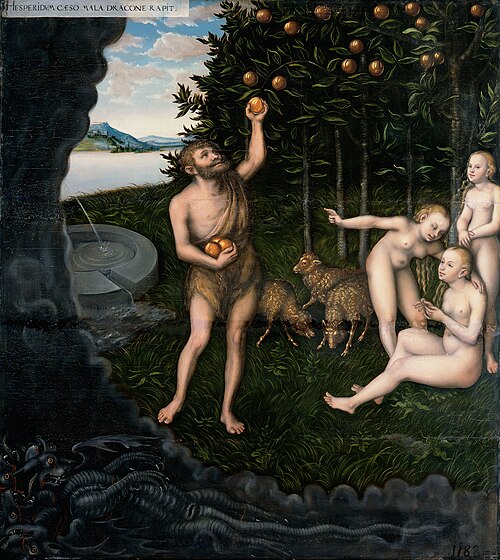
The command given by King Eurystheus is deceptively simple: Herakles must retrieve the golden apples of the Hesperides. Yet these are no ordinary fruits. The apples belong to a sacred garden situated at the far western edge of the world, beyond the limits of ordinary geography, near the place where heaven and earth seem almost to meet.
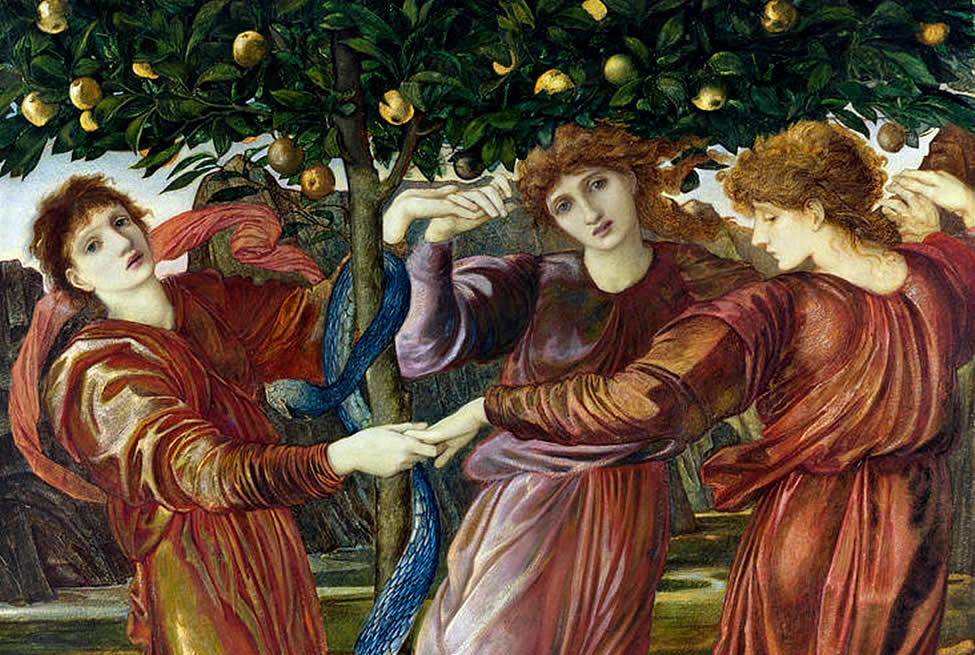
The apples are associated with Hera herself, queen of the gods, and guarded both by the Hesperides, whose name means “Daughters of the West.” The name is probably derived from “hespera,” meaning “evening” and by the great serpent-dragon Ladon, a sleepless guardian coiled around the sacred tree. Herakles is journeying into the night, and already the symbolism is immense.
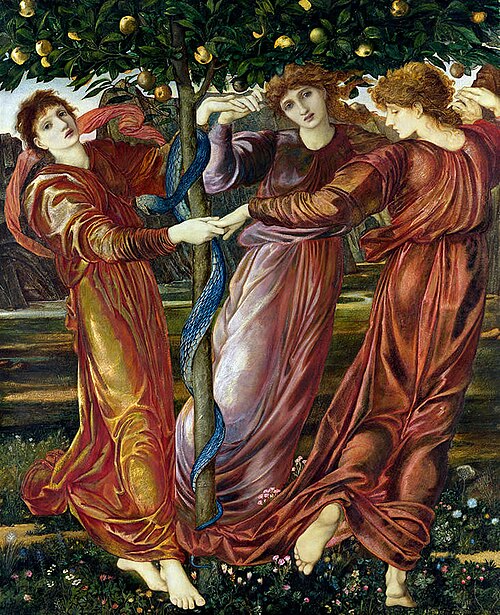
The West, as we have seen in Labor 10, is never merely a direction in Greek mythology. It is the realm of sunset, endings, mortality, and the mysterious borderlands where the known world gives way to transcendence. To travel westward is to move toward the edge of ordinary human existence itself. However, unlike the Geryon Labor, where the hero confronted exhaustion and distance, here the object sought is not cattle but immortality.
The golden apples possess extraordinary significance throughout ancient mythology. Fruit-bearing trees repeatedly symbolize life, wisdom, renewal, and divine order. In ancient Greek tradition, these apples were often associated with eternal youth or divine vitality. In Norse mythology, the gods preserve their immortality through magical apples. In the biblical tradition, the fruit of Eden is associated with knowledge, temptation, and humanity’s longing to transcend its appointed limits—and thus, paradoxically, with the entrance of death into the world.
The parallels are unlikely to be accidental. At a symbolic level, the labor belongs naturally to Sagittarius, the sign associated with questing, higher knowledge, distant journeys, philosophy, and spiritual aspiration. Sagittarius is the traveler of the zodiac, the seeker who aims beyond the immediate and visible toward some larger truth. Unlike Capricorn, which endures hardship through discipline, Sagittarius moves outward through vision and longing, something symbolically reflected in the figure of the archer itself, as Herakles famously was. An archer must always have something beyond himself to aim at. This distinction is crucial.
Whereas before, Herakles prevailed through strength, courage, or endurance, the apples of the Hesperides cannot simply be seized through force. The 11th Labor repeatedly frustrates direct action. The garden itself is hidden. Its location is uncertain. The hero must question travelers, wrestle shape-shifters, cross deserts, and seek guidance from obscure figures before he can even approach the sacred place. Gaining knowledge itself becomes the challenge.
Riddles, Reversals, and Cosmic Burdens
The act of seeking knowledge is one reason the 11th Labor feels strangely dreamlike compared with the earlier tasks. Herakles enters a world of riddles, transformations, and cosmic beings. Along the way, he encounters Nereus, the ancient sea-god sometimes called “the Old Man of the Sea,” who continually changes shape while attempting to evade capture. Only by holding firmly through all these transformations does Herakles finally force him to reveal the way.
The symbolism is profound. Truth is not easily obtained. Wisdom changes shape before us; reality itself appears unstable, something akin to the concept of Maya in Eastern philosophy, where appearances veil a deeper reality. Only perseverance joined to discernment allows the seeker to grasp what constantly escapes him. Indeed, Nereus’s advice sends Herakles east, away from the Hesperides themselves, to consult Prometheus, whose guidance ultimately lead him to Atlas. In short, the hero must first go backward to move forward—an insight not entirely foreign to Zen philosophy.
Thus, it is by way of significant detours that Herakles encounters and frees Prometheus, the Titan who had stolen fire from the gods and bestowed it upon humanity. For this transgression, Zeus had chained him to a mountain where each day an eagle descended to devour his liver, only for it to regenerate again by night.
In the ancient world, the liver was widely regarded as the seat of life itself. So, the punishment symbolized not merely physical agony, but the continual assault upon vitality, consciousness, and human aspiration.
Herakles kills the eagle and releases Prometheus from his torment. The episode is profoundly suggestive. Prometheus had suffered for elevating mankind beyond its primitive condition; now Herakles, son of Zeus, helps bring that punishment to an end. Symbolically, it is as though some part of the ancient curse hanging over humanity is finally lifted.
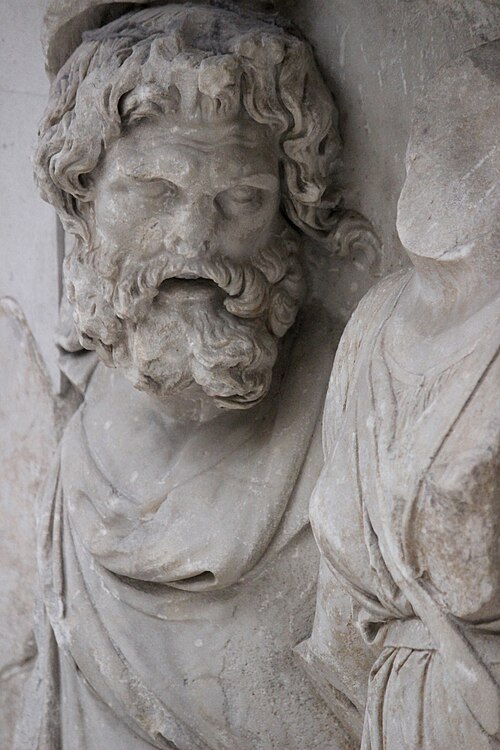
Eventually, the hero reaches the realm of Atlas, the Titan condemned to hold the heavens upon his shoulders. Here, the Labor reaches its deepest symbolic level. Atlas is no mere Titan. He represents cosmic burden itself: the weight of the heavens, the crushing responsibility of sustaining order against collapse. Earlier labors explored the burden metaphorically; now Herakles encounters burden on a universal scale.
In one version of the myth, Herakles agrees temporarily to bear the heavens while Atlas retrieves the apples from the garden. The image is extraordinary. For a brief moment, the hero assumes the very burden of the cosmos. This is no longer merely a heroic adventure but a metaphysical symbolism of a very high order. Inevitably, perhaps, the scene invites comparison with the Christian image of Christ upon the cross: The Son bearing the weight of sin, suffering, and brokenness in the world, yet enduring toward redemption and victory.
This scene has resonated through centuries precisely because it speaks to something permanent in human experience. Every mature life eventually encounters responsibilities that cannot be avoided, burdens that must simply be carried. Parenthood, leadership, artistic vocation, political responsibility, moral duty: All involve, in one form or another, “holding up the heavens.” That is to say, creating and sustaining order.

Yet the myth contains another subtle insight. Once Atlas returns with the apples, he attempts to avoid reassuming his burden. He proposes that Herakles continue carrying the sky while he himself delivers the fruit. Herakles, however, responds not with force but with intelligence. Pretending to agree, he asks Atlas to take back the heavens briefly while he adjusts his cloak, and once Atlas resumes the burden, Herakles calmly departs with the apples. The final victory, therefore, comes not through violence but through wisdom.
This marks a decisive transformation in the hero’s development. The Herakles who strangled the Nemean Lion with his bare hands has become more reflective, more strategic, and more spiritually aware. Strength remains, but it is no longer primary. Intelligence, discernment, and self-command now govern action.
Wisdom as the Ultimate Prize
The apples themselves reinforce this meaning. Gold traditionally symbolizes perfection, incorruptibility, and permanence. Unlike ordinary fruit, these apples do not decay. They represent the ancient human longing for permanence in a mortal world—the desire to overcome transience and somehow participate in eternity. And yet there is a paradox at the heart of the Labor.
Herakles succeeds in obtaining the apples, but he does not keep them. In many versions of the myth, Athena ultimately returns them to the sacred garden, since such divine treasures cannot permanently belong within the ordinary human sphere.
This ending matters enormously. The Labor suggests that immortality cannot simply be possessed as property or seized by force. Human beings may glimpse transcendence, participate in higher realities, or momentarily bear the weight of heaven itself, but ultimate permanence remains beyond complete human ownership.
Modern culture often treats fulfillment as acquisition: more success, more wealth, more visibility, more control. Yet the myth quietly undermines this assumption. The highest realities are not commodities to be owned. Wisdom itself teaches humility before what transcends us. For modern readers, the relevance of the Labor lies precisely here. Many of our deepest pursuits—truth, beauty, wisdom, meaning—resemble the garden of the Hesperides. They cannot be reached quickly, nor mastered through force alone. They require endurance, discernment, humility, and the willingness to journey beyond the familiar boundaries of the self.
In this sense, the 11th Labor becomes one of the most philosophical of the entire cycle. Herakles is no longer merely defeating monsters or restoring civic order. He has become a seeker standing at the threshold between mortality and transcendence. And that, perhaps, is the enduring lesson of the tale, that the greatest treasures are not those we permanently possess, but those moments in which, however briefly, we touch what lies beyond ourselves.
Yet if the 11th Labor is the most philosophical of the cycle, the 12th and final one, to which we next turn, is by far the most dangerous. There, Herakles must descend into Hades: the ultimate liminal space, the dark frontier from which no living man was ever expected to return.
What arts and culture topics would you like us to cover? Please email ideas or feedback to features@epochtimes.nyc.