



By the time Herakles is sent to Crete to confront the Cretan Bull, he has already learned a great deal about strength—and, crucially, about its limits. The earlier labors forced him into direct confrontation with fear and chaos: The Nemean Lion demanded courage; the Lernaean Hydra demanded ingenuity. Later labors refined his moral education: The Ceryneian Hind required reverence and restraint; the Erymanthian Boar demanded that raw aggression be captured rather than unleashed.
Now, in his seventh labor, Herakles faces a challenge that appears deceptively familiar. Once again, the task concerns a powerful animal, raging and destructive. Yet the Cretan Bull is not merely another beast to be subdued. It is the product of misused power, divine favor mishandled, and authority that has failed to govern itself. This labor is not simply about strength; it is about responsibility.
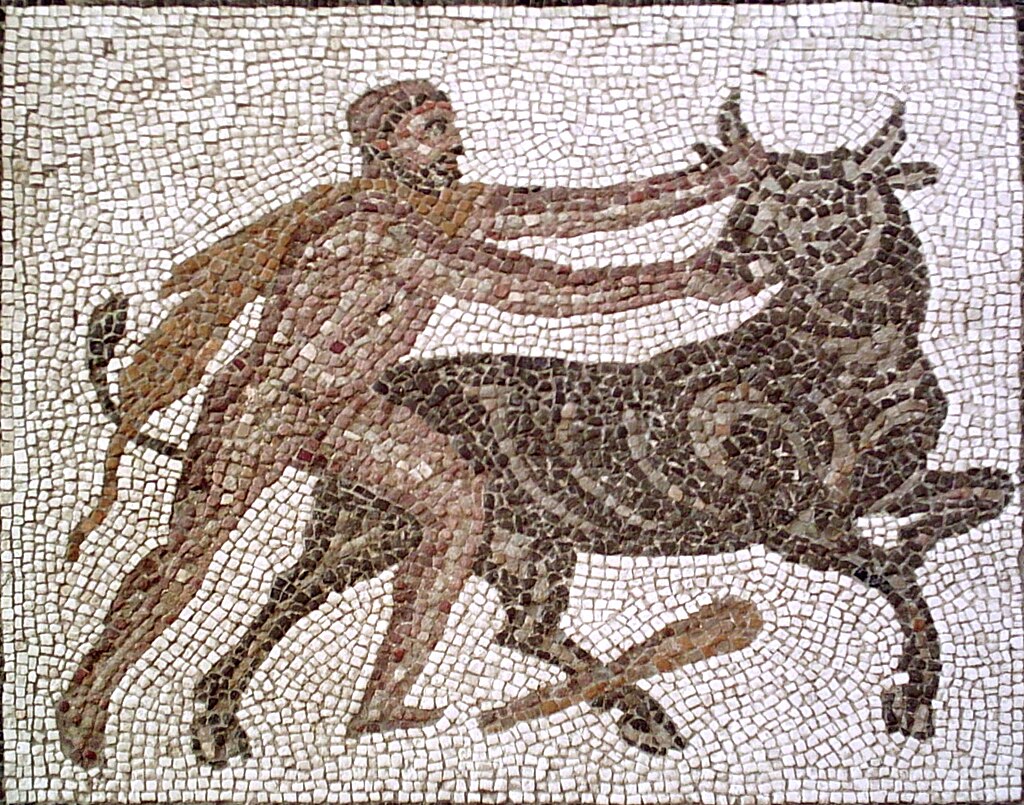
The Cretan Bull
The bull originally belonged to Poseidon, brother of Zeus, and ruler of the ocean—which, in Greek thought, is invariably a symbol of emotion, turbulence, and uncontrollable currents. Poseidon is the god not of calm waters, but of upheaval: earthquakes, storms, and the instability that lies beneath apparent order.
Poseidon famously opposed the homecoming of Odysseus, whose greatest trials occur at sea, where he repeatedly encounters the god’s wrath—most memorably in the perilous waters dominated by Charybdis, the devouring whirlpool that embodies the sea’s destructive excess.
Here, though, the bull is sent as a sign of divine favor to Minos. It was intended to be sacrificed in gratitude. Minos, however, kept the bull for himself, offering another in its place; this was because the bull was beautiful and so perfect.
Minos’s deception seemed small, but its consequences were vast. Divine gifts, when hoarded rather than honored, curdle into curses. Poseidon’s response was not immediate punishment, but corruption: The Bull was driven mad, and Minos’s household descended into moral chaos, most notoriously through Pasiphae, Minos’s wife. She fell in love with and mated with the bull, giving birth, thereby, to the Minotaur, a monster disrupting Zeus’s order and creation.
Thus, the bull that Herakles must capture is already laden with symbolic weight. It represents power without gratitude, strength divorced from obligation, authority that refuses accountability. It is sacred in origin, monstrous in effect—a paradox that runs through many of the labors, and one that becomes central here.
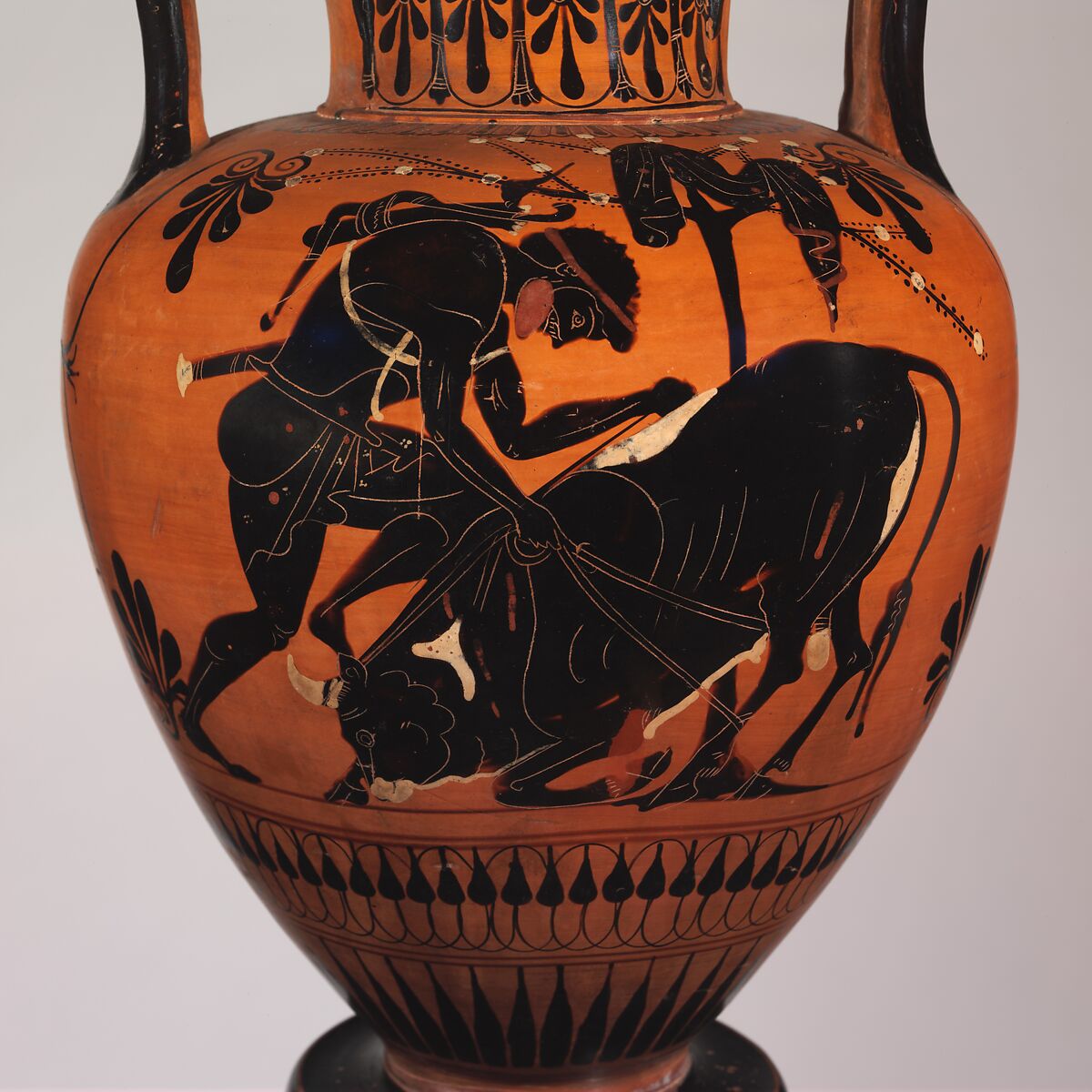
Containing Power
Astrologically and symbolically, this labor belongs to Taurus, the earth sign associated with strength, fertility, stability, and material abundance. Taurus energy is constructive when grounded: It builds, sustains, and nourishes. But when distorted, it becomes stubborn, possessive, and destructive. The Cretan Bull is Taurus ungoverned: physical force that has lost its moorings, abundance turned violent, vitality rampaging through the land.
Unlike the Hydra or the Lion, the Cretan Bull is not inherently evil. Nor is it sacred in the way the Hind was. It is something more unsettling: power that should have been integrated into the social order, but wasn’t. It tramples fields, terrifies communities, and destabilizes Crete not because it is demonic but because it has been allowed to exist without stewardship.
Herakles’s task, significantly, is not to kill the bull but to subdue and transport it. Once again, we see the pattern that has been emerging since the Hind and the Boar: Strength must be governed, not obliterated. Herakles seizes the bull by the horns, wrestles it into submission, and carries it—in some accounts, on Herakles’ shoulders—back across the sea. This is not an act of domination as much as one of containment.
Here the image is crucial. Herakles does not destroy the bull; he bears it. The labor becomes a meditation on what it means to carry power responsibly—to shoulder the weight of force rather than discharge it destructively. Taurus, as an earth sign, is about bearing loads, sustaining structures, holding steady. The hero now embodies that principle physically.
Following my last article on the Erymanthian Boar, the contrast is instructive. The Boar represents fire—rage, impulse, explosive energy—mastered by leading it into exhaustion. The Bull represents earth—brute strength, mass, inertia—mastered by grounding and control. Together, the two labors form a pair: Fire disciplined into self-command, earth disciplined into stewardship.
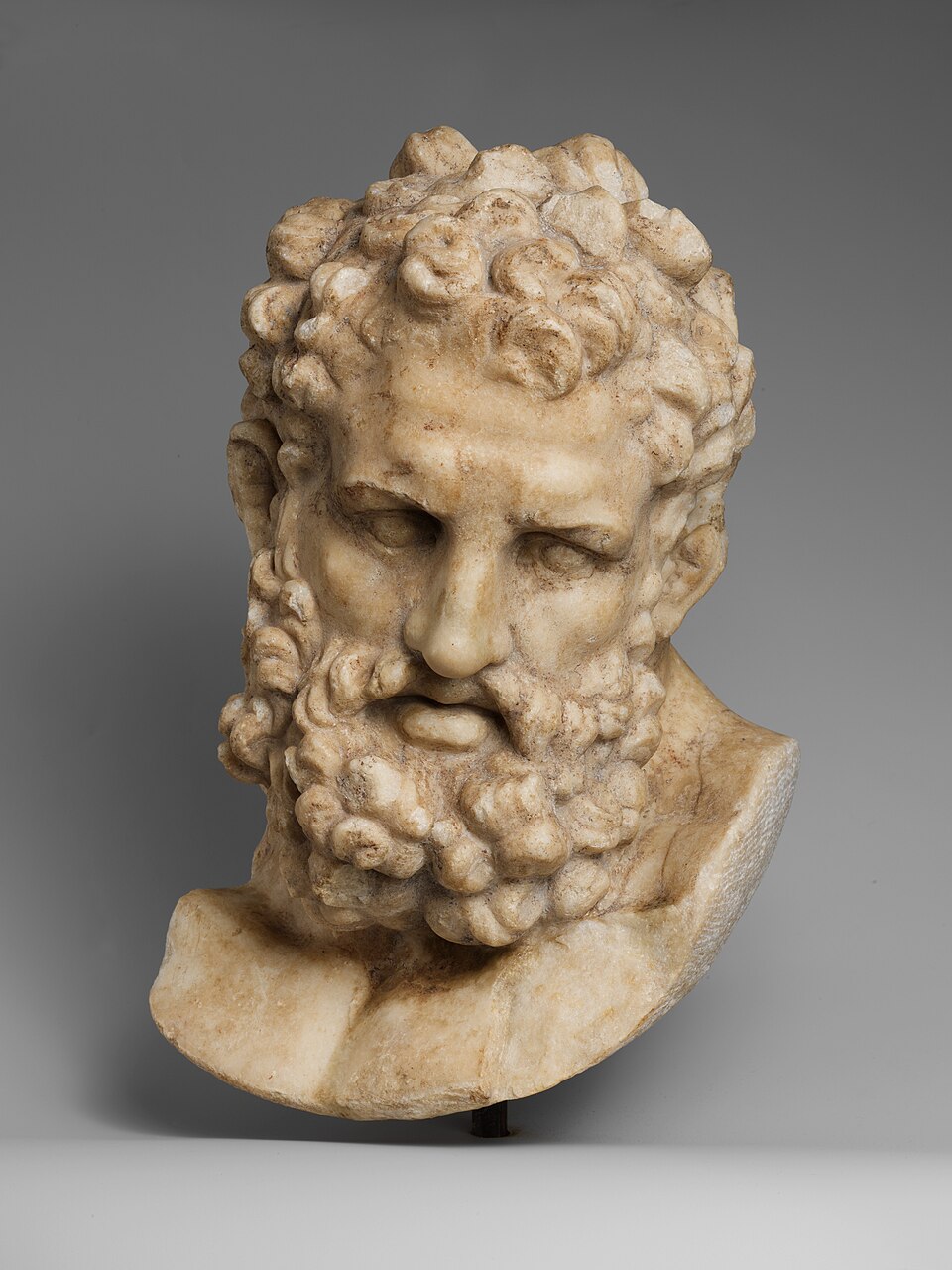
A Lesson for Those in Power
There is also a political dimension to this labor that would not have been lost on ancient audiences. Minos’s failure was not weakness, but misrule. He was given a sign of divine favor and chose expediency over piety, possession over obligation. The result was a chain reaction of disorder that required heroic intervention. Herakles arrives not to punish Minos directly, but to clean up the consequences of a leadership that refused to take responsibility for power.
In this sense, the Cretan Bull is a profoundly civic labor. It asks what happens when authority is exercised without moral restraint—when leaders accept privilege but evade duty. The damage is rarely confined to the one who errs; it spreads outward, destabilizing whole communities. Herakles’s intervention restores order not by replacing Minos but by removing the uncontrolled force his failure unleashed.
These dynamics play out in the modern world. When long-suppressed abuses of power finally surface—as they have done recently through high-profile disclosures originating in the United States—the consequences are not limited to those directly implicated. Public trust falters, institutions are shaken, and reputations far beyond the original circle are destabilized. The myth reminds us that it is not the scandal itself that causes the greatest damage but the unchecked force that was allowed to exist for so long without restraint.
Psychologically, the bull can be read as the body’s strength and appetites. It is the raw physical energies that must be integrated rather than denied. Many modern pathologies arise not from excess desire alone but from desire that has not been properly acknowledged, guided, or honored. Repressed, it returns as compulsion; indulged, it becomes destructive.
Swiss psychiatrist Carl Jung understood this very well:
“The gods have become diseases; Zeus no longer rules Olympus but rather the solar plexus, and produces curious specimens for the doctor’s consulting room, or disorders the brains of politicians and journalists who unwittingly let loose psychic epidemics on the world.”
Herakles’s solution again charts a middle path: recognition, engagement, control.
The bull is not humiliated; it is restrained. Indeed, it is overpowered. In most retellings of the myth, Herakles faces the bull head-on and wrestles it down to the ground by grasping its horns and using his superior strength. Power is not shamed; it is placed back within bounds, for the bull accepts Herakles as its master once it is grounded.
That Herakles carries the bull away from Crete is also significant. The hero does not simply solve the problem locally; he removes the destabilizing force altogether. Power that cannot be governed where it arises must be relocated—a sobering lesson in both psychology and politics. Some forces, once unleashed, cannot be safely reintegrated without wider consequences.
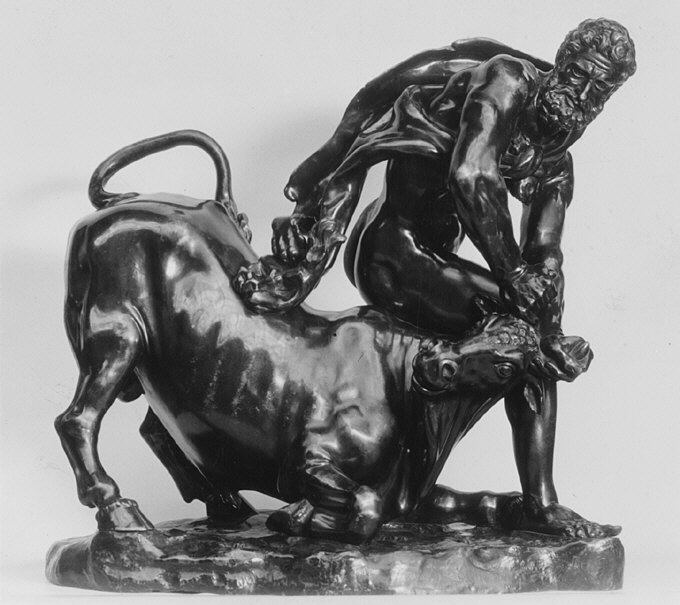
The Bull Amok Today
For a modern audience, the relevance is unmistakable. We live amid forms of power—technological, economic, political—that were once gifts and are now sources of anxiety. Like Minos, we are tempted to keep what benefits us and defer the cost. Like Crete, we then live with the consequences: systems that run away from us, energies that no longer answer to their creators. The Cretan Bull asks whether we are capable of bearing the strength we have unleashed—or whether, like Minos, we will leave it to others to clean up the wreckage.
In the unfolding education of Herakles, this labor marks another step away from the fantasy of the hero as destroyer. He is becoming something rarer: a bearer of responsibility, a figure who understands that the highest form of strength lies not in domination, but in containment. The bull is not slain, but carried; not erased, but managed.
Yet the myth offers a further, cautionary insight. Having completed the labor, the bull is later set loose in Greece, and havoc follows once again. This time it falls to another hero, Theseus, a kinsman of Herakles, to bring the disruption to an end. The implication is sobering: Power that has been mastered still demands ongoing responsibility. To contain a force is not to neutralize it forever. Released without wisdom, it will resume its destructive course.
If the Lion taught courage, the Hydra taught intelligence, the Hind taught reverence, and the Boar taught self-command, then the Cretan Bull teaches stewardship. Power is neither to be worshipped nor feared, but held—firmly, consciously, and for the good of the whole.
And that, perhaps, is why this labor feels so modern. We are no longer short of power. What we lack is the ability to carry it without being crushed by its weight.
What arts and culture topics would you like us to cover? Please email ideas or feedback to features@epochtimes.nyc

_07.jpg)