Ancient Greece made its first mark on the world through poetry. The epic battles of the “Iliad” and Odysseus’s adventures continue to fascinate readers, not least because they vividly depict love, strife, homecoming, and other universal themes.
Among the most influential ancient Greek poets was Hesiod, a farmer-turned-lyricist whose works are the earliest written versions of such popular Greek myths as “Pandora’s Box” and “Prometheus and the Stolen Fire.”
A frank observer of nature and society, Hesiod also wrote about ordinary life. His pastoral poem “Works and Days” combined pragmatic observations on mundane topics with timeless advice on how to live a simple, fulfilling life. It made Hesiod into one of history’s earliest moral guides.
Migrant, Farmer, Poet
Hesiod lived around 700 B.C. in Ascra, central Greece, where his family settled when he was a boy. In “Works and Days,” he described the small village as “bad in winter, sultry in summer, and good at no time.”
When his father died, the poet inherited a small plot of land at the foot of Mount Helicon. The mountain was the imaginary site of many myths, including the famous story of Narcissus, the young man whose obsession with his own reflection in a lucid pond drove him mad.
In “Theogony” (“The Generation of the Gods”), Hesiod described meeting the Muses on Helicon. The Greeks hailed the inspirational goddesses as the divine protectresses of literature, science, and the arts. After they noticed him “shepherding his lambs under holy Helicon,” the Muses “plucked and gave [Hesiod] a rod, a shoot of sturdy laurel, a marvellous thing, and breathed into [him] a divine voice to celebrate things that shall be and things there were aforetime.”
Unlike his father, who sailed often for business reasons, Hesiod was allegedly averse to sea travel. He only boarded a ship once to attend the funeral games in honor of Amphidamas of Calchis, probably a popular poet. The Greeks often commemorated someone’s legacy with competitions. Hesiod won first prize for best recitation and then returned to Ascra, never to leave the Greek mainland again.
Mystery surrounds the poet’s death. He might have died during a siege, while trying to avoid a prophecy, or at the hands of two infuriated brothers who falsely blamed him for violating their younger sister. This uncertainty seems fitting for one who spent his life blurring the lines between falsity and truth.
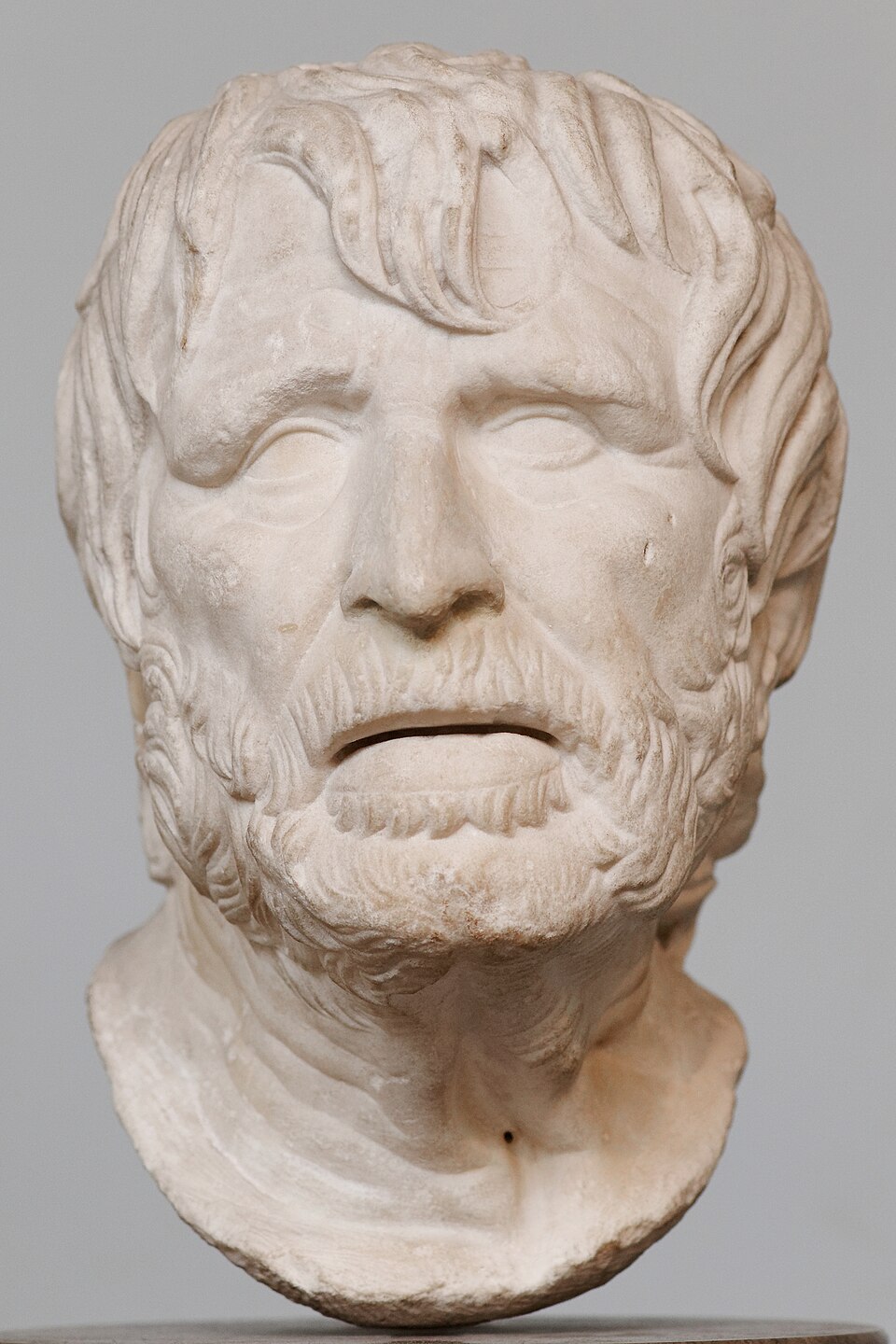 A bust suspected to be of Hesiod, from the 2nd century B.C. British Museum, London. (Public Domain)
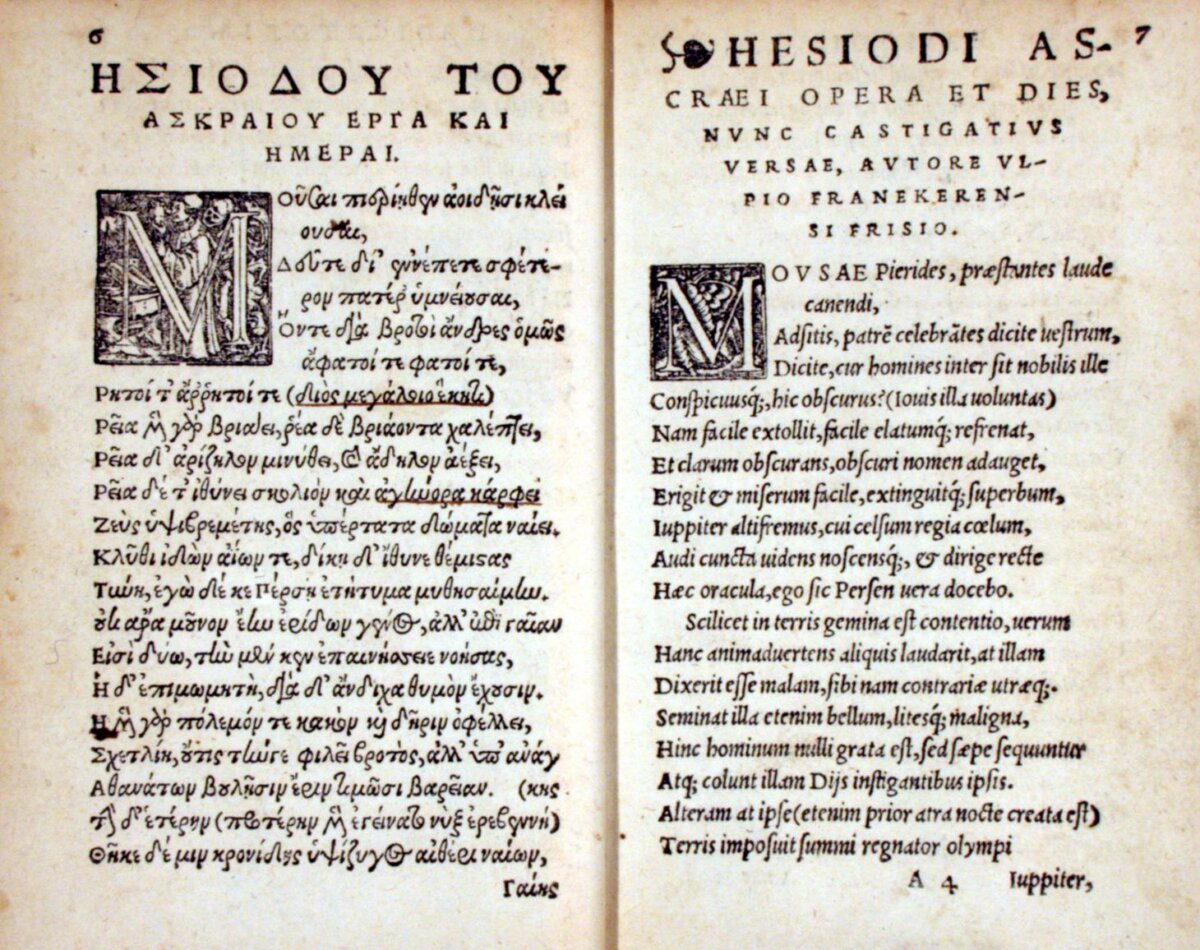
Hesiod belongs to the same epic tradition as Homer. Unlike Homer, who never wrote down his stories, Hesiod’s much shorter and more specific works were most likely penned before they were recited. His earliest poem was “Theogony,” a compilation of myths about the origin of the world and of the major Greek gods, from primordial Gaia and Chaos all the way to Zeus and the “Olympians.”
‘Works and Days’
Though small and ordinary, Hesiod’s land occasioned lawsuits between him and his brother Perses, who bribed local authorities to cheat the poet out of his rightful share of land. The episode may have inspired Hesiod to write “Works and Days,” his second, shorter, but most-read work.
The 828-line opus concentrates on remote pastures, petty disputes, and similar mundane scenes. It stands out from other ancient Greek poems for its caustic and shamelessly prescriptive style. Almost every line chastises Perses, whom Hesiod singled out as the poster-boy of corruption and moral decadence.
Unlike “Theogony,” “Works and Days” is didactic. Hesiod scolded harshly, but only because he aimed to teach. He understood that myths could captivate the reader and drive his lessons home, hence his choice to introduce the pastoral work with a story about human evolution.
“Works and Days” opens with the “Five Ages of Man”: an account of humanity’s evolution from a pristine but long-gone age to Hesiod’s harsh, wicked world. Four of the five ages correspond to progressively sturdier but less valuable metals. The metals represent moral worth, and the different ages offer food for thought.
The people from the first, golden generation “lived like gods without sorrow of heart, remote and free from toil and grief.” They fed on the earth’s plentiful resources without needing to sweat and toil. Age didn’t weaken them. They remained youthful until their peaceful deaths.
Unlike their predecessors, the silver people were weak, corrupt, and irreverent. They lived sheltered childhoods, which set them up for a short, pain-ridden existence spent “in sorrow because of their foolishness, for they could not keep from sinning and from wronging one another.” They also stopped worshipping the gods, who destroyed them because of their impiety.
The bronze people were more pious, but they loved war. They were violent and terrible, with hearts “made of hard rock.” Their demise was self-induced. So strong was their desire to fight that “they killed each other with their own hands.”
The fourth age was an exception. It was the generation of Odysseus, Achilles, and other Homeric heroes, whom Hesiod thought were far better in physical prowess and moral quality than their forerunners.
Yet, despite the promise of progress that the “Heroic Age” presented, the world quickly resumed its decline. As the heroes died, so did any trace of excellence. The final age of iron was the most corrupt. Children dishonored their parents, families quibbled and crumbled, and selfishness undermined hospitality and honesty. Such were Hesiod’s times.
 Detail from “The Voyage of Life: Youth,” 1842, by Thomas Cole. Oil on canvas; 52.8 inches by 76.8 inches. National Gallery of Art, Washington. (Public Domain)
An Agricultural Manual
“Works and Days” is a practical guide to withstand economic hardship. The vast majority of Greeks during Hesiod’s life were farmers. Their lives depended largely on the climate, which wasn’t always favorable. Hesiod was also writing as large migrations troubled Greece. Settlers needed instructions to survive in their new environments.
To prepare his readers for harsh winters, the poet recommended dressing in layered, well-fitted clothing, protecting the head and feet especially, rationing food wisely, sowing “with your clothes stripped off,” reaping before sunrise, and many more basic but useful tips.
He exhorted readers to work hard and resist laziness: “Through work men grow rich in flocks and substance, and working they are much better loved by the immortals. Work is no disgrace: It is idleness which is a disgrace.”
A Brother’s Advice
Despite scathing comments about Ascra’s landscapes, Hesiod loved his town, at least enough to try to improve it with his verses.
The poem is dedicated to the Muses, but it addresses Perses, whose name is mentioned 10 times. Hesiod urged his brother to give up idleness, stop participating in shady legal schemes, and reject bribery in favor of honest, prudent diligence.
Although “fishes and beasts and winged fowls should devour one another, for right is not in them,” Hesiod reminded Perses that humans can tell right from wrong. He was writing about testifying truthfully in court, which Perses evidently didn’t do. In verses that resemble a curse, the poet offered his brother scathing advice: “Whoever deliberately lies in his witness and forswears himself, and so hurts Justice and sins beyond repair, that man’s generation is left obscure thereafter. But the generation of the man who swears truly is better thenceforward.”
Hesiod also implored Perses to stop thinking and acting violently. He reminded him that wrongdoing affects both victim and perpetrator: “He does mischief to himself who does mischief to another, and evil planned harms the plotter most.”
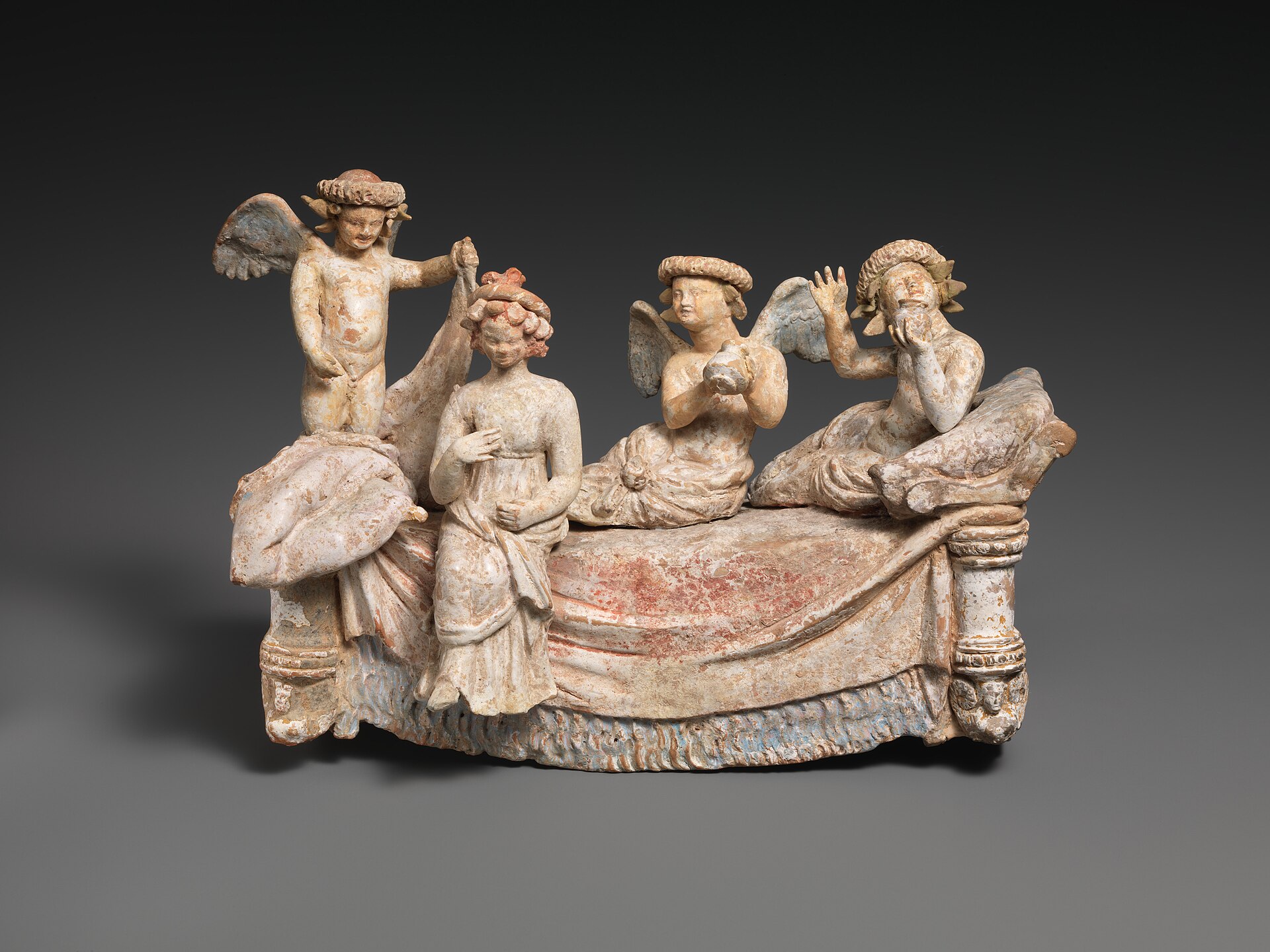 “Terracotta Banquet Group,” circa 3rd–2nd century B.C. Greece. Metropolitan Museum of Art. New York. (Public Domain)
The Greeks believed in personal agency. But the Greek “individual” was first and foremost a member of society. As the philosopher Aristotle put it three centuries after Hesiod: “A man who is incapable of entering into partnership, or who is so self-sufficing that he has no need to do so, is no part of a state, so that he must be either a lower animal or a god.”
Perses’s self-interested actions damaged his relationship with his brother, but they also damaged Ascra by setting a bad precedent. To remind him of his civic responsibility, Hesiod echoed Aristotle’s sentiment in another pithy maxim: “Often even a whole city suffers for a bad man who sins and devises presumptuous deeds.”
Good and Evil
Hesiod thought that evil was an easier choice than good. That statement still rings true. Lying is often more convenient than telling the truth. At least temporarily, it can divert responsibility and dodge undesired consequences. Telling the truth can be daunting and uncomfortable, hence people’s widespread resistance to do so, especially when guilty.
The poet deemed the good more difficult to reach. As he put it, between humans and goodness “the gods have placed the sweat of our brows: Long and steep is the path that leads to her.” Yet, despite the alluring nature of evil and the difficulty of goodness, Hesiod’s conclusion was clear: “That man is altogether best who considers all things himself and marks what will be better afterwards and at the end.” In other words, it’s best to forego immediate gains for future rewards.
Demanding though they are, careful planning, steady effort, and patient endurance go much farther than lying, stealing, and cheating. Hesiod observed this principle in his own life. Perses got his share of land, but he mismanaged it so poorly that he ended up mooching off his brother. Whether or not Hesiod helped Perses, he certainly enjoyed chiding him:
“To you, foolish Perses, I will speak good sense. Badness can be got easily and in shoals: The road to her is smooth, and she lives very near us. … If you work, the idle will soon envy you as you grow rich, for fame and renown attend on wealth. And whatever be your lot, work is best for you.”
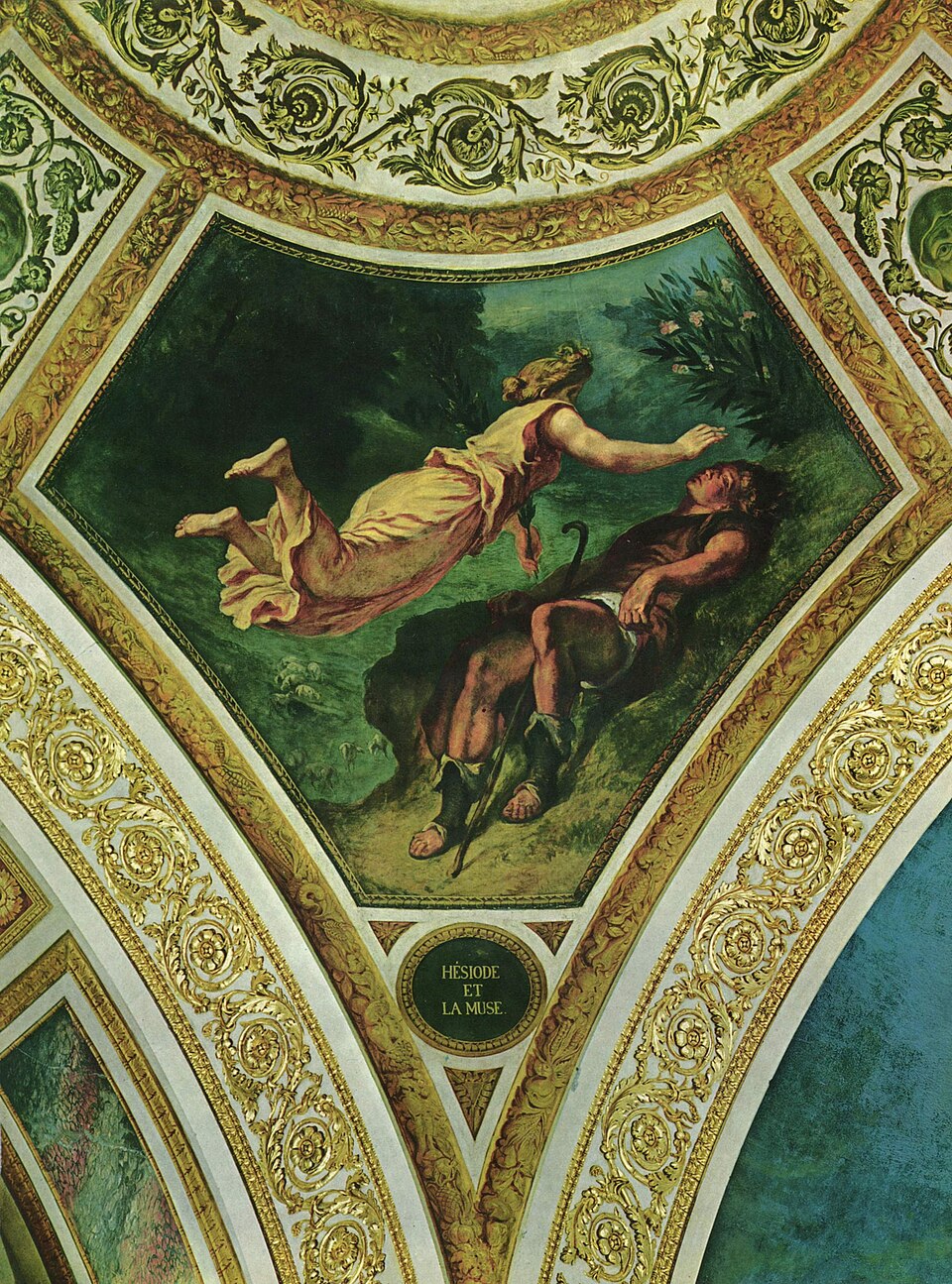 “Hesiod and the Muse,” mid-19th century, by Eugene Delacroix. Library of the Palais Bourbon, Paris. (Public Domain)
For most people today, Hesiod’s pastoral world is a distant reality. Contact with nature seems ever rarer, as does the tight-knit atmosphere of Hesiod’s community, which was enlivened by daily interactions between strangers-turned-friends.
Yet, historical differences aside, the poet’s counsel remains timely. Hesiod urges readers to guard their time against misleading distractions and alluring shortcuts—to rather focus energy on tending to what lies immediately before them, be it a field, a garden, or a home.
What arts and culture topics would you like us to cover? Please email ideas or feedback to features@epochtimes.nyc