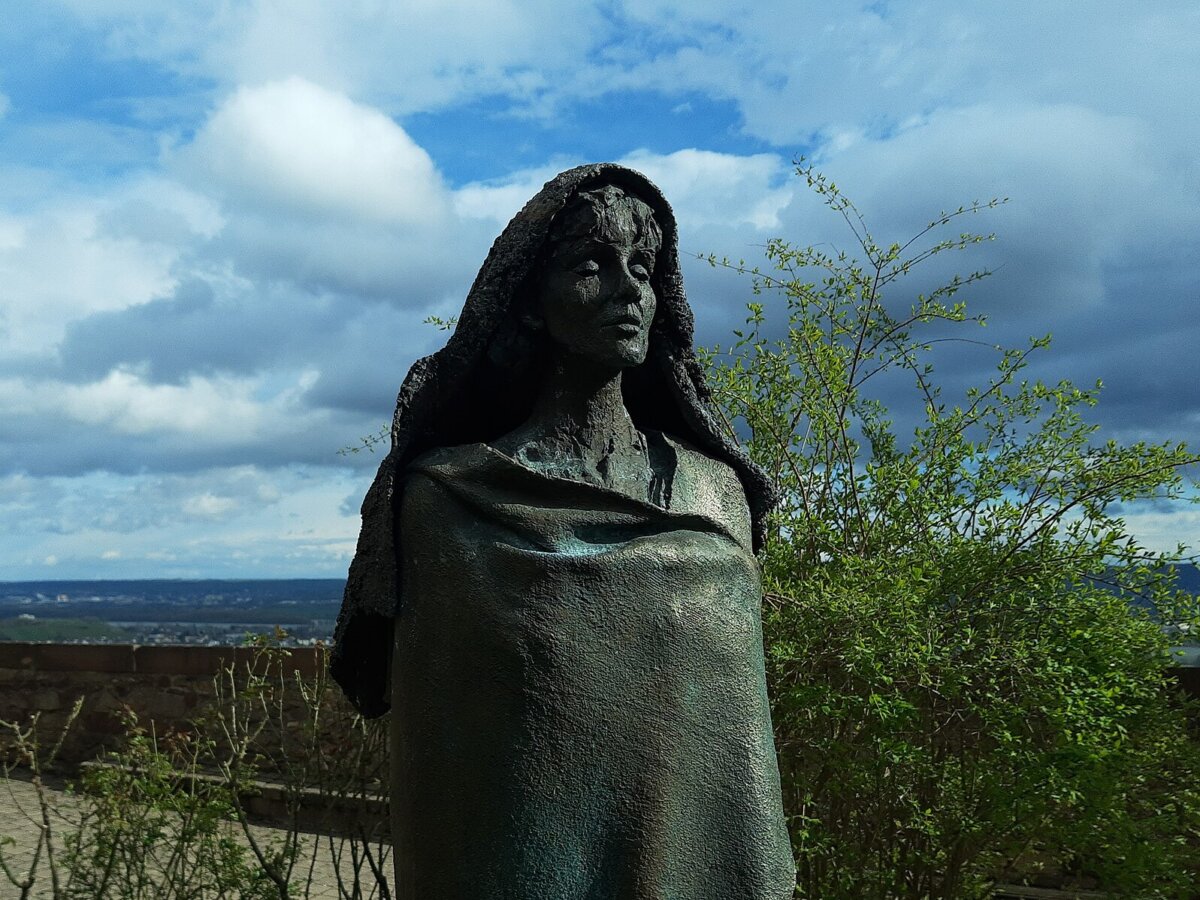
Far from an ordinary abbess, the polymathic Hildegard of Bingen left behind sacred music, medical treatises, and evocative descriptions of divine visions.
In the 12th century, Benedictine nun Hildegard of Bingen wrote dozens of works under the influence of what she called “the living light.” She went on to become one of the most remarkable figures of the Middle Ages: a theologian, composer, scientist, and visionary whose inspiring work transcended her historical context.
Illness, Visions, and the Living Light
Born around 1098 in the heart of the feudal Holy Roman Empire, Hildegard was the youngest of at least seven. Her parents belonged to Germany’s lower nobility. They served the Count Meginhard of Sponheim, a position that gave them and their children access to material resources otherwise unavailable to the ordinary person.
But Hildegard wasn’t particularly healthy. She was often bedridden and “fettered by sickness,” as she said in an autobiographical letter to her secretary. Ill health could partially explain her proneness to experiencing visions while asleep or wide awake, though Hildegard always assigned them spiritual significance. In the same letter, written at the age of 77, she reflected on the onset of her visionary life, which began in childhood and continued until her death in 1179. She wrote:
“In my infancy, before my bones, muscles, and veins had reached their full strength, I was possessed of this visionary gift in my soul, and it abides with me still up to the present day. … The light that I see is not local and confined. It is far brighter than a lucent cloud through which the sun shines. And I can discern neither its height nor its length nor its breadth.”
Hildegard claimed that she perceived the objects in this recurrent experience not with her five senses, but with her “spirit alone.” She called the light that usually enveloped her during these intense visions “a shadow of the living light.”
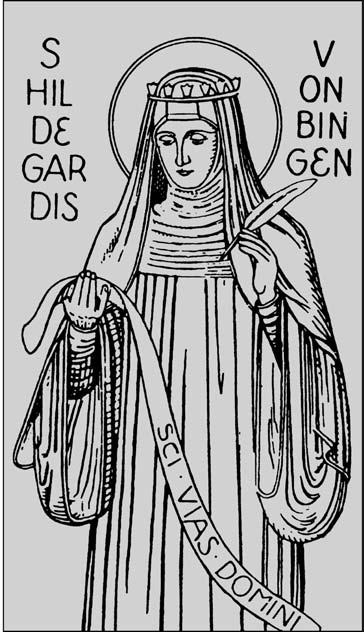 An 18th-century depiction of Hildegard of Bingen. (Public Domain)
The Monastic Life
Sensing a powerful but vulnerable potential in their daughter, Hildegard’s parents decided to enroll her as an oblate at the male-led Benedictine monastery of Disibodenberg, in the German Rhineland. She permanently joined the monastery at age 14.
Hildegard had never received a formal education. As she admitted in one of her many autobiographical remarks, “I had scarcely any knowledge of letters. An uneducated woman had taught me.” This uneducated woman was the Benedictine nun Jutta von Sponheim, a slightly older noblewoman who became Hildegard’s caretaker and spiritual mentor.
Jutta taught her reading and writing. Her lessons included musical notations that later enabled Hildegard to become one of the most prolific composers in the Middle Ages. But Jutta had also never studied formally. Although the value of her teaching gradually diminished as Hildegard became a prolific autodidact, their sisterly bond never waned.
When Jutta died in 1136, Disibodenberg’s nuns elected Hildegard leader of their convent. She petitioned to move her congregation to the nearby town of Rupertsberg, where she founded a community more closely aligned with the Benedictine precept “ora et labora” (“pray and toil”). Although the new convent was less grand, it gave her and her fellow nuns more autonomy.
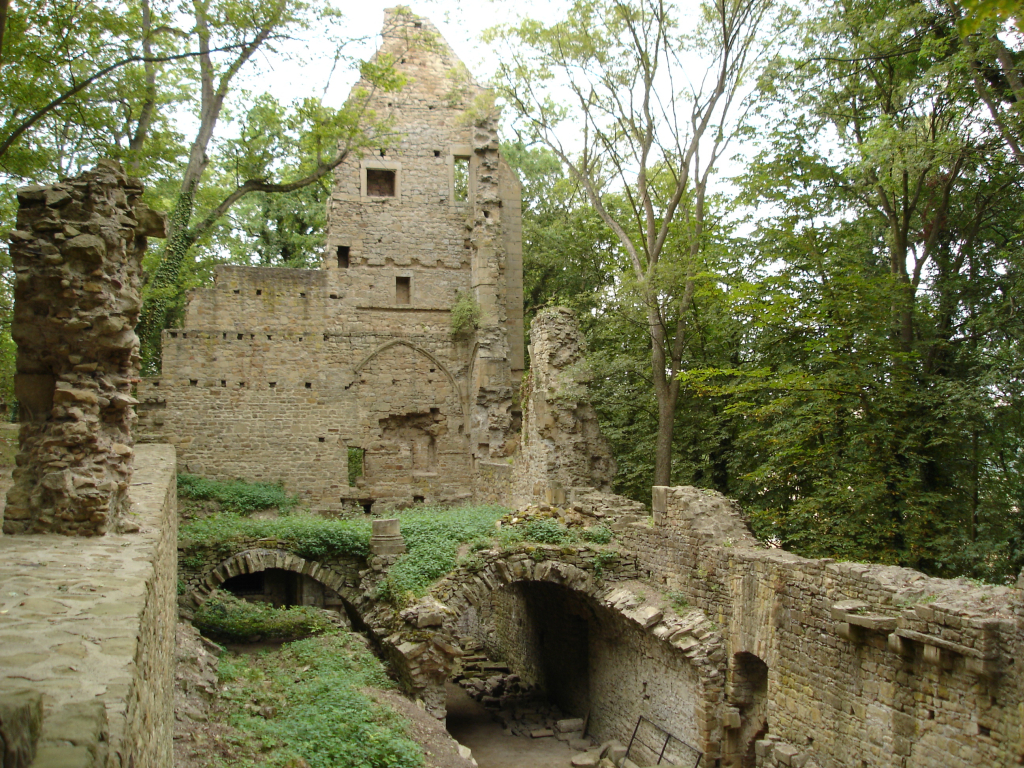 The ruins of the monastery at Disibodenberg, Germany. (Saharadesertfox/CC BY-SA 3.0)
In 12th-century Germany, women were largely forbidden from speaking publicly, let alone publishing writings or other materials under their names. Monastic women enjoyed better access to literacy than their secular counterparts, but their options were still severely limited.
Out of fear, Hildegard kept everything she wrote within the confines of her convent. Since her genius fostered a rich community, she continued feeling a yearning to share her visions with a wider audience. Decades after founding the convent, she received permission from church authorities to finally reveal her formidable work to a broader audience.
Polymathy
Hildegard’s wide-ranging skills and interests made her one of the most accomplished European polymaths in history. She wrote three large theological volumes, which describe and interpret her visions as a way to better understand what an ongoing relationship with God entails. She also composed more liturgical chants than any other individual from the Middle Ages.
Unlike most composers of her time, Hildegard wrote both music and lyrics. Her compositions were collected in the “Symphony of the Harmony of Celestial Revelations.” A recent surge of interest in her life and works has inspired contemporary performances of some of her most noteworthy pieces.
Hildegard was also a playwright. Her dramatic musical play “Ordo Virtutum” (“Order of the Virtues”) is the earliest example of a “morality play.” The modern term refers to a type of religious play especially popular from the 14th to the 16th centuries. Personified concepts like Anger and Grace share the stage with angels and demons as they strive to convince a human character that theirs is the good side. The purpose of morality plays was to impart ethical prescriptions, be they about marriage, religious service, or similar matters.
In Hildegard’s drama, the conflict is between an ecstatic human Soul, a Devil who tempts it to heed worldly things, and 17 Virtues. The virtues try and eventually succeed in persuading the Soul that, though it will be able to linger in the world, its destiny lies elsewhere. Hildegard supplemented a simple plot with intricate musical arrangements that make the play stand out even today.
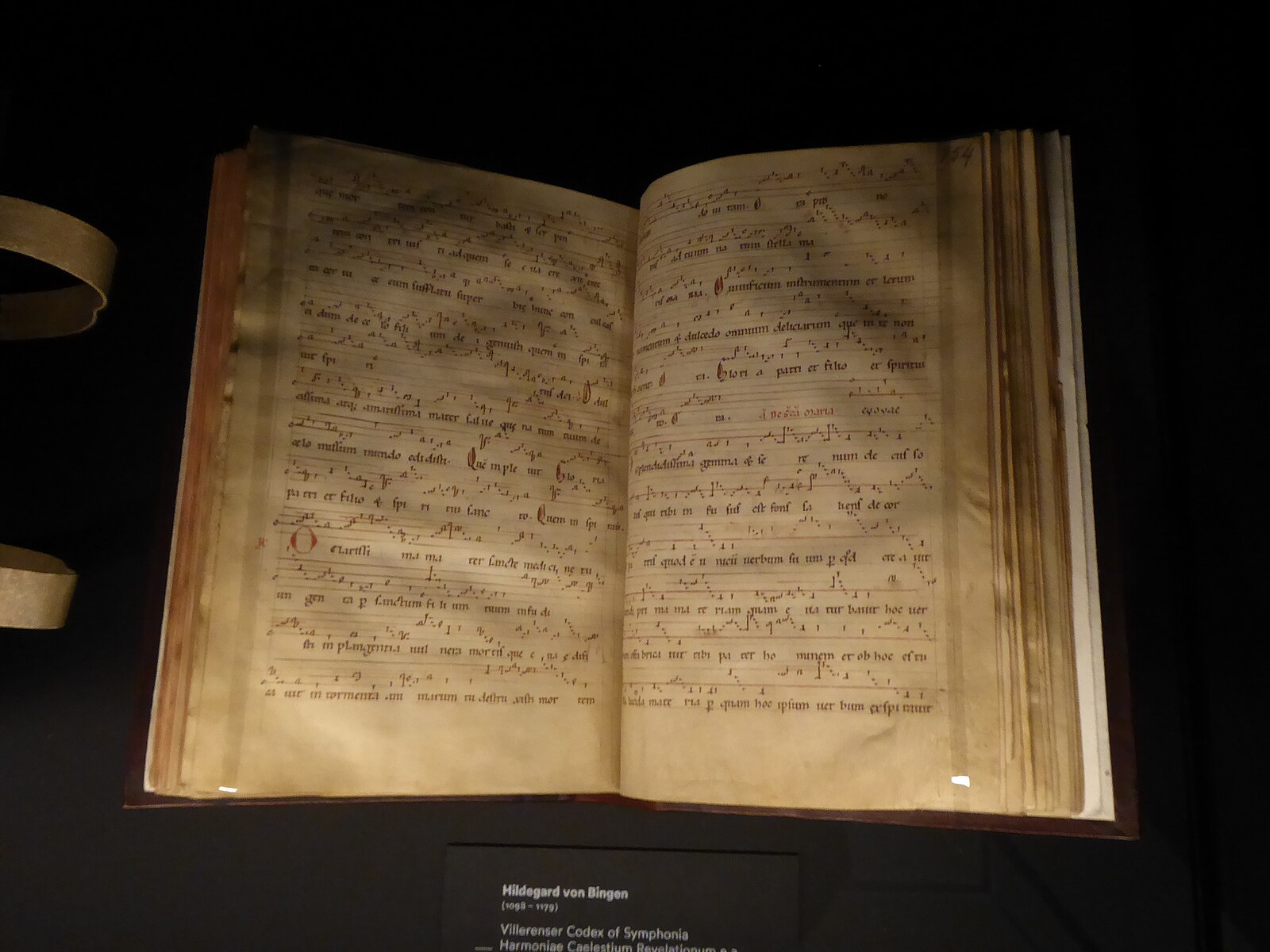 Part of the Dendermonde Codex was written in the 12th century by Hildegard of Bingen and named the “Symphonia Harmoniae Caelestium Revelationum.” Catholic University of Louvain, Louvain-la-Neuve, Belgium. (Public Domain)
The abbess’s contributions to natural science are no less remarkable than her theological works. She wrote several detailed studies on human anatomy, developed theories about various diseases, and even catalogued plants, stones, and animals based on their medicinal properties. Her invention of a complex language illustrated a keen interest in languages as well.
Once she gained a reputation as a polymathic visionary, Hildegard began preaching publicly and corresponding extensively with popes and emperors.
‘Viriditas’
Her prolific life exemplified a concept that defined her intellectual legacy. “Viriditas” is Latin for “greenness,” “abundance,” and “vitality.” In Christian contexts, the word has been used since the 4th century to connote spiritual health. The 64th pope, known as Gregory the Great (circa 540–604), described the Christian church as a fruit-bearing earth, where “viriditas” symbolized the healthy abundance faith offers believers.
“Viriditas” appears often in the abbess’s writings. In a vision illustrated in “Book of Divine Works,” the word is said by a figure who, though human in appearance, emanates a light brighter than the sun. Crowned with a golden circlet, the figure speaks directly to Hildegard:
“I am likewise the fiery life of the substance of divinity. I flame over the beauty of the fields and sparkle in the waters, and I burn in sun, moon, and stars. And with an airy wind that sustains all things with invisible life, I raise them up vitally. For air lives in greenness.”
Like Gregory I, Hildegard took greenness to mean a life-force that animates all creation and its bountiful manifestations. She mentioned natural features like fields, water, and the stars, paying special attention to air, one of the elements of this life-force.
 Musicians from the “Book of Divine Works,” 1172–1174, by Hildegard of Bingen. Unknown illustrator. (Public Domain)
Literally, “air lives in greenness” might mean that air, like water, is vital for nature to flourish. For example, the success of an essential life-bearing process like pollination depends partly on wind currents that spread pollen steadily across vast areas. Without air, the natural world would be poorer and starker, if it existed at all.
But for Hildegard, the force that air represented was more than natural vitality. Just as sap flows through leaves and blood through veins, she believed that “viriditas” flowed throughout the cosmos, enlivening and renewing it perpetually.
To live without direct knowledge of this vitality was to be spiritually barren, Hildegard suggested. To cultivate it was to align ourselves with the creative power of the cosmos.
Embodied Harmony
Hildegard’s own life embodied this verdant, overflowing vitality. Though she lived within the strict confines of monastic discipline, often troubled by illness, her imaginative intellect and aesthetic sensibilities powerfully displayed a human form of the divine creativity governing the cosmos.
It was in music that Hildegard seemed to find the optimal mode of communication. To her ears, music was the closest medium to angels and the best approximation of the multifarious but perfectly unitary living light. “A man’s soul also has harmony in itself and is like a symphony,” she wrote. In her play, only the Devil doesn’t sing. He shouts chaotically, causing dissonance with the graceful voices of the Virtues.
 An engraving of Hildegard of Bingen by W. Marshall. (Fæ/CC BY-SA 4.0)
The abbess’s life was a tribute to the living light, and an invitation to partake in its bounteous concert.
What arts and culture topics would you like us to cover? Please email ideas or feedback to features@epochtimes.nyc