Lest we forget, America’s liberty comes from immense sacrifice.
In July 1952, Retired U.S. Army Gen. Dwight D. Eisenhower addressed an 82nd Airborne Division luncheon in Chicago:
“My old comrades, ladies and gentlemen, I have been frightened in my time and never as much as right now—and I’ll tell you why. It’s not because of the old comrades in arms that are here, but because of others. … There is every possibility that I will break down.”
Eisenhower then paused to compose himself. “Those soldiers will understand. There is no glory, no place that any man can reach in this world, no honor that can ever hide in his heart, the sacrifices that American soldiers pay to retain our freedom.”
Eisenhower spoke from experience.
As the Supreme Commander of Allied Forces in Europe, he commanded the Allies’ Normandy landings, which led to the liberation of most of northwestern Europe. The 82nd Airborne Division paratroopers were there in that Allied force. They, too, understood the Soldier’s Creed and sacrifices made.
Two years later, as the U.S. president, Eisenhower signed legislation that replaced Armistice Day, which memorialized those who perished in World War I, with Veterans Day in a bid to recognize all veterans—those living and those resting in eternal peace. Americans have honored the country’s veterans on the 11th hour of the 11th day of the 11th month as they did for Armistice Day from 1918, but since 1954 on Veterans Day.
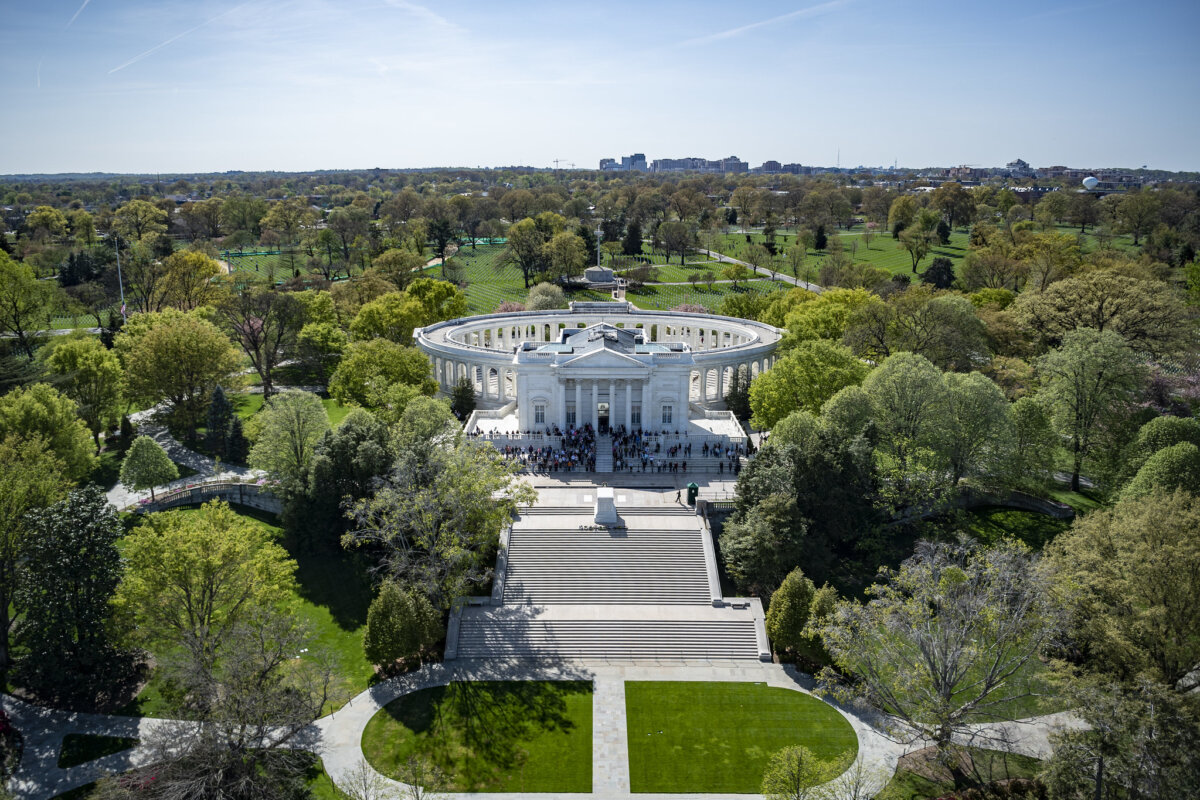
Every Veterans Day, the U.S. president or the president’s designee lays a remembrance wreath at the Tomb of the Unknown Soldier and addresses the nation from Arlington National Cemetery’s Memorial Amphitheater, in Arlington County, Virginia.
These solemn ceremonies and memorials represent the nation’s sorrow, strength, and hope.
America’s Memorial Amphitheater
In 1873, U.S. Army Quartermaster Gen. Montgomery C. Meigs designed a simple memorial amphitheater near the Tomb of the Civil War Unknowns. He constructed the amphitheater in less than a month, ready for Memorial Day that year.
Meigs’s amphitheater consists of an elliptical, brick pergola surrounding a sunken grass bowl. Twelve Ionic columns form the rostrum on the north side of the bowl. Young plantings of grapes, wisteria, and the like, would cover the pergola in the years to come.
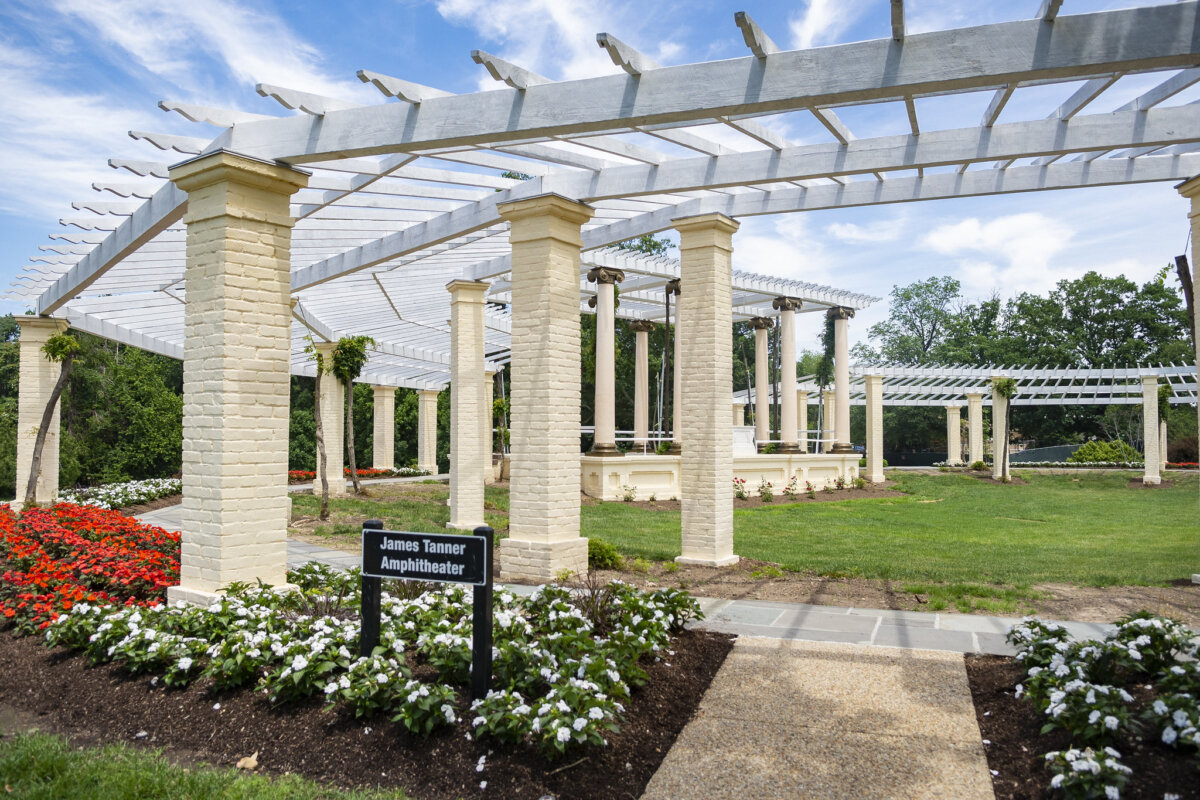
The amphitheater was renamed the James R. Tanner Memorial Amphitheater, as part of Arlington National Cemetery’s 150th Anniversary celebrations, on May 30, 2014. Tanner was a Civil War veteran who served in the 87th New York Volunteer Infantry. He suffered catastrophic injuries in the Second Battle of Bull Run in 1862 and lost both legs. Tanner served as Abraham Lincoln’s stenographer, and later as the Commissioner of Pensions and the commander in chief of the Grand Army of the Republic. He’s buried just yards from the amphitheater named in his honor.
The James Tanner Amphitheater was restored between 2015 and 2019. Restorers colored the rostrum base and ambulatory piers yellow and the capitals and bases of the 12 Ionic columns metallic bronze.
America’s Grand Memorial Amphitheater
By the early 1900s, Arlington National Cemetery required a larger and grander memorial amphitheater. According to Arlington Cemetery: “While a simple, pastoral pergola had fit American ideas of death and honor in the nineteenth century, a new century and a new world power required something grander.”
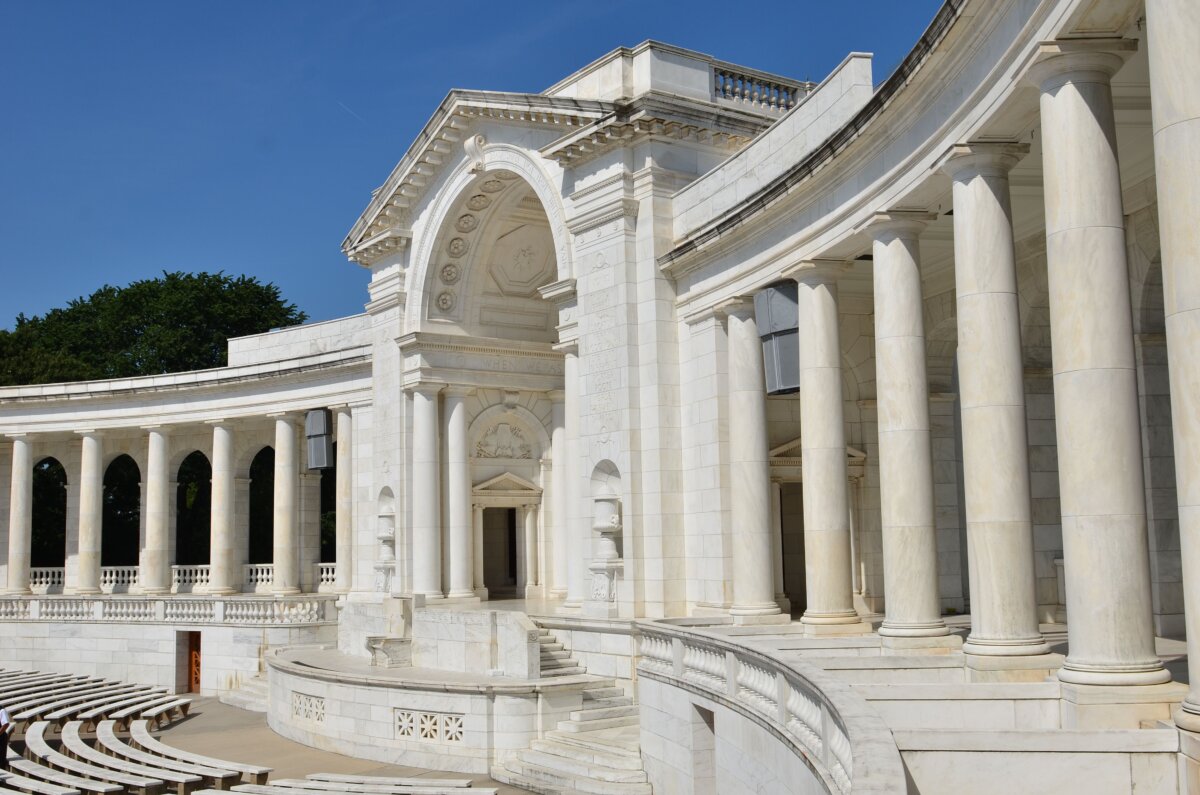
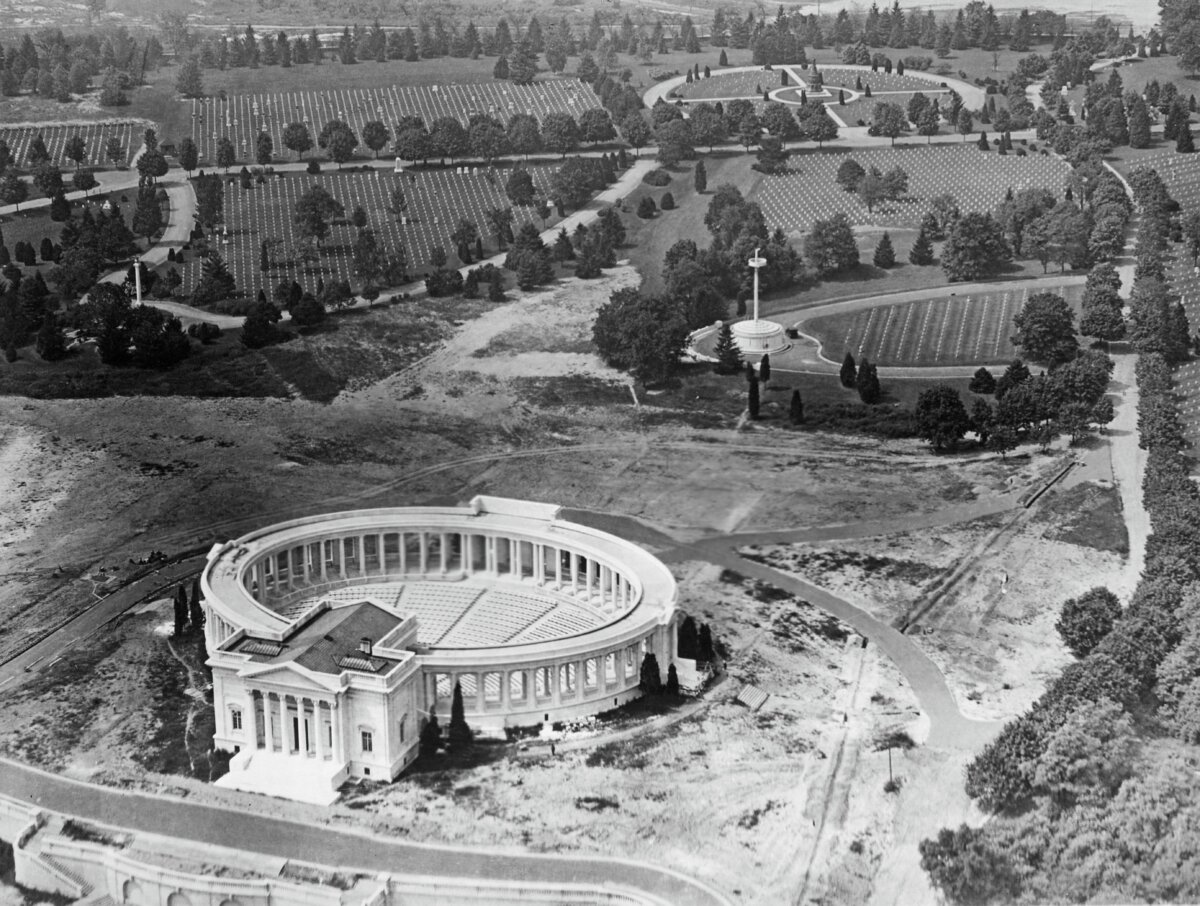
Thomas Hastings (1860–1929) of the Carrère & Hastings architectural firm designed the amphitheater, which also contains a Memorial Chapel and Memorial Display Room. The amphitheater echoes the elliptical plan of the original amphitheater, featuring a colonnade with a rostrum on one side.
On Oct. 13, 1915, President Woodrow Wilson laid the Memorial Amphitheater cornerstone, which contained a copper time capsule. Along with a plan of the amphitheater, the capsule included the American flag, copies of the Bible, U.S. currency and postage stamps from 1915, and documents of national significance such as the Declaration of Independence, the U.S. Constitution, and a map of Pierre Charles L’Enfant’s design for Washington.
The Memorial Amphitheater was dedicated on May 15, 1920.
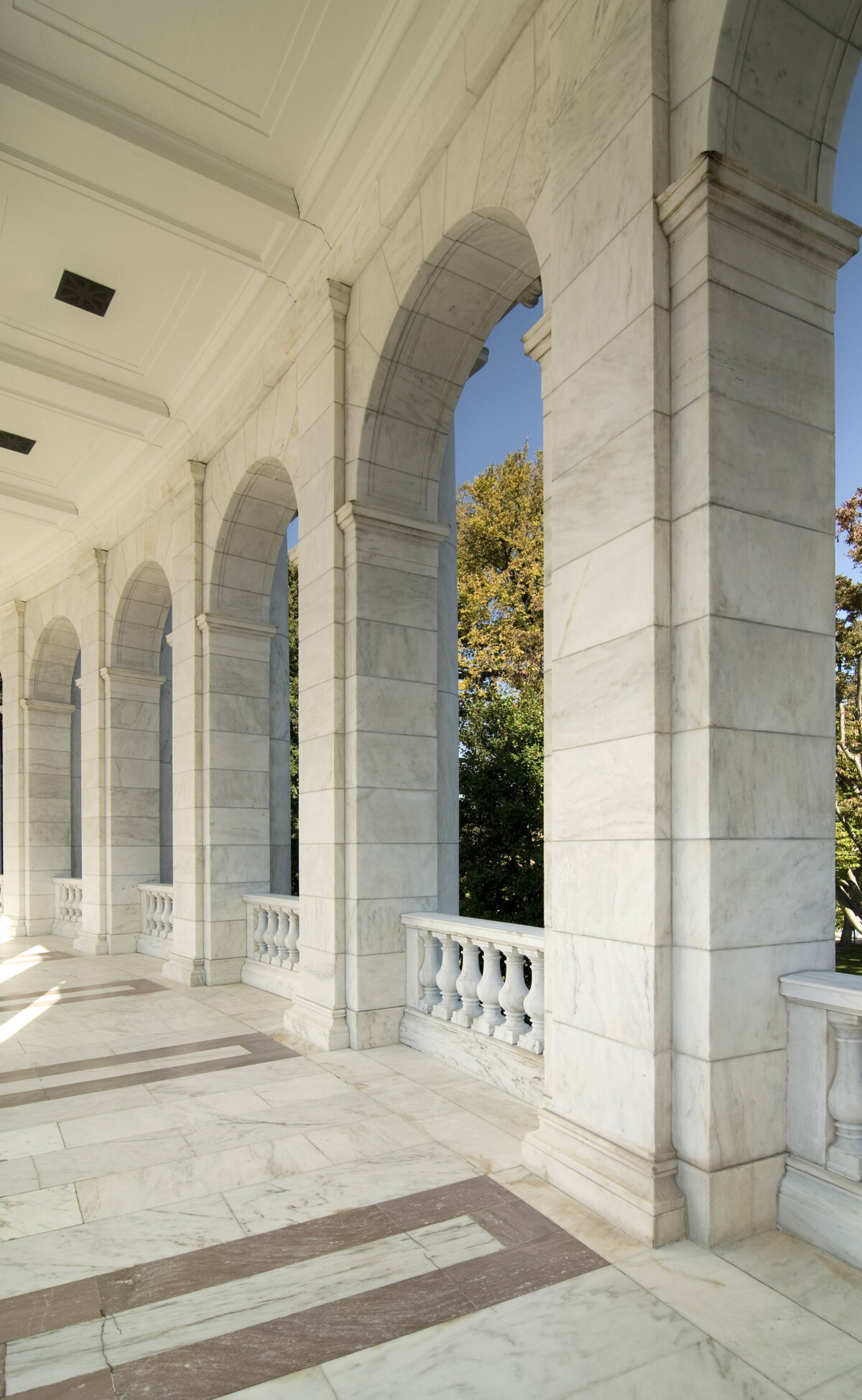
Every inch of the amphitheater’s stone was designed for remembrance. On the frieze above the Vermont Danby marble colonnade, 44 U.S. military battles—from the American Revolution through the Spanish-American War—are listed. The names of the 14 U.S. Army generals and 14 Navy admirals who fought in those battles are inscribed on the sides of the stage.
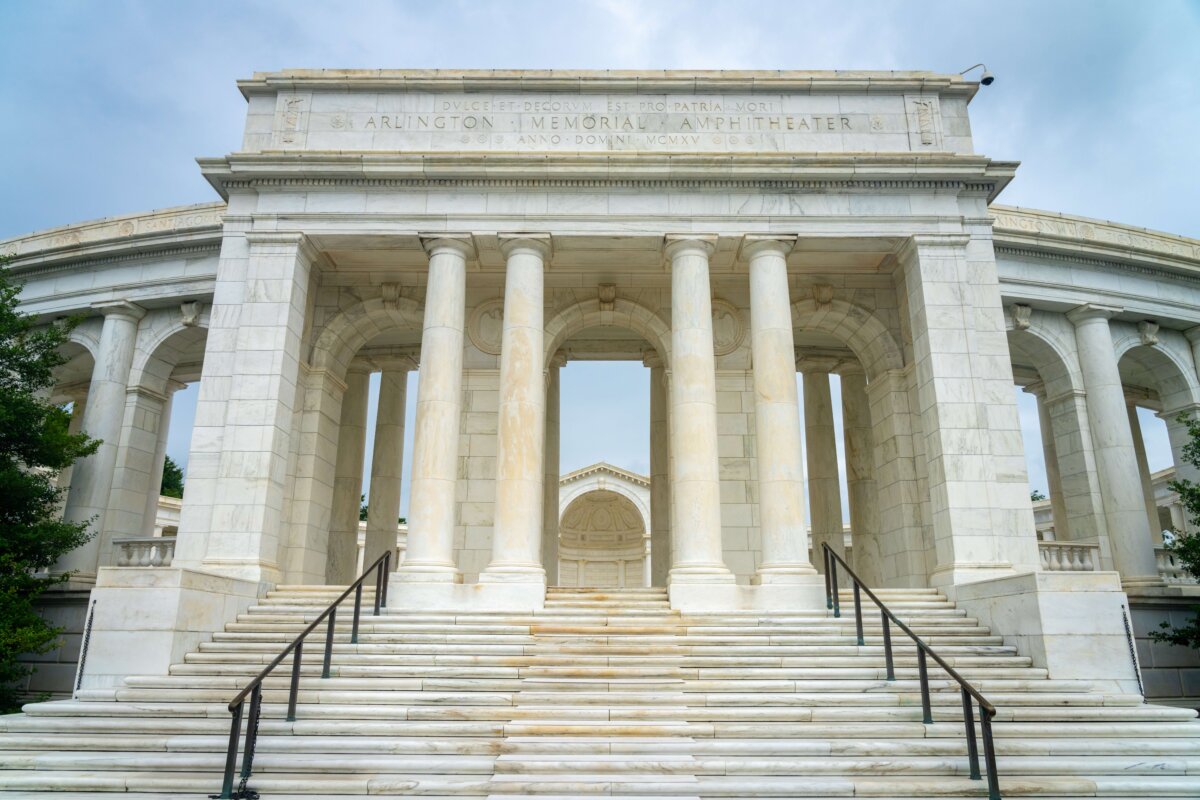
A Latin inscription over the west entrance reads: “Dulce et decorum est pro patria mori.” The quote, from Horace’s “Odes III,” translates to “It is sweet and fitting to die for one’s country.”
Poignant memorial quotes from leading Americans run throughout the amphitheater’s marble. In the apse, a 1775 quote by George Washington reads: “When we assumed the soldier, we did not lay aside the citizen.” Above the stage, words from Abraham Lincoln’s 1863 Gettysburg Address reads: “We here highly resolve that these dead shall not have died in vain.”
Tomb of the Unknown Soldier
In front of the Memorial Amphitheater lies the Tomb of the Unknown Soldier. England and France had instigated the national memorial dedicated to unidentified war dead in 1920. England’s unknown soldier rests in Westminster Abbey, London, and France’s in the Arc de Triomphe in Paris. America followed its Allies’ tradition and interred its unknown soldier on Nov. 11, 1921.
A white marble sarcophagus now covers the crypt of America’s unknown soldier. Three crypts in front of the sarcophagus commemorate unknown soldiers who died in World War II, the Korean War, and the Vietnam War. The Vietnam War crypt is empty, after the unknown soldier’s remains were identified and disinterred in 1998.
World War I veterans, architect Lorimer Rich (1891–1978), and sculptor Thomas Hudson Jones (1892–1969) designed the 11-foot-high by 9-foot-wide marble sarcophagus. Both had studied at the American Academy in Rome. The Colorado Yule marble tomb incorporates the beaux arts style with neoclassical elements. Marble carvers, the Piccirilli Brothers created the Doric pilasters at each corner of the sarcophagus. They also roughed out the carvings on the marble panels that Hudson Jones completed onsite. Hudson Jones carved low-relief sculptures of wreaths on the north and south panels, and personifications of peace, valor, and victory on the east panel.
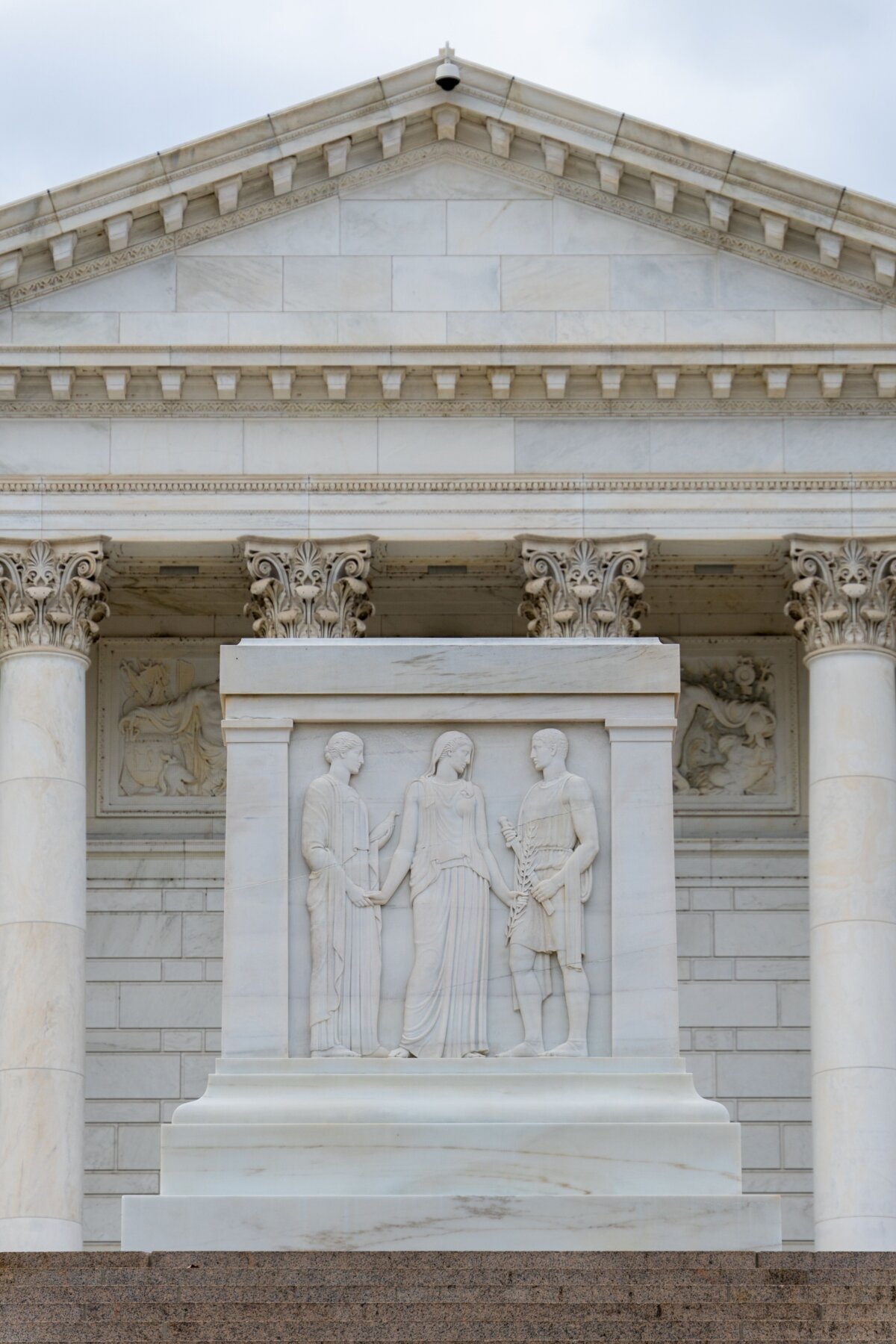
Ancient Romans honored warriors with wreaths of laurel, and today funeral wreaths adorn graves. The wreath’s circular design symbolizes the circle of life.
The Piccirilli Brothers also carved the inscription onsite on the east panel that faces the amphitheater. It reads: “Here Rests in Honored Glory an American Soldier Known but to God.”
The sarcophagus of the Tomb of the Unknown Soldier was unveiled, without ceremony, on April 9, 1932.
Guarding the Tomb
For nearly 100 years, sentinels from the 3rd U.S. Infantry Regiment have guarded the tomb. Since 1937, they have maintained a vigil for 24 hours a day, seven days a week.
According to Arlington Cemetery: “The Tomb Guard marches exactly 21 steps down the black mat behind the Tomb, turns, faces east for 21 seconds, turns and faces north for 21 seconds, then takes 21 steps down the mat and repeats the process.” Twenty-one represents the highest military honor. The 21-gun salute originates from naval warfare. Firing 21 shots signaled to nearby ships that there was no hostile intent, and indicated that all ammunition was spent.
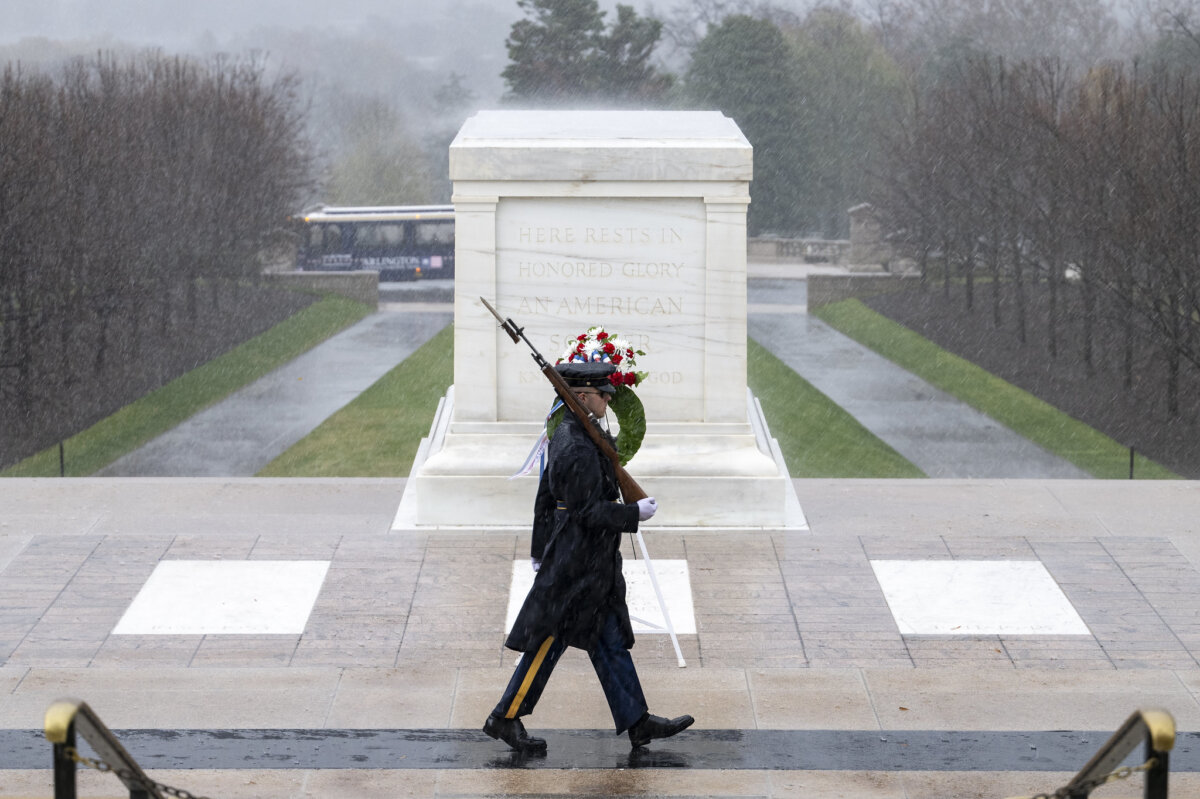
Part of The Sentinel’s Creed states:
“Through the years of diligence and praise and the discomfort of the elements, I will walk my tour in humble reverence to the best of my ability. It is he who commands the respect I protect, his bravery that made us so proud. Surrounded by well meaning crowds by day, alone in the thoughtful peace of night, this soldier will in honored glory rest under my eternal vigilance.”
Lest we forget, America’s liberty comes from immense sacrifice and unimaginable suffering. American veterans’ continual sacrifices retain the country’s freedom and the American way of life.
What arts and culture topics would you like us to cover? Please email ideas or feedback to features@epochtimes.nyc