The Baltimore & Ohio Railroad (B&O) had long made a habit of being first. The B&O was founded by a group of Maryland bankers and merchants on Feb. 28, 1827, making it the country’s first railroad company. The ultimate objective was in the name: be the first railroad to reach the Ohio River.
That same year, out in Pennsylvania, the Lehigh Coal and Navigation Company built a nine-mile railroad to transport coal up and down a large hill. The rail carts, however, were pulled up the hill by mules, with gravity as the driving force downhill. For the B&O, however, mules simply would not do. The Maryland owners eyed the relatively new face of industrial power: steam.
One of the country’s leading inventors, John Stevens, was one of the first proponents and users of steam power. In 1791, he obtained the nation’s first steam patents “for two types of steam boiler and a method of propelling boats using steam power.” In fact, it was at Stevens’s urging that Congress passed the U.S. Patent Act of 1790. Shortly after the turn of the 19th century, Stevens began promoting what he called “Rail-Ways and Steam-Carriages.”
Stevens, considered the Father of the American railroad, promoted the construction of railroads with train cars powered by steam. His efforts fell short of any interstate or inner city railroads, though he certainly did try. He did, however, prove the feasibility of the nation’s first steam locomotive in 1825 by building a small circular railroad on his property in Hoboken, New Jersey.
Carroll and Cooper
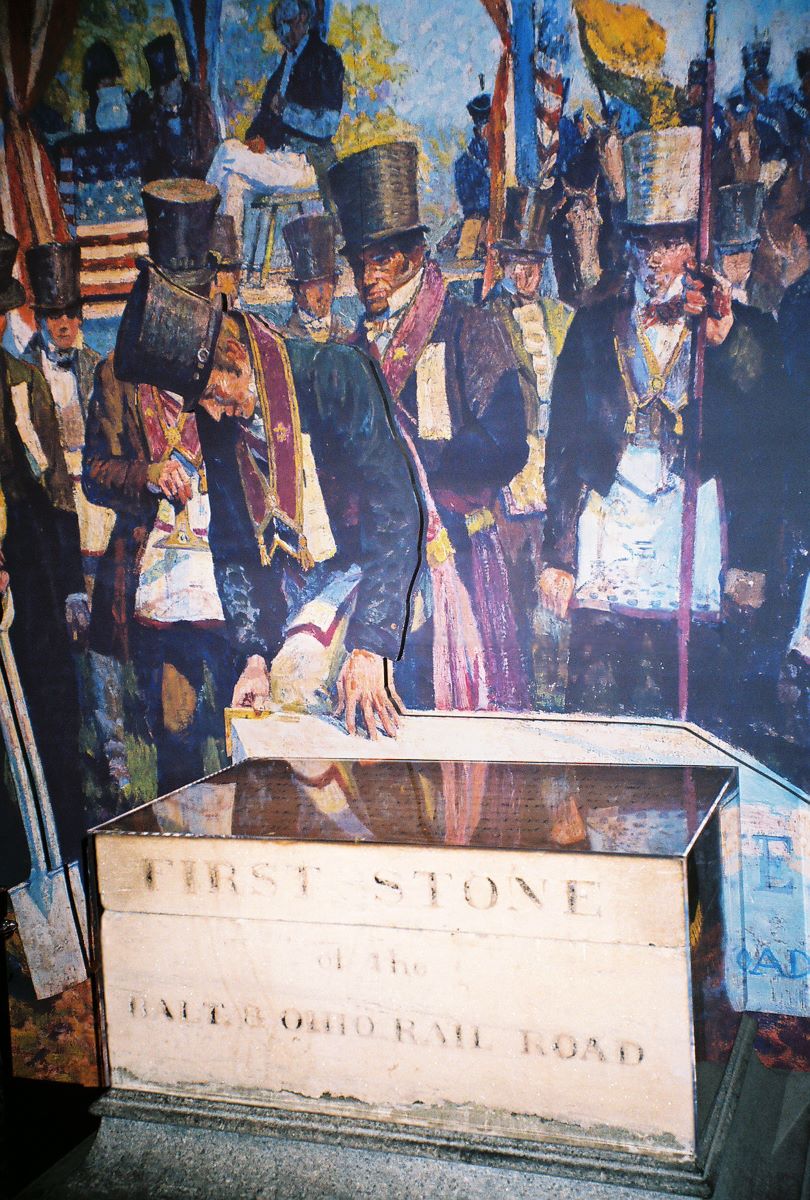
The popularity of Stevens’s New Jersey creation needn’t have traveled far before it reached Maryland. His point had more or less been proven about the future of transporting goods and people, and the members of the B&O Railroad firmly believed in that future. To demonstrate that belief, they conducted an elaborate groundbreaking ceremony on the country’s 52nd birthday.
On July 4, 1828, construction began for the country’s first railroad company. Participating in this ceremony was Charles Carroll, the last living signer of the Declaration of Independence. In a sense, the past had met the future in a single event.
Construction was relatively slow, building just 14 miles of railroad by 1830. It was nonetheless timely, as another inventor by the name of Peter Cooper had built his own steam locomotive he called Tom Thumb. With 14 miles to prove the locomotive’s capabilities, Cooper had his locomotive placed on the B&O rails, invited a number of the board members to join him, and off they went at a blistering pace of up to 14 miles per hour. The B&O had obtained another first, making the Tom Thumb the first steam-powered locomotive to operate a public railroad.
The B&O Railroad zoomed ahead of the arising competitors and dominated the railroad industry for some time. But, soon, more railroad companies were founded, creating massive competition, leading to faster times, longer routes, and mergers. Train companies attempted to lure riders by offering new amenities, like better seating, better service, dining, and a more luxurious experience.
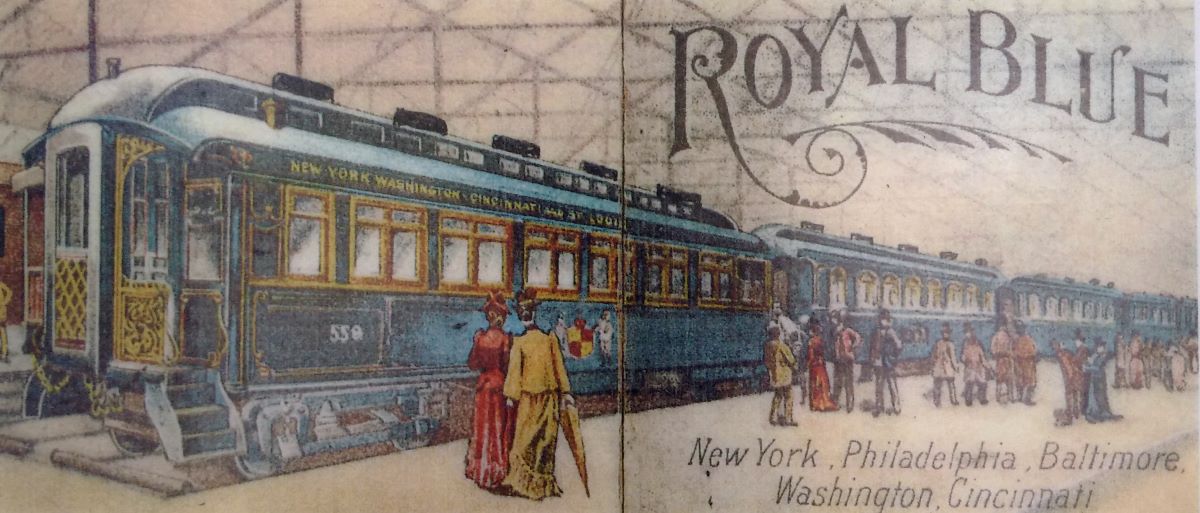
Garrett’s Royal Blue Line
John W. Garrett, the president of B&O Railroad from 1858 to 1884, had a vision to meet the demand for a stylish experience. In 1872, he began planning the Royal Blue Line, a rail line with beautified train cars inside and out. Although Garrett died in 1884, his vision was realized in 1890.
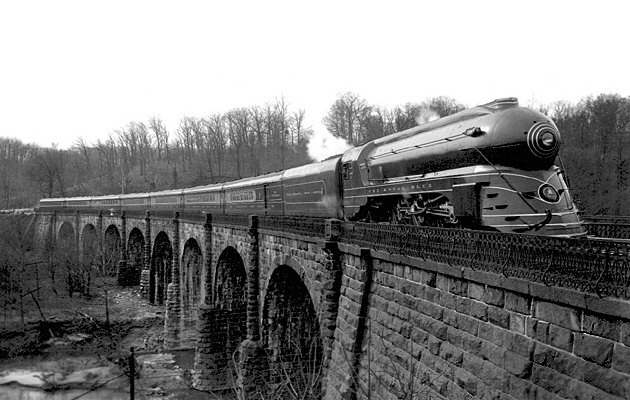
The Royal Blue Line offered travelers a way to travel in style. Each car was painted Saxony blue with gold leaf trim. The cars were longer, providing more space for riders, had gas lamps, and, for the cold winter months, the warmth of steam heat. The trains were faster and safer than most others, and they also came with the new technology called the air braking system, which made for smoother rides.
As the Royal Blue Line elevated the experience of commuters and travelers, demand increased for a cleaner experience. Steam, the solution to America’s transportation needs, had also become part of its problem. The smoke and soot that came from the steam-powered locomotives left areas, as well as travelers, dirty.
Luckily, for the B&O Railroad, the solution to this problem was fast approaching.
A New Line—Electrified
B&O made changes to its line for a number of reasons: to satisfy customers and to compete with rivals. Its primary competitor was the Pennsylvania Railroad (PRR), which had grown quickly by building more railways and purchasing or merging with other railroads. When the PRR built its rail system into Baltimore, it was painfully obvious that B&O needed to make major changes or fall by the industry’s wayside.
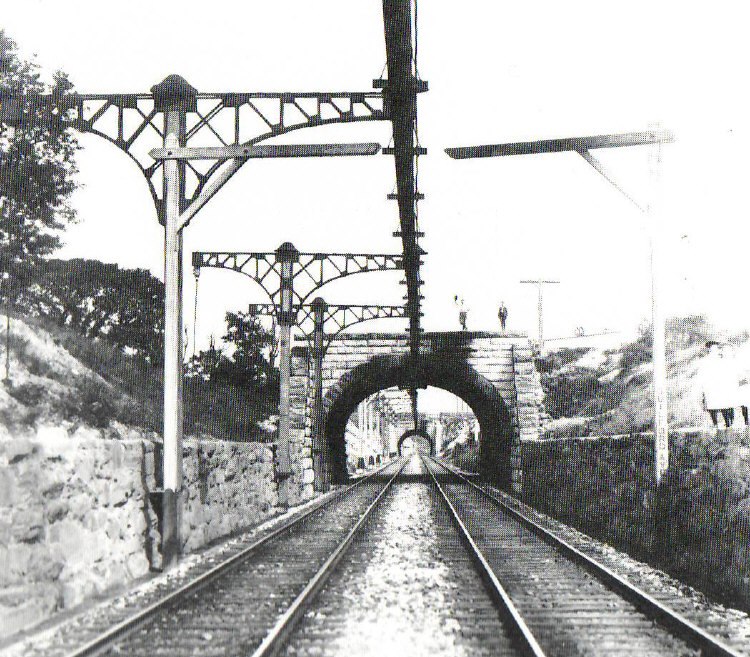
In 1890, the same year B&O launched its Royal Blue Line, the company began construction of the Baltimore Belt Line (BBL). The BBL was ultimately a five-year project to connect Baltimore with Washington and New York City. Construction included the underground 1.4-mile-long Howard Street Tunnel. The construction of the BBL and the creation of the Royal Blue Line were perfectly timed.
While construction was ongoing, the 1893 World’s Columbian Exposition in Chicago exhibited a small train service that was powered not by steam, but electricity. The B&O executives knew they had another chance to be first.
When the Baltimore Belt Line opened in 1895, B&O became the first railroad company to run an electrified line. Electricity became the solution to the steam problem, and railroad companies began adopting it—even at great cost.
Expanding the ‘Royal’ Standard
As the 20th century progressed, so did the train industry. Trains continued to become faster, safer, and cleaner. With progress came newer demands. Customers expected better experiences, and many were prepared to pay for it. Competition among the railroads grew fiercer, especially the rivalry between B&O and PRR. When PRR completed the construction of its Penn Station in Manhattan, it left B&O behind, literally—on the other side of the Hudson River.
The B&O executives scrambled for ways to compete with PRR since it now had the upper hand on the coveted Manhattan market. It looked to its Royal Blue Line.
As historian and author Herbert Hardwood Jr. noted, “Garrett personally created the line as his last grand gesture, a gesture of defiance and frustration as much as anything else, to show the world that the B&O was a major power. [Daniel] Willard, who ruled the railroad more gently but equally autocratically for 31 years, steadfastly and stubbornly kept the Royal Blue Line as the company’s showpiece and, in the process, made so much railroad history.”
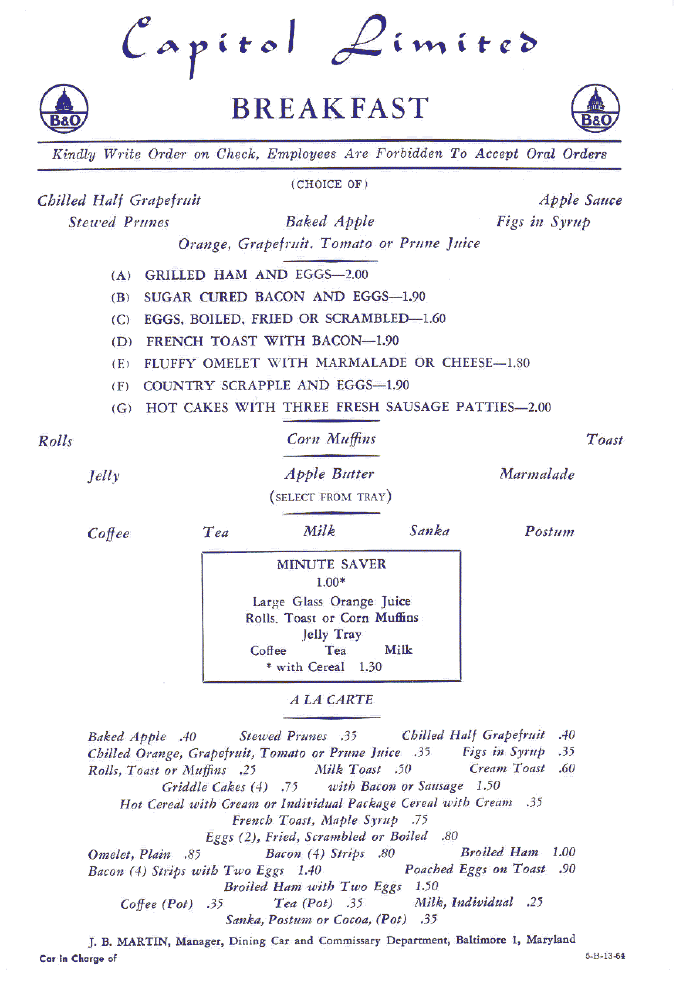
B&O implemented the Royal Blue Line standard into many of its other long-distance rail lines. In 1923, the company’s Capitol Limited train from New York to Chicago offered guests fine dining and later expanded to include barbers and secretary service. Two years later, the company added these amenities to its New York-to-St. Louis National Limited. Under Willard’s leadership, B&O achieved firsts several more times with its air-conditioned car, followed by a fully air-conditioned train.
A New ‘Royal’ Face
A major part of B&O’s history began with the arrival of a new school of architectural design called Art Deco. Originating in Western Europe during the 1910s and 1920s, the school arrived in the United States in the late 1920s and took off in the 1930s. Otto Kuhler, a German immigrant, arrived in America in 1923 and brought with him a gift for design and ultimately a vision for a new style of train.
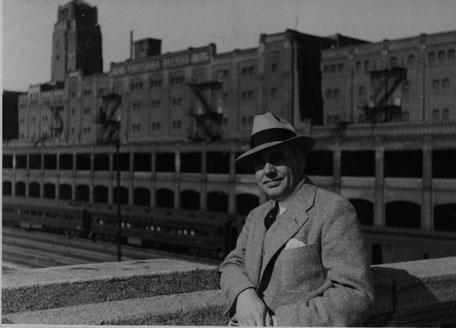
His success in design enabled him to open his own studio in Manhattan in 1928, though this studio closed shortly after the Stock Market Crash of 1929. His talents, however, remained in demand, and he soon began working for the American Locomotive Company in 1931, designing locomotives.
His bullet nose and streamlined designs of the electric and steam locomotives took the industry by storm. His design called the Hiawatha became world-famous and became the demand of several railroad companies—most notably the B&O Railroad.
The Final Run
According to Tim Walter, who runs the website Classic Streamliners, Kuhler’s concept was not the first of these types of locomotives, but “they were the first built-to-order streamlined steam locomotives.” Companies jumped at the opportunity to purchase the “Kuhler concept” of “integrated aerodynamics with aesthetic elegance.”
When B&O Railroad adopted the Art Deco look, the Royal Blue Line, along with many of the company’s other trains, forever altered its image. Again, competition motivated the company, as well as the expectations of its clientele. That the Royal Blue Line remained in business until 1958 was, according to many railroad historians, a major accomplishment in itself.
According Hardwood Jr., “[The Royal Blue line] was indeed one of the most memorable images in the transportation business, an inspired blend of majesty and mystique.” Hardwood added that “‘Royal Blue’ may have been merely a marketing device, but in this case the image and the reality were unforgettably intertwined. For almost seventy years, the Royal Blue Line was B&O’s showpiece.”
As Adam Burns, of American Rails, noted, “In terms of pure royalty, elegance, and opulence no passenger train ever operated could compare to the Baltimore & Ohio’s Royal Blue.”
B&O’s showpiece made its final run from Washington to New York City during this week in history, on April 26, 1958.
Never miss a This Week in History story! Sign up for the American History newsletter here.
What arts and culture topics would you like us to cover? Please email ideas or feedback to features@epochtimes.nyc