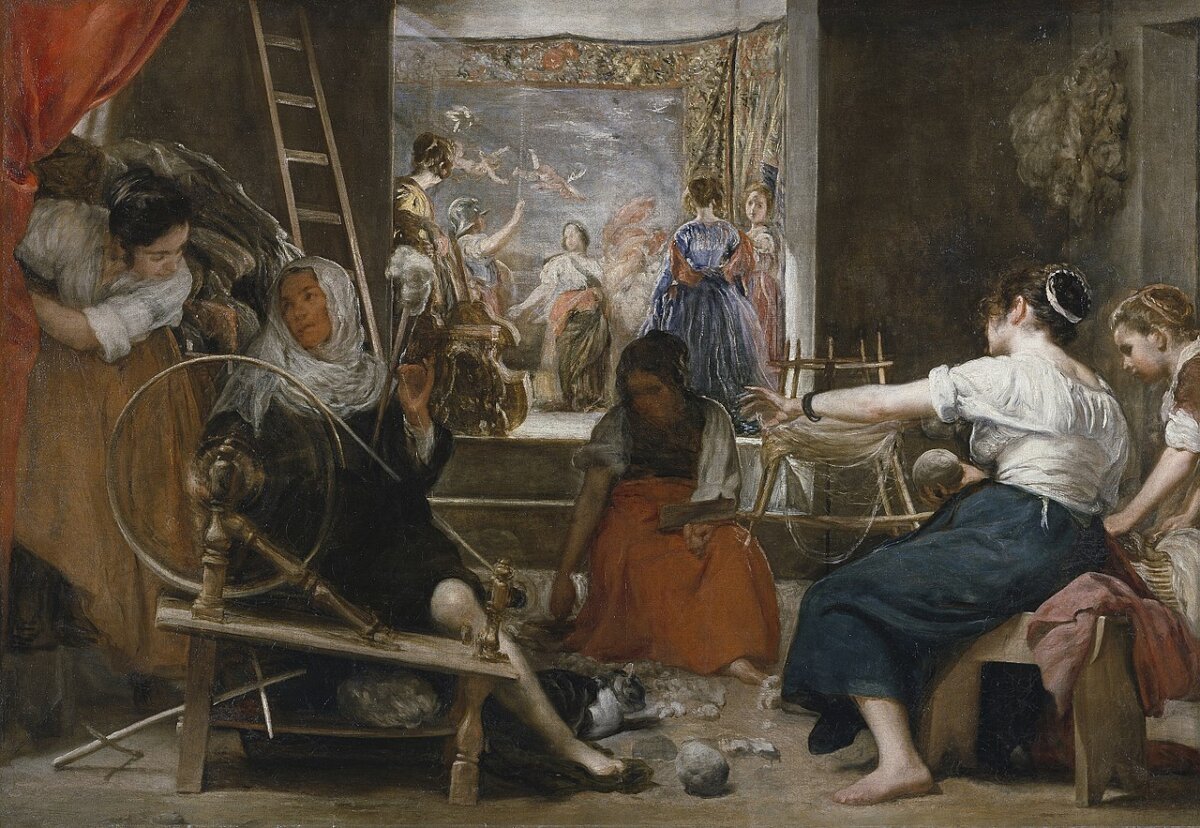
Not until the 1930s and 1940s did scholars realize that “The Spinners,” by 17th-century painter Diego Velázquez, contained mythological content. The figures in the background weren’t, as many viewers believed, simply showing the tapestry woven by the women in the foreground. In the background, the Spanish painter depicted part of the ancient Greek myth of Arachne, which is the central story of his painting and explains its alternative title, “The Fable of Arachne.”
In “The Metamorphoses,” Ovid described how Arachne, a girl of humble birth and parentage, wove cloth so exquisitely—from the spinning of the yarn through to the finished decoration—that “often the nymphs of Mount Tmolus deserted their vine-covered slopes, and the nymphs of the River Pactolus deserted their waves, to examine her wonderful workmanship.” But Arachne always denied that her talent was bestowed by the goddess of handicrafts, Pallas Athena. Full of bravado, Arachne challenged Pallas to a weaving competition, vowing that if the goddess won, then she would concede that her artistic gifts were divinely bestowed.
Pallas then disguised herself as an old woman, symbolic of wisdom, and told Arachne that “Not everything old age has is to be shunned: Knowledge comes with advancing years. Do not reject my advice: Seek great fame among mortals for your skill in weaving, but give way to the goddess, and ask her forgiveness, rash girl, with a humble voice: She will forgive if you will ask.”
The defiant, young Arachne retorted that she too felt unheeded, and she asked why Pallas was not present for the contest. Pallas then dropped her disguise, and the contest began.
In Velázquez’s painting, Pallas can be seen as the old woman at her spinning wheel. And on the right side of the painting, Arachne has her back turned to us as she ignores the old woman’s plea, and winds a skein of wool.
Arachne’s Fall
Pallas wove a moral lesson into the four corners of her tapestry. Each story warned Arachne of the consequences that come to mortals who compete with or defy the divine. Pallas hoped Arachne would take heed.
Arachne wove a tapestry depicting instances of when the gods acted improperly in the mortal world, such as when Zeus (Pallas’s father) abducted Europa by disguising himself as a beautiful white bull. Velázquez reflected the scene by recreating Titian’s painting “The Rape of Europa” as the tapestry hanging in the background of his painting. Velázquez, a Spanish royal court painter, probably saw Titian’s painting in the royal palace.
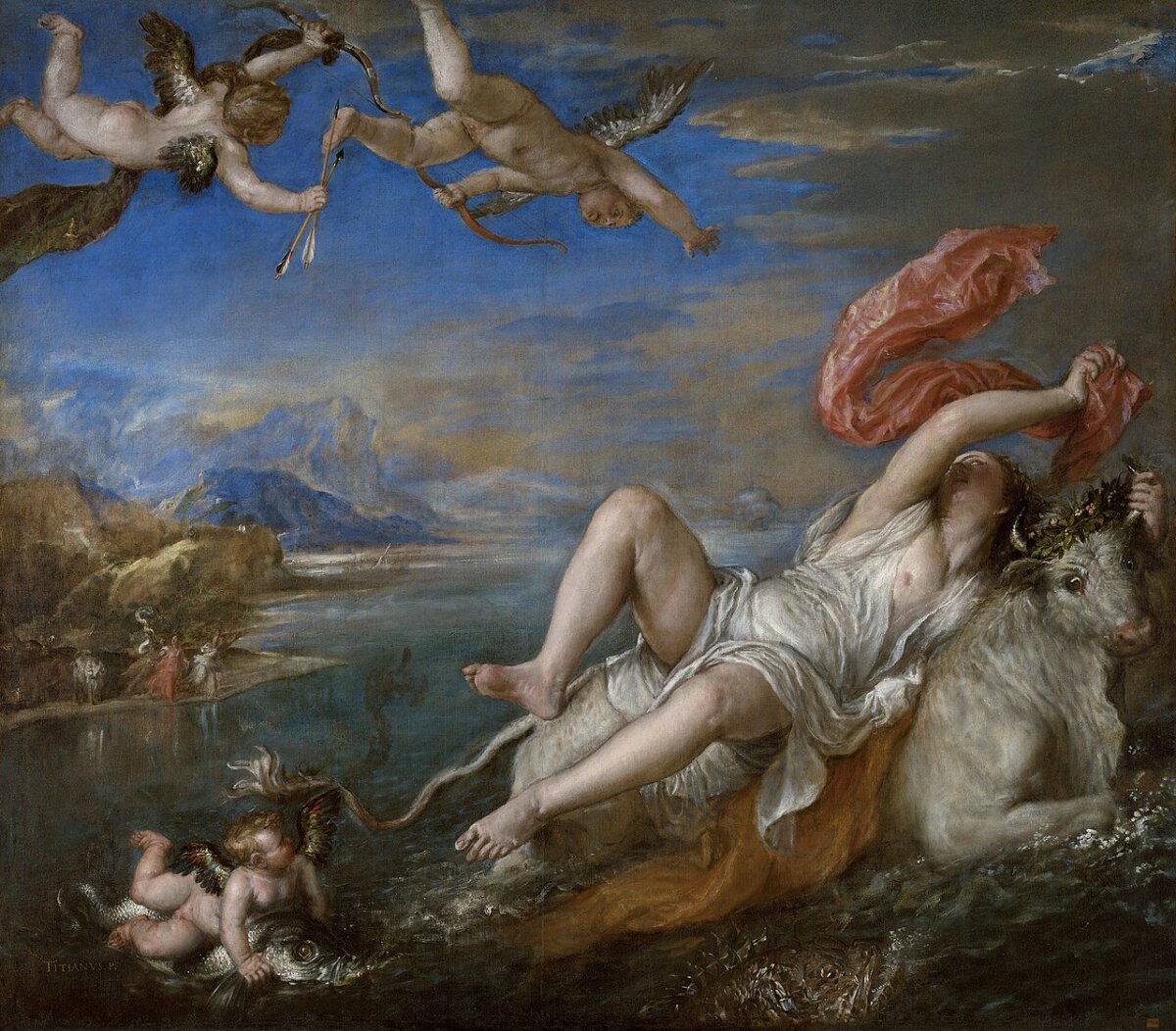
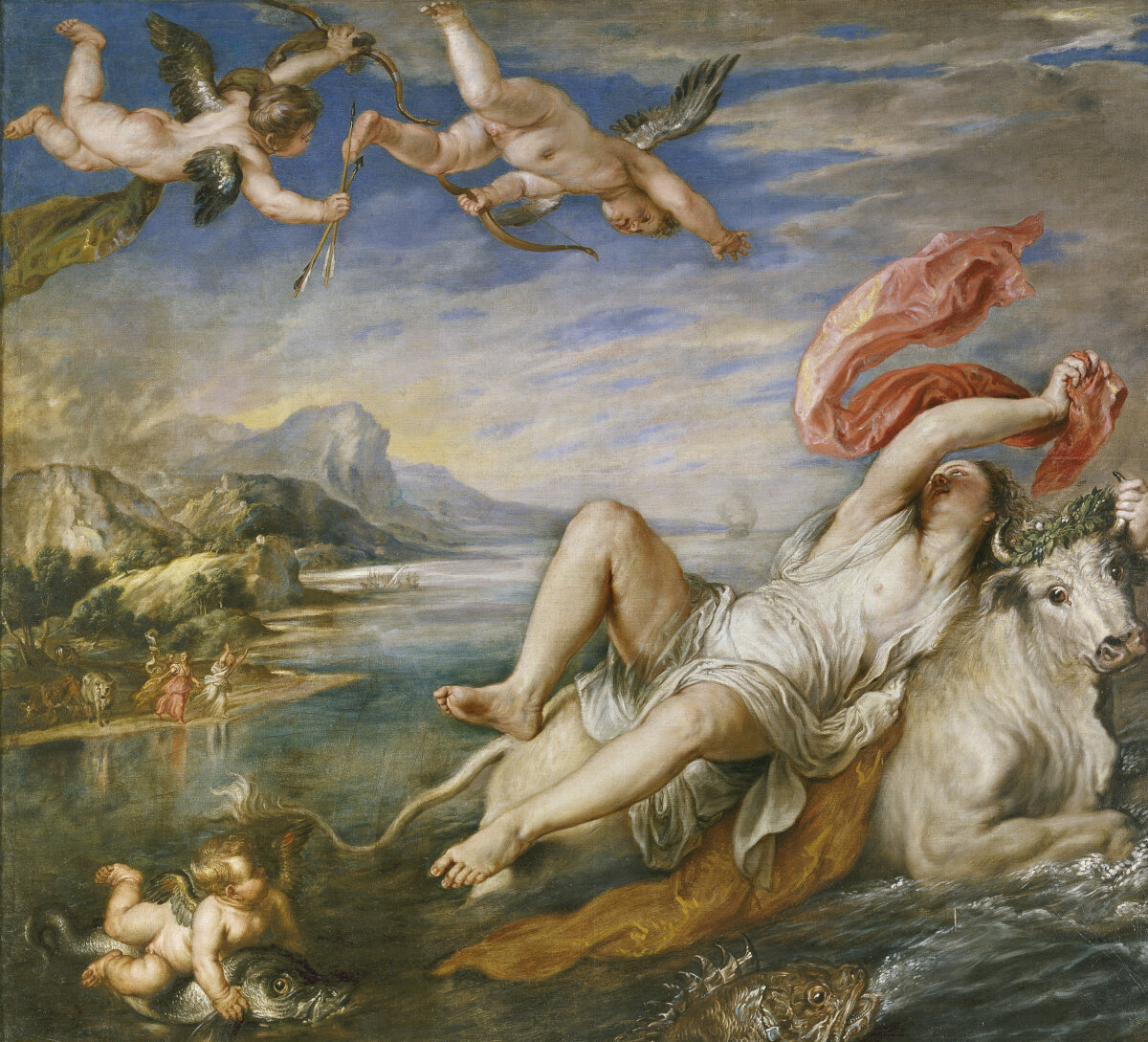
Pallas stands in front of the tapestry. Here, she’s with her helmet and shield as the goddess of war, surveying Arachne’s perfectly woven cloth. She is livid; Arachne dared to outshine a goddess.
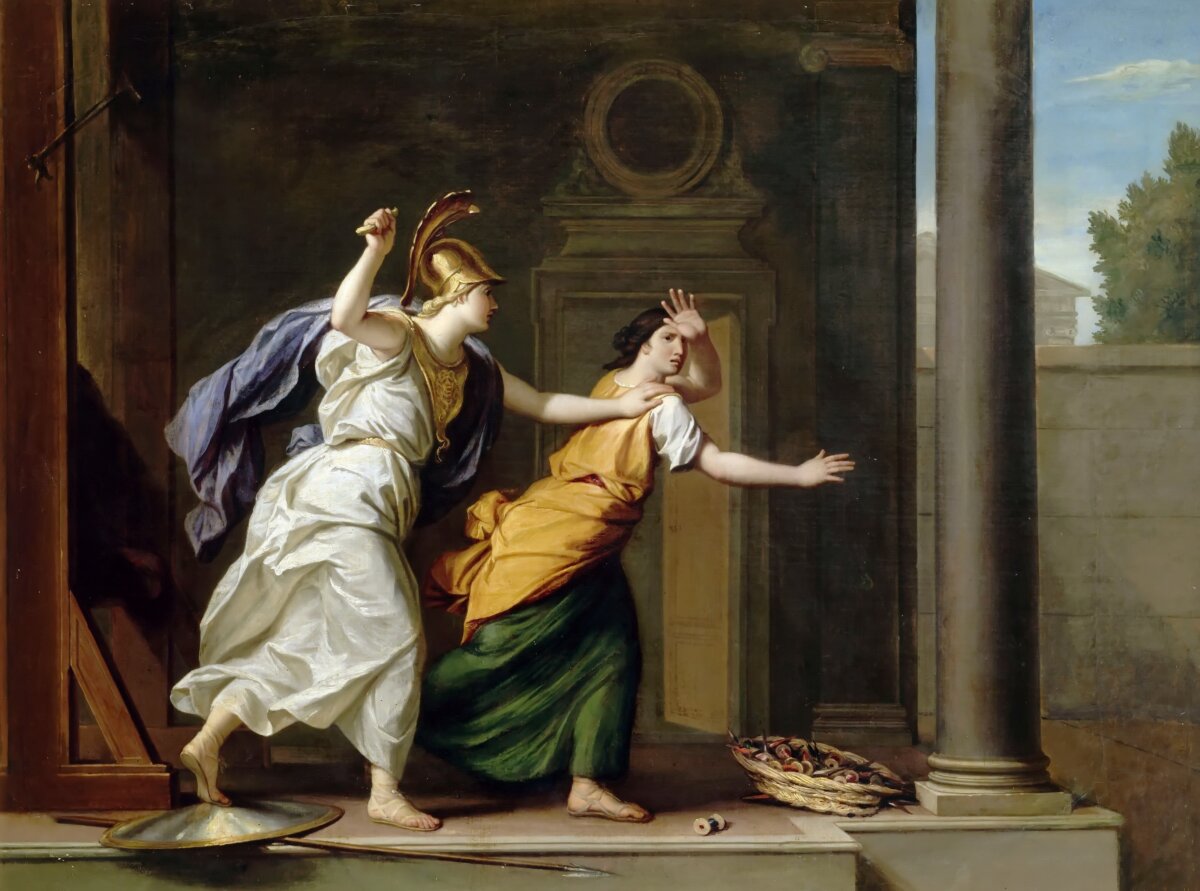
Velázquez didn’t depict what happened next in Ovid’s myth, but 18th-century French artist René-Antoine Houasse did: Pallas struck Arachne with her shuttle. In unbearable pain, Arachne then put a noose around her own neck. At that moment, Pallas turned Arachne into a spider so that she must constantly weave and hang for eternity.
An Ode to Painting
The Prado Museum website considers “The Spinners” an ode to the nobility of painting because Velázquez expertly used his brush and paints to depict the passage of time from when the material is spun, woven, and made into the tapestry. Velázquez not only told Arachne’s story through the medium of painting, but he also used a famous painting to depict her accomplishments.
The website also notes that Velázquez was aware of mythologist Juan Pérez de Moya’s view that the myth of Arachne demonstrated the constant advancement of art. In “The Spinners,” Velázquez built a narrative about artistic progress and competitiveness by depicting the tapestry in the background and by reproducing an original painting by Titian, which was, and continues to be, copied by many artists aspiring to mastery.
What arts and culture topics would you like us to cover? Please email ideas or feedback to features@epochtimes.nyc