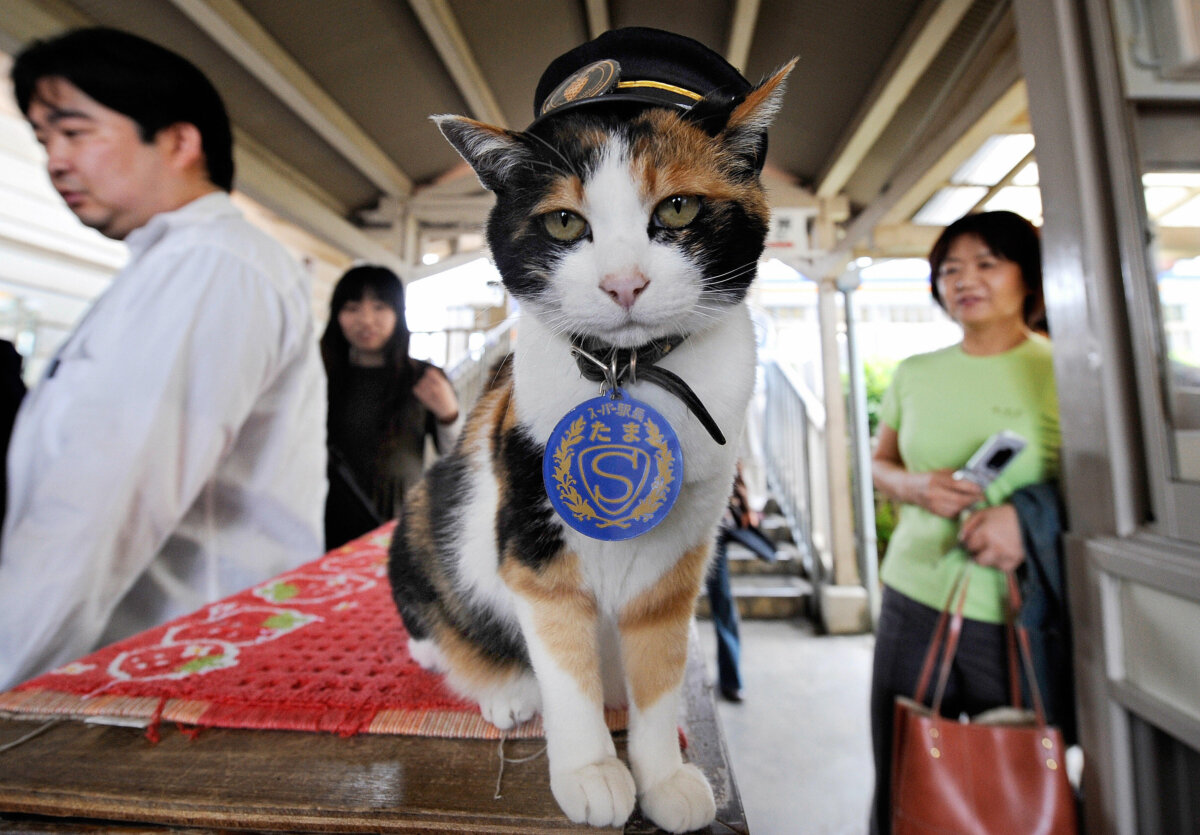
There are many ways to spend a holiday in Japan. You can pursue temples, noodles, lacquerware, cherry blossoms, whisky, vintage denim, highly specialized stationery, or the sort of strawberries that look as if they were raised by perfectionists in a laboratory. Or you can make a beeline for one of the country’s most successful and emotionally competent public servants: a cat in a hat.
This is not slang or one of those travel-writer flourishes that collapses on contact with reality. Japan really does have stationmaster cats, and they are exactly what they sound like—feline officials attached to railway stations, photographed with great enthusiasm, treated with formal respect, and credited with doing a better job of local revitalization than a battalion of consultants.
Tama, the Great Dowager Cat
The great dowager of this furry civil service was Tama, the calico stationmaster of Kishi Station in Wakayama Prefecture.
Appointed in 2007, Tama arrived at a moment when the local Kishigawa railway line was struggling and rural rail, the most melancholy of transport categories, needed help. Into this atmosphere of quiet municipal anxiety stepped a cat with a cap.
Tama’s achievements were considerable. Tourist numbers surged. The station became famous. The line found new life. She inspired merchandise, media coverage, devoted fans, and the sort of civic affection most regional mayors can only fantasize about while opening agricultural shows in synthetic polos.
Tama did not do any of this by giving speeches or unveiling strategy documents. She sat very still, looked magnificent, and allowed the public to project onto her an entire fantasy of charm and soft-pawed authority.
Since then, the line has maintained a feline succession. Nitama followed. Yontama has since taken up the mantle. The whole arrangement has acquired the settled air of a hereditary institution.
Where to Meet a Stationmaster Cat
If you want to meet one of these whiskered officeholders, your destination is Kishi Station, south of Osaka, on the Wakayama Electric Railway Kishigawa Line.
Getting there is part of the pleasure. You travel from Osaka to Wakayama, then join the local line as the city mood falls away and the odd, cheering splendor of your mission becomes clear. Somewhere ahead lies a station whose chief drawcard is the possibility of glimpsing a cat on official duties.
And Kishi does not disappoint. The station building itself leans cheerfully into the theme. The trains are decorated. The gift shop is alert to your weaknesses.
The whole enterprise has been carried off with the sort of polished commitment Japan brings to anything involving ritual and public behavior.
Other countries might have made a mascot and stopped there. Japan built a mythology and, quite possibly, a better model of governance.
The joy of the stationmaster cat is that the idea works on every level. It is adorable, obviously. Even the stoniest traveler would have to be some kind of emotional tax auditor not to feel a flicker at the sight of a cat in formal headwear.
But it is also culturally coherent. Cats occupy a rich and curious place in Japanese life, from the beckoning maneki-neko promising good fortune from shopfronts to the stranger feline presences in folklore, in which cats are clever, uncanny, faintly superior, and occasionally a little alarming. In short: exactly like cats.
That is part of why the stationmaster tradition feels so perfectly judged. It draws on affection, symbolism, ritual, and place. It gives visitors a reason to come and locals something to cherish.
Many tourism campaigns spend millions of dollars trying to manufacture “authentic connection.” Wakayama put a cat in a station and let human nature do the rest.
Stationmaster Cat Etiquette
A small note on etiquette. These are not pets put on display for the shrieking amusement of tourists who’ve had too much canned coffee.
They are treated as local icons, and one should behave accordingly. Admire quietly. Take photographs if allowed. Do not bang about demanding a performance. A stationmaster cat is there to embody composure and the possibility that one perfectly judged absurdity can save an entire place.
And perhaps that is why people love them so much. The stationmaster cats offer something modern life has made terribly scarce: a public institution that inspires uncomplicated delight.
No spin. No jargon. No man in a blazer explaining resilience metrics. Just a cat, a station, a community, and a wildly successful act of collective whimsy.
After meeting one, you may find it difficult to return to ordinary human authority at all.