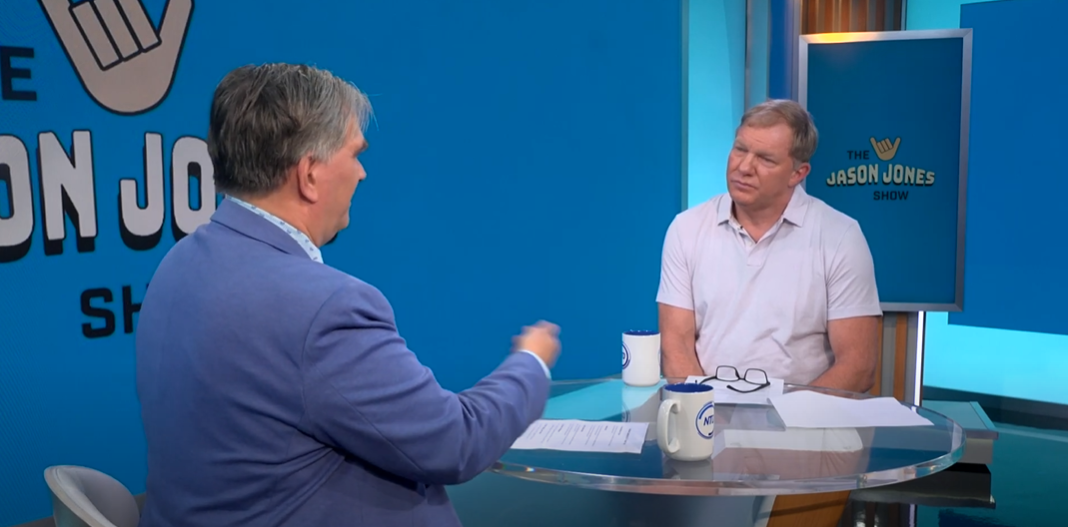
It’s halfway through 2025 and, so far, Jason Jones has spent only two weeks of the year at home. The filmmaker, activist, nonprofit director, and humanitarian is a busy man who travels the four corners of the world, raising awareness as he stands between the most vulnerable populations and their oppressors.
“This summer I’ll be in Africa, I’ll be in the Middle East, I’ll be in Asia, and everywhere I go, I’m nose-to-nose with the CCP [Chinese Communist Party]. If we’re standing to protect vulnerable people, we’re nose-to-nose with the CCP,” Jones said during the filming of an episode of the Jason Jones Show podcast in New York.
It’s an episode focused on the CCP’s horrific practice of live organ harvesting on Falun Gong practitioners, something Jones has wanted to talk about for many years. Jones said he first learned about Falun Gong around the year 2000, when he was protesting in front of the Chinese Embassy in Washington, D.C., to bring attention to the CCP’s human rights abuses, and met Falun Gong practitioners doing the same.
Followers of the peaceful spiritual practice Falun Gong, also known as Falun Dafa, became enemies of the state overnight in 1999, when then-CCP leader Jiang Zemin targeted the group for “eradication.” Falun Gong had, until then, enjoyed immense popularity in China, where its practitioners numbered between 70 million and 100 million, according to official state estimates. The practice had even earned admiration from state officials who benefited from a healthy, positive population of people who strove to live by “truth, compassion, and tolerance,” the three principles of Falun Gong.
Interviewing Dr. Torsten Trey, executive director of Doctors Against Forced Organ Harvesting, Jones revealed in the hour-long episode how a country with no program for organ donations saw a spike in organ transplants in the early 2000s, as the CCP began executing prisoners of conscience to sell their organs for profit. Trey disclosed how doctors in wealthy Western nations have referred patients to China; these doctors turned their backs on oaths to do no harm and turned a blind eye to the mounting evidence of the CCP’s practice of forced organ harvesting.
In 2019, an independent tribunal in London concluded beyond a reasonable doubt that the CCP was harvesting organs on a large scale, and that Falun Gong practitioners were the primary victims. Trey and Jones warned that though these spiritual practitioners were the first target, they are not the last—evidence suggests the CCP sees Middle Easterners as a vital market, and that Uyghur Muslims in Xinjiang have been persecuted and subjected to forced organ harvesting to serve this market.
Jones encouraged his listeners to talk about forced organ harvesting, as the CCP’s active efforts to silence such discussion are telling. If their efforts could help bring down the CCP even one day earlier, Jones said, it would be worthwhile and could save thousands of lives.
The week before Jones’ podcast about organ harvesting, he spoke out for the Christians in Gaza caught in the middle of a conflict not of their making. These Christians, the same Christians who descended from the Jews and who accepted Jesus Christ, are now the most vulnerable Christians in the world, Jones said.
Jones is the founder of the Human-Rights Education and Relief Organization (HERO), a nonprofit organization with two main programs: a filmmaking arm called Movie to Movement and the Vulnerable People Project (VPP), which provides aid and rescue to populations facing genocide and persecution. Both have an overarching mission to protect the vulnerable from violence.
“We do it two ways,” Jones told NTD Television. “To promote the incomparable dignity and beauty of the human person, and then to inspire solidarity with the vulnerable.”
Movies That Matter
The journey of his life’s work began two days before Jones’ 17th birthday. His girlfriend had biked five miles to his house and woke him up by telling him, “I’m pregnant.”
Jones said his mother was 16 when he was born, and he had “a really broken, wild childhood.” He dreamt of becoming a father one day and having a stable home and family. When his girlfriend delivered the announcement, he thought, “Well, here we are,” and dropped out of high school to join the Army.
While in basic training, Jones discovered that his girlfriend’s father had beaten her and forced her to have a third-trimester abortion. Shortly after that, he had his first overseas non-combat deployment, where he saw fathers and sons in deep poverty.
“And that’s when I decided, as a young infantryman, that I wanted to order my life to stand between the vulnerable and the violence, and really to help fathers that are in impossible situations to defend their families. That’s kind of how I’ve always seen my work. I’m here to stand with fathers to defend their families,” Jones said.
On his days off, Jones went door to door, talking to people about abortion. This advocacy led him to join political campaigns and to become a spokesperson for a Catholic organization even before he took up the faith. He wound up on radio shows, sent out press releases, and made television appearances on CNN, Fox News, and Bill Maher’s Politically Incorrect. With every new experience, Jones says he thought, “Oh, well that’s not so hard,” and ventured deeper into the media industry.
“This isn’t that difficult,” he thought. “Let’s make movies. Let’s be on the silver screen.”
His first feature film would be “Bella,” which won the People’s Choice Award at the 2006 Toronto International Film Festival. The story follows a young woman experiencing a crisis pregnancy who is considering an abortion. Jones shared that, nearly 20 years later, people send him messages and approach him at events to tell him that the film spoke to them during a time of need.
“That’s what solidarity is about,” Jones said.
“You’ve got a young woman who is alone, and her friend says, ‘No, you’re not alone. I’m here with you,’” he said. “It was an impossible situation, but through friendship, the impossible becomes possible.”
“Bella” would be the first of numerous films Jones would bring to market with the goal of creating a significant impact. The Holocaust short film “Sing a Little Louder” was shown on tours through Israel and Poland by former U.S. Ambassador Mike Huckabee. The short film “Crescendo,” in which Maria Magdalena Beethoven is determined not to bring a child into what she views as a life of misery, won 11 international awards. It also saw one of the most successful crowdfunding weekends when executive producer Pattie Mallette, the mother of Justin Bieber, shared the story of her own teen pregnancy during which friends advised an abortion.
“I was invited to screen at the United Nations, to ambassadors from around the world,” he said. “I thought, ‘Our goal was to make a film that resonated across cultures, and here I am getting to share our film at the United Nations.’ It was really a profound moment.”
Conflict-Zone Rescues
In August 2021, amid the United States’ withdrawal from Afghanistan, Jones received a call from his producing partner asking him to rescue a friend’s mother in Afghanistan who had received a credible death threat from the Taliban.
“I’m an Army infantry veteran. My oldest son also fought in Iraq and Syria. My father was an infantryman. My grandfather was an infantryman. We don’t leave our friends behind,” Jones said.
When word got out that Jones had built a team to rescue the elderly Afghan woman, requests came pouring in for help—12 on the first day, and 563 by the end of the first week.
“It’s something that I thought would take two or three weeks. We still run safe houses across Central Asia. We’re still working to resettle and help get visas for our former Afghan allies to return to Afghanistan,” Jones said. “There were a lot of groups there when Afghanistan first fell. Within months, we were really the only one, and we’re still there now.”
Then war broke out in Ukraine, and Jones was asked by a fellow filmmaker to help rescue his son’s former hockey coach’s father. Jones built an operation in Ukraine, and when that had stabilized, he received news of the wildfires in Hawaii. Jones arrived in Lahaina, Hawaii, within 24 hours of the wildfires, organized aid efforts, and raised money to provide classes for students whose school had burned down. VPP has also made a difference in Sudan, Nigeria, Malawi, and Zambia, and Jones regularly raises awareness of vulnerable peoples, often forgotten peoples, facing genocide and persecution elsewhere around the world.
He says the project’s primary service is to run “aggressive influence campaigns” about these embattled communities. Even when delivering aid and doing charitable work, the goal is “to teach that they’re worth it,” Jones said. These missions have taught him that people are not vulnerable because they’re weak; in fact, he often finds they are stronger than he is, more intelligent, more moral, he said, yet born into harrowing circumstances.
He once remarked to his wife that he felt guilty about living a rich and beautiful life because of an abortion that happened when he was 17.
“And my wife said, ‘No, you live a beautiful life because of how you responded to that abortion,’” Jones said. What began as a lonely and insecure 17-year-old knocking on doors has turned into a mission where, everywhere around the world, Jones finds himself side by side with people who hold the same mission to serve the vulnerable.
NTD contributed to this report.