




R | 2h | Drama, Biography | 2026
In February of this year, actor Robert Aramayo received the British Academy of Film Awards (BAFTA) Best Actor in a Lead Role prize for his performance in “I Swear.” In November 2025, Aramayo won in the same category at the British Independent Film Awards.
After watching “I Swear,” I can understand why Aramayo won; his was the finest performance of its kind in 2025. What made little sense to me was that Aramayo wasn’t even nominated for any other major organization industry award—not an Oscar, not an Actor (SAG), not a Golden Globe, and nothing from the Critic’s Choice Association. This has never happened before.
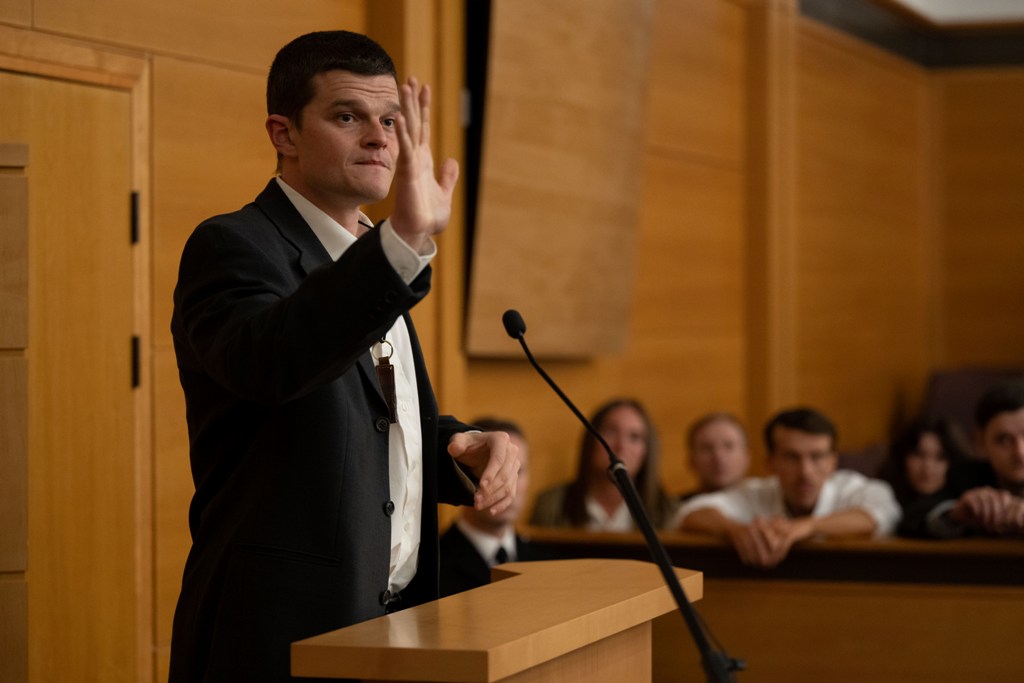
At the same BAFTA ceremony, John Davidson, the man Aramayo plays in the movie that has Tourette syndrome, loudly blurted out a racial slur when actors Delroy Lindo and Michael B. Jordon were on stage presenting another award. To their extreme credit, the men paused briefly but didn’t react or reply to the outburst.
This life-imitates-art-imitates-life moment tells us a great deal about the content of “I Swear” and the still relatively small amount of what is known about Tourette’s.
The movie opens in 1983 with John (played as a preteen by Scott Ellis Watson) in the early throes of his illness.
Relatively well adjusted, John is a talented football (soccer) goalie with aspirations to go pro until a series of profane-laden tics in front of a talent scout end his hopes. This exasperates the patience of his already easily angered father David (Steven Cree), who soon abandons his wife, Heather (Shirley Henderson), and their three children. Although she’d never admit it, Heather blames John for all of her woes.
Welcomed Empathy
When John reconnects with his childhood chum Murray (Francesco Piacentini-Smith), a sliver of light shows up. Murray returns home to care for his mother, Dottie (Maxine Peake), who’s been diagnosed with cancer. A former nurse, Dottie recognizes the severity of John’s disorder and, more importantly, understands and empathizes with him.
It takes some gentle pressure, but Dottie convinces Heather to allow John to live with her. Dottie slowly weans John off his ineffective medication (haloperidol) and tells him not to make blanket apologies for his outbursts. Dottie also gets John a job at a local community center under the supervision of Tommy (Peter Mullan), who is equally understanding of John’s condition.

At this point in the narrative, writer and director Kirk Jones gets dangerously close to turning the movie into a blue version of a Hallmark movie, but never goes over that line. John’s transition from involuntary social misfit to valuable member of society and man with a purpose isn’t rushed. It even includes a few surprising detours.
Award Seeking
It wouldn’t be incorrect to state that Aramayo’s performance is “award seeking,” yet I state this with the utmost respect. Never once did I think Aramayo was too over the top. But, many others said this performance smacked of previous “mentally challenged” characters that received multiple nominations and awards.

Some of these performances include but aren’t limited to Cliff Robertson in “Charly,” Dustin Hoffman in “Rain Man,” Tom Hanks in “Forrest Gump,” Leonardo DiCaprio in “What’s Eating Gilbert Grape,” Billy Bob Thornton in “Sling Blade,” and Sean Penn in “I Am Sam.”
All of the awards won and nominations these actors received were fully warranted and deserved, and the same goes for Aramayo. The biggest trap of these types of performances is in taking it too far while still trying to remain human, humane, and sympathetic without soliciting pity or projecting surrender.
It’s Forever
What’s most impressive about Aramayo’s performance arrives in the third act, when it becomes clear to John that his “sentence” of Tourette’s is forever and will never be fully conquered. He realizes the best that can happen is that it will be able to be “managed.” The real John’s outburst at the BAFTAs more than lends credence to this mindset.
The movie begins and ends with John being recognized by Queen Elizabeth II for his work in Tourette syndrome.
There have been 17 previous productions that have dealt at whole or part with Tourette’s. Most of them aren’t very good or stray too far from the point. A few worth searching out include “Maze” (2000), “Matchstick Men” (2003), “Front of the Class” (2008), and “Motherless Brooklyn” (2019).
Two great companion pieces to “I Swear” is “John’s Not Mad,” a 30-minute BBC documentary from 1988 about Davidson’s early life, and its 2002 follow-up “The Boy Can’t Help It.”
For viewing options, go to Justwatch.
The film opens in theaters on April 24.
‘I Swear’
Director: Kirk Jones
Starring: Robert Aramayo, Maxine Peake, Shirley Henderson, Peter Mullan
Running Time: 2 hours
MPAA Rating: R
Release Date: April 24, 2026
Rating: 4 1/2 stars out of 5
What arts and culture topics would you like us to cover? Please email ideas or feedback to features@epochtimes.nyc
